trackback https://targetedmanhattanprojectvictim.wordpress.com/2022/11/03/comes-ed-donegan-cont/
What is an example of a litany?
Litanies consist of a lead statement followed by a repeated response, such as “pray for us” or “we praise you, we bless you, we thank you” or “Lord hear us”; or “Lord Have Mercy”. The word litany comes from the Greek word litaneia which means petition or supplication.
Supplicant petitioner to the court Edward Paul Donegan brings public records to the court. Police records, Sworn accounts before the House Subcommittee On Assassinatios (HSCA) c/ sworn and unsworn accounts of those involved the activities surrounding the Kennedy assassination such as Colonel Fletcher Prouty in their own accounts offered in books books listed here in a bibliography.
Here is a litany here are literature hear our prayer that Justice be brought against a corrupt government.
This Bibliography is offered to the court the public sworn and unsworn records in expanding knowledge base populated with deathbed confessions and more located and declassified documents around the world now accessible.
The basic point of it all is that those who were involved now point to Prescott Bush descendenets with Oil Barrens from Standard Oil and Saudi Arabia in a Deep State conspiracy. I can add the names of Donald Barr (CIA) and William Barr (CIA DOJ and Bush White House counsel) who werea the very center of it. Also freemasons.
Leroy Fletcher Prouty (author as an adullt fried of the Donegan family including myself Edward Paul Donegan as achild in Boston-Situate Massachusetts.(January 24, 1917 – June 5, 2001)[1] served as Chief of Special Operations for the Joint Chiefs of Staff under President John F. Kennedy. A former colonel in the United States Air Force, he retired from military service to become a bank executive. He subsequently became a critic of U.S. foreign policy, particularly the covert activities of the Central Intelligence Agency (CIA), about which he had considerable inside knowledge.
Prouty was the inspiration for the character “Mr. X” in Oliver Stone‘s film JFK.[2]
IT was when the Donegans and Proutys were skating togher in masschussettes transported by among other vehecles a Volkswagan Beatle that Prouty was working on this book. 1965 to 1972 are about the times we were friends Donegans and Proutys.

JFK: The CIA, Vietnam, and the Plot to Assassinate John F. Kennedy
by L. Fletcher Prouty , Oliver Stone, et al. | Apr 1, 2011
With an Introduction by Oliver Stone, the director of the hit movie JFK and a Foreword by Jesse Ventura, author of the New York Times Bestseller, They Killed our President, here is an insider’s view of JFK, the CIA, Vietnam and the plot that led to the assassination of President John F. Kennedy.
Colonel L. Fletcher Prouty, the former CIA operative known as “X,” offers a history-shaking perspective on the assassination of president John F. Kennedy. His theories were the basis for Oliver Stone’s controversial movie JFK.
Prouty believed that Kennedy’s death was a coup d’état, and he backs this belief up with his knowledge of the security arrangements at Dallas and other tidbits that only a CIA insider would know (for example, that every member of Kennedy’s cabinet was abroad at the time of Kennedy’s assassination). His discussion of the elite power base he believes controlled the U.S. government will scare and enlighten anyone who wants to know who was really behind the assassination of John F. Kennedy.
This is must reading for anyone who believes that Lee Harvey Oswald did not act along and that a complicated plot led to the murder of President Kennedy.
The Secret Team: The CIA and Its Allies in Control of the United States and the World is a book by L. Fletcher Prouty, a former colonel in the US Air Force, first published by Prentice-Hall in 1973. Wikipedia
Originally published: 1973
Author: L. Fletcher Prouty
The Man Who Killed Kennedy: The Case Against LBJ hit the New York Times bestseller list the week of the 50th Anniversary of the assassination of President John F. Kennedy. … Google Books
Originally published: November 1, 2013
Author: Roger Stone
Genres: Biography, True crime
(athor Roger Stone, decades White House insder operative including in Nixon whitehouse and invited to CREEP (The Comittie to reeliect the President Nixon, that was the watergate breakin-team. nowRoger Stone and his book.
The Man Who Killed Kennedy: The Case Against LBJ hit the New York Times bestseller list the week of the 50th Anniversary of the assassination of President John F. Kennedy. … Google Books
Originally published: November 1, 2013
Author: Roger Stone
Genres: Biography, True crime
I feel that I am uniquely qualified to make the case that LBJ had John F. Kennedy killed so that he could become president. I have been involved in every presidential election since 1968 with the exception of 1992, when I sat out Republican efforts and George H. W. Bush—who, as a Reaganite myself, I never had much regard for anyway—went down to ignominious defeat. I first met the then former Vice President Richard Nixon in 1967. In 1968, I was appointed chairman of Youth for Nixon in Connecticut by Governor John Davis Lodge. I later attended George Washington University in Washington, DC by night and worked in the Nixon White House press operation by day. In 1972, I was the youngest member of the senior staff of the Committee to Re-elect the President (CREEP).
CHAPTER NINE THE ROAD TO WATERGATE Nixon’s deep involvement in Operation 40 made him fully aware of a CIA assassination team that included E. Howard Hunt, Frank Sturgis, and David Morales. Nixon’s attorney general John Mitchell told me that he learned in 1971 that Nixon, as vice president, had approved the CIA outreach to organized crime in their plan to kill Castro. The CIA authorized ex-FBI agent Maheu to contact the mob through Johnny Rosselli shortly before Nixon’s surprise defeat in November of 1960. The approach by Maheu happened on Nixon’s watch and at a time when most believed that Nixon would be the next president. Nixon had his own long-term relationship with Maheu, who had funneled money to his campaign from Hughes. As the point man for the CIA-led operation.
Prescott Bush won a special election to fill the seat of Senator Brien McMahon, who died unexpectedly. Prescott Bush was friendly with John Foster and Allen Dulles (CIA and State Dept under VP Nixon 1952-1961,) and Wall Street lawyers who represented Brown Brothers. In 1952, George Bush served as Co-Chair of Citizens for Eisenhower–Nixon in Midland County, Texas, where he had relocated to work for Dresser Industries and later founded the Zapata Petroleum Company and Zapata Offshore. In his masterful book, Family of Secrets, author and reporter Russ Baker established that both Dresser and Zapata had been used as covers for CIA business. According to a CIA internal memo dated November 29, 1975, Zapata Petroleum began in 1953 through Bush’s joint efforts with Thomas J. Devine, a CIA staffer who had resigned his agency position that same year to go into private business, but who continued to work for the CIA under commercial cover.2
[fLETCHER PROUTY OUTS GOERGE BUSH AS 1950S CIA IN GUATEMALA]
George Bush, known to his Ivy League friends as “Poppy,” may have been associated with the CIA as early as 1953. Fabian Escalante, the chief of a Cuban counterintelligence unit during the late 1950s and early 1960s, describes a plan called “Operation 40” that was put into effect by the National Security Council and presided over by Vice President Richard Nixon. Escalante said that Nixon, as operation director or “case officer,” had assembled an important group of businessmen headed by George Bush and Jack Crichton, both Texas oilmen, to gather the necessary funds for the operation. Operation 40, a group of CIA assassins, was subsequently brought into the Bay of Pigs invasion. Interestingly, CIA official FLETCHER PROUTY delivered three Navy ships to agents in Guatemala to be used in the invasion. Prouty claims that he delivered the ships to a CIA agent named George Bush. Agent Bush named the ships Barbara J, Houston, and Zapata.3
In the Dallas Speech JFK was GOING TO GIVE he denounved the CIA activities of Bush, Dulles, and others and said they were not representative of the USA and even a liability of the USA because the democratic practives of the USA are the USA’s greatest selling point, that along with strong miitary, are the US source of strength and allies building.
Book by Philip Marshall
The Big Bamboozle got a 4.17 stars review on AbeBooks.4.2/5GoodreadsThe Big Bamboozle got a 4.17 stars review on Goodreads.4.7/5eBayThe Big Bamboozle got a 4.7 stars review on eBay.
Did you like this book?
Description
From the perspective of a Boeing 767 captain and former “special activities” contract pilot, Philip Marshall straps the reader into the cockpits of hijacked commercial airliners to tell the story of the most sophisticated terrorist attack in history. … Google Books
Originally published: 2012
Author: Philip Marshall
Goodreads helps you keep track of books you want to read.
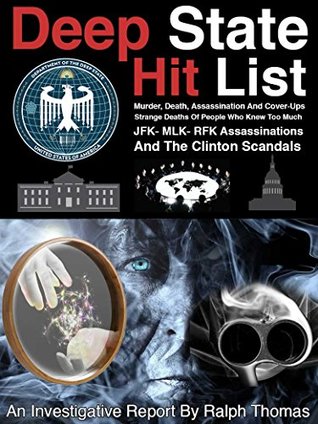
Start by marking “Deep State Hit List- Strange Deaths Of People Who Knew Too Much: JFK- MLK – RFK Assassinations And The Clinton Scandals” as Want to Read:Want to Read
Want to Read
Rate this book
1 of 5 stars2 of 5 stars3 of 5 stars4 of 5 stars5 of 5 stars
Deep State Hit List- Strange Deaths Of People Who Knew Too Much: JFK- MLK – RFK Assassinations And The Clinton Scandals
by
3.20 · Rating details · 5 ratings · 0 reviews
On November 22, 1963 John F. Kennedy was murdered in the streets of Dallas by gunshot in broad daylight in front of some 500 people. 54 years later, the debate rages on as to who was involved in the JFK conspiracy. Within five years, Robert F. Kennedy, Martin Luther King Jr. and Malcolm X would also be murdered as a result of a conspiracy. The debates on the assassination …more
JFK Assassination Witnesses: -Accounts And Locations Of Shots Fired An Investigative Report Nov 25, 2017
by Ralph Thomas
$9.95
There are almost 200 witnesses to the assassination documented in this investigation. The material covers 14 witnesses who had either been in the limousine or in the car in front of or the two cars behind that indicate shots from the front. There are over 40 witnesses who observed the assassination that described shots from other places than from behind. There are over twenty medical witnesses who describe wounds that would indicate shots from the front. This material also covers overwhelming evidence in and around the School Book Depository Building. Over two-dozen witnesses place two men in a window with a rifle. Neither of them had been OSWALD. Witnesses on the first and second floors of the building state that OSWALD was on the lower floors of the building minutes before, during and after the assassination.
All of the 14 witnesses in the motorcade including five witnesses in the actual car describe either a conspiracy or shots from other places than from behind. Over forty witnesses thought shots had come from places other than the School Book Depository Building. One witness saw a man with a rifle behind the fence. Several witnesses saw a puff of some come out from the bushes on top of the knoll. About two dozen medical witnesses describe wounds that would indicate a shot from the front. Several dozen witnesses saw two men in the upper floors of the School Book Depository Building with a rifle that was not OSWALD. School Book Depository employees place OSWALD on the first or second floor of the building minutes before, during and after the assassination. Several witnesses place people running out the side or back of the building right after the assassination.
All of this overwhelming evidence indicates that OSWALD did not fire any shots from the sixth floor of the School Book Depository Building because he was not there. Someone likely did but it was not OSWALD. Other shots had been fired from other locations and the assassination was a conspiracy.
Note: This is an excerpt from 2,000 plus page investigation knows as JFK Beyond A Question Of Conspiracy: An Investigation And Revision Of History Last updated 04.2018.
Subscribers read for free.Read for Free Buy now with 1-Click ®
Sold by: Amazon.com Services LLC
by Ralph Thomas
$9.95
Now includes new information from the 04.2018 JFK Files Release!
When the Jim Garrison trials started, there had already been a huge number of witnesses, reporters, police officers and others who had suddenly died who knew too much about the Kennedy Assassination. On March 1, 1967 New Orleans district attorney Jim Garrison arrested Clay Shaw for conspiring to murder John F. Kennedy. Shaw promptly had his attorneys file a motion for dismissal based on the fact that the Warren Commission proved that there was no conspiracy in the JFK Assassination. The court ruled in the state’s favor claiming that the Warren Commission was hearsay. Garrison had wanted to bring to trial David Ferrie and was about ready to do so but he suddenly died. Since that time, the death toll has slowly risen to almost 100 people.
Here are a few samples of silenced victims: Organized crime figures Johnny Rosselli, Sam Giancana, Charles Nicoletti had all been murdered right before they were to give testimony before the House Select Committee On Assassinations. CIA handler of Lee Harvey Oswald George DeMohrehschildt also died of a gunshot wound to the head after he was notified he was to give testimony before the House Select Committee On Assassinations. David Ferrie died right before he was charged with conspiracy to assassinate JFK. Intelligence officers And FBI agents David Sanchez Morale- CIA, William Guy Banister- FBI, James Cadigan –FBI, John Garrett Underhill Jr. – Intelligence Officer all died because they knew to much. Rolando Masferrer
, Dorothy Kilgallen, Bill Hunter and Jim Koethe were going to expose too much but their exposure died with them. Assassination researchers Joe West, Larry Howard and Larry Harris were all about ready to bring forward new evidence of a conspiracy but their evidence was taken to the grave with them when they died. Material witnesses Jean Hill, Roger Craig, Hank Killam, Karen Carlin, Marily Walle, Rose Cheramie
and Lee Bowers were just a few of the witnesses who saw and heard too much. The evidence they had died with them. Congressman Hale Boggs was a member of the Warren Commission that wanted to reopen the investigation. He disappeared in a small plane over Alaska.
Lt. William Bruce Pitzer took photographs of the autopsy that revealed shots from the front. These photographs disappeared and he died of a gun shot to the head.
This investigation details the strange deaths of 92 people who knew way too much about the Kennedy Assassination. Inside there are 92 Witnesses, Researchers, CIA Agents, Police Officers, Reporters, Politicians and Girlfriends who just knew way too much! Some of them were outright murders like Mary Pinchot Meyer who was the girlfriend of John F Kennedy. Some of them are highly suspicious suicides, accidents and other strange incidents. In the profile of each victim, you will sometimes find links to online videos you can watch by clicking on the link.
Note: This investigation was last updated on 05.01.2018
Subscribers read for free.Read for Free Buy now with 1-Click ®
MARK SHAW BOOKS

“The Dead cannot cry out for Justice. It is the duty of the living to do so for them.”
– Lois McMaster Bujold
Governmental Corruption at its Most Destructive Exposed Through Eyewitness “Whistleblower” Account
MARK SHAW BOOKS
“The Dead cannot cry out for Justice. It is the duty of the living to do so for them.”
- Lois McMaster Bujold
NEWSLETTER – October / 2022
Attention!
The Countdown has Begun
In less than two months, and 60 years since JFK’s finest hour, saving the world from nuclear destruction during the Cuban Missile Crisis, Government Corruption at its most diabolical is exposed for the first time when cover-ups of the President’s assassination by the bogus Warren Commission (WC) and the FBI are detailed by an Eyewitness, still alive today, who was the trusted legislative assistant to a commission member, and was actually present at the
WC Hearings.
Read the Eyewitness’ shocking “whistleblower” account and corroborative evidence completely discrediting the “Oswald Alone” theory, arguably the biggest lie in American history, in my latest true crime book, “Fighting for Justice,” one that provides firsthand information revealed to the Eyewitness by the commission member including:
“They [the commission members] already know about the Ruby connection to organized crime, but they don’t want to touch it.”
“They [the commission] want to bury the truth under a pile of stones.”
“Our new President, Lyndon Baines Johnson, now wants to cover up and move on.”
“It’s more than Oswald but [Chief Justice] Earl Warren and J. Edgar Hoover keep pushing the ‘Oswald Alone’ conclusion.”
“They [the commission] are getting it all wrong. It is a whitewash. A rush to judgment.”
“They [the commission members] say this [Oswald Alone conclusion] is good for God and the country, but there is ‘internal corruption’ and I don’t know why.”
“My own views are different than the Report conclusions.”
“I have written a letter to LBJ offering my resignation.”
Also Learn:
How celebrated journalist and JFK assassination investigate reporter Dorothy Kilgallen, a close friend of the WC member to the extent of being invited along with the legislative assistant to “soirees” at the member’s Georgetown home, was surreptitiously passed the explosive Jack Ruby WC testimony by the commission member’s “associate” infuriating J. Edgar Hoover and was also told about the WC “internal corruption,” which put Kilgallen in danger as the reporter who knew too much leading to her murder in 1965.
Based on new evidence, how Joseph P. and Robert F. Kennedy pressured the Warren Commission to focus ONLY on Oswald so there would be no investigation of the “fixed” 1960 presidential election and RFK’s complicity in Marilyn Monroe’s death.
“Investigative reporting at its best. Mark Shaw’s original work into the questionable deaths of Marilyn Monroe and Dorothy Kilogallons is now focused on the many unanswered questions left by the Warren Commission’s inquiry into the JFK assassination. Fighting for Justice has to be read.”
- Nicholas Pileggi, author of Wiseguy (movie: Goodfellas) and Casino
Release Date: Nov. 29, 2022.
Available Now for Pre-Order Everywhere Books are Sold
“If a writer is so cautious that he/she never writes anything that cannot be criticized, he/she will never write anything that can be read.”
— Thomas Merton
Get Published
LITERARY CONSULTANT | MARK SHAW PUBLISHING PROGRAMS
Author of “How to Become a Published Author: Idea to Publication”, Mark Shaw’s book on the writing and book publishing process includes his successful 10-Step Method as well as literary tips to assist those who dream of being published. For twenty years and counting, Mark, who can speak to writers as an accomplished author himself, has provided literary consulting to hundreds of aspiring authors. Learn more
About Mark Shaw
A former criminal defense attorney and legal analyst for CNN, ESPN, and USA Today for the Mike Tyson, O.J. Simpson and Kobe Bryant cases, Mark Shaw is an investigative reporter and the author of 25+ books whose latest is the bestseller, “The Reporter Who Knew Too Much.”
Regarding his books, Mark says, “My purpose is to make people stop and think about historical subjects and important issues confronting society today. | Learn more
Mark’s Blog!
News, views and commentary on social issues of importance in today’s crazy world will be forthcoming in the Mark Shaw Books blog. Best of all, you’ll get to weigh in. | Learn more
Mark Shaw Websites
TheReporterWhoKnewTooMuch.com | CourageInTheFaceOfEvil.com
TheDorothyKilgallenStory.org | MarkShawBooks.com
In the past, you have expressed interest in Mark Shaw. Thank you for your continued interest. We hope you enjoy Mark’s newsletter.
Unsubscribe eddonegan@hotmail.com from this list.
Our mailing address is:
Mark Shaw Books
1085 Santa Clara St, Apt 7
Santa Clara, CA 95050-5474
Add us to your address book
Copyright (C) 2022 Mark Shaw Books All rights reserved.
Forward this email to a friend
Email Marketing Powered by Mailchimp
Sold by: Amazon.com Services LLC
by Ralph Thomas
$9.95
This new material recovers evidence found in the 2017 and 2018 JFK records releases that show that both James Angleton and William Harvey set up a covert assassination operation inside the CIA. The material tends to show that this executive action team went on to engage in what Lyndon Johnson termed a “Murder Inc. inside the CIA. There is strong evidence that now indicates that this covert operation assassinated John F. Kennedy on November 22,1963 and that Lee Harvey Oswald had been set up as the patsy. Angleton created a wall of secrecy in a elaborate wilderness of mirrors that hide the operation for decades that had been constructed in a way that created it’s own confusion when anyone attempted to unravel the truth. Angleton had managed to hide the truth, the whole truth and nothing but the truth from both the Warren Commission in the 1960’s and the House Select Committee On Assassination the 1970’s. It had not been until the Assassination Records Review Board in the 1990s uncovered additional files that the pieces of this puzzle emerged and started to be put together. While some LEE HARVEY OSWALD records appear to now be missing that had been reviewed once before in the 1970s and other records are still withheld, the 2017 and 2018 records releases shed even more light on these assassination operations.
The evidence as we know it today tends to indicate that various people involved who had been in Dallas, Texas on or around the date of the assassination may have had an understanding that the operation might have been either a fake assassination attempt of the President or had been part of an abort team set up to stop an assassination. The evidence shows that these various covert operations and various people involved had been hidden inside other operations within the CIA. Some of these operations had been hidden behind a wall of secrecy inside the CIA itself that only Angleton and a few other people actually knew about. The evidence also tends to show that various groups and individuals may have also been set up to become a secondary patsy should Lee Harvey Oswald as the patsy not pan out in the actual operation.
This material exposes several subplots in the assassination operation. State Department employee Otto F. Otepka developed suspicions that Lee Harvey Oswald had been a fake defector sent to Russia by the CIA and then driven out of his job. It had been feared that mob bosses Johnny Rosselli and Sam Giancana may have exposed what they knew about the assassination operations before the House Select Committee On Assassinations in the 1970s so they had been murdered along with several people. A Russian defector by the name of Yuri Nosenko had exposed the fact that the KGB believed that OSWALD had been CIA when he defected to Russia. The CIA then placed Nosenko in a secret jail where he had been held incognito
and tortured through partial starvation.
This material examines the role and background of both James Jesus Angleton and William Harvey and then provides backup material found in the JFK file releases. The investigation also exposes other bit players that may have been involved in the assassination. This material is part of a main investigation that is 2,900 plus page long known as JFK Beyond A Question Of Conspiracy.
Read moreBuy now with 1-Click ®
Sold by: Amazon.com Services LLC
JFK FILES – The Roscoe White Story: -Grassy Knoll Assassin Or Hoax? Jul 10, 2018
by Ralph Thomas
$8.95
This new material is an excerpt from the 3,000 plus page investigation known as JFK Beyond A Question Of Conspiracy. This excerpt focuses on the Roscoe White story as it relates to the JFK Assassination. This material also provides and exposes new material from witnesses who have come forward and new documents found in the 2017 and 2018 JFK File releases that are relevant.
The Roscoe White story came forward in the early 1990s that had been the pre JFK movie days. Brought forth by the son of Roscoe White who’s name is Ricky White, the story claims the following. Roscoe White had been in military intelligence and became an assassin for the federal government. He had been assigned to the Dallas Police Department two months before the JFK Assassination. Roscoe White had been a shooter behind the picket fence and wore a Dallas Police uniform when he performed the assassination. Roscoe White fired shots that murdered JFK. Later in the day, he murdered officer. J. D. Tippet. Four of the investigators who had worked on this story had been Joe West, Larry Howard, Bud Fensterwald, and Larry Harris. All four of them died under suspicious circumstances. Since the 1990s, some new witnesses have come forward and records have been released that tend to confirm the story.
The Roscoe White story is controversial. All or parts of the story may be true. Others claim and suspect it is a hoax. The Roscoe White story could be a deliberate and planted diversion using witting and unwitting players to throw off the focus of other investigations by private researchers which appears to have been done many times in the past. Parts of the Roscoe White story can be verified while other parts of the story cannot be.
The serious JFK assassination research community is divided on if the story has any substance to it or if it is a complete fabrication. The purpose of this story, if parts of it are not true, could have been and could continue to be to divide and therefore conquer those involved in the JFK assassination and create a situation that tends to scatter the assassination research community to the winds. Since there appears to be some verified substance to the story that goes beyond what could be considered a coincidence, someone might of taken what is truth and twisted the truth that tends to create a trap. On the other hand, there are those who have studied the White story and believe that all or most of what is presented in it is truthful. This material presents this story in a new light with some new evidence and includes both sides of the “fence.”
(Last updated: 07.16.2018)
Read moreBuy now with 1-Click ®
Sold by: Amazon.com Services LLC
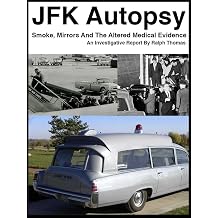
Smoke And Mirrors – The JFK Autopsy: An Investigative Report Nov 25, 2017
by Ralph Thomas
$9.99
A new witness has come forward and new JFK files are now released! A careful review of the new evidence clearly shows that the medical evidence of JFK’s body had been altered to only show shots had been fired from behind, evidence is missing and evidence has been forged. New evidence from three witnesses clearly indicate that JFK’s body was covertly taken by helicopter first to Water Reed Hospital and then to Bethesda Naval Hospital while a decoy Navy Ambulance containing a coffin that JFK’s body was not in with Mrs. Kennedy And Robert Kennedy.
The ARRB uncovered and made public an Action Report From USMC Sergeant Roger Boyajian that stated that JFK’s body arrived at Bethesda Naval Hospital 20 minutes before the motorcade carrying the official expensive bronze coffin in a navy ambulance that was also carrying Mrs. Kennedy and Robert Kennedy. The coffin that arrived at the rear of the Bethesda Naval Hospital 20 minutes ahead of the official motorcade was taken into the autopsy room and opened. The JFK body had arrived in a plain grey shipping casket. It contained the body of the President inside a standard body bag that was zipped up. The President’s body was removed from the body bag and placed on the autopsy table.
By reviewing interviews conducted by the ARRB concerning the autopsy and comparing it to the evidence that now exists in the National Archives, substantial and key evidence is missing. This includes autopsy photographs, bullet fragments removed from the President’s head, the brain and several x-rays. Based on careful eyewitness interviews, this evidence is undisputable.
By reviewing interviews conducted by the ARRB concerning the autopsy and comparing this to the artifacts that now exists in the National Archives, several pieces of evidence have been forged or altered. This includes several autopsy photographs and x-rays.
By reviewing the ARRB records and interviews, evidence has been developed that the body of the President was altered before the official autopsy was conducted in order to make it appear that all shots fired were fired from behind. This investigation covers the details of this activity. This evidence is based on the description of wounds from eyewitness accounts at the time of the assassination and eyewitness accounts from doctors and nurses at Parkland Hospital compared to the description of wounds detailed in the official autopsy. It is also based on the activity that occurred in the autopsy room and at Bethesda Navel Hospital before the official autopsy was commenced.
Last Updated: 04.12.2018
Subscribers read for free.Read for Free Buy now with 1-Click ®
Sold by: Amazon.com Services LLC
by Ralph Thomas
$8.95
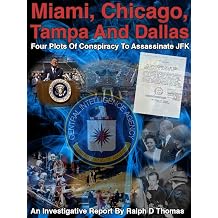
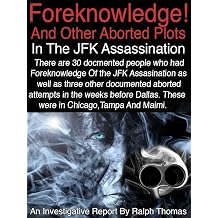
In the weeks before Dallas, there had been three other plots to assassinate JFK that had been aborted. Each of these plots involved a conspiracy and appeared to have a patsy. These aborted plots had been in Miami, Chicago and Tampa. If there had been three aborted plots in the weeks before the assassination in Dallas that involved a conspiracy and a patsy, how is it that we are supposed to believe that Dallas was not the same thing. This material is an excerpt from the larger 1,900 plus page investigative report known as JFK: Beyond A Question Of Conspiracy. This material covers the details of those four plots and exposes why the successful on in Dallas was a conspiracy.
Read moreBuy now with 1-Click ®
Sold by: Amazon.com Services LLC
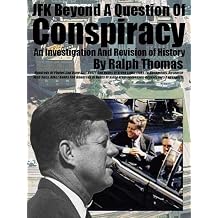
JFK Beyond A Question Of Conspiracy: An Investigation And Revision Of History – Including New 2018 Material! Nov 16, 2017
by Ralph Thomas
$29.95
Note: This Updated Edition Now Includes Material Uncovered From The New 2018 JFK Document Release That Indicate A Conspiracy With Clues That Indicate Who Was Involved!
New Witnesses have come forward, old witnesses have said more, new JFK documents have been released and new evidence has been developed that clearly show the JFK Assassination was a conspiracy beyond a reasonable doubt. The new material in this 2,200 plus page investigation hands you new smoking guns that crack the case wide open and hands you names you have likely not heard before. This material is written much like a professional investigative report setting out clear and convincing evidence of what happened and breaks the Warren Commission into a thousand pieces scattering it to the winds.
The author of this material is the founder and director of the National Association Of Investigative Specialists. Using networking and team work consisting of a small army of investigators, researchers and specialists, he was able to slowly piece together different aspects of the case that exposes two conspiracies that involve the assassination itself, This includes the massive cover-up that took place after the actual murder, and the reasons it was done. This investigation unravels the smoke and mirrors related to the case that peel away the layers of deception that then expose the truth. Along the way, various forms of deception detection techniques have been used to separate and rule out deception and false leads that separate what is fact and what is fiction. JFK Beyond A Question Of Conspiracy is filled with thousands of new documents, witnesses, photographs, diagrams and charts that hand you the final answers. There is back material that provide you online links to other documents, resources, videos and book reviews that hands you a goldmine of related material. This includes how to access online hundreds of thousands of pages of documents and testimony as well as hundreds of hours of video and audio files you can access online.
In order to avoid information friction that delays the release of and freezes information in a printed book form, this material is only available in a digital form and is updated often. Within the material, you are shown how to gain access and follow along with developments as the investigation moves forward and obtain the updates in the investigation as they happen. Nothing like this has ever been offered before and we urge you to join the movement that continues to develop the truth, the whole truth and nothing but the truth by obtaining JFK Beyond A Question Of Conspiracy right now.
Note: This investigation was last updated on 08.02.2018.
Subscribers read for free.
You borrowed this itemBuy now with 1-Click ®
Sold by: Amazon.com Services LLC
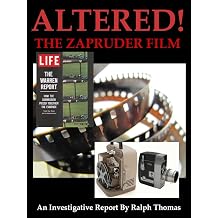
ALTERED! The Zapruder Film: An Investigative Report Nov 26, 2017
by Ralph Thomas
$4.95
For those who are not familiar, the Zapruder film is a silent homemade motion picture made by Abraham Zapruder of the assassination while he stood on a concrete pedestal on Elm Street. There has been hundreds of thousands of pages of documents written about it and it had been sort of the Holy Grail concerning photographic evidence of the Kennedy assassination. The Z film was purchased by Life Magazine and hidden away for decades. It was not until the Assassination Records Review Board started studying and interviewing people about the film that it came to light that there is considerable evidence that the film was altered. The American people were never told that copies of the Z film had been sent to a CIA lab. The Zupruder film we see today is much different than the film of those who had observed the original. This investigation traces the copies made of the Z film and shows clear and convincing evidence that the film we see today is an alteration.
8 ½ X 11, 40 pages.
Subscribers read for free.Read for Free Buy now with 1-Click ®
Sold by: Amazon.com Services LLC
by Ralph Thomas
$8.95
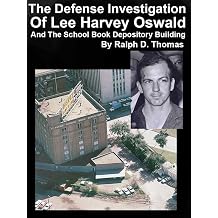
This material is part of a larger investigation that is 3,000 plus pages long known as JFK Beyond A Question Of Conspiracy. The specific focus of this material deals with a defense investigation concerning if LEE HARVEY OSWALD fired three shots with a Mannlicher Carcano rifle from the sixth floor window of the Texas School Book Depository Building. The evidence of OSWALD’S innocence is overwhelming and if a trial had been held, dozens of witnesses would of testified that shots had come from other locations, that OSWALD was on the first and second floors minutes before, during and seconds after the shots had been fired. The overwhelming evidence that OSWALD had been set-up as a patsy is covered including documents found in the new 2017 and 2018 JFK File releases. Photographic evidence proves that OSWALD had not been in the sixth floor window seconds before and seconds after the assassination. This investigation also uncovers the fact of deception, concealment, suppression and alternation of the evidence. The physical evidence and traces of both the rifle and the ammo for the rifle conclude that neither came from the mail order company that was supposed to be where OSWALD ordered it from and that the whole thing was a set-up to implicate him. The rifle that sets in the Nation Archives today is not the same rifle seen in the famous Backyard photos that had been published in Life Magazine to incriminate OSWALD in the eyes of the public. J Edgar Hoover and Lyndon Johnson had a tape-recorded conversation that clearly shows that they thought shots had been fired from the front and LBJ knew that the US had been running a Murder, Inc. Because of the way almost all of the evidence had been handled, it would have been thrown out of court because the chain of custody had been broken. Compelling and riveting, it is time that you know the truth, the whole truth and nothing but the truth when it comes to the actual evidence that shows that OSWALD would not have been convicted in a real court of law with a jury.
Read moreBuy now with 1-Click ®
Sold by: Amazon.com Services LLC
by Ralph Thomas
$9.99
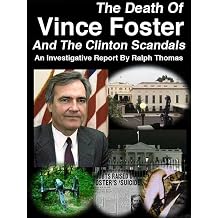
The death of Clinton White House Deputy Counsel Vince Foster is riddled in controversy. This investigation takes a look at his death and details facts and circumstances that tend to indicate that Vince Foster did not commit suicide. Aside from the actual crime scene investigation, a background on the work Vince Foster was involved in had to do with containing numerous Clinton scandals and exposes an array of evidence that would tend to lead to reasons for his death. While researching the Clinton scandals Foster was in charge of containing as Clinton’s attorney, many other strange deaths that are uncovered. The murder of private investigator Jerry Parks is especially alarming since he had conducted investigtions on various ladies Bill Clinton had affairs with and had spoken with Vince Foster a week before his death about these files. The lead investigator, Miguel Rodriguez, resigned after Ken Starr canceled a grand jury probe to develop the truth and after he had located a hidden photograph that revealed Foster had a bullet wound in his neck. The date and time of the autopsy was changed and investigators from the Park Police were not present to observe all of the autopsy. The position of the body is highly suspect. Four experienced homicide investigators looked into the Foster death. They were Arthur Nascarella, Gene Wheaton, Fred Santoshi and Vincent Scalise. They all said the same thing. The death scene looked staged and Vince Foster did not die in Fort Mercy Park.
Evidence that Indicates Vince Foster did not commit suicide and there was a cover-Up Found In this investigative report: Patrick Knowlton stated that Foster’s car was not in the parking lot during a time period after the time of death had been established. Foster’s fingerprints were not found on the gun and Foster didn’t own the gun found in his hand. The gun was not traceable and only two bullets had been in the gun. No other ammo for the gun was owned by Foster. The FBI determined that the body had been moved based on blood flow analysis. The powder marks on Foster’s hands indicate he could not have fired the gun. A gun remaining in one’s hand after shooting oneself in the head or mouth is highly unlikely. The lack of blood at the crime scene is suspicious. Carpet fibers were found all over the body. Long blond hairs and traces of semen were found on Foster’s underwear. No exit bullet, skull fragments or exit brain tissue was ever found at the crime scene. A witness saw someone who looked like Foster being carried into Fort Marcy Park. Gunpowder tests found on Foster’s cloths did not match the gun. Crime scene technicians saw a bullet wound in the neck that is not in the autopsy report. There is evidence that Foster didn’t leave the White House Complex in his car but walked over to the Old Executive Office Building. Foster’s car keys were not found in his pocket or at the crime scene. A crime scene technician saw tramped areas below the body and one saw someone fleeing the area at the bottom of the brim. No witnesses heard any gunshots. Forensic evidence from Foster’s shoes indicate hat he did not walk the dirt paths to the location of where the body was found. There were back entrances to the park that had been altered during the official investigations. X-Ray photos and crime scene photos are missing.
This is more than just a investigative and research report that runs over 222 pages. It contains scores of photos, diagrams, references to other sources and resources as well as links to dozens of hours of video you can access online.
Subscribers read for free.Read for Free Buy now with 1-Click ®
Sold by: Amazon.com Services LLC
High Crimes, Misdemeanors And The Clinton Scandals: An Investigative Report Dec 3, 2017
by Ralph Thomas
$8.95
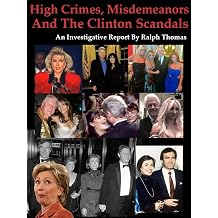
When Bill Clinton booted Monica Lewinsky out of the oval office he turned into a sexual pleasure den for himself with he, he said, “I have lead a life of lies and deception.” What an understatement that turned out to be. Lewinsky latter stated on tape, “I would not cross those people for fear of my life.” This investigation goes over the Clinton scandals that include, Whitewater, Travelgate, Filegate, Cattlegate, Troopergate, Waco Siege, Mena Airport Drug Operaitons, Pay To Play Commerce Department Payoffs, Lincoln Bedroom For Rent, Hillary Bosnia Airport Sniper Lie, BenghaziGate, Email Scandals, Clinton Foundation Scandals, DNC Email Wikileaks Scandals and Tarmac Gate.
This investigation then goes on to look at the death of Clinton private investigator Jerry Parks, Vince Foster and over 80 other strange deaths related to the Clintons and their scandals. This investigation exposes, money, power, greed, drugs, sex, death, murder and lies.
Subscribers read for free.Read for Free Buy now with 1-Click ®
Sold by: Amazon.com Services LLC
by Ralph Thomas
$7.95
This investigative report covers those who knew in advance that an assassination of John F. Kennedy was going to happen and that there had been three other aborted attempts to assassinate him in the weeks before Dallas.
I Edward Paul Donegan have my own book out. St John Hunt son of CIA E. Howard Hunt as a book all.
All say the same thing. The Rockefller Oil barrons have overthrown the US, work out of FBI and CIA to silence whistleblowers.
Rchard Belzer has a book out, same subject mysterious deaths of JFK assasinatioon witnesses.
Plaintiff Edward Paul Doneganas theory of the case by his own and other’s aurthored books and columns.
The High and Noble Brains of John F. Kennedy and Robert F. Kennedy. Fighting Mafia as government, the system of rule England uses.
John F. Kennedy (guided book writen by Sorenson)
Kennedy’s Profiles in Courage served as a clarion call to every American. The inspiring true accounts of eight unsung heroic acts by American patriots at different junctures in our nation’s history, Kennedy’s book became required reading, an instant classic, and was awarded the Pulitzer Prize.
Profiles in Courage (P.S.): Kennedy, John F. – Amazon.com
Profiles in Courage (fighting agaist the methods of British in East India Tea Company and United Fruit Company (Dulles) or Coffee Companies in Guetamala, India, or elsewhere
From Wikipedia, the free encyclopedia
Jump to navigationJump to search
This article is about the biographical book. For the television series partly based on the book, see Profiles in Courage (TV series). For the private award, see Profile in Courage Award.
| First edition | |
| Author | John F. Kennedy Ted Sorensen (ghostwriter) |
|---|---|
| Subject | United States Senators |
| Genre | Biography |
| Publisher | Harper & Brothers |
| Publication date | January 1, 1956[1] |
| Pages | 272 |
| ISBN | 978-0-06-095544-1 |
| Preceded by | Why England Slept |
| Followed by | A Nation of Immigrants |
Profiles in Courage is a 1956 volume of short biographies describing acts of bravery and integrity by eight United States Senators. Then-Senator John F. Kennedy won the Pulitzer Prize for the work. The book profiles senators who defied the opinions of their party and constituents to do what they felt was right and suffered severe criticism and losses in popularity because of their actions. It begins with a quote from Edmund Burke on the courage of the English statesman Charles James Fox, in his 1783 attack upon the tyranny of the East India Company in the House of Commons.[2]
The book focuses on mid-19th-century antebellum America and the efforts of senators to delay the American Civil War. Profiles was widely celebrated and became a bestseller. It includes a foreword by Allan Nevins.
In 1990, Kennedy’s family created the Profile in Courage Award to honor individuals who have acted with courage in the same vein as those profiled in the book.
In his 2008 autobiography, Kennedy speechwriter Ted Sorensen, who was presumed as early as 1957 to be the book’s ghostwriter,[3] acknowledged that he “did a first draft of most chapters” and “helped choose the words of many of its sentences”.[4][5]
Contents
- 1Background and history
- 2Summary of senators profiled
- 3Reception
- 4Authorship
- 5Accuracy
- 6References
- 7External links
Background and history[edit]
Kennedy was elected to the House of Representatives in 1946, 1948, and 1950 from the state of Massachusetts. In 1952 and 1958, he was elected a senator from Massachusetts, and served in the Senate until resigning after he was elected president in 1960. It was a passage from Herbert Agar‘s book The Price of Union about an act of courage by an earlier senator from Massachusetts, John Quincy Adams, that gave Kennedy the idea of writing about senatorial courage. He showed the passage to Ted Sorensen and asked him to see if he could find some more examples. This Sorensen did, and eventually they had enough not just for an article, as Kennedy had originally envisaged, but a book.[6] With help from research assistants and the Library of Congress, Sorenson wrote a first draft of the book while Kennedy was bedridden with Addison’s disease during 1954 and 1955, while recovering from back surgery.[7]
As John F. kennedy was (through Sorenson or vice versa) forming his anti-colonialism Mafia rule of Espionage Bed Sharing agreements with top crime figures as top FBI, Richard Nixon George H.W. Bush Lyndon B. Johnson and J.Edgar Hoover were doing just the opposite, using mafia in the USA and Mafia elsewhere for dirty war against regimes.
At home and abroud the Mafia were unstopable even by JFK. But the Profiles in Courage were profiles of British Pols who stood up on Parlimanent AGAINAT overthrow of soverieng nations using mafia, and these pols getting political reward of courages leadership.
It was just that courage JFK showed when he campainged for 1964 on a police of REJECTING the illegal programs Richard Nixon as VP kept secret but for the Nixon ROckefeller planning meetings in the library of the White House where regime changes were plottted to benefit Standard Oil Rockefeler, Middle East North Africa MENA airport and smuggling activitis, and Mafia to kill journalists, police, and politicians to keep a lid on the CIA activities.
It was that very ambition (standing up the the CIA politically) JFK and RFK took on , and thus they lost their brains, litteraly to scum Charles Harrleson and his 50 calibre assasination rifle that left a bloody nose from the muzzle shockwave possible in a train car.
Charles Harrelson was born in Huntsville, Texas, in 1939. After leaving school Harrelson moved to California where he eventually became an encyclopedia salesman. He later turned to crime and in 1960 was convicted of armed robbery. He was also believed to be a contract killer.
Jack Anderson, is one of those reporters who believe Harrelson was involved in the assassination of John F. Kennedy. In their book he Man on the Grassy Knoll, John R. Craig and Philip A. Rogers claimed that Harrelson and Charles Rogers were the two gunman behind the picket fence on the Grassy Knoll.
It was also claimed that Harrelson, Rogers and Chauncey Holt were the three tramps arrested in Dealey Plaza on 22nd November, 1963. It was not until 1992 that the Dallas Police Department revealed that the three tramps were Gus Abrams, John F. Gedney and Harold Doyle.
In 1968 Harrelson, the father of the actor, Woody Harrelson, was convicted of the murder of businessman, Sam Degelia, in a contract killing in South Texas. He was sentenced to 15 years in prison but with time off for good behavior, he was free in five years.

Charles Rogers is on the left and Harrelson is in the middle of the photograph.
It is believed that in 1979 Harrelson was paid $250,000 by drug dealers to assassinate John H. Wood. On 29th May, 1979, Wood was shot dead as he left his Alamo Heights townhouse. Wood, known as “Maximum John” for his tough sentences of drug traffickers, was the first federal judge to be murdered in the 20th century.
When he was arrested he confessed to being one of the gunman who killed President John F. Kennedy. He later withdrew this confession but he was eventually convicted of the murder of Wood and sentenced to two life sentences.
In 1988 Harrelson told the producer of The Men Who Killed Kennedy, Nigel Turner, that “on November 22, 1963, at 12.30, I was having lunch with a friend in a restaurant in Houston, Texas.” He also told Turner that he would not have accepted such a contract as he knew that if he had, he would have ended up, like Lee Harvey Oswald, being killed by the Mafia.
Assassination of John F. Kennedy Encyclopedia
In October, 1991, Chauncey Holt confessed to John Craig, Phillip Rogers and Gary Shaw about his role in the assassination of John F. Kennedy. Holt’s story was undermined in 1992 when the Dallas Police Department revealed that the three tramps were Gus Abrams, John F. Gedney and Harold Doyle. Ray and Mary LaFontaine carried out their own research into this claim. They traced Doyle and Gedley who confirmed they were two of the tramps in the photograph. Gus Abrams was dead but his sister identified him as the third tramp in the photograph.
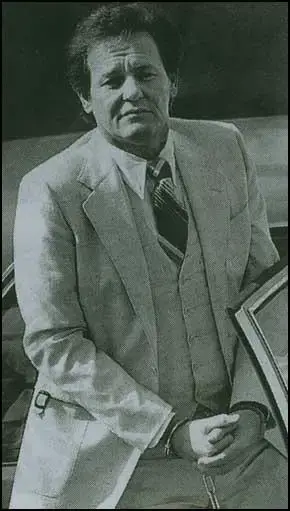
In 1995 Harrelson attempted to break out of Atlanta Federal Prison. He was recaptured and moved to Florence Administrative Maximum Penitentiary in Colorado. Woody Harrelson attempted to have his father’s conviction overturned and secure a new trial.
Charles Harrelson died of a heart attack on 15th March, 2007.By John Simkin (john@spartacus-educational.com) © September 1997 (updated January 2020).
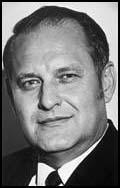
Jack Anderson was born in Long Beach, California, on 19th October, 1922. Two years later his family moved to Utah, the stronghold of the Mormon Church. Anderson was brought up in Salt Lake City and his journalistic career started at school when he began writing for his local newspaper, The Murray Eagle. At eighteen he joined the Salt Lake Tribune but left the job to become a Mormon missionary in the Deep South.
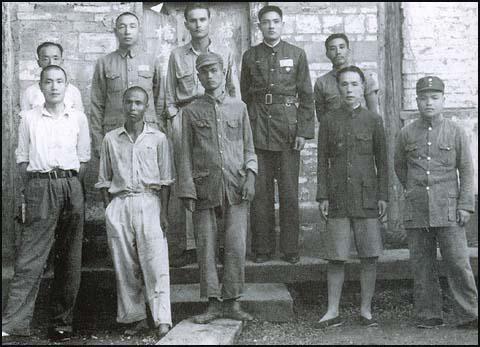
In 1943 Anderson he enrolled in the Merchant Marine officers training school. After seven months he persuaded the Desert News to accredit him as a foreign correspondent in China. Acccording to Anderson he was supposed to write “stories about hometown heroes gone to war”. He disliked this work and managed to get involved with the Office of Strategic Services (OSS). The OSS sent Anderson to contact a band of Chinese Nationalist guerrillas fighting the Japanese Army. Soon afterwards Anderson met Chou En-lai and wrote about his activities for the Associated Press.
Others working in China at the time included Ray S. Cline, Richard Helms, E. Howard Hunt, Jake Esterline, Mitchell WerBell, John Singlaub, Paul Helliwell, Jack Anderson, Robert Emmett Johnson, Jack Hawkins, Lucien Conein, Philip Graham, Tommy Corcoran, Whiting Willauer and William Pawley. These men were later to become very important to Anderson in his journalistic career.
In 1945 Anderson joined the United States Army in Chunking. He first served in the Quartermaster Corps and then wrote for the Stars and Stripes. He also did some reporting for the Armed Forces Radio. According to Anderson’s autobiography, Confessions of a Muckraker (1979), Spencer Moosa of the Associated Press suggested to Anderson that he should try and get a job with Drew Pearson in Washington.
Anderson took Moosa’s advice and in 1947 he became a member of Pearson’s staff. Anderson was a “legman” for Pearson’s column, Merry-Go-Round, that appeared in the Washington Post and in newspapers all over the United States. One of Anderson’s first stories concerned the dispute between Howard Hughes, the owner of Trans World Airlines, and Owen Brewster, chairman of the Senate War Investigating Committee. Hughes claimed that Brewster was being paid by Pan American Airways (Pan Am) to persuade the United States government to set up an official worldwide monopoly under its control. Part of this plan was to force all existing American carriers with overseas operations to close down or merge with Pan Am. As the owner of Trans World Airlines, Hughes posed a serious threat to this plan. Hughes claimed that Brewster had approached him and suggested he merge Trans World with Pan Am. Pearson and Anderson began a campaign against Brewster. They reported that Pan Am had provided Bewster with free flights to Hobe Sound, Florida, where he stayed free of charge at the holiday home of Pan Am Vice President Sam Pryor. As a result of this campaign Bewster lost his seat in Congress.
In the late 1940s Anderson became friendly with Joseph McCarthy. As he pointed out in his autobiography, Confessions of a Muckraker, “Joe McCarthy… was a pal of mine, irresponsible to be sure, but a fellow bachelor of vast amiability and an excellent source of inside dope on the Hill.” McCarthy began supplying Anderson with stories about suspected communists in government. Drew Pearson refused to publish these stories as he was very suspicious of the motives of people like McCarthy. In fact, in 1948, Pearson began investigating J. Parnell Thomas, the Chairman of the House of Un-American Activities Committee. It was not long before Thomas’ secretary, Helen Campbell, began providing information about his illegal activities.
On 4th August, 1948, Pearson published the story that Thomas had been putting friends on his congressional payroll. They did no work but in return shared their salaries with Thomas. Called before a grand jury, Thomas availed himself to the 1st Amendment, a strategy that he had been unwilling to accept when dealing with the Hollywood Ten. Indicted on charges of conspiracy to defraud the government, Thomas was found guilty and sentenced to 18 months in prison and forced to pay a $10,000 fine. Two of his fellow inmates in Danbury Prison were Lester Cole and Ring Lardner Jr who were serving terms as a result of refusing to testify in front of Thomas and the House of Un-American Activities Committee.
In 1949 Drew Pearson criticised the Secretary of Defence, James Forrestal, for his conservative views on foreign policy. He told Jack Anderson that he believed Forrestal was “the most dangerous man in America” and claimed that if he was not removed from office he would “cause another world war”. Pearson also suggested that Forrestal was guilty of corruption. Pearson was blamed when Forrestal committed suicide on 22nd May 1949. One journalist, Westbrook Pegler, wrote: “For months, Drew Pearson… hounded Jim Forrestal with dirty aspersions and insinuations, until, at last, exhausted and his nerves unstrung, one of the finest servants that the Republic ever had died of suicide.”
Anderson and Pearson also began investigating General Douglas MacArthur. In December, 1949, Anderson got hold of a top-secret cable from MacArthur to the Joint Chiefs of Staff, expressing his disagreement with President Harry S. Truman concerning Chaing Kai-shek. On 22nd December, 1949, Pearson published the story that: “General MacArthur has sent a triple-urgent cable urging that Formosa be occupied by U.S. troops.” Pearson argued that MacArthur was “trying to dictate U.S. foreign policy in the Far East”.
President Truman and Dean Acheson, the Secretary of State, told MacArthur to limit the war to Korea. MacArthur disagreed, favoring an attack on Chinese forces. Unwilling to accept the views of Truman and Dean Acheson, MacArthur began to make inflammatory statements indicating his disagreements with the United States government.
MacArthur gained support from right-wing members of the Senate such as Joe McCarthy who led the attack on Truman’s administration: “With half a million Communists in Korea killing American men, Acheson says, “Now let’s be calm, let’s do nothing. It is like advising a man whose family is being killed not to take hasty action for fear he might alienate the affection of the murders.”
On 7th October, 1950, MacArthur launched an invasion of North Korea and by the end of the month had reached the Yalu River, close to the frontier of China. On 20th November, Pearson wrote in his column that the Chinese was “sucking our troops into a trap.” Three days later the Chinese Army launched an attack on MacArthur’s army. North Korean forces took Seoul in January 1951. Two months later, Harry S. Truman removed MacArthur from his command of the United Nations forces in Korea.
Joe McCarthy continued to provide Anderson with a lot of information. In his autobiography, Confessions of a Muckraker, Anderson pointed out: “At my prompting he (McCarthy) would phone fellow senators to ask what had transpired this morning behind closed doors or what strategy was planned for the morrow. While I listened in on an extension he would pump even a Robert Taft or a William Knowland with the handwritten questions I passed him.” In return, Anderson provided McCarthy with information about politicians and state officials he suspected of being “communists”. Anderson later recalled that his decision to work with McCarthy “was almost automatic.. for one thing, I owed him; for another, he might be able to flesh out some of our inconclusive material, and if so, I would no doubt get the scoop.” As a result Anderson passed on his file on the presidential aide, David Demarest Lloyd.
On 9th February, 1950, McCarthy made a speech in Salt Lake City where he attacked Dean Acheson, the Secretary of State, as “a pompous diplomat in striped pants”. He claimed that he had a list of 57 people in the State Department that were known to be members of the American Communist Party. McCarthy went on to argue that some of these people were passing secret information to the Soviet Union. He added: “The reason why we find ourselves in a position of impotency is not because the enemy has sent men to invade our shores, but rather because of the traitorous actions of those who have had all the benefits that the wealthiest nation on earth has had to offer – the finest homes, the finest college educations, and the finest jobs in Government we can give.”
The list of names was not a secret and had been in fact published by the Secretary of State in 1946. These people had been identified during a preliminary screening of 3,000 federal employees. Some had been communists but others had been fascists, alcoholics and sexual deviants. As it happens, if Joe McCarthy had been screened, his own drink problems and sexual preferences would have resulted in him being put on the list.
Drew Pearson immediately launched an attack on McCarthy. He pointed out that only three people on the list were State Department officials. He added that when this list was first published four years ago, Gustavo Duran and Mary Jane Keeney had both resigned from the State Department (1946). The third person, John S. Service, had been cleared after a prolonged and careful investigation. Pearson also argued that none of these people had been members of the American Communist Party.
Anderson asked Pearson to stop attacking McCarthy: “He is our best source on the Hill.” Pearson replied, “He may be a good source, Jack, but he’s a bad man.” On 20th February, 1950, McCarthy made a speech in the Senate supporting the allegations he had made in Salt Lake City. This time he did not describe them as “card-carrying communists” because this had been shown to be untrue. Instead he argued that his list were all “loyalty risks”. He also claimed that one of the president’s speech-writers, was a communist. Although he did not name him, he was referring to David Demarest Lloyd, the man that Anderson had provided information on. Lloyd immediately issued a statement where he defended himself against McCarthy’s charges. President Harry S. Truman not only kept him on but promoted him to the post of Administrative Assistant. Lloyd was indeed innocent of these claims and McCarthy was forced to withdraw these allegations. As Anderson admitted: “At my instigation, then, Lloyd had been done an injustice that was saved from being grevious only by Truman’s steadfastness.”
McCarthy now informed Anderson that he had evidence that Professor Owen Lattimore, director of the Walter Hines Page School of International Relations at Johns Hopkins University, was a Soviet spy. Pearson, who knew Lattimore, and while accepting he held left-wing views, he was convinced he was not a spy. In his speeches, McCarthy referred to Lattimore as “Mr X… the top Russian spy… the key man in a Russian espionage ring.” On 26th March, 1950, Drew Pearson named Lattimore as McCarthy’s Mr. X. Pearson then went onto defend Lattimore against these charges. McCarthy responded by making a speech in Congress where he admitted: “I fear that in the case of Lattimore I may have perhaps placed too much stress on the question of whether he is a paid espionage agent.”
McCarthy then produced Louis Budenz, the former editor of The Daily Worker. Budenz claimed that Lattimore was a “concealed communist”. However, as Anderson admitted: “Budenz had never met Lattimore; he spoke not from personal observation of him but from what he remembered of what others had told him five, six, seven and thirteen years before.”
Pearson now wrote an article where he showed that Budenz was a serial liar: “Apologists for Budenz minimize this on the ground that Budenz has now reformed. Nevertheless, untruthful statements made regarding his past and refusal to answer questions have a bearing on Budenz’s credibility.” He went on to point out that “all in all, Budenz refused to answer 23 questions on the ground of self-incrimination”. Owen Lattimore was eventually cleared of the charge that he was a Soviet spy or a secret member of the American Communist Party and like other victims of McCarthyism, he went to live in Europe and for several years was professor of Chinese studies at Leeds University.
Despite the efforts of Jack Anderson, by the end of June, 1950, Drew Pearson had written more than forty daily columns and a significant percentage of his weekly radio broadcasts, that had been devoted to discrediting the charges made by Joe McCarthy. As a result, McCarthy decided to take on Pearson. McCarthy told Anderson: “Jack, I’m going to have to go after your boss. I mean, no holds barred. I figure I’ve already lost his supporters; by going after him, I can pick up his enemies.” McCarthy, when drunk, told Assistant Attorney General Joe Keenan, that he was considering “bumping Pearson off”. On 15th December, 1950, McCarthy made a speech in Congress where he claimed that Pearson was “the voice of international Communism” and “a Moscow-directed character assassin.” McCarthy added that Pearson was “a prostitute of journalism” and that Pearson “and the Communist Party murdered James Forrestal in just as cold blood as though they had machine-gunned him.”
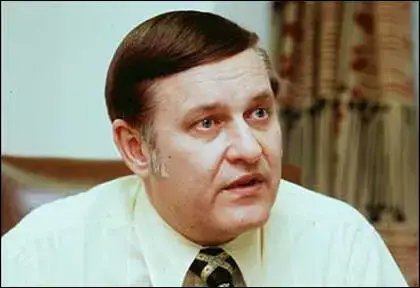
Over the next two months McCarthy made seven Senate speeches on Drew Pearson. He called for a “patriotic boycott” of his radio show and as a result, Adam Hats, withdrew as Pearson’s radio sponsor. Although he was able to make a series of short-term arrangements, Pearson was never again able to find a permanent sponsor. Twelve newspapers cancelled their contract with Pearson.
Joe McCarthy and his friends also raised money to help Fred Napoleon Howser, the Attorney General of California, to sue Pearson for $350,000. This involved an incident in 1948 when Pearson accused Howser of consorting with mobsters and of taking a bribe from gambling interests. Help was also given to Father Charles Coughlin, who sued Pearson for $225,000. However, in 1951 the courts ruled that Pearson had not libeled either Howser or Coughlin. Only the St. Louis Star-Times defended Pearson. As its editorial pointed out: “If Joseph McCarthy can silence a critic named Drew Pearson, simply by smearing him with the brush of Communist association, he can silence any other critic.” However, Pearson did get the support of J. William Fulbright, Wayne Morse, Clinton Anderson, William Benton and Thomas Hennings in the Senate.
After his attack on Drew Pearson, Anderson had no choice but to abandoned Joe McCarthy. He now joined forces with Wisconsin reporter Ronald W. May to write McCarthy: The Man, the Senator, the Ism (1952). In October, 1953, Joe McCarthy began investigating communist infiltration into the military. Attempts were made by McCarthy to discredit Robert Stevens, the Secretary of the Army. The president, Dwight Eisenhower, was furious and now realised that it was time to bring an end to McCarthy’s activities.
The United States Army now passed information about McCarthy to journalists who were known to be opposed to him. This included the news that Joe McCarthy and Roy Cohn had abused congressional privilege by trying to prevent David Schine from being drafted. When that failed, it was claimed that Cohn tried to pressurize the Army into granting Schine special privileges. Drew Pearson published the story on 15th December, 1953.
Some figures in the media, such as writers George Seldes and I. F. Stone, and cartoonists, Herb Block and Daniel Fitzpatrick, had fought a long campaign against McCarthy. Other figures in the media, who had for a long time been opposed to McCarthyism, but were frightened to speak out, now began to get the confidence to join the counter-attack. Edward Murrow, the experienced broadcaster, used his television programme, See It Now, on 9th March, 1954, to criticize McCarthy’s methods. Newspaper columnists such as Walter Lippmann also became more open in their attacks on McCarthy.The senate investigations into the United States Army were televised and this helped to expose the tactics of Joseph McCarthy. One newspaper, the Louisville Courier-Journal, reported that: “In this long, degrading travesty of the democratic process, McCarthy has shown himself to be evil and unmatched in malice.” Leading politicians in both parties, had been embarrassed by McCarthy’s performance and on 2nd December, 1954, a censure motion condemned his conduct by 67 votes to 22.
McCarthy also lost the chairmanship of the Government Committee on Operations of the Senate. He was now without a power base and the media lost interest in his claims of a communist conspiracy. As one journalist, Willard Edwards, pointed out: “Most reporters just refused to file McCarthy stories. And most papers would not have printed them anyway.”
Anderson helped Pearson investigate stories of corruption inside the administration of President Dwight Eisenhower. They discovered that Eisenhower had received gifts worth more than $500,000 from “big-business well-wishers.” Anderson was a close friend of Lyndon B. Johnson. In 1956 Pearson began investigating the relationship between Johnson and two businessmen, George R. Brown and Herman Brown from Texas. Pearson believed that Johnson had arranged for the Texas-based Brown and Root Construction Company to avoid large tax bills. Johnson brought an end to this investigation by offering Pearson a deal. If Pearson dropped his Brown-Root crusade, Johnson would support the presidential ambitions of Estes Kefauver. Pearson accepted and wrote in his diary (16th April, 1956): “This is the first time I’ve ever made a deal like this, and I feel a little unhappy about it. With the Presidency of the United States at stake, maybe it’s justified, maybe not – I don’t know.”
In 1957 Anderson threaten to quit as Pearson’s assistant. He complained that his stories always appeared under Pearson’s name. Pearson responded by promising him more bylines and pledged to leave the column to him when he died. Anderson agreed to do the deal and continued work for him. Jack Anderson’s next assignment was the investigation of the presidential assistant Sherman Adams. The former governor of New Hampshire, was considered to be a key figure in Eisenhower’s administration. Anderson discovered that Bernard Goldfine, a wealthy industrialist, had given Adams a large number of presents. This included suits, overcoats, alcohol, furnishings and the payment of hotel and resort bills. Anderson eventually found evidence that Adams had twice persuaded the Federal Trade Commission to “ease up its pursuit of Goldfine for putting false labels on the products of his textile plants.”The story was eventually published in 1958 and Adams was forced to resign from office. However, Anderson was much criticized for the way he carried out his investigation and one of his assistants, Les Whitten, was arrested by the FBI for receiving stolen government documents.
In 1960 Drew Pearson supported Hubert Humphrey in his efforts to become the Democratic Party candidate. However, those campaigning for John F. Kennedy, accused him of being a draft dodger. As a result, when Humphrey dropped out of the race, Anderson persuaded Pearson to switch his support to Lyndon B. Johnson. However, it was Kennedy who eventually got the nomination. Anderson and Pearson now supported Kennedy.
One of the ways they helped Kennedy’s campaign was to investigate the relationship between Howard Hughes and Richard Nixon. Pearson and Anderson discovered that in 1956 the Hughes Tool Company provided a $205,000 loan to Nixon Incorporated, a company run by Richard’s brother, F. Donald Nixon. The money was never paid back. Soon after the money was paid the Internal Revenue Service (IRS) reversed a previous decision to grant tax-exempt status to the Howard Hughes Medical Institute. This information was revealed by Anderson and Pearson during the 1960 presidential campaign. Nixon initially denied the loan but later was forced to admit that this money had been given to his brother. It was claimed that this story helped Kennedy defeat Nixon in the election.
In 1963 Senator John Williams of Delaware began investigating the activities of Bobby Baker. As a result of his work, Baker resigned as the secretary to Lyndon B. Johnson on 9th October, 1963. During his investigations Williams met Don B. Reynolds and persuaded him to appear before a secret session of the Senate Rules Committee. Reynolds told B. Everett Jordan and his committee on 22nd November, 1963, that Johnson had demanded that he provided kickbacks in return for him agreeing to this life insurance policy. This included a $585 Magnavox stereo. Reynolds also had to pay for $1,200 worth of advertising on KTBC, Johnson’s television station in Austin. Reynolds had paperwork for this transaction including a delivery note that indicated the stereo had been sent to the home of Johnson. Reynolds also told of seeing a suitcase full of money which Bobby Baker described as a “$100,000 payoff to Johnson for his role in securing the Fort Worth TFX contract”. His testimony came to an end when news arrived that President John F. Kennedy had been assassinated.
As soon as Johnson became president he contacted B. Everett Jordan to see if there was any chance of stopping this information being published. Jordan replied that he would do what he could but warned Johnson that some members of the committee wanted Reynold’s testimony to be released to the public. On 6th December, 1963, Jordan spoke to Johnson on the telephone and said he was doing what he could to suppress the story because ” it might spread (to) a place where we don’t want it spread.”
Abe Fortas, a lawyer who represented both Lyndon B. Johnson and Bobby Baker, worked behind the scenes in an effort to keep this information from the public. Johnson also arranged for a smear campaign to be organized against Reynolds. To help him do this J. Edgar Hoover passed to Johnson the FBI file on Reynolds. On 17th January, 1964, the Senate Rules Committee voted to release to the public Reynolds’ secret testimony. Johnson responded by leaking information from Reynolds’ FBI file to Anderson. On 5th February, 1964, the Washington Post reported that Reynolds had lied about his academic success at West Point. The article also claimed that Reynolds had been a supporter of Joseph McCarthy and had accused business rivals of being secret members of the American Communist Party. It was also revealed that Reynolds had made anti-Semitic remarks while in Berlin in 1953.
Like other political journalists, Anderson and Drew Pearson investigated the death of John F. Kennedy. Sources close to John McCone and Robert Kennedy claimed that the assassination was linked to the plots against Fidel Castro of Cuba.
In 1965, Jack Anderson achieved full partnership in the Merry-Go-Round column and now sharing a byline with Drew Pearson. However, Anderson still complained about the relationship because he was only paid $15,000 a year. Anderson returned to the investigation of the assassination of John F. Kennedy in 1966. At the time attempts were made to deport Johnny Roselli as an illegal alien. Roselli moved to Los Angeles where he went into early retirement. It was at this time he told attorney, Edward Morgan: “The last of the sniper teams dispatched by Robert Kennedy in 1963 to assassinate Fidel Castro were captured in Havana. Under torture they broke and confessed to being sponsored by the CIA and the US government. At that point, Castro remarked that, ‘If that was the way President Kennedy wanted it, Cuba could engage in the same tactics’. The result was that Castro infiltrated teams of snipers into the US to kill Kennedy”.
Morgan took the story to Jack Anderson and Drew Pearson. The story was then passed on to Earl Warren. He did not want anything to do with it and so the information was then passed to the FBI. When they failed to investigate the story Anderson wrote an article entitled “President Johnson is sitting on a political H-bomb” about Roselli’s story. It has been suggested that Roselli started this story at the request of his friends in the Central Intelligence Agency in order to divert attention from the investigation being carried out by Jim Garrison.
In 1968 Jack Anderson and Drew Pearson published The Case Against Congress. The book documented examples of how politicians had “abused their power and priviledge by placing their own interests ahead of those of the American people”. This included the activities of Bobby Baker, James Eastland, Lyndon B. Johnson, Dwight Eisenhower, Hubert Humphrey, Everett Dirksen, Thomas J. Dodd, John McClellan and Clark Clifford.
On the death of Drew Pearson in 1969, Anderson took over his Merry-Go-Round column. Co-written with Jan Muller, the column was distributed to more than 400 newspapers. Anderson and Muller also wrote the Jack Anderson Confidential, an in-depth monthly newsletter.
Anderson has achieved many important stories including the discovery that Central Intelligence Agency plot to kill Fidel Castro. In 1972 Anderson won the Pulitzer Prize for journalism. This was for his reports claiming that the Nixon administration secretly tilted toward Pakistan in its war with India. The following year his book, The Anderson Tapes, dealt with the activities of Richard Nixon and J. Edgar Hoover.
Anderson interviewed Johnny Roselli just before he was murdered. On 7th September, 1976, Anderson reported Roselli as saying : “When Oswald was picked up, the underworld conspirators feared he would crack and disclose information that might lead to them. This almost certainly would have brought a massive U.S. crackdown on the Mafia. So Jack Ruby was ordered to eliminate Oswald.”
Anderson’s autobiography, Confessions of a Muckraker, was published in 1979. Anderson also investigated the Watergate Scandal. It was later discovered that Jeb Magruder and G. Gordon Liddy discussed the possibility of having Anderson added to a hit list. Anderson pointed out in Peace, War and Politics: An Eyewitness Account (1999) that Liddy was under the impression that “Richard Nixon wanted me dead”.
Mark Feldstein, director of the journalism program at George Washington University, has argued: “Part circus huckster, part guerrilla fighter, part righteous rogue, Anderson waged a one-man journalistic resistance when it was exceedingly unpopular to do so.” Douglas Martin of the New York Times, commented: “His bombastic, self-congratulating style, abbreviated exegeses and a blistering moral outrage fueled both by his Mormon upbringing and unabashed theatrical flair caused some to question his gravity.” Anderson defended his work in an article in The Washington Post in 1983: “I have to do daily what Woodward and Bernstein did once” it is a column of “tweaks, leaks and piques, born of idealism, stoked by cynicism, a brazen, high-risk, righteously indignant antiwaste, anticorruption, anticommunist watchdog of a column that has been called everything from ‘gold’ to ‘garbage.’ Sometimes on the same day. Sometimes in the same sentence.”
In 1989 Anderson received information from Joseph Shimon, that he had been at meetings with Sam Giancana and Santo Trafficante where they discussed plans to assassinate Fidel Castro. All these plots failed and Shimon became convinced that Trafficante was working for Castro. This story eventually appeared in the Merry-Go-Round column.
In 1992 Anderson was working on a television project on the Exxon Valdez oil spill. However, he was eventually forced to withdraw from the project when it was revealled that Anderson had received $10,000 from Exxon to make the program. Other books by Anderson include The Washington Money-Go-Round (1997) and Peace, War and Politics: An Eyewitness Account (1999).
Jack Anderson retired from journalism in July, 2004. He died at his home in Bethesda, Maryland, of complications from Parkinson’s disease, on 17th December, 2005.By John Simkin (john@spartacus-educational.com) © September 1997 (updated October 2021).
https://fad17b2cac2290909da303d9ffb63c3f.safeframe.googlesyndication.com/safeframe/1-0-38/html/container.html▲ Main Article ▲
Primary and Secondary Sources
(1) Jack Anderson, The Anderson Papers (1973)
Honest men will lie and decent men will cheat for power. Few reach the political pinnacles without selling what they do not own and promising what is not theirs to give. In the great and grueling quest for power it is easy to forget that power belongs not to those who possess it for the moment but to the nation and its people.
While power need not be corrupting, it is impossible to deny that the American political system invites corruption. Men must accumulate funds to campaign for office. Those who finance the campaigns expect a return on their investment. Those who are elected must listen to the special interests while they preach about the public interest. To lead they often must follow men whose motives are self-serving.
To keep the White House, Richard Nixon raised more campaign cash than it cost him originally to gain the White House. His agents systematically contacted the nation’s great corporations and gave them campaign quotas for their executives to raise. Some paid their allotments hoping it would keep the government off their backs. Others, like International Telephone and Telegraph, sought to make a deal in return for a campaign commitment. Only a few, like American Motors, refused to ante up. Staggering sums were raised to reelect the President. The cost to the people of the United States, and to the free enterprise system, is still being paid in installments.
(2) Jack Anderson, The Anderson Papers (1973)
The experience of ascending the pinnacle of power changes the men who must exercise power. Some men can grow and be strengthened by the process. Most are diminished. When Lyndon Johnson was President, it was possible sometimes to glimpse the gangling adolescent from the Texas dirt farm. And somewhere under the brittle shell of Richard Nixon lurks the quiet, studious youngster in Whittier who wanted to be a railroad engineer. But in the White House, they no longer were the men they once had been. The aging process for all human beings tends to replace
idealism with cynicism; for the powerful the change is often more pervasive.
The men of the press seldom remind the leaders of their obligations, nor the citizens that they are the true owners of power. All too many who write about government have been seduced by those who govern. The press, like the powerful, often forgets its obligations to the public. Too many Washington reporters consider it their function to court the high and mighty rather than condemn them; to extol public officials rather than expose them.
It is far more pleasant to write puffery about the powerful, of course, than it is to probe their perfidy. Public officeholders are usually likable; that is why they got elected. Many reporters are taken in by this personal charm, are awed by the majesty of office; and they become publicists rather than critics of the men who occupy the offices.
(3) Jack Anderson, The Anderson Papers (1973)
The need for the press to occupy an adversary role was clear to America’s founding fathers. That is why they made freedom of the press the first guarantee of the Bill of Rights. Without press freedom, they knew, the other freedoms would fall. For government, by its nature, tends to oppress. And government, without a watchdog, would soon oppress the people it was created to serve.
(4) Jack Anderson, The Anderson Papers (1973)
Unquestionably, the way an investigative reporter is compelled to operate is an imperfect system of newsgathering. Sometimes the sources do not have all the details. Sometimes the jigsaw pieces of information do not form a complete picture and the missing pieces are buried too deeply. Investigative reporters must work without the power of subpoena. They lack the money and manpower that the government can marshal to counter their efforts. The authority to classify embarrassing facts, the ability to shut off channels of information, the power to intimidate sources who could tell the truth – all these are on the side of the government.
It is not altogether surprising, therefore, that investigative reporters do not always get all the facts. They can uncover enough hidden scraps, however, to cast light on a blunder or an embarrassment or a scandal that the people in power had conspired to conceal. If our society was as free and open as it should be, and if government officials fully subscribed to their oaths to protect the public interest, there would be little difficulty in quickly establishing the truth. But officials all too often cover up the facts and then lie to the public.
Investigative reporters must work harder, dig deeper, and verify their facts more carefully than establishment reporters. Preposterous lies can be told to make the powerful look good; grievous blunders can be committed by officials in the name of the government; the public can be cheated by men sworn to uphold the public trust. But let an investigative reporter make a mistake and there will be howls of outrage. There can be a good word for a Lyndon Johnson who sent boys to die in a senseless war, or a General Motors which releases unsafe cars upon the highways, or a Richard Nixon who condones lawlessness while preaching law and order. But there is no good word for an investigative reporter who wrongly condemns someone in authority.
(5) Jack Anderson, The Anderson Papers (1973)
The article described efforts by the White House staff to influence Dita Beard to disown her memo and also their attempts to discover some suitable scandal involving myself. The Post went on to quote from an “interim memorandum” written for the White House by its investigators reporting on my personal and business life. I was one of the founders of the Chinese Refugee Relief Organization, the report revealed; my fellow founders included Mrs. Claire Chennault, a prominent Republican and the widow of the organizer of the Flying Tigers; I had a bank account at the D.C. National Bank where the widow Chennault was on the board of directors; I owned a small interest in the Empress Restaurant in Washington and in a newspaper in Las Vegas. The incriminating picture was rounded out by a mysterious claim that I maintained “a close association with the operating arm of the Democratic Party,” an entity I had thought to be nonexistent. The White House report was dismissed by the Post as “dealing with already known and generally uncontroversial details about Anderson.” Such entries, while they might be helpful in an application for credit at Thorn McAn’s, seemed to me unworthy of sleuths operating at the presidential level.
What I did not take into account was the secret doings that were then fragmenting the energies of the compilers of my White House biography. These gentlemen – James McCord, G. Gordon Liddy, E. Howard Hunt, lohn Dean, and various presidential dispatchers and controls – were engaged in truly momentous events, compared with which their investigation of me was just a sideshow. For example, they were preparing blueprints for the burglarizing of Watergate and the bugging of George McGovern headquarters; they were perfecting schemes to burglarize the offices of Daniel Ellsberg’s psychiatrist, to recruit call girls who would romance Democratic party leaders and report back the pillow talk, to forge documents framing President Kennedy for the murder of President Diem, to fabricate a new version of Chappaquiddick. The operatives were occupied not only with conceiving and planning these vaulting designs but in making formal presentations to the Attorney General of the United States and various high aides to the President – presentations replete with elaborate charts so that busy Nixon proconsuls could get a quick grasp of the finer points of the felonies within their purview…
As it happened, I was personally acquainted with some of the Waterbuggers. Frank Sturgis, a soldier of fortune who had roamed the world in search of danger and excitement, had been a friend of mine for years. I had written about his exploits fighting first for and then against Fidel Castro. Sturgis introduced me in Miami to Bernard Barker, a short, swarthy swashbuckler who was known to his associates as Macho (he-man). Both of them spoke of Eduardo, their CIA superior during the Bay of Pigs, who I realized much later was E. Howard Hunt. They were a collection of romantics, forever seeking adventure, forever finding misadventure.
(6) Jack Anderson, The Anderson Papers (1973)
If government is to regain the trust of the nation, the administration of justice must be even-handed and freed from the pressures of political favoritism. The recent custom of appointing election campaign managers as attorneys general must cease. It is transparent that the men who raise the money to elect a President cannot be expected to deal honestly with major contributors. The lustice Department, if its name is to have meaning, should be led by the nation’s best lawyers, not its political hacks. Its proceedings should be open, its prosecutions just.
The FBI, Justice’s investigative arm, must be allowed to free itself from the web of politics now entangling it and regain its reputation as an unbiased, straightforward servant of the people. The responsibilities for internal security were thrust upon the bureau as America hurriedly geared itself for World War II. The emergency is long past; it is time for a new approach. No agency is as well equipped to fight crime as the FBI. That should be its job. The responsibility for evaluating political thought and activity should be turned over to a new branch of government closely supervised by Congress. America cannot afford a political police force.
Perhaps most important of all, Congress must rip aside the veil of censorship that prevents the American people from knowing what their government is doing. The United States now possesses more than twenty million documents that are hidden from public scrutiny by the censor’s stamp. Men familiar with this hoard insist that only ten to thirty percent of the papers have any genuine bearing on national security. The rest are classified to keep Americans from learning of malfeasance, or bungling, or simply because the censor lacked the wit to make the papers public.
We are willing to agree, albeit grudgingly, that the President cannot make many of the cold, hard decisions he faces in the bright light of publicity. There are maneuvers of extreme delicacy that must be executed, and unpublicized deals that must be negotiated, if he is to meet his responsibilities. Let him keep these documents secret, for up to two years if necessary. Documents dealing with national security, of course, should remain secret as long as they remain sensitive. But the President and his underlings cannot be allowed to decide arbitrarily what will remain secret.
We call for the establishment of a national commission on security, comprised of intelligent, trustworthy individuals from outside the government, who would periodically review those documents the government feels must remain classified. The burden of establishing the need for secrecy would be on the government, rather than the present rule, which compels scholars and researchers to show why certain papers – some dealing with World War II – should be made public.
No other nation has been as successful as the United States in maintaining a free society. Yet the invasion of this freedom – secrecy, the politicization of justice, the hoarding of authority, official deception – are abuses of power that threaten our freedom.
Power corrupts not only those who abuse it, but whole nations as well, when they tolerate this abuse.
(7) Louis Stokes, House Select Committee on Assassinations (September 28, 1978)
In 1967, 1971, 1976, and 1977, those 4 years, columnist Jack Anderson wrote about the CIA-Mafia plots and the possibility that Castro decided to kill President Kennedy in retaliation. Mr. Anderson even contends in those articles that the same persons involved in the CIA-Mafia attempts on Castro’s life were recruited by Castro to kill President Kennedy. The September 7, 1976 issue of the Washington Post contains one of Mr. Anderson’s articles entitled, “Behind John F. Kennedy’s Murder,” which fully explains Mr. Anderson’s position. I ask, Mr. Chairman, that at this point this article be marked as JFK exhibit F-409 and that it be entered into the record at this point.
Mr. Trafficante, I want to read to you just two portions of the article I have just referred to, after which I will ask for your comment. According to Mr. Anderson and Mr. Whitten in this article, it says: Before he died, Roselli hinted to associates that he knew who had arranged President Kennedy’s murder. It was the same conspirators, he suggested, whom he had recruited earlier to kill Cuban Premier Fidel Castro. By Roselli’s cryptic account, Castro learned the identity of the underworld contacts in Havana who had been trying to knock him off. He believed, not altogether without basis, that President Kennedy was behind the plot. Then over in another section, it says: According to Roselli, Castro enlisted the same underworld elements whom he had caught plotting against him. They supposedly were Cubans from the old Trafficante organization. Working with Cuban intelligence, they allegedly lined up an ex-Marine sharpshooter, Lee Harvey Oswald, who had been active in the pro-Castro movement. According to Roselli’s version, Oswald may have shot Kennedy or may have acted as a decoy while others ambushed him from closer range. When Oswald was picked up, Roselli suggested the underworld conspirators feared he would crack and disclose information that might lead to them. This almost certainly would have brought a massive U.S. crackdown on the Mafia. So Jack Ruby was ordered to eliminate Oswald making it appear as an act of reprisal against the President’s killer. At least this is how Roselli explained the tragedy in Dallas.
(8) Jack Anderson, Confessions of a Muckraker (1979)
My mentor’s sympathies, then, lay with (Howard) Hughes, but Drew (Pearson) felt stranded in an unsatisfying posture. It was his nature to want to play an important part in the great political brawls of the time, to put his mark on them, to help shape their outcome toward the benefit of his causes or the distress of his foes. Yet he would not take Brewster’s side and could not take Hughes’s. For though Hughes was probably the victim of an unsavory gang-up, his own conduct in the matter was too shabby to defend and he was not even making a fight of it himself. Grumbling at each day’s leaks, Drew held back, watching the thing spin, looking for a handle to pick it up by.
At this point in his disintegrating fortunes, Howard Hughes phoned Drew from one of his West Coast redoubts. He had long considered Pearson to be journalism’s leading molder of public opinion and the man most knowledgeable about the Byzantine twists of conspiratorial Washington. And since Drew’s animus against Hughes’s tormentors was clear, there was a mutuality of interest present that encouraged him to seek Drew’s help and advice.
In the manner of cornered men whose expense accounts have already been made public, Hughes admitted to misdemeanors but pled innocent to felonies. He had indeed wined and wenched government officials and military brass, sometimes to excess. It was necessary, he said; his competitors did it, and as a relative newcomer trying to buck long-entrenched interests and liaisons, he had to play the game in order to get a hearing on his proposals. He had never looked on aviation as a moneymaker, he insisted; he was in it because he had a passion for it. He yielded to no man in his mastery of the dark arts of making money, as the astronomical profits of his other businesses showed, but in aviation, he had lost $14 million in thirteen years.
Then he got to the nub: three months before, Brewster had attempted to lobby him in behalf of Pan Am, he said, and having failed, they were both out to destroy him. Pan Am had put great pressure on him to merge Trans World with Pan Am and co-sponsor the chosen-instrument plan. Brewster himself had told him at the Mayflower Hotel that the probe would be dropped if he joined forces with Pan Am.
(9) Jack Anderson, Peace, War, And Politics (1999)
When CIA chief John McCone learned of the assassination, he rushed to Robert Kennedy’s home in McLean, Virginia, and stayed with him for three hours. No one else was admitted. Even Bobby’s priest was turned away. McCone told me he gave the attorney general a routine briefing on CIA business and swore that Castro’s name never came up. Yet McCone’s agency had been trying to kill Castro, and just two months earlier Castro had threatened to retaliate if the assassination attempts continued. Another thing: On November 22, 1963, when I could talk about nothing else, when my wife could talk about nothing else, when the entire world was riveted on Dallas, the director of the CIA claimed that he spent three hours with the brother of the slain president and that they discussed routine CIA business.
Sources would later tell me that McCone anguished with Bobby over the terrible possibility that the assassination plots sanctioned by the president’s own brother may have backfired. Then the following day, McCone briefed President Lyndon Johnson and his National Security Advisor McGeorge Bundy. Afterward, McCone told subordinates – who later filled me in – what happened at that meeting. The grim McCone shared with Johnson and Bundy a dispatch from the U.S. embassy in Mexico City, strongly suggesting that Castro was behind the assassination.
The CIA chief put this together with what he knew of the mood in Moscow. Nikita Khrushchev was on the ropes inside the Kremlin, humiliated over backing down less than a year earlier during the Cuban missile crisis. If Castro were to be accused of the Kennedy assassination, Americans would demand revenge against Cuba, and Khrushchev would face another Cuban crisis. He was an impulsive man who could become dangerous if backed into a corner. McCone warned that Khrushchev was unlikely to endure another humiliation over Cuba. This time he might do something reckless and provoke a nuclear war, which would cost forty million American lives. It was a staggering figure that the new president repeated to others.
A trusted source told me that Johnson later picked up the phone and called a man who had been his neighbor in Washington for three decades – FBI Director J. Edgar Hoover. From all that I have learned about those two men, I can speculate what Johnson told Hoover. More than likely, LBJ invoked flag, country, and the fate of forty million Americans who might die. He probably asked Hoover to make sure that the FBI postmortem on the Kennedy assassination did not even hint at the name Fidel Castro.
In times of national trauma, many people fancy themselves heroes. Witnesses see things that never happened; eavesdroppers overhear things that were never said; patriots fabricate stories to protect the national well-being; bureaucrats doctor paperwork to fit the official line; statesmen hide the truth while it is too painful to tell. Lies are told and rules are broken in the name of a greater good. Hoover was a man of many motives, but above all he was a patriot and a master bureaucrat. He despised many of the presidents who were his bosses; he was loyal only to his perception of the United States and the FBI. But LBJ knew how to appeal to Hoover’s patriotism. To save forty million Americans from nuclear oblivion, the J. Edgar Hoover I knew would not only have agreed to whitewash the most important murder investigation of the century; he also would have agreed to use his power and control over the FBI to impose his will.
In less than a week, Hoover notified Johnson that the FBI investigation into the assassination was almost complete. It would lay the blame on a lone gunman, Lee Harvey Oswald, who could no longer challenge the findings because by then he was dead.
(10) Jack Anderson, speech at the University of Utah (22nd September, 1999)
The press in America today is not particularly popular. It probably does not deserve to be particularly popular. We have adopted many of our mainstream organizations radio, TV, newspapers have adopted the legal profession’s way of learning the truth. A lawyer can prove anything. He may represent the defendant one day, the plaintiff the next, and he can take whatever facts are available on one side of the story and spell out a tale that proves either side, and he doesn’t much care which side he is on. Depends usually on who offers him the biggest fee. Increasingly tabloid television programs and tabloid newspapers are doing the same thing. They decide what would make a good story and then they go out to prove the story, and they can prove anything there, investigate your background, find out all there is to know, all there is on the record about you, and take all the derogatory stuff that I learned, and put it all in one column without any compensating favorable information on the other side, and I could destroy your reputation. Well, I appeal to you, who are going in to this business, you who are taking communications under a great communications director, who will teach you right.
Let me tell you what I tell my reporters. I say I want to know the facts. I want to know the facts as they are, not as you think they are, not as you hope they are, not as someone tells you they are. I want to know the facts as they are, and I confess it is more difficult for them to find out those facts than it is for me to tell them to find out those facts. But I tell them that politicians (whom it is our duty to cover in Washington), that politicians are proud, egocentric people. Most of them would give an arm or a leg before they gave up their reputations, their good name. I can tell you that a man named Bill Clinton is in absolute agony over the stories about his personal life. He suffers. He has complained petulantly to friends: “How can they write these stories about Hilary and me? What do they know? Only Hillary and I know what our relationship is. How can they write these terrible stories?”
Richard Nixon went off his rocker for a short period of time, over the agony of Watergate, and the stories that we wrote about him. So I say to my reporters, “So, if you enjoy doing this too much, I don’t think I’m going to like you.” But I tell them it is our function to do it. This is our function. Our Founding Fathers understood, that government by its nature tends to oppress those it has power over. Our Founding Fathers decided that there must be, there had to be, there should be and there is, an institution that keeps an eye on government. That is what we do. There is nothing in the Constitution about freedom to practice law; there is nothing in the Constitution about freedom to practice medicine; there is nothing in the Constitution about freedom to engage in commerce; there is nothing in the Constitution about teaching. But there is something in the Constitution about freedom of the press. Our Founding Fathers understood, that it would be necessary to have a watchdog on government.
(11) Jack Anderson, Peace, War and Politics: An Eyewitness Account (1999)
The CIA’s Sheffield Edwards was supposed to make the contact with the underworld. He approached a former FBI agent and CIA operative, Robert Maheu, who moved at the subterranean level of politics. Maheu knew his way around the shady side of Las Vegas; he had been recruited by billionaire Howard Hughes to oversee his Las Vegas casinos. Happily, Hughes was a friend who owed me a favor. Intermediaries persuaded Maheu to confide in me. He confirmed that the CIA had asked him to sound out the Mafia, strictly off the record, about a contract to hit Fidel Castro. Maheu had taken the request straight to Johnny Rosselli.
Rosselli had a reputation inside the mob as a patriot; he was quite willing to kill for his country. But as he told me, there was an etiquette to be followed in these matters. Santo Trafficante was the godfather-in-exile of Cuba after Castro chased out the mob. Rosselli couldn’t even tiptoe through Trafficante’s territory without permission, and he couldn’t approach Trafficante without a proper introduction. So Rosselli prevailed upon his boss in Chicago, Sam “Momo” Giancana, to attend to the protocol. Since Giancana had godfather status, he could solicit Trafficante’s help to eliminate Castro. The project appealed to Giancana who had commiserated with other dons over the loss of casino revenues in Havana. Killing Castro for the government would settle some old scores for the mob, and it would put Uncle Sam in the debt of the Mafia.
Maheu had been ordered to keep a tight lid on the involvement of the U.S. government. The CIA was ready with a cover story that the Castro hit had been arranged by disgruntled American businessmen who had been bounced out of their Cuban enterprises by Castro.
On September 25, I960, Maheu brought two CIA agents to a suite at the Fountainebleau Hotel on Miami Beach. Rosselli delivered two sinister mystery men whom he introduced only as Sicilians named “Sam” and “Joe.” In fact, they were two of the Mafia’s most notorious godfathers, Sam Giancana and Santo Trafficante, both on the FBI’s ten-most-wanted list. They discussed the terms of Castro’s demise, with Giancana suggesting that the usual mob method of a quick bullet to the head be eschewed in favor of something more delicate, like poison.
The wily Giancana was less interested in bumping off Castro than in scoring points with the federal government, and he intended to call in as many chips as he could before the game was over.
(12) Mark Feldstein, The Last Muckraker, Washington Post (28th July, 2004)
Jack Anderson, 81 and ailing with Parkinson’s disease, quietly gave up his syndicated column last week after more than half a century. It was not the ending some of Richard Nixon’s men once had in mind.
In 1972, in one of the most bizarre and overlooked chapters in American political history, Anderson was the target of a Mafia-style hit ordered in the White House itself. Two Nixon operatives admitted under oath that they plotted to poison the troublemaking investigative reporter at the behest of a top aide to President Nixon. Ultimately the plot was aborted and the conspirators were arrested a few weeks later, as part of the Watergate break-in.
Anderson’s retirement symbolizes the end of an era that predates Watergate. He was the last of the old-fashioned muckrakers. In his heyday, from the 1950s through the ’70s, his daily “Washington Merry-Go-Round” column was the most widely read in the nation, reaching an audience of 40 million in nearly a thousand newspapers.
Anderson’s dramatic exposés of political scandal led to resignations and prison terms. He swiped secret documents, used bugging equipment to eavesdrop on conversations, and jubilantly savaged his enemies, unconcerned with such journalistic niceties as fairness and balance.
Anderson was an important transitional figure in the evolution of adversarial journalism, a link in the historical chain between the advocacy of Progressive-era reformers from the early 1900s and the more professionalized class of investigative reporters who came to dominate Washington in the 1970s. After World War II, when he joined the column under the tutelage of the late Drew Pearson, Anderson was for years the only Washington reporter of genuine influence who consistently exposed wrongdoing in the nation’s capital – from the fur-coat scandals involving presidents Truman and Eisenhower, to corruption by numerous members of Congress, to the secret foreign policy machinations of the Nixon and Reagan administrations.
Anderson was able to break these stories in part because he was an independent journalistic entrepreneur, empowered by the technology and economic autonomy of the syndicated column. His reach extended beyond the control of any single editor or publisher.
He was a strict Mormon who viewed investigative reporting as a noble calling from God. He believed as a matter of theology that life is an eternal struggle between good and evil, and that the First Amendment was quite literally a divinely inspired charter that sanctioned his muckraking mission.
Anderson was decidedly unencumbered by ties to the Washington establishment, and he was in many ways uniquely situated to hold the muckraking banner aloft. He provided a vital check on governmental power during a time when journalists preferred to socialize with public officials rather than investigate them.
To be sure, his flaws could be glaring. He was bombastic and self-righteous, even when retracting stories, such as his false report that a Democratic vice presidential nominee had been arrested for drunk driving. The muckraker’s unsavory techniques included threats, rifling through garbage, and financial relationships with sources. He openly lobbied senators on their votes, ghost-writing their speeches and using his column as leverage to influence them. His cliche-ridden evangelical style was an anachronism that sacrificed complex truths for simplistic but dramatic portrayals of good guys vs. bad.
In this respect, too, Anderson was ahead of his time, anticipating the victims-and-villains entertainment values that have come to dominate 21st-century television news. Ironically, despite the black-and-white view he expressed in his column, Anderson’s own reporting was itself a far more grayish mix of courageous digging and sensationalistic self-promotion. In many ways, the columnist embodied the contradictions that have characterized investigative reporting throughout American history; from the beginning it has alternated between the highbrow ideals of public service and the lowbrow reality of celebrity gossip.
Part circus huckster, part guerrilla fighter, part righteous rogue, Anderson waged a one-man journalistic resistance when it was exceedingly unpopular to do so. That no one has emerged to take his place shows not only the void he leaves behind but also how much America’s media landscape has changed.
(13) Howard Kurtz, The Washington Post (18th December, 2005)
Anderson, who died yesterday at 83, was the most feared investigative reporter of his day, but in person Jack was the gentlest of men. He was patient and avuncular with the young and ambitious wannabes who rotated through his small office (and whose numbers included Fox News’s Brit Hume, NBC’s Jack Cloherty, the novelist James Grady and prizewinning Los Angeles Times correspondent Gary Cohn). He was a wonderful storyteller, a good listener and a devoted father of nine kids who was happy spending summer weekends at a big beach house in Rehoboth. He would begin even routine phone conversations with “Good to hear your voice.” He once told me that the best way to develop a source was to be inconvenienced together at some distant airport.
It is hard to imagine now, when every minor publication is clawing away in search of government secrets, but Anderson was once one of the capital’s few purebred investigative journalists. He managed to compete with the likes of the New York Times and Washington Post based on his own ingenuity and a tiny staff, though he was never quite seen as being establishment, in part because he was a lone figure blazing his own iconoclastic path.
He would produce worldwide headlines with scoops about chicanery by corporate giant ITT or behind-the-scenes dealings involving India and Pakistan, the latter work earning him a Pulitzer Prize in 1972. He could also be spectacularly wrong, put his faith in a bad source and have to issue an embarrassing retraction. But his ability to persuade people at the highest levels of government to share secrets with him was uncanny, especially in an era when most journalists were deferential toward the nation’s leaders and when top political columnists had cozy relationships with the high and mighty.
Anderson was for decades the most widely read columnist in America, appearing in about 1,000 newspapers, including his odd but hardly obscure spot in The Washington Post’s comics pages (before the paper dropped him almost a decade ago). He was also a regular on “Good Morning America” and churned out best-selling books. When I later served a two-year stint with him as a reporter in the late ’70s, almost anyone, from senators to Cabinet members, would quickly return my calls. And Jack was generous with credit, writing the names of his “associates” into pieces they had reported. I think he was sensitive on this point because he had spent so many years as the less heralded legman for Drew Pearson, from whom he inherited the Washington Merry-Go-Round column. Nor was Anderson above telling the greenest rookie that if he worked hard, one day he might take over the franchise.
I became an expert in Anderson’s style because, for a time, I was ghostwriting the column, subject, of course, to his editing and approval. Jack spent much of his time on the lecture circuit, and for a very basic reason: For all its prestige, he lost money on the column. The speaking fees he raked in – and he was a skilled performer in front of crowds – were what kept the enterprise afloat.
And so I studied the art of Andersonian hype. He always “learned” this or that from “secret” or “eyes-only” documents, or reported on what was being “whispered in the capital’s back rooms.” I once went to Texas to write about a controversial state senator, and Jack, never having met the man, reworked my copy to say that the politician’s “ruddy face turned redder” when asked about some outrage.
He once told me something that stuck in my mind. Although the 750-word columns were often devoted to exposing nefarious misdeeds, when it came to the person under fire, Anderson said, “Act like you’re his defense lawyer.” In other words, make the strongest possible case for the innocence of the public figure you were prosecuting….
In later years, I began to see that Anderson’s judgment was often flawed. He had a disturbing knack for entering into business arrangements with shady characters, and the dealings would later blow up on him. In 1992 he had to back out of a television project on the Exxon Valdez oil spill after it turned out – Anderson later claimed ignorance – that Exxon had put up $10,000 for the program. The quality of his work declined with his advancing age when, despite a struggle with Parkinson’s disease, he refused to retire. His column was his life.
(14) Douglas Martin, New York Times (18th December, 2005)
Mr. Anderson was a flamboyant bridge between the muckrakers of the early decades of the 20th century and the battalions of investigative reporters unleashed by news organizations after Watergate. He relished being called “the Paul Revere of journalism” for his knack for uncovering major stories first almost as much as he enjoyed being at the top of President Richard M. Nixon’s enemies list.
His journalistic reach extended to radio, television and magazines, and his scoops were legion. They included the United States’ tilt away from India toward Pakistan during Bangladesh’s war for independence, which won the Pulitzer Prize for national reporting in 1972.
Another was his linking of the settlement of an antitrust suit against ITT by the Justice Department to a $400,000 pledge to underwrite the 1972 Republican convention. Still another was revealing the Reagan administration’s efforts to sell arms illegally to Iran and funnel the proceeds to anti-Communist forces in Central America.
In what was the nation’s most widely read, longest-running political column, Mr. Anderson broke stories that included the Central Intelligence Agency’s enlisting of the Mafia to kill Fidel Castro, the savings and loan scandal, Senator Thomas J. Dodd’s loose ethics, and the mystery surrounding Howard Hughes’s death.
He liked to say that he and his staff of eager investigators did daily what Bob Woodward and Carl Bernstein did just once when they dug out the truth of the Watergate scandal.
But his bombastic, self-congratulating style, abbreviated exegeses and a blistering moral outrage fueled both by his Mormon upbringing and unabashed theatrical flair caused some to question his gravity.
When he made a mistake on a big story, it could reverberate mightily. In 1972, he had to apologize to Senator Thomas Eagleton for reporting on the radio about drunken-driving arrests that he could not later authenticate. Mr. Eagleton had to withdraw as the Democratic Party nominee for vice president in the face of disclosures that he had received psychiatric treatment.
Mr. Anderson’s decidedly roguish techniques included eavesdropping, spiriting off classified documents, rifling through garbage (Mr. Hoover’s, in particular) and sometimes blatant threats – methods he defended as justified in his lifetime campaign to keep government honest. His printing of verbatim transcripts of the secret Watergate grand jury thwarted Mr. Nixon’s efforts to stonewall the scandal by hiding behind grand jury secrecy…
Not only was Mr. Anderson on Nixon’s notorious list, but G. Gordon Liddy, a Watergate burglar, plotted his murder.
Mr. Anderson marked a departure from traditional Washington columnists like Walter Lippmann who reported on politics as insiders with high-level contacts. His approach also veered sharply from that of Drew Pearson, who began the “Merry-Go-Round” column in 1932.
Mr. Pearson basked in his own celebrity, confiding with the powerful and playing them for large scoops. Mr. Anderson, by contrast, kept his distance from politicians. He would rather go to a movie than a state dinner, which was fortunate because he was never invited to any.
He quietly cultivated dissatisfied and idealistic lower-level government workers, convincing them that the public’s right to information trumped their bosses’ personal interests. His stock and trade were the secret documents he persuaded sources to leak.
Mr. Anderson’s prominence gradually faded, as the sort of investigative journalism he pioneered became more standard fare. As this competition for stories stiffened, Mr. Anderson was also spreading himself thinner and thinner as his television and radio enterprises demanded nearly constant news.
The number of papers subscribing to “Washington Merry-Go-Round” finally dwindled to around 150. In 2002, Slate, the online magazine, noted that nobody had picked up Mr. Anderson’s report that Senator John McCain was poised to switch parties. Mickey Kaus, the Slate writer, wrote that this demonstrated “how unseriously Jack Anderson is taken these days.”
What many of his readers did not realize was that Mr. Anderson himself added up to a fascinating story. He was a close personal friend of Senator Joseph McCarthy before becoming one of his most fervent and earliest pursuers. He invited Adolph Eichmann’s son to live in his home to learn about his upbringing.
One employee, Les Whitten, told Washingtonian magazine in 1997 how Mr. Anderson showed scant favoritism toward friends. Mr. Whitten recalled his boss glancing at a draft of a critical column he had written about Senator Wallace Bennett of Utah, a friend of Mr. Anderson’s.
(15) Patricia Sullivan, Washington Post (18th December, 2005)
A crusader in the mold of muckrakers from a century ago, unbounded by contemporary notions of objectivity, Mr. Anderson was highly successful during the 1950s and 1960s, when few reporters actively sought to uncover government wrongdoing. At one point, his column appeared in about 1,000 newspapers with 45 million daily readers.
His influence flagged in recent years, but for decades he had the investigative field virtually to himself. The number of scoops that he had a hand in was amazing: the Keating Five congressional ethics scandal; revelations in the Iran-Contra scandal; the U.S. government’s tilt away from India toward Pakistan, for which he received the Pulitzer Prize in 1972; the ITT-Dita Beard affair, which linked the settlement of a federal antitrust suit against International Telephone & Telegraph to a $400,000 pledge to underwrite the 1972 Republican National Convention; the CIA-Mafia plot to kill Fidel Castro; the final days of Howard Hughes; U.S. attempts to undermine the government of Chilean president Salvador Allende; allegations about a possible Bulgarian connection to the shooting of the pope; an Iranian connection to the bombing of the U.S. Embassy in Beirut…
Mr. Anderson and Drew Pearson, his predecessor on “The Washington Merry-Go-Round” column, were among the few investigative reporters working in the mass media after the Great Depression until the technique came back into style during the Vietnam War and Watergate era.
Mr. Anderson was an investigator from the start, when he went to work in 1947 as a “legman” for Pearson’s column, which began in 1932. In 1969, Pearson died and left the column to him. Mr. Anderson ran it – with an ever-changing cast of interns – until he unofficially retired in 2001, when Douglas Cohn, his writing partner since 1999, and Eleanor Clift of Newsweek took over. The column ran until July 30, 2004, when United Feature Syndicate announced its end…
Mr. Anderson’s work enraged those in power. President Richard M. Nixon tried to smear him as a homosexual, the CIA was ordered to spy on him, and, according to the Watergate tapes, a Nixon aide ordered two cohorts to try to kill the journalist by poisoning.
“I have to do daily what Woodward and Bernstein did once,” Anderson told The Post in 1983, without a trace of embarrassment. The article called Anderson’s “a column of tweaks, leaks and piques, born of idealism, stoked by cynicism, a brazen, high-risk, righteously indignant antiwaste, anticorruption, anticommunist watchdog of a column that has been called everything from ‘gold’ to ‘garbage.’ Sometimes on the same day. Sometimes in the same sentence.”
Mr. Anderson was considered significantly more accurate than his predecessor, although he was not error-free. He admitted he wrongly charged Donald H. Rumsfeld with lavishly decorating his office while cutting expenses on programs of the Office of Economic Opportunity. He also admitted giving covert aid to Sen. Joseph McCarthy (R-Wis.) in the early days of his anti-Communist crusade, although he turned on McCarthy later. He also regretted not publishing a scoop about President Reagan’s arms-for-hostages swap.
He was not above flamboyant “Front Page” style tactics. During Watergate, when the FBI sought copies of grand jury transcripts that Mr. Anderson had obtained, he and Whitten decided to bar their office door and throw the papers out their window. Interns waiting below were supposed to scoop up the falling documents.
“We didn’t have to do it because we got an agreement with Judge [John] Sirica,” Whitten said. “He said if we’d return the papers and let him get rid of them, he would not pursue contempt of court against Jack. Jack agreed to that, and we took them out of a [hidden] panel in a desk. Jack took them home, what do you think he did? Xeroxed them and buried them in his backyard before he gave them back to Sirica. They’re probably still back there.”


.jpg)