“Its another 38th Parrallel, another Berlin Wall.”
Distance between Guatemala and Cuba Countries
 Guatemala
 Cuba
Cuba
📍 Distance between countries Centers: (Straight line or Air distance)
↔️ Kilometers: 1457.62 km. / Miles: 905.72 miles. / Nautical Miles: 786.53 NM.
✈️ Estimated flight time: 1.6 hours. (With average airplane speed of 567mph).
📍 Closest distance between countries Borders: (Straight line or Air distance)
↔️ Kilometers: 633 km. / Miles: 393 miles. / Nautical Miles: 342 NM.
✈️ Estimated flight time: 0.69 hours. (With average airplane speed of 567mph).
Cuba is a threat! Who thought that! That tiny little remote island is so small my kinds Polaroid land camera could monitor it. From his school room in Florida.
Now Guatemala. For submarine bases, land armies, anti aircraft, naval ports, radio listening post and high speed supersonic plan bases, now THAT’S a threat!”
42,042 mi² Guatamala
42,803 mi²
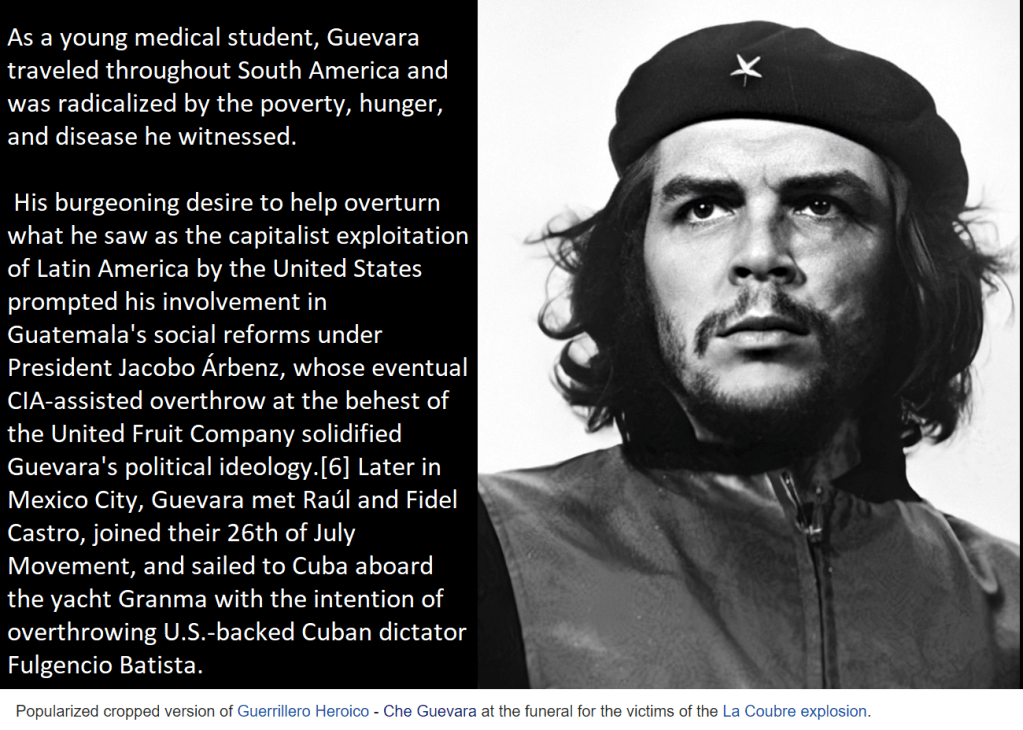
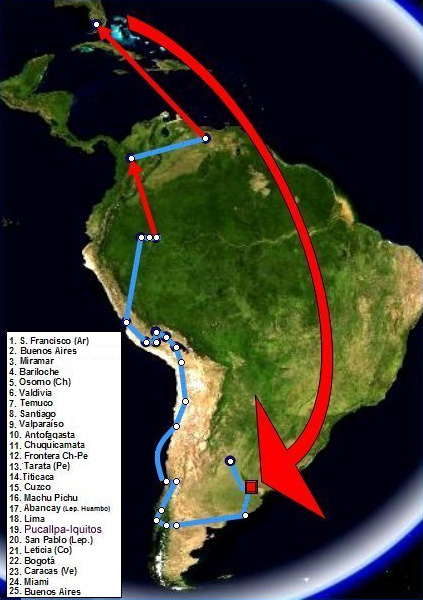
After the Cuban Revolution, Guevara played key roles in the new government. These included reviewing the appeals and firing squads for those convicted as war criminals during the revolutionary tribunals,[10] instituting agrarian land reform as Minister of Industries, helping spearhead a successful nationwide literacy campaign, serving as both President of the National Bank and instructional director for Cuba’s armed forces, and traversing the globe as a diplomat on behalf of Cuban socialism. Such positions also allowed him to play a central role in training the militia forces who repelled the Bay of Pigs Invasion,[11] and bringing Soviet nuclear-armedballistic missiles to Cuba, which preceded the 1962 Cuban Missile Crisis.[12] Additionally, Guevara was a prolific writer and diarist, composing a seminal guerrilla warfare manual, along with a best-selling memoir about his youthful continental motorcycle journey. His experiences and studying of Marxism–Leninism led him to posit that the Third World‘s underdevelopment and dependence was an intrinsic result of imperialism, neocolonialism, and monopoly capitalism, with the only remedies being proletarian internationalism and world revolution.[13][14] Guevara left Cuba in 1965 to foment continental revolutions across both Africa and South America,[15] first unsuccessfully in Congo-Kinshasa and later in Bolivia, where he was captured by CIA-assisted Bolivian forces and summarily executed.[16
From Los Angles to San Francisco is 347 miles. That is about how far Cuba and Gautamla are!
By Fidel a baseball team and welcome him into the USA. I don’t give a damn. But you don’t know what is happening in the Guatemala Civil War and what the Communists could get out of it.
I want to discuss with you today the status of our strength and our security because this question clearly calls for the most responsible qualities of leadership and the most enlightened products of scholarship. For this Nation’s strength and security are not easily or cheaply obtained, nor are they quickly and simply explained. There are many kinds of strength and no one kind will suffice. Overwhelming nuclear strength cannot stop a guerrilla war. Formal pacts of alliance cannot stop internal subversion. Displays of material wealth cannot stop the disillusionment of diplomats subjected to discrimination.
Above all, words alone are not enough. The United States is a peaceful nation. And where our strength and determination are clear, our words need merely to convey conviction, not belligerence. If we are strong, our strength will speak for itself. If we are weak, words will be of no help.
I realize that this Nation often tends to identify turning-points in world affairs with the major addresses which preceded them. But it was not the Monroe Doctrine that kept all Europe away from this hemisphere – it was the strength of the British fleet and the width of the Atlantic Ocean. It was not General Marshall’s speech at Harvard which kept communism out of Western Europe – it was the strength and stability made possible by our military and economic assistance.
In this administration also it has been necessary at times to issue specific warnings – warnings that we could not stand by and watch the Communists conquer Laos by force, or intervene in the Congo, or swallow West Berlin, or maintain offensive missiles on Cuba. But while our goals were at least temporarily obtained in these and other instances, our successful defense of freedom was due not to the words we used, but to the strength we stood ready to use on behalf of the principles we stand ready to defend.
This strength is composed of many different elements, ranging from the most massive deterrents to the most subtle influences. And all types of strength are needed – no one kind could do the job alone. Let us take a moment, therefore, to review this Nation’s progress in each major area of strength.
I.
First, as Secretary McNamara made clear in his address last Monday, the strategic nuclear power of the United States has been so greatly modernized and expanded in the last 1,000 days, by the rapid production and deployment of the most modern missile systems, that any and all potential aggressors are clearly confronted now with the impossibility of strategic victory–and the certainty of total destruction – if by reckless attack they should ever force upon us the necessity of a strategic reply.
In less than 3 years, we have increased by 50 percent the number of Polaris submarines scheduled to be in force by the next fiscal year, increased by more than 70 percent our total Polaris purchase program, increased by more than 75 percent our Minuteman purchase program, increased by 50 percent the portion of our strategic bombers on 15-minute alert, and increased by 100 percent the total number of nuclear weapons available in our strategic alert forces. Our security is further enhanced by the steps we have taken regarding these weapons to improve the speed and certainty of their response, their readiness at all times to respond, their ability to survive an attack, and their ability to be carefully controlled and directed through secure command operations.
In 1962, the concept of mutually assured destruction started to play a major part in the defence policy of the US. President Kennedy’s Secretary of Defense, Robert McNamara, set out in a speech to the American Bar Foundation a theory of flexible nuclear response. In essence it meant stockpiling a huge nuclear arsenal.Feb 15, 2012
Pre-1945[edit]
The concept of MAD had been discussed in the literature for nearly a century before the invention of nuclear weapons. One of the earliest references comes from the English author Wilkie Collins, writing at the time of the Franco-Prussian War in 1870: “I begin to believe in only one civilizing influence—the discovery one of these days of a destructive agent so terrible that War shall mean annihilation and men’s fears will force them to keep the peace.”[10] The concept was also described in 1863 by Jules Verne in his novel Paris in the Twentieth Century, though it was not published until 1994. The book is set in 1960 and describes “the engines of war”, which have become so efficient that war is inconceivable and all countries are at a perpetual stalemate.[11][non-primary source needed]
MAD has been invoked by more than one weapons inventor. For example, Richard Jordan Gatling patented his namesake Gatling gun in 1862 with the partial intention of illustrating the futility of war.[12] Likewise, after his 1867 invention of dynamite, Alfred Nobel stated that “the day when two army corps can annihilate each other in one second, all civilized nations, it is to be hoped, will recoil from war and discharge their troops.”[13] In 1937, Nikola Tesla published The Art of Projecting Concentrated Non-dispersive Energy through the Natural Media,[14] a treatise concerning charged particle beam weapons.[15] Tesla described his device as a “superweapon that would put an end to all war.”
The March 1940 Frisch–Peierls memorandum, the earliest technical exposition of a practical nuclear weapon, anticipated deterrence as the principal means of combating an enemy with nuclear weapons.[16]
Early Cold War[edit]
Aftermath of the atomic bomb explosion over Hiroshima (August 6, 1945), to date one of the only two times a nuclear strike has been performed as an act of war
In August 1945, the United States became the first nuclear power after the nuclear attacks on Hiroshima and Nagasaki. Four years later, on August 29, 1949, the Soviet Union detonated its own nuclear device. At the time, both sides lacked the means to effectively use nuclear devices against each other. However, with the development of aircraft like the American Convair B-36 and the Soviet Tupolev Tu-95, both sides were gaining a greater ability to deliver nuclear weapons into the interior of the opposing country. The official policy of the United States became one of “Instant Retaliation”, as coined by Secretary of State John Foster Dulles, which called for massive atomic attack against the Soviet Union if they were to invade Europe, regardless of whether it was a conventional or a nuclear attack.[17]
By the time of the 1962 Cuban Missile Crisis, both the United States and the Soviet Union had developed the capability of launching a nuclear-tipped missile from a submerged submarine, which completed the “third leg” of the nuclear triad weapons strategy necessary to fully implement the MAD doctrine. Having a three-branched nuclear capability eliminated the possibility that an enemy could destroy all of a nation’s nuclear forces in a first-strike attack; this, in turn, ensured the credible threat of a devastating retaliatory strike against the aggressor, increasing a nation’s nuclear deterrence.[18][19][20]
Campbell Craig and Sergey Radchenko argue that Nikita Khrushchev (Soviet leader 1953 to 1964) decided that policies that facilitated nuclear war were too dangerous to the Soviet Union. His approach did not greatly change his foreign policy or military doctrine but is apparent in his determination to choose options that minimized the risk of war.[21]
Strategic Air Command[edit]
| This subsection needs additional citations for verification. Please help improve this article by adding citations to reliable sources. Unsourced material may be challenged and removed. Find sources: “Mutual assured destruction” – news · newspapers · books · scholar · JSTOR (July 2019) (Learn how and when to remove this template message) |
See also: Operation Chrome Dome

Boeing B-47B Stratojet Rocket-Assisted Take Off (RATO) on April 15, 1954
_is_refueled_by_Boeing_KC-135A-BN_(SN_55-3127)_061127-F-1234S-009.jpg)
B-52D Stratofortress being refueled by a KC-135 Stratotanker, 1965
Beginning in 1955, the United States Strategic Air Command (SAC) kept one-third of its bombers on alert, with crews ready to take off within fifteen minutes and fly to designated targets inside the Soviet Union and destroy them with nuclear bombs in the event of a Soviet first-strike attack on the United States. In 1961, President John F. Kennedy increased funding for this program and raised the commitment to 50 percent of SAC aircraft.[citation needed]
During periods of increased tension in the early 1960s, SAC kept part of its B-52 fleet airborne at all times, to allow an extremely fast retaliatory strike against the Soviet Union in the event of a surprise attack on the United States. This program continued until 1969. Between 1954 and 1992, bomber wings had approximately one-third of their assigned aircraft on quick reaction ground alert and were able to take off within a few minutes.[citation needed] SAC also maintained the National Emergency Airborne Command Post (NEACP, pronounced “kneecap”), also known as “Looking Glass”, which consisted of several EC-135s, one of which was airborne at all times from 1961 through 1990.[citation needed] During the Cuban Missile Crisis the bombers were dispersed to several different airfields, and also were sometimes airborne. For example, some were sent to Wright Patterson, which normally did not have B-52s.[citation needed]
During the height of the tensions between the US and the USSR in the 1960s, two popular films were made dealing with what could go terribly wrong with the policy of keeping nuclear-bomb-carrying airplanes at the ready: Dr. Strangelove (1964)[22] and Fail Safe (1964).[23]
Retaliation capability (second strike)[edit]
See also: Second strike
The strategy of MAD was fully declared in the early 1960s, primarily by United States Secretary of Defense Robert McNamara. In McNamara’s formulation, there was the very real danger that a nation with nuclear weapons could attempt to eliminate another nation’s retaliatory forces with a surprise, devastating first strike and theoretically “win” a nuclear war relatively unharmed. The true second-strike capability could be achieved only when a nation had a guaranteed ability to fully retaliate after a first-strike attack.[4]
The United States had achieved an early form of second-strike capability by fielding continual patrols of strategic nuclear bombers, with a large number of planes always in the air, on their way to or from fail-safe points close to the borders of the Soviet Union. This meant the United States could still retaliate, even after a devastating first-strike attack. The tactic was expensive and problematic because of the high cost of keeping enough planes in the air at all times and the possibility they would be shot down by Soviet anti-aircraft missiles before reaching their targets. In addition, as the idea of a missile gap existing between the US and the Soviet Union developed, there was increasing priority being given to ICBMs over bombers.
The USS George Washington (SSBN-598), the lead ship of the US Navy‘s first class of Fleet Ballistic Missile Submarines, Nuclear (SSBN)
It was only with the advent of ballistic missile submarines, starting with the George Washington class in 1959, that a genuine survivable nuclear force became possible and a retaliatory second strike capability guaranteed.
The deployment of fleets of ballistic missile submarines established a guaranteed second-strike capability because of their stealth and by the number fielded by each Cold War adversary—it was highly unlikely that all of them could be targeted and preemptively destroyed (in contrast to, for example, a missile silo with a fixed location that could be targeted during a first strike). Given their long-range, high survivability and ability to carry many medium- and long-range nuclear missiles, submarines were credible and effective means for full-scale retaliation even after a massive first strike.[citation needed]
This deterrence strategy and the program have continued into the 21st century, with nuclear submarines carrying Trident II ballistic missiles as one leg of the US strategic nuclear deterrent and as the sole deterrent of the United Kingdom. The other elements of the US deterrent are intercontinental ballistic missiles (ICBMs) on alert in the continental United States, and nuclear-capable bombers. Ballistic missile submarines are also operated by the navies of China, France, India, and Russia.
The US Department of Defense anticipates a continued need for a sea-based strategic nuclear force.[24] The first of the current Ohio-class SSBNs are expected to be retired by 2029,[24] meaning that a replacement platform must already be seaworthy by that time. A replacement may cost over $4 billion per unit compared to the USS Ohio‘s $2 billion.[25] The USN’s follow-on class of SSBN will be the Columbia class, which began construction in 2021 and enter service in 2031.[26]


_underway_at_sea,_circa_in_the_1970s.jpg)