The later released First Break in the Case Picture
When Oswald came to New Orleans, he was hired as an oiler greasing coffee machines at Reily Coffee Company for two months between May-July of 1963. The two Reily brothers were active in anti-Castro politics. Eustis Reily supported the right-wing propaganda operation known as INCA (Information Council of the Americas). William Reily backed the Crusade to Free Cuba Committee, filled with luminaries like Claire Boothe Luce of Time-Life who raised funds for the would-be government-in-exile, the Cuban Revolutionary Committee (CRC). [1]
A SHORT HISTORY OF INCA https://cuban-exile.com/doc_076-100/doc0078.html
(INFORMATION COUNCIL OF THE AMERICAS)
by Frank DeBenedictis
One aspect of anti-communism which has not received the attention given to the US conflict with the Soviet Union is the more recent war with Fidel Castro and his Communist regime in Cuba. Cuba’s conversion to Marxism in 1959 caused much consternation in the United States, and especially in cities doing trade with that Latin American country. New Orleans in particular feared the new regime, and out of this fear a new anti-communist organization based in this city was born in 1961 called the Information Council of the Americas (INCA).
By the 1950s, 75% of US imports from Latin America came through the port of New Orleans. Civic and business leaders of the Crescent City throughout the decades forged closer business, political and social ties with their Latin American counterparts. Fidel Castro’s rise to power sent shock waves through New Orleans and threatened a lucrative mutual relationship. In Tampa, Florida (another large port city) where cigar manufacturing played an important part of that cities industry, the Cuban Revolution also caused alarms to go off when Senator George Smathers of Florida proposed an embargo against Cuban tobacco. But Tampa reacted differently from New Orleans.
Instead of fear and reaction leading to the anti-communist INCA, Tampa saw a rise in pro-Castro activity. The Fair Play for Cuba Committee started a chapter and in an early 1961 rally proclaimed Smathers action, “would lead to unemployment in Tampa.” Castro’s revolution began to take effect in the United States. Three months after the Tampa FPCC rally, the Information Council of the Americas would begin its own campaign against the changing economic sensibilities of a Communist Cuba.
INCA was founded on May 15, 1961 by public relations professional Edward Scannell Butler. From the beginning its agenda was narrowly focused on Communism as an issue. INCA in fact sought support from liberal as well as conservative anti-communists, asking liberal anti-communist Smathers to speak at an organization function. Ed Butler had prior to the Castro takeover, laid plans for an anti-communist organization. But when Castro took over in Cuba, and New Orleans expressed growing anxiety over the new Latin American dictator, the 27 year old public relations man was handed a searing issue and an alarmed constituency.
In 1961 Alton Ochsner, with the financial help of Clint Murchison, established the Information Council of the Americas (INCA). Ed Butler was appointed as Executive Director of INCA. The main objective of the organization was to prevent communist revolutions in Latin America. Ochsner told the New Orleans States Item: “We must spread the warning of the creeping sickness of communism faster to Latin Americas, and to our own people, or Central and South America will be exposed to the same sickness as Cuba.” (16th April, 1963)
Edgar and Edith Stern, owners of WDSU radio and television, were members of INCA. Eustis Reily of the Reily Coffee Company personally donated thousands of dollars to INCA. However, it was Patrick J. Frawley, a Californian industrialist and close friend of Richard Nixon, who was INCA’s largest financial contributor. The organization used some of this money to make a film about Fidel Castro entitled, Hitler in Havana. The New York Times reviewed the film calling it a “tasteless affront to minimum journalistic standards.”
Ed Butler had an interest in both pubic relations and psychology, so in a real sense his organization was not ideologically based, even though this public relations man exhibited a penchant for conservative politics. He especially expressed admiration for red-baiting Wisconsin Senator Joe McCarthy whom he described as a great American. So Ed Butler the founder of INCA did have ideological convictions beyond the function of INCA, but he put his promotional talents rather than politics into the organization. INCA soon evolved into an effective propaganda machine under its youthful leader.
Loyola University archivist Arthur Carpenter expressed anti-communism in a realpolitik sense when he poses the question, “Was anti-communism a manifestation of popular, democratic sentiment or of elite interests?” He answers that question in the latter vein, including the formation of INCA. Carpenter also describes anti-communism and the origins of INCA in a post-World War II context.
——-wikipedia—
The origins of Garrison’s case can be traced to an argument between New Orleans residents Guy Banister and Jack Martin. On November 22, 1963, the day that President John F. Kennedy was assassinated, Banister pistol whipped Martin after a heated exchange. (There are different accounts as to whether the argument was over phone bills or missing files.)[12][13]
Over the next few days, Martin told authorities and reporters that Banister had often been in the company of a man named David Ferrie who, Martin said, might have been involved in the assassination of John F. Kennedy.[14]
Martin told the New Orleans police that Ferrie knew accused assassin Lee Harvey Oswald going back to when both men had served together in the New Orleans Civil Air Patrol and that Ferrie “was supposed to have been the getaway pilot in the assassination.”
Martin also said that Ferrie had driven to Dallas the night before the assassination, a trip which Ferrie explained as research for a prospective business venture to determine “the feasibility and possibility of opening an ice skating rink in New Orleans.”[15][16]
Some of this information reached New Orleans District Attorney Garrison, who quickly arrested Ferrie and turned him over to the Federal Bureau of Investigation (FBI), which interviewed Ferrie and Martin on November 25. Martin told the FBI that Ferrie might have hypnotized Oswald into assassinating Kennedy. The FBI considered Martin unreliable.[17] Nevertheless, the FBI interviewed Ferrie twice about Martin’s allegations.[18] The FBI also interviewed about twenty other persons in connection with the allegations, said that it was unable to develop a substantial case against Ferrie, and released him with an apology.[19] (A later investigation, by the United States House Select Committee on Assassinations, concluded that the FBI’s “…overall investigation … at the time of the assassination was not thorough.”)[19]
In the autumn of 1966, Garrison began to re-examine the Kennedy assassination. Guy Banister had died of a heart attack in 1964,[20] but Garrison re-interviewed Martin, who told the district attorney that Banister and his associates were involved in stealing weapons and ammunition from armories and in gunrunning. Garrison believed that the men were part of an arms smuggling ring supplying anti-Castro Cubans with weapons.”[21]
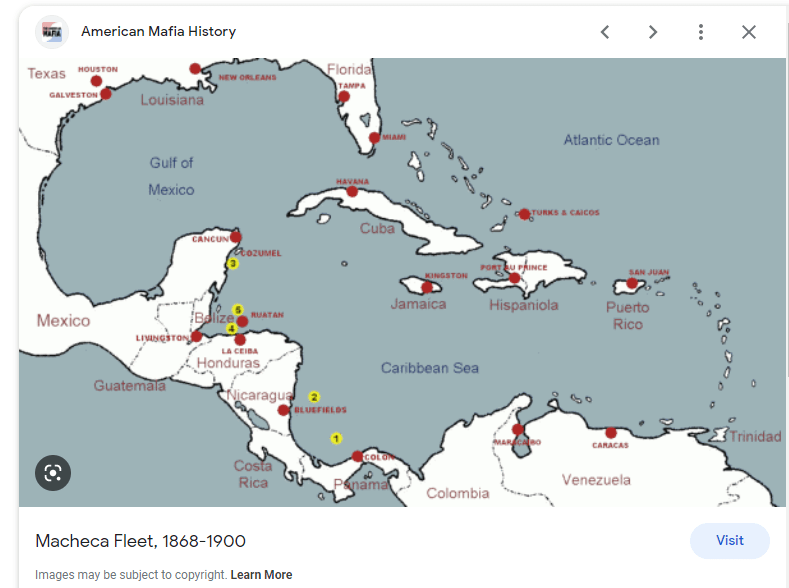
Cuba is half way along the steamship and overwater flight path. It is reported planes flew over water and when over land faked being commercial regular flights by giving those commercial flight numbers to air traffic control towers. These flights bisected Cuba and latin america when possible.
Along with founder Ed Butler, the most important member of INCA was famed physician Dr. Alton Ochsner. Ochsner, 38 years Butler’s senior formed a partnership with his younger colleague which would last twenty years. Ed Butler, who didn’t have a great knowledge of Latin American affairs, benefited substantially from the association with the celebrated doctor. Alton Ochsner had an internationalist outlook—especially when it pertained to the field of medicine. Ochsner felt medicine transcended national boundaries, and had trained many physician exchange students from Latin America since the 1920s. His prominence as an international physician led him to be elected to leadership of both the International Trade Mart and International House in the 1960s. Both business groups promoted Latin American trade for New Orleans, and had been founded immediately after World War II. Ochsner also was elected to the presidency of the Cordell Hull Foundation which administered a program of Inter-American university study.
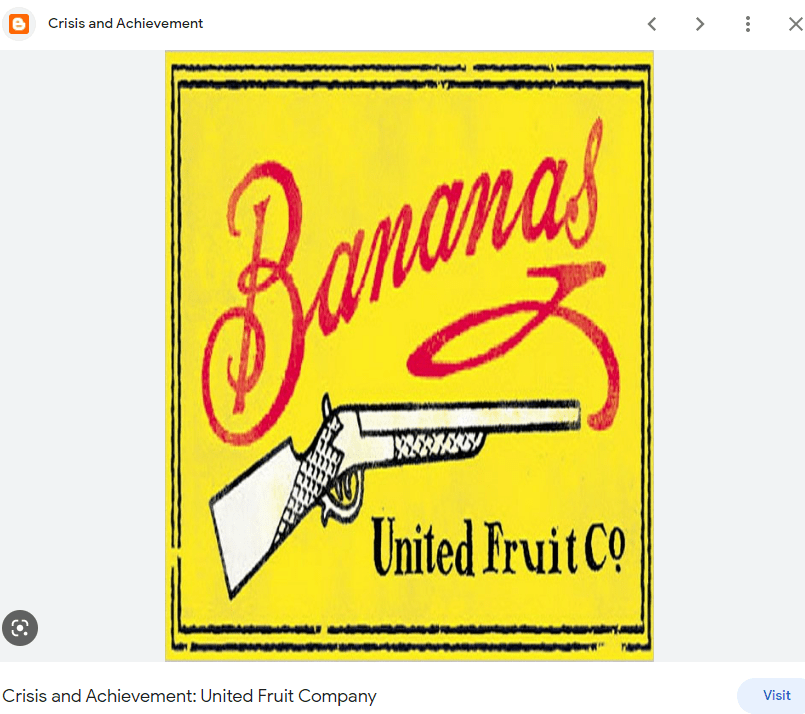
Ochsner fit the mode of the wealthy educated elite. He was elderly and encouraged other New Orleans prominent and wealthy citizens to join INCA. Ochsner’s persuasiveness helped Ed Butler recruit United Fruit’s Joseph W. Montgomery, Delta Steamship Line’s John W. Clark, International Trade Mart’s William Zetzmann and William B. Reily of Reily Coffee Company. The local Catholic hierarchy also joined with Archbishop Phillip M. Hannan and Dean of Loyola University Law School AE Papale becoming members. INCA also received endorsements from Mayor deLesseps Morrison and Congressman Hale Boggs.
A SHORT HISTORY OF INCA
A SHORT HISTORY OF INCA
(INFORMATION COUNCIL OF THE AMERICAS)
by Frank DeBenedictis
One aspect of anti-communism which has not received the attention given to the US conflict with the Soviet Union is the more recent war with Fidel Castro and his Communist regime in Cuba. Cuba’s conversion to Marxism in 1959 caused much consternation in the United States, and especially in cities doing trade with that Latin American country. New Orleans in particular feared the new regime, and out of this fear a new anti-communist organization based in this city was born in 1961 called the Information Council of the Americas (INCA).
https://cuban-exile.com/doc_076-100/doc0078.html
Journalist James Phelan said Garrison told him that the assassination was a “homosexual thrill killing.”[22]
As Garrison continued his investigation he became convinced that a group of right-wing activists, which he believed included David Ferrie, Guy Banister, and Clay Shaw (director of the International Trade Mart in New Orleans), were involved in a conspiracy with elements of the Central Intelligence Agency (CIA) to kill President Kennedy. [and that Civil Air Patrol was a CIA adjunct assisting he Latin American Trademart CIA activities and assisting in the assination of JFK, and it all fits Richard Bissle Jr, Alan Dulles, Devils Chessboard, etc.,]
Garrison would later say that the motive for the assassination was anger over Kennedy’s foreign policy, especially Kennedy’s efforts to find a political, rather than a military, solution in Cuba and Southeast Asia, and his efforts toward a rapprochement with the Soviet Union.
[Garrison also believed that Shaw, Banister, and Ferrie had conspired to set up Oswald as a patsy in the JFK assassination.[23] News of Garrison’s investigation was reported in the New Orleans States-Item on February 17, 1967.[6][24]
On February 22, 1967, less than a week after the newspaper broke the story of Garrison’s investigation, David Ferrie, then his chief suspect, was found dead in his apartment from a brain aneurysm. Garrison suspected that Ferrie had been murdered despite the coroner’s report that his death was due to natural causes.[25] According to Garrison, the day news of the investigation broke, Ferrie had called his aide Lou Ivon and warned that “I’m a dead man”.[26]
With Ferrie dead, Garrison began to focus his attention on Clay Shaw, director of the International Trade Mart. Garrison had Shaw arrested on March 1, 1967, charging him with being part of a conspiracy in the John F. Kennedy assassination.
Earlier, Garrison had been searching for a “Clay Bertrand,” a man referred to in the Warren Commission report.[27] New Orleans attorney Dean Andrews testified to the Warren Commission that while he was hospitalized for pneumonia, he received a call from “Clay Bertrand” the day after the assassination, asking him to fly to Dallas to represent Oswald.[28][29] According to FBI reports, Andrews told them that this phone call from “Clay Bertrand” was a figment of his imagination.[30] Andrews testified to the Warren Commission that the reason he told the FBI this was because of FBI harassment.[30]
In his book On the Trail of the Assassins, Garrison says that after a long search of the New Orleans French Quarter, his staff was informed by the bartender at the tavern “Cosimo’s” that “Clay Bertrand” was the alias that Clay Shaw used. According to Garrison, the bartender felt it was no big secret and “my men began encountering one person after another in the French Quarter who confirmed that it was common knowledge that ‘Clay Bertrand’ was the name Clay Shaw went by.”[31] A February 25, 1967 memo by Garrison investigator Lou Ivon to Garrison states that he could not locate a Clay Bertrand despite numerous inquiries and contacts.[32]
In December 1967, Garrison appeared on a Dallas television program and claimed that a photograph taken in Dealy Plaza immediately after the assassination depicted a federal agent in plain clothes picking up and walking away with a .45 caliber bullet.[33] He said that the bullet was not entered into evidence for the Warren Commission and was proof that another gunman was involved in the assassination.[33] The photograph also showed Dallas Deputy Sheriff Buddy Walthers looking on with a uniformed Dallas policeman. Walthers stated the following week that the photograph was taken approximately 10 minutes after the assassination, and that the finding was “nothing significant”. He said that it appeared to be blood on the grass or possibly a piece of skull.[33] Walthers added: “If it had been a bullet, it would have been significant.”[33]
When Garrison’s evidence was presented to a New Orleans grand jury, Shaw was indicted on a charge that he conspired with Ferrie, Oswald, and others named and charged to murder Kennedy. A three-judge panel upheld the indictment and ordered Shaw to a jury trial.[6]
——-wikipedia—
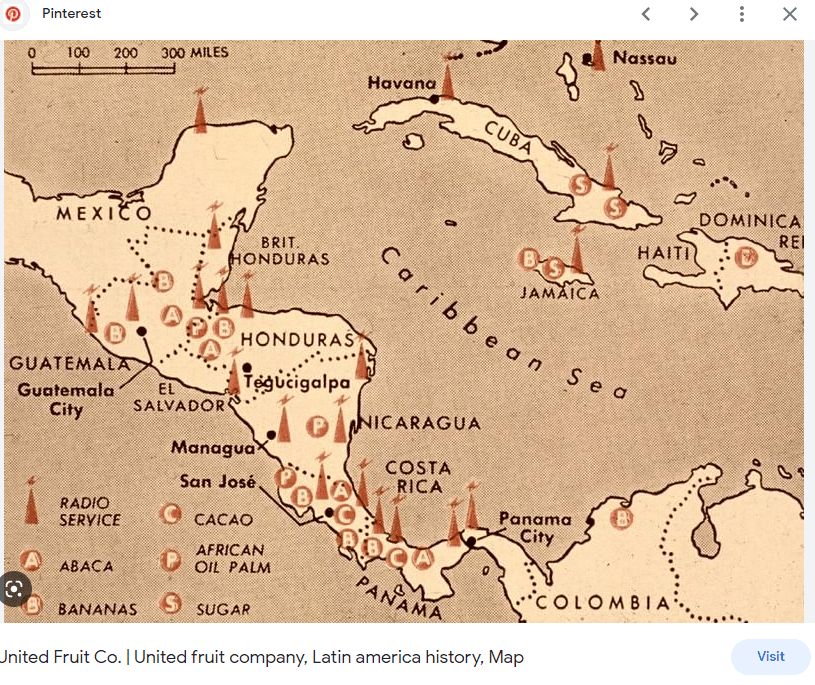
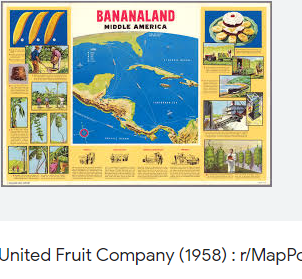
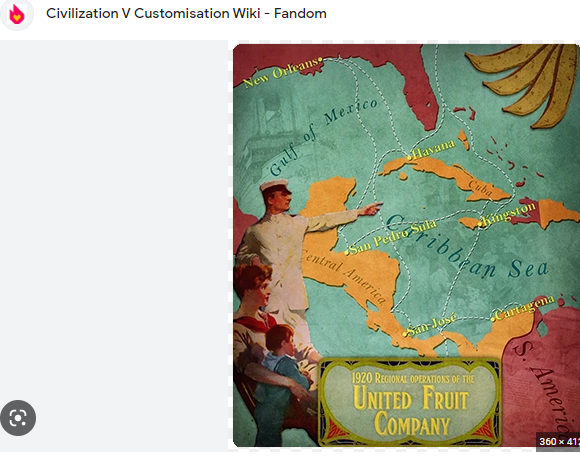
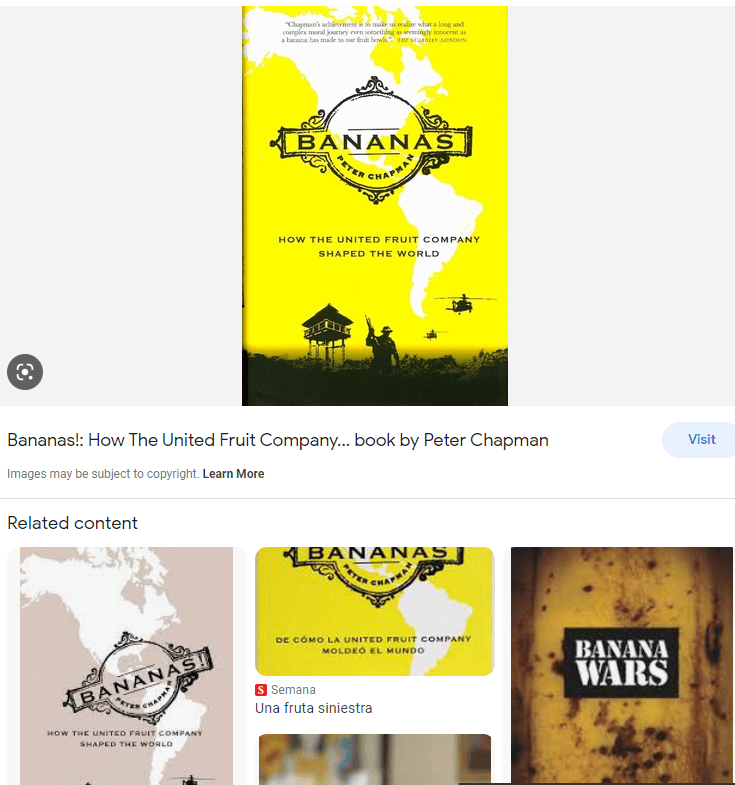
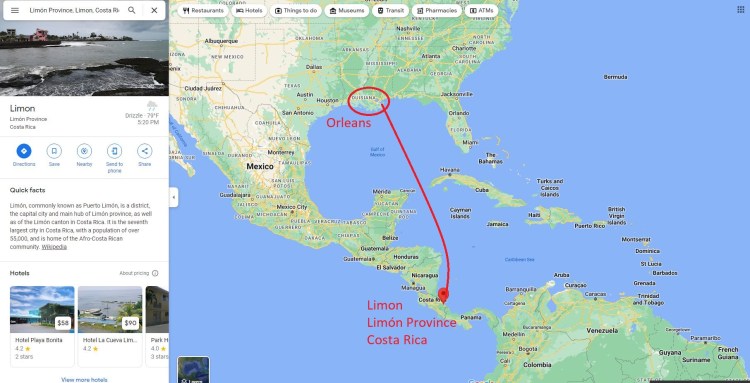
This seems true the according to Phillip Marshall, Edward Paul Donegan online research, and other materials New Orleans, Orleans Parish was the business store front of United Fruit Company and International Trade Mart, and a few other coffee and other businesses, and these were really CIA operations who didn’t care if they made a profit or not, the Zapata Oil equivilinents, fronts for the CIA in Latin America.
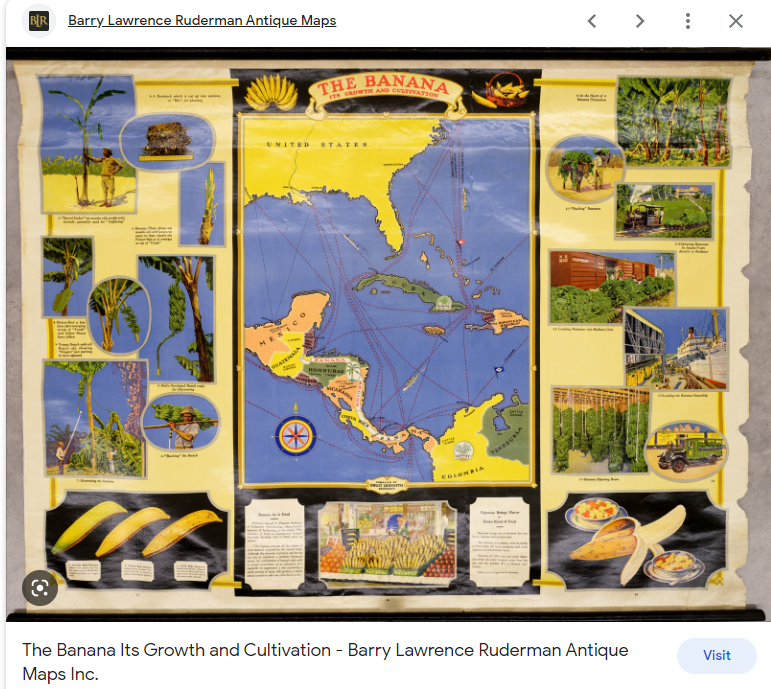
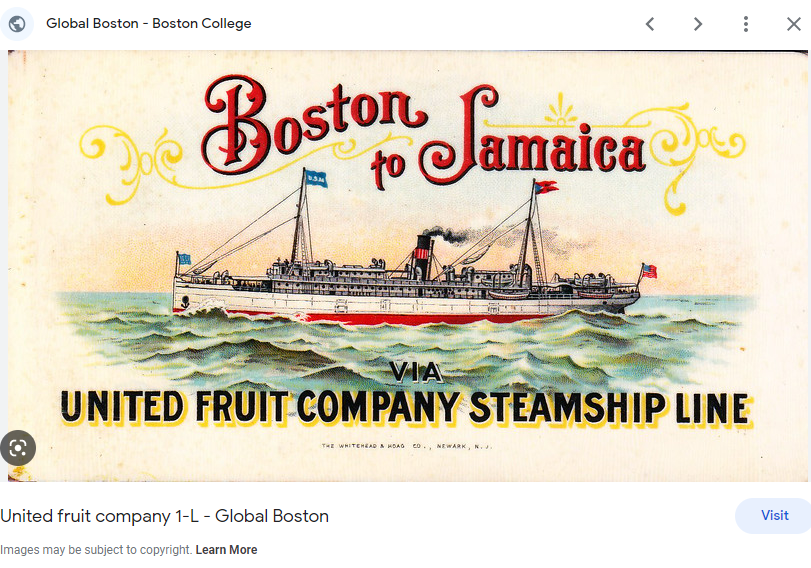
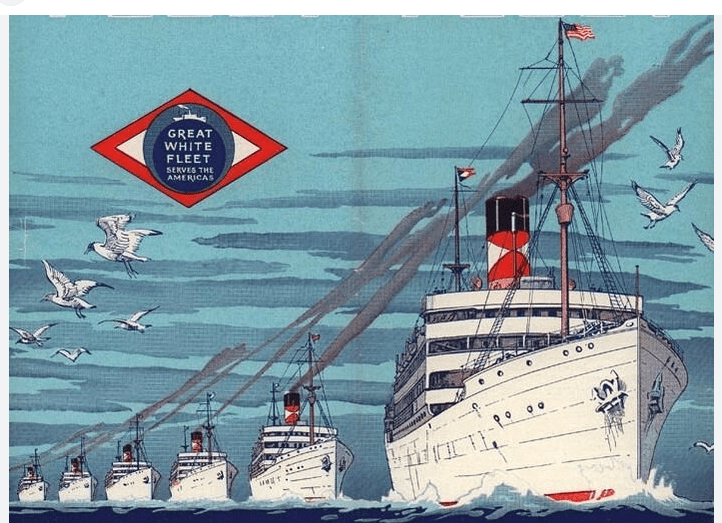
Shiiping by steam ship was how it went from a long time getting bananas INTO the USA and flights of arms and weapons and cash and CIA operatives INTO Latin America.
Civil Air Patrol – Non USAF flights the CIA can conduct (and out of New Orleans into Latin America with small planes, not like USAF at all)
Under Richard Bissle Jr small aircraft ofen had US military pilots in FOREIGN planes calling in English in USASF uniforms, hiding in Latin American plane paint colors.
On May 8, 1967, the New Orleans States-Item reported that Garrison charged that the CIA and FBI cooperated to conceal the facts of the assassination, and that he planned to seek a Senate inquiry looking into the CIA’s role in the Warren Commission’s investigation.[59]
Garrison later wrote a book about his investigation of the JFK assassination and the subsequent trial called On the Trail of the Assassins. This book served as one of the main sources for Oliver Stone’s movie JFK. In the movie, this trial serves as the back story for Stone’s account of the assassination of John F. Kennedy.
Jack Wardlaw, then of the since defunct New Orleans States-Item, an afternoon newspaper, and his fellow journalist Rosemary James, a native of South Carolina, co-authored Plot or Politics, a 1967 book which takes issue with the Garrison investigation as one of political style, rather than substantive evidence. Wardlaw also won an Associated Press award for his story on the death of David Ferrie.[60][61]
In 1979, the House Select Committee on Assassinations stated that available records “lent substantial credence to the possibility that Oswald and David Ferrie had been involved in the same Civil Air Patrol (CAP) unit during the same period of time.”[62] Committee investigators found six witnesses who said that Oswald had been present at CAP meetings headed by David Ferrie.[63]
In 1979, the House Select Committee on Assassinations stated in its Final Report that the Committee was “inclined to believe that Oswald was in Clinton, Louisiana in late August, [or] early September 1963, and that he was in the company of David Ferrie, if not Clay Shaw,”[64] and that witnesses in Clinton, Louisiana “established an association of an undetermined nature between Ferrie, Shaw and Oswald less than three months before the assassination”.[65]
David Ferrie (second from left) with Lee Harvey Oswald (far right) in the New Orleans Civil Air Patrol in 1955. This photo showing Ferrie and Oswald together only became public after the trial was over.
In 1993, the PBS television program Frontline obtained a group photograph, taken eight years before the assassination, that showed Oswald and Ferrie at a cookout with other Civil Air Patrol cadets. Frontline executive producer Michael Sullivan said, “one should be cautious in ascribing its meaning. The photograph does give much support to the eyewitnesses who say they saw Ferrie and Oswald together in the CAP, and it makes Ferrie’s denials that he ever knew Oswald less credible. But it does not prove that the two men were with each other in 1963, nor that they were involved in a conspiracy to kill the president.”[66]
In a 1992 interview, Edward Haggerty, who was the judge at the Clay Shaw trial, stated: “I believe he [Shaw] was lying to the jury. Of course, the jury probably believed him. But I think Shaw put a good con job on the jury.”[67]
In On the Trail of the Assassins, Garrison states that Shaw had an “extensive international role as an employee of the CIA.”[68] In the September 1969 issue of Penthouse, Shaw denied that he had had any connection with the CIA.[69]
During a 1979 libel suit involving the book Coup D’Etat In America, Richard Helms, former director of the CIA, testified under oath that Shaw had been a part-time contact of the Domestic Contact Service of the CIA, where Shaw volunteered information from his travels abroad, mostly to Latin America.[70] (Richard Helms wanted to reveal the CIA Family Jewels program and was found dead in the potomac)
Like Shaw, 150,000 Americans (businessmen, and journalists, etc.) had provided such information to the DCS by the mid-1970s (CIA Domecstric Contracts Service)
.[70] [nb 1] In February 2003, the CIA released documents pertaining to an earlier inquiry from the Assassination Records Review Board about QKENCHANT, a CIA “project used to provide security approvals on non-Agency personnel”, that indicated “Clay Shaw received an initial ‘five agency’ clearance on 23 March 1949”, and that “Shaw in all probability was not cleared by the QKENCHANT program.”[72]
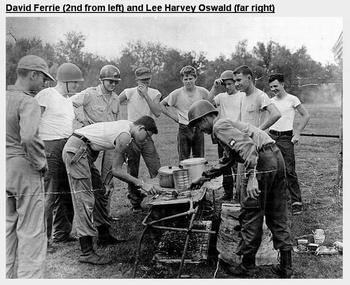
David Ferrie (second from left) with Lee Harvey Oswald (far right) in the New Orleans Civil Air Patrol in 1955. This photo showing Ferrie and Oswald together only became public after the trial was over.
In the late 1950s LHO will go to Atsugi Airbase operating RADAR and I think tell the James and Glorian Donegan story through Jet Pilot.
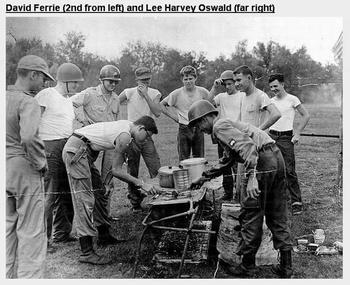
So To Review the Civil Air Patrol is said to be CIA DIA and might help airlift the assasins of JFK out, per Ferrie and others
In the autumn of 1966, Garrison began to re-examine the Kennedy assassination. Guy Banister had died of a heart attack in 1964,[20] but Garrison re-interviewed Martin, who told the district attorney that Banister and his associates were involved in stealing weapons and ammunition from armories and in gunrunning. Garrison believed that the men were part of an arms smuggling ring supplying anti-Castro Cubans with weapons.”[21]
On May 8, 1967, the New Orleans States-Item reported that Garrison charged that the CIA and FBI cooperated to conceal the facts of the assassination, and that he planned to seek a Senate inquiry looking into the CIA’s role in the Warren Commission’s investigation.[59]
The origins of Garrison’s case can be traced to an argument between New Orleans residents Guy Banister and Jack Martin. On November 22, 1963, the day that President John F. Kennedy was assassinated, Banister pistol whipped Martin after a heated exchange. (There are different accounts as to whether the argument was over phone bills or missing files.)[12][13]
Over the next few days, Martin told authorities and reporters that Banister had often been in the company of a man named David Ferrie who, Martin said, might have been involved in the assassination of John F. Kennedy.[14]
Martin told the New Orleans police that Ferrie knew accused assassin Lee Harvey Oswald going back to when both men had served together in the New Orleans Civil Air Patrol and that Ferrie “was supposed to have been the getaway pilot in the assassination.”
Martin also said that Ferrie had driven to Dallas the night before the assassination, a trip which Ferrie explained as research for a prospective business venture to determine “the feasibility and possibility of opening an ice skating rink in New Orleans.”[15][16]
Some of this information reached New Orleans District Attorney Garrison, who quickly arrested Ferrie and turned him over to the Federal Bureau of Investigation (FBI), which interviewed Ferrie and Martin on November 25,
Martin told the FBI that Ferrie might have hypnotized Oswald into assassinating Kennedy.
[Edward Donegan interjects. Hypnotized might mean being led blindly around like a patsy and not to actually kill JFK but just be in the wrong place at the wrong time, the sixth floor window, a job with un-hypnoitized Oswald botched by being in the cafeteria on a different floor at that time.]
The FBI considered Martin unreliable.[17] Nevertheless, the FBI interviewed Ferrie twice about Martin’s allegations.[18] The FBI also interviewed about twenty other persons in connection with the allegations, said that it was unable to develop a substantial case against Ferrie, and released him with an apology.[19] (A later investigation, by the United States House Select Committee on Assassinations, concluded that the FBI’s “…overall investigation … at the time of the assassination was not thorough.”)[19]