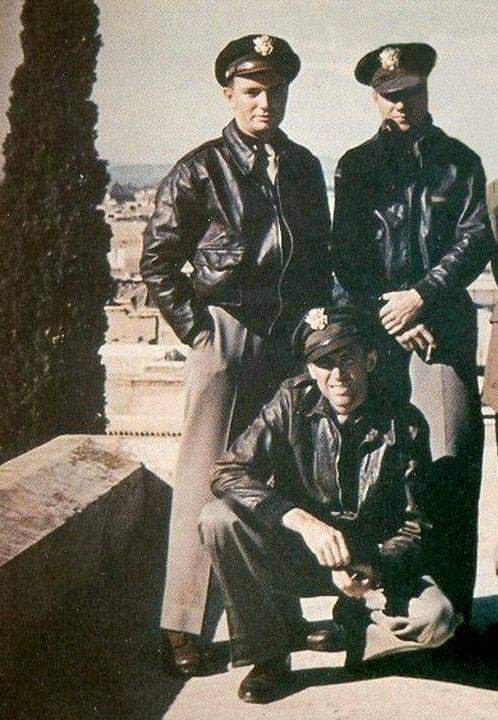
The sound of the impact is deafening. More than 18,000 feet above the German city of Fürth, the World War II B-24 bomber they call Dixie Flyer has just delivered its full payload onto a German manufacturer, devastating its ability to build military aircraft and turning the airfield into a scrap heap. But even before making the full turn out of Bavaria, Dixie Flyer’s copilot and the leader of this bombing group, Maj. James Stewart (Jimmy Stewart to his fans), is nearly lifted out of his chair.
That’s because a German shell (or flak) has pierced directly through the center of his B-24 Liberator. The whiplash is so intense that only harnesses keep him in his seat. Still, Stewart rises in the air; pilot Capt. Neil Johnson’s hands are briefly shaken from the controls; and for a moment, the entire plane is consumed with smoke as it violently ascends. When Stewart finally gets his bearings, he’s able to look down and see the hole in the aircraft—the edge of it is inches from his boot. Almost two feet in width, the gap offers a clear view through the plane’s fuselage and straight on to the German landscape below.
There is little time to worry though. The German ground defenses and their 88mm shells are rattling the sky with more flak, and out of the corner of his eye, Stewart can see one of his planes, and his crews, also get hit. They’re not so lucky as a wing comes off and the craft falls to the earth. Meanwhile, German Focke-Wulf 190 fighters are beginning to swarm.
Stewart’s 445th Bombing Group only have each other and the tightness of their formation for protection—the Eighth Air Force and RAF fighters that accompanied the mission are spread too thin across the rest of Operation Argument’s ambitious list of targets to help—and they’re a long way from home.
It was the fifth day of the Eighth Air Force’s Big Week in February 1944, and Stewart was on his 10th combat mission in the air as either a group, wing, or squadron leader. This is what he left Hollywood for, circumvented Louis B. Mayer to participate in, and felt a lifetime of obligation to fulfill. It would be his finest moment in the air. It also would be the one that almost broke him.
The Mission of a Lifetime
Long before he entertained the idea of movie stardom, James Maitland Stewart felt the call of military service. In many ways, it was viewed as his birthright. His father’s father, the original James Maitland Stewart, served in the Union Army during the Civil War, participating in the valley campaigns of Shenandoah and serving under Gen. Philip Sheridan and a young officer named George Armstrong Custer. His maternal grandfather was at Gettysburg and Fredericksburg (he would die before “Jimmy” was born). And as a boy in the 1910s, the younger James Stewart would sit on his namesake’s knee, hearing eyewitness accounts about the war that preserved the United States.
Around the same time, young Jim was also receiving German helmets and paraphernalia shipped home by his father Alexander Stewart, who was off in Europe serving in World War I. Jim would use these real mementos of war in the makeshift plays he’d put on at his home in Indiana, Pennsylvania.
Biographer Robert Matzen, who authored the definitive account of Stewart’s World War II years, Mission: Jimmy Stewart and the Fight for Europe, tells us this background had a formative influence on the rest of Stewart’s life and his sense of duty, which he carried with him on the train to Hollywood and then, eventually, on the plane ride out of it.
“All of these things added up into this sort of nexus of ‘I will serve, I have to serve, it’s my duty, it’s my time,’” Matzen says during a Zoom conversation. “And when the time came, he answered the bell. He was so fast out of the gate in the sweepstakes for World War II that he was in the first draft class. He willingly went. It’s not that he enlisted, he was drafted, but he was happy to be drafted. He called it winning the lottery.”
Indeed, Stewart’s then-recent status as a movie star of the 1930s was practically an accident, at least as far as MGM, the studio which held his contract, was concerned. The studio’s top brass viewed Stewart as a possible character actor or background comic talent. But then Frank Capra saw the everyman appeal in Jim’s thin frame and irrepressible earnestness, and cast him in You Can’t Take It with You (1938) and Mr. Smith Goes to Washington (1939)—on loan at Columbia Pictures.
Stewart of course positioned himself to have that career, just as he positioned himself to be ready to serve if his country ever needed him. Hence alongside his sense of service and sacrifice, he also carried a passion for flying. And as soon as his movie star bona fides were cemented, he celebrated by flying his personal aircraft, a military trainer, learning his way around the skies.Join our mailing list
Get the best of Den of Geek delivered right to your inbox!Subscribe
“There’s so many things to think about up there that you forget things down below,” Stewart told an interviewer in the late 1930s. “Flying is something altogether different from the way I’m earning my living. That’s what I like about it… Flying is sort of a guarantee that life will continue to have variety.”
According to biographer Matzen, it also was a guarantee he’d be ready to serve when the time came.
“Step by step, he set himself up to end up in England in a bomb group,” Matzen says. “One of those steps was taken years before he was drafted, and that was when he became a star in Hollywood and bought a plane that was an army trainer and proceeded to learn to fly and train, and log hours on that plane so that he could be a pilot when the war came. And war seemed inevitable by 1938.”
Stewart even used his off-time to prepare for it. Says Matzen, “He took out a trip to Europe toward the end of ’39 to get the lay of the land because he thought he was going to end up fighting there.”

My father had his WWII stuff stored not inside the Gararage by in the laundry room just inside the door from the garage at 52 Lambeth Square. In a box were photos and his European Bomber Group mug. When he moved out from the divorce 1982 or so it was missing and he asked me if I had used for drinking. I recall looking at it I think with a finger operated lid as I remember but I neither used it nor moved it or took it.
I think maybe Tom Donegan did.
ABOUT THUNDERBIRD
Thunderbird is one of the recognizable P-51 mustangs from the post war era. The cobalt blue P-51C NX5528N, most notably won the 1949 Bendix race piloted by Joe DeBona where it set the piston driven speed record at 470 mph. Thunderbird was finished with 48 coats of primers and the iconic gloss cobalt blue paint adorned with the Red Pegasus logo of Mobile Oil. Polished to a high shine, the paint job reportedly added 8 mph to the speed of the aircraft.
HISTORY
Thunderbird was owned by WWII Brigadier General, bomber pilot and academy award winner Jimmy Stewart. Jackie Cochran, the Speed Queen, also owned Thunderbird. Warren Pietsch has engaged AirCorps Aviation to restore his P-51C to honor this historic aircraft.
NORTH AMERICAN P-51C THUNDERBIRD SPECIFICATIONS
- BUILT: Dallas, TX
- ENGINE: Rolls-Royce “Merlin” V-1650-7 Liquid cooled, fuel injected V-12 inline. 1800 hp @ 3000rpm
- FUEL: 150 octane gasoline produced by General Petroleum Company
- PROPELLER: Hamilton Standard, 11’2 inch 4 blade (hydraulic)
- ARMAMENT: None
- LENGTH: 32′
- HEIGHT: 13′ 8”
- WINGSPAN: 37′
- WEIGHT: 6,223 lbs
- RANGE: 2008 miles plus (wet wing)
- SERVICE CEILING: 41,800 ft
- MAX SPEED: 470 mph
When QEII is inaugurated on King George dying Jimmy Steward will carry the Movietone news by P-51 to the USA.
ames Maitland Stewart (May 20, 1908 – July 2, 1997) was an American actor and military pilot. Known for his distinctive drawl and everyman screen persona, Stewart’s film career spanned 80 films from 1935 to 1991. With the strong morality he portrayed both on and off the screen, he epitomized the “American ideal” in the mid-twentieth century. In 1999, the American Film Institute (AFI) ranked him third on its list of the greatest American male actors.[1]
Born and raised in Indiana, Pennsylvania, Stewart started acting while at Princeton University. After graduating in 1932, he began a career as a stage actor, appearing on Broadway and in summer stock productions. In 1935, he landed his first supporting role in a movie and in 1938 he had his breakthrough in Frank Capra‘s ensemble comedy You Can’t Take It with You. The following year, Stewart garnered his first of five Academy Award nominations for his portrayal of an idealized and virtuous man who becomes a senator in Capra’s Mr. Smith Goes to Washington (1939). He won the Academy Award for Best Actor, the only competitive Oscar of his career, for his work in the comedy The Philadelphia Story (1940), which also starred Katharine Hepburn and Cary Grant.
Stewart’s first postwar role was as George Bailey in Capra’s It’s a Wonderful Life (1946). Although the film was not a major success upon release, he earned an Oscar nomination and the film has become a Christmas classic, as well as one of his most well known roles. In the 1950s, Stewart played darker, more morally ambiguous characters in movies directed by Anthony Mann, including Winchester ’73 (1950), The Glenn Miller Story (1954) and The Naked Spur (1953), and by Alfred Hitchcock in Rope (1948), Rear Window (1954), The Man Who Knew Too Much (1956), and Vertigo (1958). His other films in the 1950s included the Broadway adaptation Harvey (1950) and the courtroom drama Anatomy of a Murder (1959), both of which landed him Oscar nominations. For the latter he won the Volpi Cup for Best Actor from the Venice Film Festival. He was one of the most popular film stars of the ’50s, with most of his films becoming box office successes. Stewart’s later Westerns included The Man Who Shot Liberty Valance (1962) with John Wayne and Cheyenne Autumn (1964), both directed by John Ford. He appeared in many popular family comedies during the 1960s. After brief ventures into television acting, Stewart semi-retired by the 1980s. He received many honorary awards, including an Academy Honorary Award and the Presidential Medal of Freedom, both in 1985.
Stewart remained unmarried until his 40s and was dubbed “The Great American Bachelor” by the press. In 1949, he married former model Gloria Hatrick McLean. They had twin daughters, and he adopted her two sons from her previous marriage. The marriage lasted until McLean’s death in 1994; Stewart died of a pulmonary embolism three years later.
1941–1947: Military service[edit]
Stewart became the first major American movie star to enlist in the United States Army to fight in World War II.[109] His family had deep military roots: both of his grandfathers had fought in the Civil War,[110] and his father had served during both the Spanish–American War and World War I.[111] After first being rejected for low weight in November, 1940, he enlisted in February, 1941.[112][a] As an experienced pilot, he reported for induction as a private in the Air Corps on March 22, 1941.[114] Soon to be 33 years old, he was over the age limit for Aviation Cadet training—the normal path of commissioning for pilots, navigators and bombardiers—and therefore applied for an Air Corps commission as both a college graduate and a licensed commercial pilot.[115] Stewart received his commission as a second lieutenant on January 1, 1942.[116]
Lieutenant James Stewart in Winning Your Wings (1942)
After enlisting, Stewart made no new commercial films, although he remained under contract to MGM. His public appearances were limited to engagements for the Army Air Forces.[115] The Air Corps scheduled him on network radio with Edgar Bergen and Charlie McCarthy, and on the radio program We Hold These Truths, a celebration of the United States Bill of Rights, which was broadcast a week after the attack on Pearl Harbor.[117] Stewart also appeared in a First Motion Picture Unit short film, Winning Your Wings, to help recruit airmen. Nominated for an Academy Award for Best Documentary in 1942, it appeared in movie theaters nationwide beginning in late May, 1942 and resulted in 150,000 new recruits.[118]
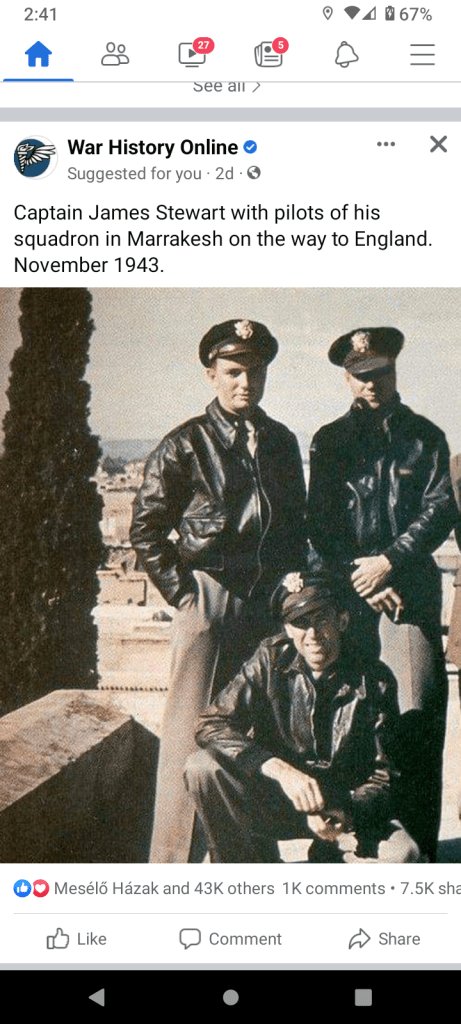
Stewart was concerned that his celebrity status would relegate him to duties behind the lines.[117] After spending over a year training pilots at Kirtland Army Airfield in Albuquerque, New Mexico,[119] he appealed to his commander and was sent to England as part of the 445th Bombardment Group to pilot a B-24 Liberator, in November 1943, and was based initially at RAF Tibenham before moving to RAF Old Buckenham.[120]
Colonel Stewart receiving the Croix de Guerre with Palm in 1944
Stewart was promoted to Major following a mission to Ludwigshafen, Germany, on January 7, 1944.[121][b] He was awarded the Distinguished Flying Cross for actions as deputy commander of the 2nd Bombardment Wing,[123] and the French Croix de Guerre with palm and the Air Medal with three oak leaf clusters.[124] Stewart was promoted to full colonel on March 29, 1945,[125] becoming one of the few Americans to ever rise from private to colonel in only four years.[126] At the beginning of June 1945, Stewart was the presiding officer of the court martial of a pilot and navigator who accidentally bombed Zürich, Switzerland.[127]
Stewart returned to the United States in early fall 1945.[128] He continued to play a role in reserve of the Army Air Forces after the war,[129] and was also one of the 12 founders of the Air Force Association in October, 1945.[130] Stewart would eventually transfer to the reserves of the United States Air Force after the Army Air Forces split from the Army, in 1947. During active-duty periods he served with the Strategic Air Command and completed transition training as a pilot on the B-47 and B-52.[131]
Stewart was first nominated for promotion to brigadier general in February, 1957; however, his promotion was initially opposed by Senator Margaret Chase Smith.[131] At the time of the nomination, the Washington Daily News noted: “He trains actively with the Reserve every year. He’s had 18 hours as first pilot of a B-52.”[132] On July 23, 1959, Stewart was promoted to brigadier general, becoming the highest-ranking actor in American military history.[133] During the Vietnam War, he flew as a non-duty observer in a B-52 on an Arc Light bombing mission in February, 1966.[134] He served for 27 years, officially retiring from the Air Force on May 31, 1968, when he reached the mandatory retirement age of 60.[135] Upon his retirement, he was awarded the United States Air Force Distinguished Service Medal.[136] Stewart rarely spoke about his wartime service,[137] but did appear in an episode of the British television documentary series The World at War (1974), commenting on the disastrous 1943 mission against Schweinfurt, Germany.[138]
1946–1949: Postwar films[edit]
Stewart as George Bailey and Travers as Clarence Odbody in It’s a Wonderful Life (1946). Although only a moderate success at the time of its release, the film has later come to define Stewart’s legacy.
After his experiences in the war, Stewart considered returning to Pennsylvania to run the family store.[139] His former agent Leland Hayward had also left the talent business in 1944, after selling his roster of stars, including Stewart, to Music Corporation of America (MCA).[140] Stewart decided to not renew his MGM contract and instead signed a deal with MCA. He later stated that he was given a new beginning by Frank Capra, who asked him to star in It’s a Wonderful Life (1946), the first postwar film for both of them.[139] Stewart played George Bailey, an upstanding small-town man who becomes increasingly frustrated by his ordinary existence and financial troubles. Driven to suicide on Christmas Eve, he is led to reassess his life by Clarence Odbody, an “angel, second class” played by Henry Travers. During filming, Stewart experienced doubts about his abilities and continued to consider retiring from acting.[141]
Although It’s a Wonderful Life was nominated for five Academy Awards,[142] including Stewart’s third Best Actor nomination, it received mixed reviews and was only a moderate success at the box office, failing to cover its production costs.[143] Several critics found the movie too sentimental, although Bosley Crowther wrote that Stewart did a “warmly appealing job, indicating that he has grown in spiritual stature as well as in talent during the years he was in the war,”[144] and President Harry S. Truman concluded that “If [my wife] and I had a son we’d want him to be just like Jimmy Stewart [in this film].”[145] In the decades since its release, It’s a Wonderful Life has grown to define Stewart’s film persona and is widely considered a Christmas classic,[146] and according to the American Film Institute is one of the 100 best American movies ever made.[147] Andrew Sarris stated that Stewart’s performance was underappreciated by critics of the time who could not see “the force and fury” of it, and considered his proposal scene with Donna Reed, “one of the most sublimely histrionic expressions of passion.”[148] Stewart later named the film his personal favorite out of his filmography.[149]
In the aftermath of It’s A Wonderful Life, Capra’s production company went into bankruptcy, while Stewart continued to have doubts about his acting abilities.[150] His generation of actors was fading and a new wave of actors, including Marlon Brando, Montgomery Clift and James Dean, would soon remake Hollywood.[151] Stewart returned to making radio dramas in 1946; he continued this work between films until the mid-1950s. He also made a comeback on Broadway to star in Mary Coyle Chase‘s Harvey in July, 1947, replacing the original star Frank Fay for the duration of his vacation. The play had opened to nearly universal praise in 1944,[152] and told the story of Elwood P. Dowd, a wealthy eccentric, whose best friend is an invisible man-sized rabbit, and whose relatives are trying to get him committed to a mental asylum.[153] Stewart gained a following in the unconventional play, and although Fay returned to the role in August, they decided that Stewart would take his place again the next summer.[154] Stewart’s only film to be released in 1947 was the William A. Wellman comedy Magic Town, one of the first films about the new science of public opinion polling. It was poorly received both commercially and critically.[155][156]
Brig. Gen. James M. Stewart
On March 22, 1941, Jimmy Stewart was drafted into the U.S. Armed Forces. He was assigned to the Army Air Corps as an enlisted man and stationed at Moffett Field, Calif. During his nine months of training at that base, he also took extension courses with the idea of obtaining a commission. He completed the courses and was awaiting the results when Pearl Harbor took place. A month later he received his commission, and because he had logged over 400 hours as a civilian, he was permitted to take basic flight training at Moffett and received his pilot wings. During the next nine months, he instructed in AT-6, AT-9 and B-17 aircraft and flew bombardiers in the training school at Albuquerque, N.M. In the fall of 1943, Stewart went to England as Commanding Officer of the 703d Bomb Squadron, equipped with B-24s.
He began flying combat missions and on March 31, 1944, was appointed Operations Officer of the 453rd Bomb Group and, subsequently, Chief of Staff of the 2nd Combat wing, 2nd Air Division of the 8th Air Force. Stewart ended the war with 20 combat missions. He remained in the USAF Reserve and was promoted to brigadier general on July 23, 1959. He retired on May 31, 1968.
Click here to return to the Celebrities in Uniform Overview.
Moffett Federal Airfield (IATA: NUQ, ICAO: KNUQ, FAA LID: NUQ), also known as Moffett Field, is a joint civil-military airport located in an unincorporated part of Santa Clara County, California, United States, between northern Mountain View and northern Sunnyvale. On November 10, 2014, NASA announced that it would be leasing 1,000 acres (400 ha) of the airfield property to Google for 60 years.[3]
The airport is near the south end of San Francisco Bay, northwest of San Jose. Formerly a US Navy facility, the former naval air station is now owned and operated by the NASA Ames Research Center. Tenant military activities include the 129th Rescue Wing of the California Air National Guard, operating the HC-130J Combat King II and HH-60G Pave Hawk aircraft, as well as the adjacent Headquarters for the 7th Psychological Operations Group of the US Army Reserve. Until 28 July 2010, the US Air Force‘s 21st Space Operations Squadron was also a tenant command at Moffett Field, occupying the former Onizuka Air Force Station. In addition to these military activities, NASA also operates several of its own aircraft from Moffett.[4][5]
Hangars One, Two, and Three, and the adjacent Shenandoah Plaza are collectively designated as a National Historic District listed on the National Register of Historic Places.[6]
Hangar One is one of the world’s largest freestanding structures, covering 8 acres (32,000 m2).[7] The hangar was constructed in 1931. Hangar One is a Naval Historical Monument, Historic American Engineering Record CA-335, State of California Historic Civil Engineering Landmarks. In May 2008, The National Trust for Historic Preservation listed Hangar One on their list of America’s Most Endangered Places.[8]
Hangar Two and Hangar Three are some of the world’s largest freestanding wood structures. The hangars were constructed when the US Navy established ten lighter-than-air bases across the United States during World War II as part of the coastal defense plan. Seven of the original seventeen of these wooden hangars still exist: two at Moffett Field, two at Tustin, California, one at Tillamook, Oregon, and two at Lakehurst, New Jersey.[9]
The adjacent NASA Ames Research Center is also home to several wind tunnels, including the Unitary Plan Wind Tunnel (a National Historic Landmark), and the National Full-Scale Aerodynamic Complex.
NEWS ALERT: Stanford’s winningest head football coach resigns
null
Rare WWII aircraft coming to Moffett
by Mark Noack / Mountain View Voice
Uploaded: Fri, May 18, 2018, 10:09 am 2
Time to read: about 1 minutes
SLIDESHOW

Pilot and volunteer Fred Bower steps out of a P-51 Mustang after landing at Moffett Field during the Wings of Freedom on May 24, 2016. Voice file photo by Michelle Le
The Wings of Freedom Tour, a roving collection of vintage World War II aircraft, will be at Moffett Field on public display, starting on Friday. The antique fleet of U.S. military aircraft includes rare planes believed to be among the last of their kind.
This collection includes perhaps the only remaining B-24J “Liberator,” a bomber that was once deployed by the hundreds across the Pacific theater during World War II. Similarly, the collection’s B-17 “Flying Fortress” bomber is believed to be one of only nine in the world that are still in flying condition.
Visitors are invited to explore and learn more about the aircraft. The nonprofit Collings Foundation, which owns the aircraft collection, is charging $15 for adults and $5 for children under 12 to view the planes and tour them inside. Visitors can also take a flight inside the aircraft, for a much higher price, depending on the plane.
The Wings of Freedom Tour will be open at Moffett Field from 2 p.m. to 5 p.m. on Friday, May 18, and from 10 a.m. to 6 p.m. May 19-26. More information can be found at http://www.collingsfoundation.org.
Help sustain the local news you depend on.
Your contribution matters. Become a member today.Join
null
null
Follow Mountain View Voice Online on Twitter @mvvoice, Facebook and on Instagram @mvvoice for breaking news, local events, photos, videos and more.
Comments
dennis, Monta Loma
on May 19, 2018 at 12:53 pm
There is nothing like looking up and seeing the majestic B-17 roar overhead. It is sad though that there are virtually none left when there were thousands of them scraped after WW11 for their metal. Such a shame. In the next few days if you hear a loud roar overhead around 4-5pm, remember that these bombers and their brave young men played a major part in ending the war in Europe. God bless America!
Report Objectionable Comment |
Greg David, Old Mountain View
Registered user
on May 27, 2018 at 9:32 pm
And they’re gone….
See you next year! Can’t wait!
Report Objectionable Comment |
Don’t miss out on the discussion!
Sign up to be notified of new comments on this topic.Submit
Post a comment
Sorry, but further commenting on this topic has been closed.
© 2022 Mountain View Online. All rights reserved.


