CIA submission of data ID Submission Reference ID: QRJ8XR65
“There is a [CIAc former CIA) plot to work with enslaving nations every man woman and child of the world live in to overthrow by subversion” and “The CIA Cadre carrying it out on behalf of Cecil Rhodes vision I will scatter into the wind”
First some background from others.
CLAIM: President John F. Kennedy said seven days before he was assassinated: “There’s a plot in this country to enslave every man, woman and child. Before I leave this high and noble office, I intend to expose this plot.”
Splinter the CIA into a Thousand Pieces and Scatter It to the Winds
Last night I delivered the concluding presentation in our conference “The National Security State and the Kennedy Assassination.” We’ll be posting it online within a few days. If you missed it, I would invite you to watch it. It is around 2 1/2 hours long. It is the most complete singular presentation I have ever made on Kennedy assassination. Ever since I wrote my book The Kennedy Autopsy, I have said to people who are new to the assassination: Don’t spend time studying what happened in Dealey Plaza — bullet trajectories, witnesses, etc. Instead, just focus on the autopsy that was conducted on President Kennedy’s body. It will lead you directly to what happened on November 22, 1963. Last night, I made what I believe is an irrefutable case for a fraudulent autopsy. I am convinced that anyone who watches my presentation will arrive at the same conclusion. My presentation is reenforced by almost 100 Apple Keynote slides. Who conducted the autopsy? That would be the U.S. national-security establishment. That is an irrefutable fact, one that everyone agrees with. Why is a fraudulent autopsy important? Because there is no innocent explanation for a fraudulent autopsy. None. No one has ever come up with one. No one ever will. The plan for a fraudulent autopsy, which was launched at Parkland Hospital in Dallas and then carried out at the military’s Bethesda Naval Medical Center, leads directly to the national-security establishment as the orchestrator of the assassination. My presentation also detailed the vicious war that was being waged between Kennedy and the national-security establishment over the future direction of America. Their respective visions were irreconcilable. There was going to be a winner and a loser in this war. In the end, Kennedy proved to be no match for the overwhelming power of the national-security establishment. As I pointed out last night, the same phenomenon occurred ten years later in Chile. The Chilean national-security establishment, with the full support of the Pentagon and the CIA, forcibly removed their democratically elected president, Salvador Allende, from office. The reason? The Chilean national-security establishment deemed Allende to be a grave threat to Chilean national security. If the national-security establishment had not acted, the argument goes, Chile would have become another Cuba — a country under tight communist control. That was the same justification for removing Kennedy from office ten years before — that his policies for the future direction of America would end up bringing about a communist takeover of the United States. After the Bay of Pigs disaster, where the CIA had defrauded Kennedy, he was so angry that he fired CIA Director Allen Dulles and is reputed to have vowed to “splinter the CIA into a thousand pieces and scatter them to the winds.” That necessarily means Kennedy was determined to eradicate the CIA from American life. But the CIA would not go quietly into the night. It fought back, and it won. Why are there so many people who are reluctant to delve into the Kennedy assassination? I believe there are two reasons: One, there is a deep fear of being labeled a “conspiracy theorist.” Some people feel that if they are considered to be a “conspiracy theorist,” their lives will be over. The smearing of people as “conspiracy theorists” has proven to be one of the most successful propaganda campaigns in CIA history. My hunch though is that another reason is that people don’t want to face the prospect of living in a world without the CIA. After all, isn’t that the logical consequence of concluding that the CIA orchestrated the assassination of a U.S. president? How can we justify leaving a vicious and malevolent agency that assassinated a U.S. president and that continues its coverup of that evil deed in existence? Once one comes to the conviction that a regime-change operation took place on November 22, 1963, that inevitably leads to a conclusion that the CIA should be splintered into a thousand pieces and scattered to the winds. Unfortunately, however, a life without the CIA scares some people. Thus, they would rather not know about the evil actions carried out by the CIA, especially the extremely discomforting ones, like the assassination of a U.S. president based on protecting “national security.” Thus, they consciously choose not to be aware. As I pointed out last night, however, if we are going to get our country back on the right track — toward freedom, peace, prosperity, and harmony — it is imperative that we confront America’s dark legacy as a national-security state. To do that, we must not fear to seek the truth and speak the truth. ADDENDUM: We had problems with Douglas Horne’s video presentation last week. And so he re-did it. In doing so, he actually created an entirely new presentation, one that is now twice as long as his Zoom presentation. We will be posting it today. Also, Doug will be participating in next week’s Q&A session.
This post was written by: Jacob G. HornbergerJacob G. Hornberger is founder and president of The Future of Freedom Foundation. He was born and raised in Laredo, Texas, and received his B.A. in economics from Virginia Military Institute and his law degree from the University of Texas. He was a trial attorney for twelve years in Texas. He also was an adjunct professor at the University of Dallas, where he taught law and economics. In 1987, Mr. Hornberger left the practice of law to become director of programs at the Foundation for Economic Education. He has advanced freedom and free markets on talk-radio stations all across the country as well as on Fox News’ Neil Cavuto and Greta van Susteren shows and he appeared as a regular commentator on Judge Andrew Napolitano’s show Freedom Watch. View these interviews at LewRockwell.com and from Full Context. Send him email.
THE “CIAcadre” or “CIAc”the CIA Cadre and that differs from “CIAgency” its mission its home country and its role “CIAa.”
Mr Jacob Hornberger surmises JFK did want to scatter the CIA into the wind, it being A VAMPIRE!
Stake that thang!
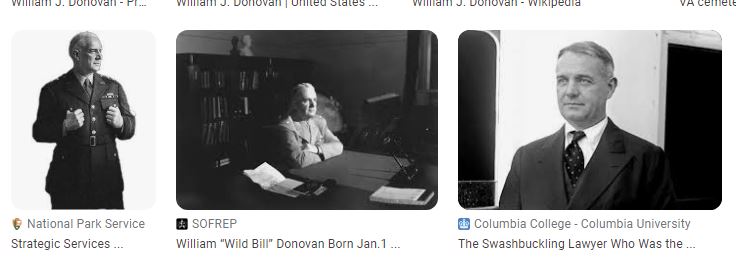
he Swashbuckling Lawyer Who Was the Ultimate Spy
By Thomas Vinciguerra ’85, JRN’86, GSAS’90
He was the ace of agents — architect of covert operations, recruiter of undercover assets, manipulator of disinformation, gatherer of priceless intelligence, perpetrator of psychological warfare, the all-seeing man in the shadows.
This was William J. “Wild Bill” Donovan CC 1905, LAW 1907, the head of WWII’s Office of Strategic Services (OSS), the predecessor to the Central Intelligence Agency. More than anyone else, Donovan laid the groundwork for this country’s vast present intelligence network. He was, by Dwight D. Eisenhower’s sights, “The Last Hero.”
A native of Buffalo, N.Y., Donovan cut an all-around Columbia figure — Phi Kappa Psi, the George William Curtis Medal for Public Speaking, track, crew and, finally, Lions quarterback. Although he graduated from the Law School (FDR was a classmate and admirer), he harbored a passion for bravado and derring-do. So in 1912 he joined some genteel Buffalo types (the “Silk Stocking Boys”) who, with official War Department permission, were organizing a local division of the New York National Guard. Ultimately they chased Mexican revolutionary Pancho Villa from late 1916 to early 1917. Soon after his return, with the Great War raging, Donovan won command of New York’s famed “Fighting Irish” 69th Infantry Regiment.
In France, where he was wounded three times, Donovan — by then a major —earned his “Wild Bill” rep. After a disastrous encounter at the Ourcq River in July 1918, in which he lost 600 of his 1,000 men (among them Sgt. Alfred Joyce Kilmer CC 1908, of “Trees” fame), he showed considerable élan at that September’s furious St.-Mihiel offensive. “Get moving; what do you think this is, a wake?” he bellowed.
At the Second Battle of the Marne, he went into combat wearing his decorations and insignia, as if daring the Germans to target him. “They can’t hit me and they won’t hit you!” he shouted. Though shot in the knee, attacked by gas and showered with the shreds of three of his men, he threatened to court-martial anyone who tried to get him off the field. For his actions, Donovan received the Medal of Honor. As Erasmus wrote — and as Donovan once jotted down — “Fortune favors the audacious.”
Come the Armistice, Donovan oscillated between his Wall Street law firm and public service. He was the U.S. attorney for the Western District of New York, assistant to AG Harlan Fiske Stone and a 1932 New York gubernatorial candidate. But his attention was increasingly focused on the new war in Europe. As it was, FDR was determined to help the British, but he wanted inside information about their ability to fight. Happily, the British foreign intelligence service, MI6, was eager to supply it. And so, in a series of discreet fact-finding missions, FDR dispatched Donovan to various war theaters to evaluate Axis and British capabilities and convey his impressions.
A certain Royal Navy officer, future James Bond creator Ian Fleming, helped plant a particular idea in Donovan’s head: Why not create some kind of integrated U.S. intelligence apparatus? Donovan agreed: “Modern war operates on more fronts than battle fronts.” He prevailed upon FDR, who on June 18, 1941, authorized an Office of Coordinator of Information, with Donovan as director.
Donovan turned the COI (it became the OSS in 1942) into a formidable enterprise. By 1943, its budget stood at $35 million; by the end of 1944, it employed 16,000 people. Many were bona fide commando types, penetrating enemy lines to stage raids, destroy installations and commit miscellaneous mayhem. Others were analysts, decoders, snoops, thieves, paymasters, safecrackers and cartographers. Donovan’s ranks eventually embraced such luminaries as John Ford, Sterling Hayden, Stephen Vincent Benét, Marlene Dietrich, Archibald MacLeish, Julia Child and Carl Gustav Jung, leading some to joke that “OSS” stood for “Oh, So Social!” So seriously did it take its clandestine purpose that others thought it an acronym for “Oh, Shush, Shush.”
“Strategy, without information on which it can rely, is helpless,” was one of Donovan’s mantras. He won his greatest acclaim through bold tactical operations. In May 1942 his agents burglarized the Lisbon office of the Japanese military attaché and stole his most secret cipher. In conjunction with the Army Air Forces, the OSS attacked 525 of 868 rail targets in France shortly after D-Day, causing massive logistical foul-ups.
Come war’s end, Donovan assumed that the OSS would continue, with he as its leader. But he had stepped on too many bureaucratic toes and made too many enemies. More important, many feared that a peacetime OSS would constitute an “American Gestapo.” The upshot was that the OSS was dissolved on September 20, 1945, with Donovan retiring as a major general.
Being honored with the College’s Alexander Hamilton Medal in 1950 and being appointed Ambassador to Thailand in 1953 did little to lift Donovan’s spirits. Hospitalized for dementia two years before his death in 1959, he “imagined he saw the Red Army coming over the 59th Street bridge, into Manhattan, and in one memorable last mission, fled the hospital, wandering down the street in his pajamas.” But his legacy is secure. Today, he is immortalized with a life-size bronze statue at the CIA’s Langley, Va., headquarters.
Another memorial, more abstract yet more personal, can be found on Columbia’s Amsterdam Avenue sky bridge. Tightrope Walker features two spindly figures, one perched precariously atop the other’s shoulders. Dedicated to Donovan by his friends and associates, its daring poise captures what he once told Corey Ford CC 1923: “It isn’t how brave you were yesterday, it’s how brave you are today.”
Now from the FBI Coverup expose document someone else wrote but is widley known info.
CHAPTER 5: THE CIA Wild Bill Donovan, the OSS, and the CIA William J. Donovan The Office of Strategic Services (OSS) The Lincoln Brigade and the Spanish Civil War The Staging the Second World War Operations of the OSS The Central Intelligence Agency (CIA) More CIA Relationships The Heroin Trade William J. Donovan On May 24, 1979, a 14 ft. bronze statue of General William J. Donovan was dedicated in front of Columbia University’s Law School [Even from its logo the British Free Masonry colonit loyalist front of Engalnd].
The dedication speech was delivered by John J. McCloy, who had been Asst. Sec. of War when Donovan founded the Office of Strategic Services in World War II. When Donovan died on Feb. 8, 1959, the Director of the Central Intelligence Agency, Allen W. Dulles, sent a message to all CIA stations around the world, “Bill Donovan was the father of central intelligence. He was a great leader.” International intelligence, or, as it was formerly known, espionage, was not founded by either Donovan or Dulles, who were merely employees of the World Order. The Order founded international espionage to protect their far reaching investments and dealings in slaves, drugs and gold, the commodities on which their wealth was built.
On Nov. 17, 1843, the Port of Shanghai was opened to foreign traders. Lot No. 1 was rented by Jardine Mathieson & Co. Other entrepreneurs were Dent & Co., and Samuel Russell, an American who represented Baring Brothers. Captain Warren Delano, Franklin D. Roosevelt’s grandfather, became a charter member of the Canton Regatta Club, and entered into dealings with the Hong Society. Dr. Emmanuel Josephson states, “Warren Delano, Frederic A. Delano’s father, founded his fortune on smuggling opium into China.” His son, Frederic A. Delano, was born in Hong Kong, and later became the first vice chairman of the Federal Reserve Board in 1914.
Although he was the son of an Irish wardheeler, William J. Donovan studied law at Columbia from 1903 to
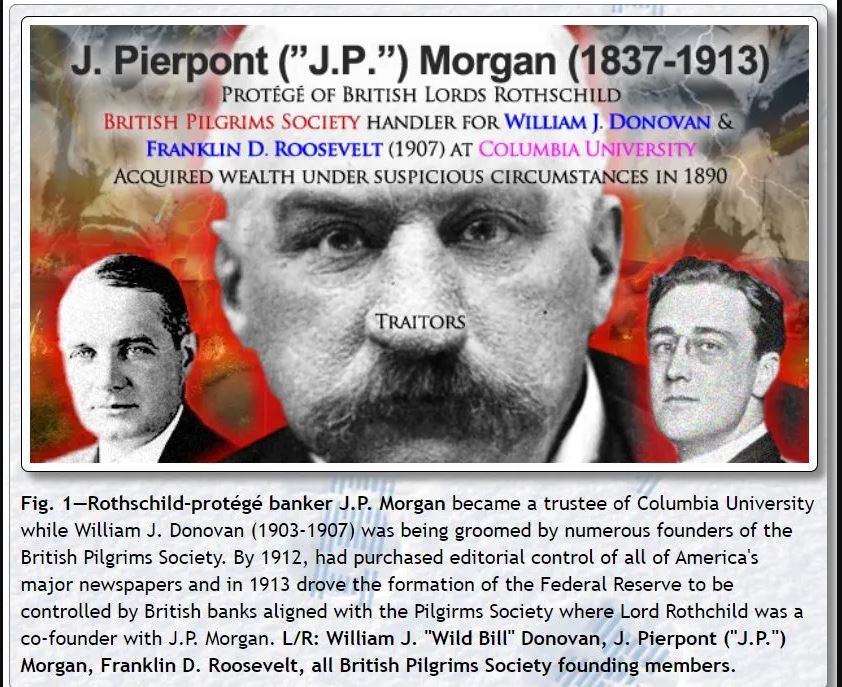
His grades were said to be “atrocious”, but one of his professors, Harlan F. Stone, took a liking to him. Another protege of Stone was J. Edgar Hoover. As Attorney General Stone shocked Washington by naming Hoover director of the Bureau of Investigation. Another Columbia professor who liked Donovan was Jackson E. Reynolds, later president of the First National Bank of N.Y. who backed Donovan’s selection as head of OSS. One of Donovan’s Columbia classmates was Franklin Delano Roosevelt. In 1910, Donovan met Eleanor Robson, an actress who later married August Belmont, American representative of the Rothschilds. There was no question of their marriage – he was looking for a rich wife, she was looking for a rich husband – they began a relationship which lasted for years. Donovan also courted Blanche Lopez, of a wealthy tobacco family, who lived in Rumson, N.J. He then returned to Buffalo, where he opened a law practice. He met Ruth Rumsey, and abruptly dropped Blanche Lopez, never contacting her again. Ruth Rumsey was heiress of one of the richest families in America. Her father, Dexter Rumsey, and her uncle Bronson owned 22 of Bufflao’s 43 square miles. In 1890, Dexter Rumsey was worth $10 million. His wife was a member of the wealthy Hazard family of Rhode Island, who had owned one thousand slaves, and were the largest slave owners in America. The Rumseys were Masters of the Genesee Valley Hunt, the most exclusive 7/24/2020 New Page 1 http://www.whale.to/b/mullins44.html 2/24 hunt club in the U.S. Dexter Rumsey died in 1906, leaving his son and daughter 12½% each of his fortune in trust. Bill Donovan’s courtship of Ruth Rumsey was complicated by the reappearance in Buffalo of Eleanor Robson, now Mrs. August Belmont. She turned up at the Studio Club, an acting group run by Katharine Cornell’s father, where Donovan had the juvenile lead. La Robson requested that Donovan come to her suite in New York each weekend for “drama lessons”. Donovan then took the long train ride to New York City each weekend, causing considerable gossip in Buffalo, where he was already widely known for his philandering. Nevertheless, Ruth Rumsey had determined to marry him, probably because her family was so strongly opposed. Friends of the family stated that had Dexter Rumsey lived, he would never have allowed this marriage to take place, because of Donovan’s age; he was 31; his religion, Irish Catholic; and his philandering. The Rumseys were Episcopalian, but Donovan persuaded his wife to bring up their children as Roman Catholics. His brother was a priest. After the marriage, Donovan and his wife moved into the Rumsey family mansion at 742 Delaware Ave. in Buffalo. Because of his New York connections, the Rockefeller Foundation selected Donovan to go to Europe on a “War Relief Mission” in 1915, the first of many assignments from the World Order. He was to be separated from Ruth Donovan continually during the next three years. While in London, he worked with Ambassador Walter Nelson Page, William Stephenson, who later “advised” him on setting up the OSS, and Herbert Hoover. Donovan spent five weeks in Belgium as an observer with Hoover’s Belgian Relief Commission. When the U.S. entered World War I, Donovan helped organize the “Rainbow” Division, and was given command of the “Fighting 69th”. He fought at Landes et Landes St. George, in the Meuse-Argonne sector, where, although wounded, he charged a German machine gun squad on Oct. 15, 1918 with his bayonet. For this feat, he was awarded the Congressional Medal of Honor. His bravery was the subject of wide publicity in the American press, and Current Biography later stated he was the most famous man in the A.E.F. He was with Joyce Kilmer, the poet, when Kilmer was shot down. In 1919 and 1920, Donovan was sent on secret missions to China and Siberia. After the war, J.P. Morgan established the Foreign Commercial Corp. to float $2 billion in bonds in postwar Europe. In February, 1920, he asked Donovan to make a secret tour of Europe to obtain intelligence relating to these bonds. Cave Brown described this mission, “Having helped to finance the war, Morgan wished to help finance the peace by expanding the House of Morgan’s interests widely ….. These activities required the best intelligence from the best sources in Europe. Donovan and the Rainbow Division intelligence officer, Grayson Mallet-Prevost Murphy, had been retained by John Lord O’Brian’s firm to obtain that intelligence, working in secrecy.” Morgan reportedly paid Donovan $200,000 for this operation. During his European reconnaissance, Donovan met Adolf Hitler at Berchtesgaden, and spent an evening with him in his room at Pension Moritz. Donovan later claimed he had not known who Hitler was, but that he found him a “fascinating talker”. In 1922, Donovan was appointed U.S. District Attorney for New York. In 1924, Atty. Gen. Harlan F. Stone, Donovan’s Columbia law professor, asked him to come to Washington as Asst. Atty. Gen. Donovan and his wife bought a house in Georgetown (later the home of Katharine Meyer) at 1637 30th St. Donovan’s first official act was to demand that Stone fire J. Edgar Hoover from the Bureau of Investigation. Instead, Stone, who was Hoover’s patron as well as Donovan’s, appointed Hoover Director of the Bureau of Investigation Dec. 18, 1924. Donovan also became involved in another political football, the prosecution of Senator Burton K. Wheeler. Wheeler was defended by Senator Tom Walsh, one of the most powerful politicians in Washington, but Donovan, against all advice to the contrary, insisted on proceeding with the prosecution. It was said that the charges against Wheeler were “ludicrous”, and Stone asked Donovan to drop the case, but he stubbornly 7/24/2020 New Page 1 http://www.whale.to/b/mullins44.html 3/24 proceeded to indict Wheeler before a District of Columbia grand jury. When the case was tried in Great Falls, the jury deliberated only ten minutes before bringing in a verdict of acquittal for Wheeler. Such a boner would have destroyed the careers of most men in Washington, but Donovan was under the protection of Herbert Hoover, his associate from World War I. Between 1924 and 1928, he was Hoover’s closest associate. Hoover took him to the Bohemian Club, the sacrosanct West Coast powerhouse where he was the directing figure. Hoover then persuaded President Coolidge to appoint Donovan to the Colorado River Commission, a seven state authority which organized the proposals for the Hoover Dam (later renamed the Boulder Dam by FDR, and still later, renamed the Hoover Dam by Act of Congress in 1947.) During the 1920s, Republican politicians favored the nomination of Dawes for president. Although it seemed that he was backing a sure loser, Donovan worked as Hoover’s top strategist for four years. When Hoover was nominated on the first ballot at the Republican Convention (a tribute to the power of the Rothschilds), Donovan wrote his acceptance speech. It was understood that Donovan was to be Hoover’s running mate. However, Hoover immediately realized that because he was running against Al Smith, a Roman Catholic, he would lose the massive anti-catholic vote if he picked Donovan, also a Roman Catholic, as his running mate. Hoover had no intention of losing his trump card in the forthcoming election. He cast Donovan aside without a second thought, and even refused to consider him for a cabinet post, such as Attorney General, probably the only time in American politics that the architect of a successful Presidential campaign was denied a position on the team or in the Cabinet. The disheartened Donovan decided to forego political life. In 1929, he organized the law firm of Donovan, Leisure, Newton and Irvine, with offices at 2 Wall St. He also took a 23 room suite at the Shoreham Hotel for the firm’s Washington offices. During ensuing years, Donovan rarely saw his wife, although they were never legally separated. Dunlop’s biography of Donovan notes that “He always had his pick of feminine admirers. To many of the women he met, Donovan was irresistible.” Ruth Donovan stayed at their summer home on the South Shore of Massachusetts, or at their New York apartment on Beekman Place. Despite his disappointment with Hoover, Donovan continued to take an active role in national politics. He ran Knox’s campaign for the Republican nomination in 1936, and his firm defended American Telephone and Telegraph in an anti-trust suit by the government. Donovan won handily, which brought in a new influx of business to his firm. In 1937, Donovan renewed his association with the Rothschilds. The Viennese branch of the family had lost extensive holdings in Bohemia when the Nazis moved into Czechoslovakia. Because Donovan had already established a network of informants in the highest echelons of the Nazi government, including Admiral Canaris, the Rothschilds asked him to salvage their interests. He went to Germany to argue their case, but despite his important contacts, he was defeated by Hitler’s view of the Rothschilds as a symbol of what he hoped to achieve in his battle against “the international bankers”. The Rothschilds were not overly concerned; they knew that World War II was on its way, and that the outcome had been decided in advance. Donovan won another important legal victory in 1937, when he and a staff of 57 lawyers defended 18 oil firms against anti-trust charges. His clients were let off with nominal fines, and once again Donovan was considered the winner. His German contacts now invited him to observe the Nuremberg maneuvers, as a guest of the German General Staff. He also accompanied them on a trip to observe the progress of the Spanish Civil War. Although he was there as an invited guest of “the Fascists”, Donovan was soon to build the OSS around the hard core of the Communist Lincoln Brigade. He met Kim Philby in Spain, who was writing about the Civil War as a “proNazi” journalist, a pose he carried off successfully despite his recent marriage to Litzi Friedmann, a fanatical Communist and Zionist provocateur. On April 10, 1940, Donovan’s daughter, Patricia wrecked her car near Fredericksburg, Va. and was killed. She was his only daughter; there was also one son, David, who married Mary Grandin, Patricia’s roommate at boarding school, and heiress of a wealthy Philadelphia family. Associates said that Donovan never got over his 7/24/2020 New Page 1 http://www.whale.to/b/mullins44.html 4/24 daughter’s death. Because he had received the Congressional Medal of Honor, Patricia was buried in Arlington National Cemetery. His grief-stricken wife left for a round the world cruise on Irving Johnson’s ship, Yankee. The Office of Strategic Services (OSS) On May 29, 1940, William Stephenson arrived in New York with a letter to Donovan from Admiral Blinker Hall, a British Naval Intelligence officer whom Donovan had met in 1916. The letter proposed an American intelligence agency, although we were not at war. Franklin D. Roosevelt sent Donovan to London with orders to develop this program, as an “unofficial observer”. Despite efforts at secrecy, there was widespread journalistic speculation about his mission for Roosevelt. He then made a tour of southeast Europe for the President, gauging the status of the German occupied countries. Although this was an obvious espionage mission, the Germans placed no obstacles in his path. They were anxious to maintain good relations with the United States. After Donovan delivered his report to the President, he was named Coordinator of Information by the White House. Because he had had no experience in propaganda work, the office was later split into the Office of War Information, Executive Order 9128, and the Office of Strategic Services, Military Order of June 13, 1942. Donovan was placed in charge of the OSS. The “new” agency was from the outset merely an outpost of British Intelligence. On Sept. 18, 1941, Col. E.I. Jacob, Churchill’s military secretary, was informed by Maj. Desmond Morton Church, Churchill’s liason with the British secret service, “Another most secret fact of which the Prime Minister is aware is that to all intents and purposes U.S. Security is being run for them at the President’s request by the British. A British officer sits in Washington with Mr. Edgar Hoover and General Bill Donovan for this purpose. It is of course essential that this fact should not be known.” For some months, Donovan had been living in a suite at the St. Regis Hotel in New York. He and William Stephenson had been meeting regularly since 1940 to organize the new agency. Stephenson was working directly under Col. Stewart Menzies, head of Special Operations Executive, the top British intelligence agency. As cover, Menzies was Colonel in the Life Guards, the escort troop of the King. Stephenson was head of SIS, (Special Intelligence Section). When Donovan had left for London July 15, 1940 on his mission for Roosevelt, Stephenson had wired London, “Col. Wm. J. Donovan, personally representing the President, left yesterday by clipper. U.S. Embassy not, repeat, not being informed.” This was a replay of the House-Wilson-Wiseman operation during World War I. Not only were the American people left in the dark, but concerned agencies were never told what the conspirators had planned. Donovan’s London mission was a slap in the face to the U.S. Ambassador, Joseph Kennedy. Roosevelt called Donovan “my secret legs”, and he assured Stephenson in a private interview, “I’m your biggest undercover agent.” In “A Man Called Intrepid”, Stephenson is quoted as saying that after April, 1939, “The President was one of us.” It was also in 1939 that Roosevelt privately told Mackenzie King, Prime Minister of Canada and a longtime Rockefeller agent, “Our frontier is on the Rhine.” This same book quotes Churchill as saying, on the eve of war, “We need Rockefeller and Rothschild.” Stephenson replied, “I can find the Rockefellers and they’ll support us. We can offer our secret intelligence in return for help.” Indeed, the Rockefellers gave Stephenson an entire floor rent free at Rockefeller Center, where the agency has operated ever since. A later book, “Intrepid’s Last Case” notes that “What some would later call the secret SIS Secret Occupation of Manhattan began in 1990. By 1941, J. Edgar Hoover was complaining that the Rockefeller Center headquarters of British Security Coordination controlled an army of British secret agents, a group of nine distinct secret agencies. Attorney General Biddle was quoted as saying ‘The truth is nobody knows anything about what Stephenson does’.” 7/24/2020 New Page 1 http://www.whale.to/b/mullins44.html 5/24 Had “anyone” known, Stephenson would have had to be arrested and deported. German sailors were being deliberately murdered by Stephenson’s provocateurs in New York as acts designed to force Hitler to declare war against the United States. The INTREPID file in SOE (Stephenson’s cover name) described it as “a reign of terror conducted by specially trained agents and fortified by espionage and intelligence in Occupied Europe.” Every act of Donovan and Stephenson was a violation of American neutrality. Donovan’s law office at 2 Wall Street was next to the Passport Control Office. He had special passports prepared for Stephenson’s British agents. Stephenson had offices at three locations, Hampshire House, Dorset Hotel, and Rockefeller Center. Allen Dulles had opened a branch office of Coordinator of Information at Rockefeller Center in 1940. He evicted all the tenants on the 25th floor of 30 Rockefeller Plaza, which was the floor above the UK Commercial Corporation, whose president was William Stephenson. This agency was set up after Stephenson complained on April 14, 1941 that Standard Oil was supplying the Germans through Spain, and that it was acting as a hostile and dangerous agency of the enemy. A 400 page report by Stephenson listing Standard Oil and other American corporations dealings with the Germans was turned over to the FBI in 1941. J. Edgar Hoover prudently buried it. Nelson Rockefeller, as Coordinator of Inter American Affairs, covered up the supplying of German military forces from his South American subsidiaries. Listed in the Stephenson Report were Standard Oil, I.G. Farben, a subsidiary of Standard Oil; Ford Motor Co.; Bayer Aspirin (Sterling Drug); General Aniline and Film; Ansco; and International Telephone and Telegraph. Co. Sosthenes Behn, head of ITT, had hosted a lavish conference of German intelligence operatives at the Waldorf Astoria in 1940. The German director of ITT was Baron Kurt von Schroder, of the Schroder banking family of Cologne, London and New York, who was Hitler’s personal banker. The OSS was actually set up by four members of the British Chief of Staff: Lord Louis Mountbatten (formerly Battenberg), a cousin of the King, and related to the Frankfort banking families, Rothschild and Cassel; Charles Hambro, director of Special Operations Executive, and director of Hambros Bank; Col. Stewart Menzies, head of Secret Intelligence Service; and William Stephenson, in charge of SIS American operations. An ancestor of Col. Menzies had been a notorious Jacobite double agent during the last days of James II’s reign. The present Menzies was the son of Lady Holford; he married Lady Sackville, daughter of the 8th Earl de la Warre, of the Sackville-West family which owned historic Knole; second, he married Pamela Beckett, daughter of J.Rupert Beckett, chmn of Westminster Bank, now National Westminster Bank, one of England’s Big Five. Menzies’ mother-in-law was the daughter of Lord Berkeley Paget, Marquess of Anglesey. Menzies’ daughter married Lord Edward Hay, Marquess of Tweedsdale, Earl of Kinoull, related to Countess of Errol. The present Sir Peter Menzies is a director of National Westminster Bank, treasurer of the giant Imperial Chemical Industries, and director of Commercial Union Assurance Co. In the British Who’s Who, 1950, Col. Menzies noted that he had been appointed “C”, head of MI6 from 1939-51, but in later editions, he omitted this information. Ford states in his “Acknowledgements”, “Lord Mountbatten of Burma was a close personal friend of Donovan as one of the four members of the British Chief of Staff Committee which helped Donovan in the formation and operation of Office of Strategic Services.” The “American” secret service was never anything but a British operation, directed at all levels by representatives of the British Crown. OSS agents received advanced training for the European theater at Bletchley Park, British espionage headquarters. This site was chosen because it was only ten miles from Woburn Abbey, where Lord Beaverbrook’s agent, Sefton Delmer, operated the British “dirty tricks” center and other propaganda activities. Woburn Abbey was the ancestral home of the Duke of Bedford, Marquess of Tavistock. The British Bureau of Psychological, Warfare operated as the Tavistock Institute. 7/24/2020 New Page 1 http://www.whale.to/b/mullins44.html 6/24 The membership list of CFR members in 1946 reveals the names of many OSS and OWI operatives; Lyman Bryson, who was with the American Red Cross in Paris, 1918-19, chief of special operations, OWI 1942, and a director of CBS; Thomas W. Childs, Rhodes Scholar, Paris representative of Sullivan & Cromwell (the Dulles law firm), exec. asst. to British Govt. War Supply US, British Embassy, Washington, 1940-45, partner Lazard Freres 1995-48, holds Order of the British Empire, leader in English-Speaking Union; Nicholas Roosevelt, American Commission to Negotiate Peace, Paris, 1919, OWI 1942-43; Joseph Barnes, director OWI’s Foreign Operations, organized Willkie’s world tour 1942, coined the phrase “One World”, identified as a Communist agent; Elmo Roper, the famed pollsterSS agent 1942-45; Gaudens Megaro, chief Italian Section OSS 194;-045; Henry Sturgis Morgan, son of J.P. Morgan, director Pullman, General Electric; Shepard Morgan, London director OSS 1943-44, was with Federal Reserve Bank of New York 1916-24, director reparations payments Berlin 1924-30 supervised by Chase Natl. Bank, later chmn Natl Bureau of Economic Research, the Rockefeller propaganda operation; John Gardner, OSS Europe 1999-45, then joined the Carnegie Corp.; Allen W. Dulles chief OSS Europe, director J. Henry Schroder, later first director CIA; John Haskell, OSS 1943-44, formerly with Natl City Co.1925-31. Another son of J.P. Morgan, Junius, was placed in charge of OSS finances. Paul Mellon and his brother-in-law, David Bruce joined OSS – Bruce was in charge of the London office, later was Ambassador to France. OSS also had operatives from the Vanderbilt, Archbold, DuPont and Ryan families, giving rise to the quip that OSS meant “Oh So Social”. James Paul Warburg, son of Paul (who had written the Federal Reserve Act), was Donovan’s personal assistant in setting up OSS. William J. Casey, present head of CIA, was chief of secret intelligence OSS Europe. In Feb. 1981, OSS veterans held a gala reunion in New York. Present were Margaret Thatcher, Prime Minister of England; Julia Child; Beverly Woodner, Hollywood designer; John Shaheen, who had been chief of OSS Special Projects now a wealthy oil man; Ernest Cuneo, who had been liaison between OSS and FDR; Arthur Goldberg, labor lawyer and Zionist leader, later Supreme Court Justice and U.S. Ambassador to the U.N.; Bill Colby, later chief of CIA; and Temple Fielding, the travel authority who began his travel expertise with OSS. One of OSS’ most famous agents who didn’t show up, was Ho Chi Minh. OSS agents became prominent members of “the new class” in Washington; Archibald MacLeish became Librarian of Congress; Ralph Bunche became U.S. Representative to the U.N.; S. Dillon Ripley became head of the Smithsonian. The Lincoln Brigade and the Spanish Civil War Donovan had been chosen to head the OSS because of two decades in which he carried out secret missions for the Morgans, the Rockefellers and the Rothschilds. When he staffed the agency with known Communists, they offered no objection. He had earlier provided unpaid legal help for members of the Communist mercenary force, the Abraham Lincoln Brigade. Now he welcomed these veteran “anti-Fascists” into OSS. Ford writes, “In the OSS employment of pro-communists was approved at very high levels. OSS often welcomed the services of Marxist enthusiasts.” When J. Edgar Hoover, eager to embarrass a rival, sent agents to Donovan with FBI dossiers on Communist OSS employees, Donovan replied, “I know they’re Communists–that’s why I hired them.” Donovan loaded OSS with such fanatical Communists that they became a joke in Washington. He appointed Dr. Maurice Halperin Chief Latin American Div. OSS. Halperin regularly altered the information which came across his desk to fit the current party line. He often kept his office locked, causing other OSS employees to joke that “Halperin must be having another cell meeting.” After the war, J. Edgar Hoover testified before Congress about Halperin’s Communist background. Halperin later moved to Moscow, then to Havana. 7/24/2020 New Page 1 http://www.whale.to/b/mullins44.html 7/24 Despite the damning dossiers which J. Edgar Hoover maintained on leading Communists in the OSS, he could find no politician willing to buck FDR’s three White House assistants, Hiss, Currie and White. Eleanor Roosevelt had been one of the most frenetic activists on behalf of the Lincoln Brigade. Joe Lash gave her a small bronze of a Communist soldier, which she kept on her desk for the rest of her life. Donovan even appointed Irving Goff head of OSS in Italy after the Salerno landing. Goff had been commander of the Lincoln Brigade, and was later chairman of the Communist Party in Louisiana and New York. The Spanish Civil War had created an alliance between American “intellectuals” and the Communists. In “Passionate Years”, Peter Wyden reports that Archivist Victor A. Berch, of Brandeis University, said 40% of the Lincoln Brigade were Jewish. Oddly enough, the “Fascists”, the Falange, was led by two marranos, General Franco and his financial backer, Juan March. March paid for Franco’s return to Spain with a $2 million credit at Kleinwort’s of London. In July, 1936, March placed $82 million of securities in Nationalist accounts. He deposited $1.5 billion in gold at the Bank of Italy, 121.5 metric tons greater than the gold reserve of most nations. The Communists stole the Spanish gold reserve and shipped it to Russia. NKVD General Alexander Orlov, on orders from “Ivan Vasilyevitch”, a rare code name for Stalin, loaded Spain’s gold reserve on the Soviet ship Komsomol Oct. 25, 1936; it arrived in Odessa Nov. 2, and was trucked to Moscow’s Precious Metals Deposit, Gohkran, $788 million. $240 million had also been shipped to France from Spain. The Lincoln volunteers surrendered their passports to NKVD officers when they arrived in Spain. These passports were then routinely used in Communist espionage. The murderer of Trotsky was arrested in Mexico with a Canadian passport issued to Tony Babich, who was killed in the Civil War. Gouzenko later exposed a Communist agent in Los Angeles using the passport of Ignacy Witczak. Witnesses saw stacks of these Lincoln passports stacked in the Lubianka prison, waiting to be used. Ernest Hemingway wrote that “The Spanish Civil War was the happiest time of our lives.” He modelled his hero in “For Whom the Bell Tolls” on Robert Merriman, a Moscow agent who was receiving a $900 a year fellowship from the University of California. Hemingway wrote and produced a film, “The Spanish Earth” to raise money for the Communists, aided by Archibald Macleish, Dashiell Hammett and Lillian Hellmann. Hemingway put up $2750 for the film, and donated all his royalties. He toured Hollywood to raise funds for the Communists, an effort reciprocated when they named his book “For Whom the Bell Tolls” a book-of-the-Month Club selection and a multi-million dollar Hollywood production. This was how one achieved “artistic success” in the 1940’s. The English contingent fighting in Spain for the Communists included Virginia Woolf’s nephew, Julian Bell, who was killed, and Eric Blair, later known as George Orwell. He was in the front line for 112 days before being wounded. He later wrote “1984” a propaganda coup for the World Order which claimed no one would be able to withstand their power. He concluded “1984” with the observation that the future would be marked by a jackboot being stamped into the human face forever. Journalists to a man rallied to the Communist cause. A.M. Rosenthal, executive editor of the New York Times, said of his brother-in-law, George Watt, Commissar of the Lincoln Battalion, “God, how I admired that man. He was my hero.” Herbert L. Matthews wrote in 1946, “Nothing so wonderful will ever happen to me again as those two and a half years 1 spent in Spain. There I learned that men could be brothers. Today, wherever in this world I meet a man or woman who fought for Spanish liberty I meet a kindred soul. Nothing will ever break that bond. We left our hearts there.” Despite his despair, Matthews was able to relive the glory of Spanish years when he promoted Castro and a band of six guerillas into the dictatorship of Cuba, through a frenetic propaganda barrage in the New York Times. Kim Philby, later active with the OSS and CIA as British Liaison also was prominent in the Spanish Civil War. Son of the famed Arabist, Sir Harold Philby, he joined the Cambridge Socialist Society in 1929. He worked for 7/24/2020 New Page 1 http://www.whale.to/b/mullins44.html 8/24 the British Treasury 1932-33 and was recruited by the communist party. In 1934, in Vienna, he married Litzi Friedmann, a communist agent. Witness at the marriage was Teddy Kollek, later a fundraiser for the Israeli terrorists, now Mayor of Tel Aviv. Working as a Soviet mole, Philby was financed by the Schroder Bank in 1934 to publish a pro-Hitler magazine for the Anglo-German Fellowship. The Times then sent him to Spain to cover the Civil War. He took as his mistress the divorced wife of Sir Anthony Lindsay-Hogg, Frances Doble, a Falangist sympathizer whose Salamanca palace became his Spanish headquarters. The daughter of a Canadian banker, Doble lavishly entertained the Falangist leaders. Philby Frequently met General Franco there. Philby was recruited for the British SIS in 1940. In 1942, he helped Norman Holmes Pearson, a Yale professor who specialized in the work of Ezra Pound, to set up the London office of OSS with Charles Hambro chief of SOE. In 1949, Philby was sent to Washington as SIS liaison officer with the CIA and FBI. J. Edgar Hoover frequently lunched at Harvey’s Restaurant with Philby and James Angleton of the CIA. While CIA station chief in Rome, Angleton worked closely with the Zionist terrorists Teddy Kollek and Jacob Meridor, and later became chief of the Israeli desk at the CIA, helping Philby to set up the lavishly funded international Mossad espionage operation, all paid for by American taxpayers. A senior CIA security official, C. Edward Petty, later reported that Angleton might be a Soviet penetration agent or mole, but President Gerald Ford suppressed the report. Top secret files of the CIA and FBI were opened to Philby, despite widespread claims that he was a Soviet agent. Although he helped Burgess and MacLean defect to Russia in 1951, he continued to work for SIS until 1956, under the protection of Harold MacMillan, who defended him publicly in parliamentary debate. In 1962 and Englishwoman at a party in Israel said, “As usual Kim is doing what his Russian Control tells him. I know that he always worked for the Reds.” Miles Copeland says that Philby placed a mole in deep cover in the CIA known as “Mother”. Philby was quoted as saying, “Foreign agencies spying on the U.S. Government know exactly what one person in the CIA wants them to know, no more and no less.” Philby was finally exposed by a defector, Michael Goleniewski. On Jan. 23, 1963, Philby left Beirut and defected to Moscow, where he became a Lt. Gen. in the KGB. On June 10, 1984, Tad Szulc wrote in the Washington Post that Philby was never a Soviet agent, according to CIA memoranda introduced in a lawsuit, but that he was a triple agent. This explains curious paradoxes in the supposed rivalry between the CIA and the KGB, when certain charmed souls float easily back and forth between the two services. Agents of either service are “eliminated” when they find out more than is good for them about this odd arrangement. “Intrepid’s Last Case” states that “For 38 years there was an official NKVD mission in London whose agents were assisted by both British Special Operations and the American OSS. Only now is it clear that Moscow had received hundreds of top secret OSS research studies; and that the British had supplied guerilla warfare expertise to the chief of the NKVD’s subversive operations, Col. A.P. Ossikov !” In 1993, Donovan was sent on a special mission to Moscow, to establish a permanent alliance between the OSS and the NKVD. Donovan, W. Averill Harriman, and Lt. Gen. Fitin and Maj. Gen A.P. Ossikov of the NKVD worked out a plan to establish offices of the NKVD in key American cities. On Feb. 10, 1944, J. Edgar Hoover sent a confidential message to Harry Hopkins, “I have just learned from a confidential source that a liaison arrangement has been perfected between the OSS and the NKVD whereby officers will be exchanged between the services; the NKVD will set up an office in Washington.” Hopkins was forced to contact Atty. Gen. Biddle to alert the Dept. of justice to this operation; because of the coming election, Roosevelt prudently withdrew his support for the plan. Because of their co-operation with the NKVD and the prominent Communists in OSS, General Douglas MacArthur refused to allow any OSS agent in his theater of operations in the Pacific. Donovan went to MacArthur’s headquarters on April 2, 1944 and made a personal appeal to him, but was rebuffed. MacArthur 7/24/2020 New Page 1 http://www.whale.to/b/mullins44.html 9/24 considered the OSS agents more dangerous to American Security than any military opponents. In Donovan’s Washington headquarters, Estelle Frankfurter was caught stealing confidential OSS reports. She was discharged, although her brother, justice Felix Frankfurter, was Roosevelt’s closest confidante. As organizer of the Harold Ware cell, Frankfurter had placed Soviet operatives in many Government agencies, and had put his personal protege, Alger Hiss, in FDR’s office. Frankfurter’s brother, Otto, served a sentence in Anamosa State Prison, Iowa for Fraud. While Joseph E. Davies was Ambassador to Moscow, the State Dept. in 1937-38 was ordered to destroy all of its irreplaceable files on the Soviet Union. The Russian Division of the State Dept. was abolished, and the last anticommunist survivors were summarily fired. Since 1935, seven Soviet networks of espionage had been active throughout Europe. Known by their German name, die Rote Kapelle, the Red Orchestra, they were run by Grand Chief Leopold Trepper, who later emigrated to Israel. In January, 1942, Allen Dulles enlisted die Rote Kapelle to form an anti-German group led by Baron Wolfgang von Pultitz, who later arranged for the defection to East Germany of Otto John, head of West Germany’s FBI. During World War II, both von Pultitz and John had worked under Charles Hambro at Britain’s SOA. The Staging the Second World War General Alfred E. Wedemeyer later testified that in 1942 he had proposed a guaranteed plan to shorten the war by at least a year, invading France across the Channel. Winston Churchill argued for his “soft Underbelly” approach through North Africa and Sicily. Gen. Marshall called Wedemeyer before Churchill and Roosevelt to explain his plan, on which he had worked for months, perfecting every detail. Churchill persuaded Roosevelt to postpone the Wedemeyer plan for another year, while the Churchill plan was put into action in North Africa in Nov. 1942. Wedemeyer’s plan was vindicated in 1946 by Gen. Franz Halder, Chief of Staff of the German Army, who said the Wedemeyer cross-Channel invasion would have been a decisive and timely blow which would have shortened the war by at least a year. However, ending the war in 1943 would have cost the munitions manufacturers many billions in profits. Ezra Pound broadcast on July 17, 1943. “I reckon my last talk was the most courageous I have ever given. I was playing with fire. I was openly talking about how the war may be prolonged, by fellows who were scared that the war might stop. I mean they’re scared right out of their little gray panties, for fear economic equity might set in as soon as guns stop shooting or shortly thereafter. The stage scenery fell with a flop, simultaneously with some anti-Axis successes.” What was Pound talking about ? Stage scenery – what a cynical way to describe a world conflagration in which one hundred million people were dying. Pound exposed the charade. Early in the war, a British Secret Service operation, Operation Ultra, had obtained the German coding machine. They were able to read every secret order from Hitler and the German General Staff. It was like shooting fish in a barrel. F.W. Winterbotham, chief of Air Intelligence, SIS, wrote about his operation of Ultra, “The Ultra Secret”. He says, “On Aug. 2 (1944) which I remember, covered two whole sheets of my Ultra paper, Hitler told Kluge not to pay any attention to the American breakout. He then outlined his master plan for handling the entire invasion.” Had Hitler had access to all secret communications of the Allies, he would have had an unbeatable advantage. The Allies listened to all of his orders, and reacted accordingly. Early in the war, Ultra informed them that the Germans were planning a massive bombing raid on Coventry. If they evacuated the city, it would show the Germans they were listening to their plans. Churchill ordered the British to do nothing. The Germans bombed Coventry, killing thousands of women and children. The Ultra secret was protected at the cost of many British lives. 7/24/2020 New Page 1 http://www.whale.to/b/mullins44.html 10/24 The British also had a double agent, Baron Wilhelm de Ropp, who was Hitler’s personal confidante on British policy. De Ropp had lived in England since 1910. He married an English wife, but maintained an apartment on the Kurfurstendamm, as a journalist moving between Germany and England. His closest friend in England was F.W. Winterbotham, chief of Air Intelligence. In Feb. 1939, de Ropp took Winterbotham to Germany, where he conferred with Hitler, Rudolf Hess, and von Milch, head of the German Air Force. Winterbotham writes, “By 1934, I had obtained personal contact with the Head of State, Hitler, and with Alfred Rosenberg, the official Nationalist Party Philosopher and Foreign Affairs expert, and Rudolf Hess, Hitler’s deputy. From my personal meetings with Hitler I learned about his basic belief that the only hope for an ordered world was that it should be ruled by three superior powers, the British Empire, the Greater Americas, and the new Greater Reich. I felt that his desperate desire for peace was no bluff. (At Dunkirk) Hitler told his General Staff exactly what he had told me in 1939; it was necessary that the great civilization Britain had brought to the world should continue to exist and that all he wanted from Britain was that she should acknowledge Germany’s position on the Continent.” Hitler failed to comprehend the depravity of the behind the scenes figures of the World Order who had gained control of the British Empire with the South Africa wealth they had won in the Boer War. This hoard of gold and diamonds represented the greatest influx of new purchasing power into Europe since the Spanish galleons brought in the gold of the Incas. The resistance encountered in this war caused the planners to resolve that in the future, wars would be managed as precisely as any other business operation. Their philosophy of Hegelian determinism called for setting up two opposing forces, thesis and anti-thesis, which would be thrown against each other in conflict to produce an outcome, synthesis. Between the two World Wars, it was necessary to rearm Germany, and also to back a German Government strong enough to prepare the nation for another war. The same people who had supplied Germany from 1916 to 1918 in order to keep World War I going now backed the Nazis to produce a Second World War. The Schroders and Rothschilds had set up Hoover with the Belgian Relief Commission, in partnership with Emile Francqui, “the Beast of the Congo”, later the U.S. Food Administration, run by selfless men who inexplicably amassed sudden fortunes in sugar, grain and shipping. Two of these men, Prentiss Gray and Julius H. Barnes, then became partners in Schroder Co. The New York Times Dec. 11, 1940 noted that “Baron Bruno von Schröder died at his home here, Dell Park, Englefield Green, Surrey. He came to England in 1900 and was naturalized in 1914. He established J. Henry Schroder & Co. in London 1904 and in New York, 1923. His son Helmut W.B. Schroder now becomes head of the firm. His partner Frank Cyril Tiarks has been a director of the Bank of England since 1912. In 1923, Baron von Schroder bought the Baghdad Railway. The deal was the biggest ever made under cover of the Lausanne Conference disposing of former German concessions in Turkey, and the Rothschilds and Lloyd’s Bank shared with Baron Schroder in the syndicate that advanced $25 million to start the rebuilding of the lines.” The importance of the Schroder firm between the two world wars is shown by the following excerpts; New York Times Dec. 3,1923; “The first installment of capital for the new currency bank which will grow out of the Rentenbank was issued in Berlin today in the shape of checks in pounds sterling, to the value of 25 million gold marks ($6,250,000) from the London bankers Schroder & Co., whose share in the capital loan is 100,000,000 gold marks, ($25,000,000). Baron Henry Schroder who is the head of the firm, has long been closely connected with German financial interests in the international field.” New York Times Nov. 25, 1928; “J. Henry Schroder Banking Corp. Finance and Trade Commentary states, ‘If, in the forthcoming reparations conference, the external obligations of Germany are fixed at some reasonable figure, it would be an important step in Germany’s whole economic recovery’.” 7/24/2020 New Page 1 http://www.whale.to/b/mullins44.html 11/24 New York Times, Nov. 2, 1928: “J. Henry Schroder Co. floats a $10,000,000 6% loan to Prussian Electric Power Co. in partnership with Brown Bros Harriman.” New York Times, Nov. 14, 1929; “The Prussian State has arranged a $5 million loan from J. Henry Schroder Co. to extend Stettin Harbor.” New York Times, Jan. 27,1933; “The City Co. of New York and the J. Henry Schroder Trust Co. have been designated as German bond scrip agents by the Gold Discount Bank of Berlin. Representatives of American houses of issue said yesterday that they were without direct advice from Berlin, where the Germans and representatives of other creditors are now conferring. The bankers are represented there by John Foster Dulles of the law firm of Sullivan and Cromwell.” New York Times, April 19, 1940; “The J. Henry Schroder Banking Corp. has succeeded Speyer & Co. as fiscal and paying agent for city of Berlin 25 years 6½% gold bonds due in 1950.” A leading economist, Professor von Wiegand, has gone on record criticizing the present writer for statements about the Schroder Co. claiming the firm had little or no connection with Germany, apparently because he had not researched the subject in the New York Times. The president of J. Henry Schroder also issued a denial in 1944 that they had done any business in Germany. Adolf Hitler had joined the German Workers Party in 1919 because it was supported by the Thule Society, an influential German society of aristocrats and financiers. In 1921, Hitler met with Admiral Schroder, commander of the German Marine Corps. In Dec. 1931, the circle of Friends was formed, twelve prominent German businessmen who promised to donate regularly to the Nazi Party. Baron Kurt von Schroder, partner of J.H. Stein Co. Cologne bankers, was the leader of this group. J.H. Stein then became Hitler’s personal banker. Hitler’s aide, Walther Funk, met with Schroder to discuss the real views of Hitler on questions concerning the international bankers. Funk was able to satisfy Schroder, and the financial support of the Nazi Party continued. Maj. Winterbotham points out that Lord Montagu Norman, Governor of the Bank of England for more than thirty years, was Hjalmar Schacht’s best friend. Schacht, Hitler’s Finance Minister, named his grandson Norman because of the friendship. Paul Einzig, in “Appeasement Before, During and After the war”, says “On May 29, 1933, Mr. F.C. Tiarks of the British Banking Delegation met with Dr. Schacht, and found Dr. Schact’s attitude wholly satisfactory.” Mr. Tiarks was a longtime partner of J. Henry Schroder and director of the Bank of England since 1912. His granddaughter married the present Duke of Bedford. On p.78, Einzig says, “Towards the end of 1936 a new firm was registered in London under the name of Compensation Brokers Ltd. which was controlled by the banking house of J. Henry Schroder & Co., and Hambro’s Bank Ltd., with the declared object of assisting with barter transactions between Germany and various parts of the English Empire.” When Alfred Rosenberg came to London, he was introduced to many leading figures, including Geoffrey Dawson, editor of the Times, Walter Eliot, M.P. Lord Hailsham, secretary for War, and the Duke of Kent, brother of king Edward VIII and George VI. The Duke of Coburg, a close friend of Hitler, had three long talks with 7/24/2020 New Page 1 http://www.whale.to/b/mullins44.html 12/24 King Edward VIII on his accession in January 1936. Edward assured the Duke of his sympathies with the Third Reich. In 1965, the then Duke of Windsor remarked, “I never thought Hitler was such a bad chap.” The story behind Edward’s sudden abdication was that his advisers realized he would not sign the papers for mobilisation against Germany. An American divorcee was brought into the picture. She led Edward off to the Rothschild castle in Austria, while his “slightly retarded” brother George was installed as King of England. During the mid-thirties, three isolationist groups were active in England, “The Link”, led by Admiral Sir Barry Domvile, and composed of genuinely patriotic Englishmen; the Anglo-German Fellowship, organized by J. Henry Schroder Co. with the help of the Soviet mole Kim Philby to lull Hitler into the belief that England would never declare war on him; and “the Cliveden Set”, who met at Lord Astor’s palatial castle, Gliveden, to promote “appeasement”. On Jan. 4, 1933, Hitler met with the Dulles brothers at the Cologne home of Baron Kurt von Schroder to guarantee Hitler the funds needed to install him as Chancellor of Germany. The Dulles Bros. were there as legal representatives of Kuhn, Loeb Co., which had extended large short-term credits to Germany, and needed a guarantee of repayment. Allen Dulles was later esconced in Switzerland by the OSS during World War II. Still later, he became Director of the CIA. He had been a director of J. Henry Schroder Co. for many years. On June 11, 1934, Lord Norman and Schacht met secretly at Badenweiler in the Black Forest, and again in Oct. 1934, to guarantee loans to National Socialist Germany. The J.H. Stein Bank of Cologne and the London and New York branches of Schroder Bank were correspondent banks often involved in transactions throughout the Hitler regime. Baron Kurt von Schroder was a member of the Herrenklub, the most influential group in Germany, and the Thule Society, which had most Hitler’s career in 1919. He was director of all of ITT’s German subsidiaries, SS Senior Group Leader, Deutsche Reichsbank, and many other high-ranking positions (listed by the Kilgore Committee, 1940). On Sept. 30, 1933, the financial editor of the London Daily Herald wrote about “Mr. Montagu Norman’s decision to give the Nazis the backing of the Bank of England.” Norman’s biographer, John Hargrave, writes, “It is quite certain that Norman did all he could to assist Hitlerism to gain and maintain political power, operating on the financial plane from his stronghold in Threadneedle Street.” Another Hitler supporter was Sir Henry Deterding, of Royal Dutch Shell, which had been founded by the Samuel family. In May, 1933, Alfred Rosenberg was a guest at Deterding’s large estate, Buckhurst Park, Ascot, one mile from Windsor Castle. Oswald Dutch writes that in 1931 Sir Henri Deterding and his backers, the Samuel family, gave Hitler 30 Million pounds. Deterding then divorced his wife, and married his secretary, an ardent Nazi and German. Otto Strasser wrote that Schroder agreed to “foot the bill” for the Nazi Party at a secret meeting, and guaranteed their debts, ending up collecting a generous amount of interest on his original capital. (Senate Hearings, Committee for Military Affairs, 1945). In England, journalist Claud Cockburn led the fight against the “Cliveden Set”, seemingly unaware that three of the Astors had founded the Royal Institute of International Affairs. He wrote indignantly, “The Astors and others clustered around Chamberlain were a set of appeasers who saw Hitler’s regime and their collaboration with it as necessary to maintain the social order they preferred.” The Cockburns are too self-limited to understand that the “appeasers” collaborated with Hitler only to obtain the world war which was essential to their world program. Hitler was duped into going into the Rhineland, duped into going into Czechoslovakia, and duped into attacking Poland. The advertised belief is that he was amazed at the weakness of the opposition to these moves; in fact, he had been promised there would be no opposition, until he went into Poland and discovered he had been duped. 7/24/2020 New Page 1 http://www.whale.to/b/mullins44.html 13/24 Once Hitler had served his purpose, these same bankers plotted to assassinate him. We know the names of Count von Stauffenberg and Fabian von Schlabrendorff, aristocrats who tried to kill Hitler, but on July 22, 1984, the Washington Post revealed the name of the master-mind, Axel von dem Bussche. He married the daughter of the Earl of Gosford, Baron Acheson, air attache at the Paris Embassy. Baron Acheson had married the daughter of John Ridgely Carter, a partner of J.P. Morgan Co., whose father, a Baltimore lawyer, had been legal counsel for the Pennsylvania Railroad and many other railroads. John Ridgely Carter married Alice Morgan, was secretary of the American Embassy, London, 1894-1909, and was partner in J.P. Morgan Co. 1914, and also the Paris branch, Morgan Harjes Co. Dean Acheson, a cousin of the Gosfords, also worked for J.P. Morgan Co. and later became Secretary of State. The 2nd Earl Gosford had been Gov. Gen. of Canada and governor-in-chief of all British North America. Richard Davis notes in “The English Rothschilds” that the Earl of Gosford was a frequent house guest of the Rothschild family. This may explain why his American cousin, Dean Acheson, was plucked from obscurity to become secretary of State. The cast of characters is really quite small in number. The grandson of a J.P. Morgan partner masterminds the plot against Hitler, cooperating with Schroder partner Allen Dulles from his Swiss redoubt of the OSS. Admiral Canaris, in charge of the Abwehr, Hitler’s intelligence services had made contact with the British Secret Service in London as soon as he assumed that post, through Frankfurt lawyer Fabian von Schlabrendorff, a key member of the plot, aided by Count Helmut von Moltke, a member of the German Bar and also a member of the Inner Temple of London. Von Moltke’s mother was Dorothy Innes, related to the Schroder banking family. Operations of the OSS During his first two years with the OSS, Bill Donovan accepted no salary. In 1943, he was promoted to Major General, and received pay for that grade. In 1943, OSS had a $35 million budget, with 1651 employees, which increased tenfold the following year to 16,000. By the end of the war, there were 30,000 agents and sub-agents, many of whom were involved in looting, blackmail, and other money-making schemes. Airplanes were often commandeered for mysterious flights to haul huge sums in gold, diamonds, paintings and other treasure. From the outset, the OSS had been dealing in large sums in gold. In the spring of 1942, $5 million in gold coins was sent to North Africa to finance secret operations. After the North African invasion, certain bankers who had been holding francs worth 100 million were suddenly worth 500 million. Large scale currency transactions were handled for the OSS by an underworld figure named Lemaigre-Dubreuil, who was shot by unknown gunmen at his Casablanca home. The political advisor to the Supreme Allied Commander, Mediterranean was Robert D. Murphy, whose wife was a manic-depressive, and whose daughter committed suicide. He was having an affair with the Princess de Ligne, official representative of the Comtede Paris, a Bourbon and pretender to the throne of France. She deeply involved Murphy and the OSS with her principal associate, a Syrian Jew named David Zagha, who dealt in million dollar estates, gems and antiques. He had large holdings in Damascus, and he laundered millions of dollars of OSS funds through Lemaigre-Dubreuil, until that worthy’s assassination in Casablanca. The wheelings and dealings have also characterized the operations of OSS successor, the CIA often called “the Central Investment Agency”, because of its many nefarious dealings. V. Lada-Mocarski, president of J. Henry Schroder, was chief of secret intelligence operations for OSS Italy 1943. The OSS secret files later turned up in the hands of Propaganda Due, P-II, a secret Masonic organization which included many prominent figures in Italy. The go-between for P-II and the CIA was Michael Sindona, the conduit for $65 million which the CIA pumped into Italian elections. He was connected with the Nixon law firm, and with John McCaffrey, chief of resistance forces in Europe for British intelligence during World War II, and later representative of Hambro’s Bank, and also with Prince Borghese. Although Borghese had been condemned to be executed during World War II, he was rescued by James Angleton, later Vatican consultant for the CIA. Sindona, McCaffrey and Borghese were partners in an Italian bank, Universal Banking Corp. which was a front for Meyer Lansky and the Mafia. The collapse of Banco Ambrosiano cost the Vatican a billion dollars (later reduced to $250 million), ending in the 7/24/2020 New Page 1 http://www.whale.to/b/mullins44.html 14/24 murder of its president Roberto Calvi, found hanging from Blackfriars Bridge in London. He was declared a “suicide”, but a judge later rendered the finding he had been murdered by “persons unknown”. Gen. Donovan also had an important family connection with the Harrimans. His wife’s cousin, Charles Rumsey, had, married W. Averill Harriman’s sister Mary. The Harrimans had been brought up on their New York estate, Arden, which had 30,000 acres, a 150 room house, and a crew of 600 working constantly to keep things in order. Harriman’s other sister married Robert Livingston Gerry, son of Commodore Elbridge Gerry. Their son, Elbridge Gerry, is a partner of Brown Bros Harriman. In 1939, Donovan had purchased a farm near Berryville, Chapel Hill Farm. In 1945, he sold his Georgetown house to Katharine Graham, of the Washington Post family. The farm was taken over by the Rumsey Trust. Donovan lived at 1 Sutton Place, New York, the address made fashionable by Bessie Marbury, the queen of the international homosexual set who, as the leading power in the Democratic Party, had made it possible for Franklin D. Roosevelt to become Governor of New York. In 1921, developer Eliot Cross sold Marbury’s “wife”, Elsie de Wolfe, No.13 Sutton Place. The Times soon noted a “curious migration”, headlining that Mrs. K. Vanderbilt and Anne Morgan had bought homes in Sutton Place, “a little known two block thoroughfare”. Mrs. Vanderbilt paid $50,000 for her home; Anne Morgan, daughter of J.P. Morgan, and member of the de Wolfe-Marbury “Hellfire” set, paid $75,000. They then spent several hundred thousand dollars renovating these homes. The Times characterized the “Sutton Place curious migration” as a malicious dig at the well-known proclivities of the new settlers, who would soon make Manhattan notorious as the world headquarters of the homosexual movement. Donovan’s surviving son had refused to enter the law firm or to have anything to do with the OSS. He had a distinguished wartime career as a Navy captain in charge of landing operations at Sicily and other invasions. At a New Years Eve celebration, 1946, his five year old daughter Sheila accidentally drank silver polish and died. His wife died after an overdose of sleeping pills. “Intrepid’s Last Case” notes that “a political decision forced the OSS to surrender to Moscow the captured Soviet military and diplomatic code books on intelligence from the nazis.” The greatest intelligence coup in history came to naught after Roosevelt’s three Communist associates demanded that this complete set of Soviet code books be returned to Stalin. On May 17, 1945, Donovan became special assistant to justice Robert H. Jackson, U.S. prosecutor at the Nuremberg Trials. Although the captured German leaders were accused of many things, they were never accused of having accepted money from the Bank of England, or of being financed by the Schroder Bank. Baron Kurt von Schroder had been arrested and transferred to a British detention camp. A German denazification court later fined him 1500 RM and sentenced him to three months detention. Since he had already been held for that period, he was released. The New York Times on Feb.29, 1948 demanded that he be tried by an Allied Military Tribunal – “von Schroder is as guilty as Hitler or Goering”. In May 1945, William Stephenson formed the British American Canadian Corp. in New York, later changed to a Panamanian registry as the World Commerce Corp. April 2, 1947. When Germany surrendered, the London office of OSS had ten million dollars on hand, deposited in Hambro’s and Schroder’s Banks. This money could not be “returned” to the U.S. Government without stating where it had come from. As proceeds from dealings in gold and jewels, an inquiry could provoke a Congressional investigation. The principals decided to hold it in abeyance for future operations in the new corporations, whose officers were Stephenson, Donovan, Sir Charles Hambro, Edward R. Stettinius, Russell Forgan of Glore Forgan Co., nephew of James Forgan, first president of the Federal Advisory Council of the Federal Reserve Board, and successor to David Bruce as chief of OSS Europe; Sidney Weinberg, head of the Special OSS Mission to Moscow; 7/24/2020 New Page 1 http://www.whale.to/b/mullins44.html 15/24 Nelson Rockefeller; Col. Rex Benson Menzies of SIS and chairman of Robert Benson Co. merchant bankers; John J. McCloy; Richard Mellon; Sir Victor Sassoon; Lord Leathers; Sir William Rootes of Rootes Motors; Sir Alexander Korda; Olaf Hambro; Brig W.T. Keswick head of Jardine Mathieson Co., director of Hudson Bay Co. Hong Kong Shanghai Bank and chief of Special Operations Executive in Asia, World War II; Sir Harold Wernher, British industrialist; Ian Fleming of the Kelmsley Press; David Bruce; Joseph C. Grew, nephew of J.P. Morgan; and L.L. Strauss of Kuhn, Loeb & Co. The new firm operated closely with Morgan Grenfell, Jardine Mathieson, and British and Western Trading Co. In 1950, Donovan listed World Commerce Corp. as the only firm in which he held an interest. The president at that time was Frank T. Ryan, director John J. Ryan, both of Bache & Co; other directors were Alfred DuPont, Russell Forgan, Jocelyn Hambro, Joseph Grew and William Stephenson, who gave his address as Plaza Hotel, N.Y. with residence in Jamaica, and listed himself as chairman of the board of Caribbean Cement Co. and Bermuda Hotels Corp. The Central Intelligence Agency (CIA) President Truman disliked the idea of a secret service, and dissolved OSS at the end of the war. 1600 of its operatives went to the State Dept. Intelligence & Research Bureau, others went to the Defense Dept. where Robert McNamara set up the Defense Intelligence Agency in 1961. Truman set up the Office of Policy Coordination in 1948, which by National Security Council directive 10/2 merged into the CIA Jan. 4, 1951 with the Office of Special and Clandestine Services. Although Truman had dissolved the OSS on Sept. 20, 1945, his 1948 directive appointed three men to supervise the organization of a new intelligence agency,
Allen W. Dulles, of the Schroder Bank;
William Harding Jackson, a Wall Street lawyer who married into the Lyman family, became a lawyer with Cadwalder, Wickersham and Taft, and later with Carter, Ledyard & Milburn (J.P. Morgan’s attorneys). In Jan. 1944, Jackson had been named head of intelligence at American Military Headquarters in London. He was chief of intelligence for Gen. Jacob Devers, and later headed G-2 intelligence for Gen. Omar Bradley. He Became a partner of J.H. Whitney Co. New York in 1947, served as deputy director of the CIA 1950-51, and later was spec. asst. to Pres. Eisenhower for national security; the third man on Truman’s team was Mathias F. Gorrea, also a Wall Street lawyer, whose mother was of the Figueroa family; his father was head of real estate and investments for the Brooklyn Diocese, and his brother was spec. asst. to the Atty Gen of the U.S. 1946, general counsel ODM 1951-52, and vice-pres. RCA. Truman later came to be deeply suspicious of the CIA. He told Merle Miller, “Plain Speaking”, “Now, as nearly as I can make out, those fellows in the CIA don’t just report on wars and the like, they go out and make their own.” 7/24/2020 New Page 1 http://www.whale.to/b/mullins44.html 16/24 Allen Dulles placed a verse from the Bible (John 8:32) in the entrance to the CIA building, “And ye shall know the truth, and the truth shall make you free.” Allen W. Dulles was chief of the new agency; Frank Wisner was his deputy; it grew from 5000 to 15,000 personnel by 1955. In 1974, it had 16,500 agents and a $750 million budget; in all, the National Security Agency had $6 billion to spend for “intelligence”. The CIA has often been called the Central Investment Agency, not only because of the Wall Street backgrounds of Donovan, Dulles and many other principals, but because of the many commercial operations in which it has engaged (the CIA is always referred to, not by accident, by its insiders, as “the company”). A great deal of stock trading is based upon inside CIA information, buying and selling on the basis of secret intelligence gathered by the CIA all over the world. The CIA has also spent billions to influence foreign elections, always for candidates inimical to the interests of the people of the United States, but dedicated to the program of the World Order. However, its principal influence has been through its control of foundations and universities. The American people remain blissfully unaware that their Constitutional government with its separated powers of legislative, judicial and executive departments, has been entirely superseded by the foundations, which generate basic policy for all three branches. Monetary policy is generated by the Brookings Institution and implemented through the Federal Reserve System independent of Congress, which has constitutional power to regulate the monetary system. Social policies, originated by the Ford and Rockefeller Foundations, are enacted into law by Congress and upheld against all challenges by the Supreme Court. Foreign policy, a prerogative of the executive branch, is entirely based on foundation “studies” and recommendations. Staffs of all three departments are heavily infiltrated by foundation operatives. The CIA functions as the coordinating agency between the foundations and the departments of government. The Washington Post of Dec. 8, 1984 verified this with an obituary of Don Harris, relating that he came to Washington in 1950 as an economist with the Brookings Institution, then moved to the CIA as chief of the Far East and the West Europe staffs for three years. He then joined the Defense Intelligence Agency’s directorate of plans and policy, where he served until 1983. McGeorge Bundy, in “The Dimensions of Diplomacy”, 1964, noted, “All area study programs in American universities after the war were manned, directed or stimulated by graduates of the OSS: there is a high measure of interpenetration between universities with area programs and information gathering agencies of the government of the U.S.” As head of the Ford Foundation, Bundy was in a position to know about the interpenetration. The Washington Post, April 21, 1984, noted that the CIA was funneling money to many universities through Air Force intelligence grants or other “defense” operations, including Duke, Stanford, Univ. of Texas and many others. The chancellor of the University of Pittsburgh, Wesley Posvar, had received many Air Force intelligence grants as a retired Air Force intelligence colonel, funnelled through Maj. Gen. James F. Pfautz, head of Air Force intelligence. Posvar is a member of the German Marshall Fund. The CIA has spent millions to fund newspapers, magazines, and publishers to promote the program of the World Order. Frederick A. Praeger Co. N.Y. an “emigre” publishing firm, admitted in 1967 it had published “15 or 16” books for the CIA. Many writers and journalists have been liberally subsidized by the CIA with travel expenses, a villa in France or Switzerland, and other perks, to produce propaganda for the CIA and its ulterior goals. The National Review is considered the most influential CIA publication. It consistently puffs Jean Kirkpatrick, Milton Friedman, and other cognoscenti of the intelligence community and the Viennese School of Economics. The New York Times, Dec. 8, 1984, noted the marriage of William Buckley’s son Christopher to Lucy Gregg, daughter of 31 year CIA official, Donald Phinney Gregg, who is now personal adviser on national security to Vice President Bush. 7/24/2020 New Page 1 http://www.whale.to/b/mullins44.html 17/24 Buckley founded the National Review with Morrie Ryskind and George Sokolsky, funding the publication with ample funds from the Central Investment Agency and its Wall Street connections. Buckley’s only known employment was his stint with the CIA under Howard Hunt at the CIA’s station in Mexico City, immediately after Buckley graduated from Yale. Buckley became godfather to Hunt’s children. “En skids” NSCIDS No. 7 gave the CIA power to question Americans in the U.S. about their foreign travel and to make contracts with American universities. J. Edgar Hoover’s influence gave rise to the National Security Act of 1947, which forbade the CIA to exercise any internal security functions or police powers in the U.S. (FBI territory) but Hoover lived to see the act continually flouted by the greater finances of the CIA. On March 12, 1947, the Truman Doctrine was announced as America’s new foreign policy. On June 5, 1947, the Marshall Plan was announced. Both “doctrines” had originated in foundation studies subsidized by the CIA and were to be implemented under close CIA supervision. The “new” CIA continues its close ties with the Schroder Bank and other linchpins of international intelligence. Allen Dulles, a director of J. Henry Schroder, and lawyer for the bank as attorney with Sullivan and Cromwell, chose Schroder to handle the vast disbursements of the CIA’s “discretionary fund”, whose financial dealings remain cloaked in secrecy. Secretary of War Robert Patterson was a director of Schroder, as was Harold Brown, Carter’s Secretary of Defense. Paul H. Nitze, our chief arms negotiator, not only was a director of Schroder, but married into the Pratt family of Standard Oil who donated their New York mansion as the headquarters of the CFR. John McCone, later director of the CIA, was partner of Bechtel-McCone, giant war contractor financed by Schroder-Rockefeller Co. Richard Helms also a director of CIA, is a consultant with Bechtel. Although from a family of modest means, Helms was educated at the world’s most exclusive prep school, Le Rosey of Switzerland, where he became a friend of the Shah of Iran. The Schroder-CIA connection was revealed in a lawsuit in which documents were filed showing a payment of $38,902 to Edwin Moore, on orders from Richard Helms. Gordon Richardson was chairman of Schroder from 1963 to 1973, when he was named Governor of the Bank of England, where he served for ten years. Richardson, also a director of Lloyd’s Bank and Rolls Royce, maintained a New York address on Sutton Place near Donovan’s residence. The Cabot family of Boston, descended from Sebastian Cabot, who was an early member of the World Order, has maintained a close relationship with the CIA. The founder of the family, Giovanni Caboto of Genoa, became John Cabot when he moved to England in 1448 under Henry 7th. His son Sebastian accompanied him on his North American trip in 1497. Sebastian had been born in Venice in 1476; he moved to England in 1551, was granted a pension and founded the London Muscovy Company which developed overland routes across Europe to Russia. Thomas D. Cabot, honorary chairman of Cabot Corp. was director of Office of Inter-American affairs for the State Dept. 1951, president of United Fruit, and set up Radio Swan on Swan Island for the CIA; he went on a special mission to Egypt in 1953. His brother John was in the foreign service from 1926, served as Consul Gen. Shanghi, ambassador to Pakistan, Finland and Colombia, Brazil and Poland; he was U.S. delegate to Dumbarton Oaks in 1994, and was secretary to the United Nations organization in San Francisco in 1945 under Alger Hiss. Paul Cabot is director of J.P. Morgan Co., Ford, Continental Can, Goodrich, and M.A. Hanna Co. Lord Harold Caccia is also a director of Cabot Corp. He served on the Allied Control Commission in Italy 1943-94 as political advisor, Ambassador to Austria 1951-54, Ambassador to U.S. 1956-61; he is also on the board of Orion Bank, National Westminster Bank and Prudential Assurance. He is chmn of Standard Telephone & Cable. An earlier member of the Cabot family, George Cabot (1752-1823) owned 40 privateers and letters of marque in 1777-78, and became the first Secretary of the Navy. More CIA Relationships 7/24/2020 New Page 1 http://www.whale.to/b/mullins44.html 18/24 High level CIA policy was regularly determined at secret meetings at Pratt House, CFR headquarters in N.Y., as revealed by Vic Marchetti, in “Cult of Intelligence”, he describes a top level meeting at Pratt House Jan. 8, 1965 at 5 pm, chaired by C. Douglas Dillon, chmn of Dillon, Read. The main speaker was Richard Bissell, director of CIA clandestine operations. This was the third meeting at this address. William J. Barnds was secretary; his father was Episcopalian Bishop of the Dallas Division. Present were Frank Altschul, partner of Lazard Freres, who married into the Lehman Family. Altschul was chmn National Planning Assn, director of Ford Foundation, China Institute in America, American Institute of International Education, and vice pres. Woodrow Wilson Foundation; Robert Amory, dep. dir CIA 1952-62, National Security planning Board 1953-61; Meyer Bernstein; Col. Sidney Berry former military asst. to Secretary of Defense 1961-64, now deputy chief of personnel operations U.S. Army; Allen W. Dulles; George S. Franklin Jr., lawyer with Davis Polk and Wardwell, asst. to Nelson Rockefeller in 1940, intelligence Dept. State 1941-44, executive div. council on Foreign Relations 1945-71, national secretary of the Trilateral Commission 1972, member Atlantic Council, Ditchley Founation, American Council on United Europe; Thomas L. Hughes, head of the Carnegie Endowment for International Peace (Alger Hiss’ former post); Joseph Kraft, newspaper columnist Washington Post, L.A. Times etc. Eugene Fubini, naturalised U.S. 1945, technical adviser U.S. AF, Army and Navy on radio techniques, was with CBS 1938-42 with the Secretary of Defense since 1961, National Security Agency since 1965, chmn Defense Intelligence Agency, Harry Howe Ransom, Vanderbilt professor, Rockefeller Foundation, Institute of Strategic Studies London; Theodore Sorensen, Pres. Kennedy’s assistant 1957-61, now attorney with Paul Weiss and Rifkind; David B. Sage, prof. Bennington, trustee Russell Sage fndtn and 20th century Fund. Bissell, the principal speaker, had been educated at Groton, Yale and London School of Economics, was economist with War Shipping Board 1942-45; Harriman committee for President 1947-48, ECA 1948-51, Ford Foundation 1952-55, dep dir. CIA 1954-64, consultant to Fortune, U.S. Steel, and Asiatic Petroleum. CIA financial operations continually surface and are quickly forgotten. Jack Anderson noted in a column July 30,1984 that two OSS pals in World War II, Joe Rosenbaum, a venture capitalist, and William J. Casey, present head of the CIA had been involved in a huge Mid East pipeline deal with former Secretary of the Navy William J. Middendorf, now U.S. Ambassador to the Organization of American States. Middendorf is a director of First American Bank of VA. which handles many financial dealings for the CIA. Directors of First American are Eugene R. Casey, Lt. Gen. Elwood Quesada, who married into the Pulitzer family, asst chief of air on the General Staff, now director of the munitions firm Olin Industries; Stuart Symington, who married into the Wadsworth family, was formerly Secretary of the Air Force and Senator from Missouri, chairman of Emerson Electric, a defense contractor; Lt. Gen James M. Gavin, director Guggenheim Foundation, chairman of Arthur D. Little Co., (said to be a branch of CIA operations). In “Spooks” Jim Hugan exposes another firm with CIA ties, Quantum Corp., based at Rockefeller owned L’enfant Plaza in Washington which sold arms to both sides in the Arab-Israeli conflict; chairman was Rosser Scott Reeves III, heir to an ad fortune; his father sold Eisenhower like soap with a series of brilliant TV ads. Reeves III married into the Squibb family, was with Lazard Freres from 1962-7, and Military Armaments Corp. 1972-4. III’s father was a limited partner of Oppenheimer Co. Other members of Quantum were Mitch Werbell III, a CIA operative who had the rank of General, U.S. Army; Edmund Lynch; Stewart Mott; Lou Conein, A Union Corse operative known throughout Southeast Asia as Black Luigi; 7/24/2020 New Page 1 http://www.whale.to/b/mullins44.html 19/24 Walter Pforzheimer, former aide to Allen Dulles; he kept two apartments at Washington’s most expensive address Watergate; one was filled with his documentation on intelligence activities; he was found murdered at Watergate; and Paul Rothermeil, liaison between CIA and FBI who was sent on a special mission to H.L. Hunt’s headquarters in Dallas to destroy the Hunt Oil Co. After millions of dollars vanished, and the Hunt Oil Co. was on the verge of bankruptcy, the Hunts sued him, but were unable to prosecute because of “national security”. The sinking of the USS Liberty, a government intelligence ship, by the Israelis in the 1967 war exposed the close collaboration between the CIA and Mossad, Israeli Military Intelligence. The CIA representative at the U.S. Embassy, Tel Aviv, reported to the senior office CIA at McLean VA. June 7, 1967 that Israel had decided to sink the U.S.S. Liberty. The CIA refused to warn the doomed American sailors. With President Johnson in the White House at the time were Mathilde and Arthur Krim, Johnson’s liaison with the Israeli Govt. Mathilde was a former Irgun terrorist who had served on terrorist strikes with Menachem Begin, who boasted he had introduced terrorism to the entire world. Andrew Tull, in “The Super Spies”, reveals another CIA coverup. The entire operational plan for the Soviet invasion of Czechoslovakia in July 1968 was obtained by a German operative in May; he delivered the plans to Lt. Gen. Jos. F. Carroll, dir. Defense Intelligence Agency in Berlin. Carroll outlined a plan to “leak” this intelligence, which would force the Soviet Union to abandon the operation. Ambassador to West Germany Henry Cabot Lodge was briefed on the “leak”, but received direct orders from Washington to cancel it from Secretary of Defense Clark Clifford. The World Order did not wish to interfere with the planned invasion. The Soviet Union was aware of the discovery, and postponed the invasion from July to August 21. During this period, they were assured by Washington officials that the U.S. would not interfere. With this top level goahead, the Red army’s conquest of Czechoslovakia was successfully implemented. We have mentioned the CIA-Mossad connection of James Angleton. The State of Israel was largely created by a Hungarian Jew named Tibor Rosenbaum, who procured arms and money through his Swiss base for both the Haganah and Stern gangs of terrorists, through his control of the International Credit Bank in Switzerland. International Credit Bank was the foreign bank for Meyer Lansky’s Mafia operations, and also handled Mossad’s European funds for secret operations. Rosenbaum was the mastermind of Bernie Cornfield’s operation. Cornfield’s successor at IOS, Robert Vesco, later fled to Central America with $224 million of IOS fund, and is now the partner of Fidel Castro in a huge drug operation which netted $20 billion profit between 1980-84. Castro’s cut, $50 million, has been deposited in Swiss banks. In 1965, the CIA correspondent in Africa was Michael King, partners with Dr. Joseph Ghurba in Consultants Rersearch Associates, 509 Fifth Ave. N.Y. He is now Meir Kahane, member of the Israel Knesset and head of the terrorist Jewish Defense League. Part of their CIA duties was to mobilize campus riots against the Vietnam War at Columbia and Adelphi College. King’s girl friend, Donna Evans, fell or was thrown from the Queensborough Bridge in July, 1966. Another important CIA figure was Robert Maheu, who was Liaison between the CIA and J. Edgar Hoover of the FBI. Maheu later became head of Howard Hughes “Las Vegas operations. His code name in the CIA was “Stockholder”. The Heroin Trade In “OSS, the Secret History”, R. Harris Smith states that Ho Chi Minh had made contact with OSS Col. Paul Helliwell at Kunming in World War II and was recruited as an agent. Ho’s reports soon received top priority at OSS Headquarters in Washington, and were placed directly on Gen. Donovan’s desk. Helliwell, who later became consul for the Thai government in Miami, and Major Austin Glass, a Socony Oil official, sent arms to Ho for his revolutionary struggle. Another early Ho supporter from OSS was Lt. Tibaut de Saint Phalle, nephew of a prominent Paris banker. 7/24/2020 New Page 1 http://www.whale.to/b/mullins44.html 20/24 Journalist Robert Shaplen was later told that an official of Chase Manhattan Bank was parachuted into Ho’s remote headquarters, where he found the guerilla leader dying of malaria and dysentery. With only a few hours to live, he was saved when an OSS medic Paul Hoagland, was flown in. He saved Ho’s life by administering the new sulfa drugs and quinine. He later served at CIA headquarters until the 1970’s, where he was always known as “the man who saved Ho’s life”. After Ho was out of danger, a special OSS contingent, the Deer Team, was sent to Ho’s headquarters in Nov. 1945. The members of this team were unanimous in their denunciation of the French “imperialists”, the colonial government. They boasted that it had been decided at the highest levels in Washington that the French had to go. A prominent member of this team was Capt. Nicholas Deak, a Hungarian, now president of Deak Pereira. He has controlling interests in Swiss and Austrian banks, and operates currency exchanges in the U.S. Canada and the Far East. The French were dismayed to learn that their “American allies” were training and arming Ho’s Viet Minh forces. Ho was informed that General Donovan represented large economic interests (the World Commerce Corp.) which planned to rebuild Vietnam’s railroads and highways, in exchange for “economic privileges” in Indochina. In Oct. 1945, the OSS sponsored the “Vietnam Friendship Association” headed by OSS Lt. Col. Carleton H. Swift. The OSS armed Ho Chi Minh’s forces with the latest weapons, and gave intensive training in infiltration and demolition to 200 selected men of General Giap’s Army. It was these men who later led the attacks against American troops in the Vietnam War. The OSS sponsorship of the Viet Min and other terrorist groups around the world led Robert Welch to charge that “The OSS has thrown the weight of American supplies, arms, money and prestige behind the Communist terrorist organizations of Europe and Asia.” The Deer team claimed that Ho was a great statesman whose nationalism transcended his Communist loyalties. To supervise the developing political situation in southeast Asia, Donovan was appointed Ambassador to Thailand by Secretary of State John Foster Dulles on Aug. 12, 1953. Donovan’s assistant was William J. van den Heuvel. After his return to the U.S. Donovan had a stroke in 1956. He kept to his apartment in Sutton Place and rarely went to his law office. In 1957, another stroke left his brain atrophied. He lingered for several years, finally going to Walter Reed Hospital, where he died in Feb. 1959. The OSS trained forces of Ho Chi Minh kept up a steady onslaught against the French Colonial Government. John Foster Dulles, playing a double game, met with Georges Bidault, and urged the French to make a stand. “We will provide support,” he promised. When the French forces were surrounded at Dien Bien Phu, Bidault, to explain his strategy, read Dulles’ commitment to the French parliament. Dien Bein Phu collapsed after a 77 day siege, and the French government was lost. Le Figaro claimed that the State Dept., the White House and the Kremlin, had made a secret deal to partition French Indo China into U.S. and Soviet zones, as had been done in Korea. Whatever agreement may have been reached, it is a fact that the Soviet Army and Navy now have full use of the Billion dollar Da Nang airport and the vast naval facilities built in Viet Nam by Lyndon B. Johnson’s financial backers, Brown & Root. One explanation of the fall of French Indo China was a behind the scenes struggle to control the dope trade in Asia. Alfred McCoy points out that during World War II, Lucky Luciano and Meyer Lansky secretly worked for the OSS. Through their influence, the OSS became deeply involved in dope running. After the war, Lansky moved the headquarters of the dope traffic to Miami, where Paul Helliwell, OSS chief of special operations in Asia, was his front man. Helliwell also operated a CIA front in Miami called Sea Supply, Inc.; one of his agents was Howard Hunt. Helliwell later served as paymaster for CIA sponsorship of the Bay of Pigs operation. He opened secret accounts for American mobsters in Miami banks, working closely with Sandro Trafficante and Louis Chesler. Chesler handled Meyer Lansky’s real estate investments. The involvement of the Mob in dope running goes back to well before the murder of Arnold Rothstein. Although Rothstein was widely known as a gambler, this was a cover for his rise to eminence as Mr. Big of the U.S. drug trade. After he was shot in 1928, Louis Lepke, head of Murder Inc., confiscated over $5 million worth of heroin from Rothstein’s hotel room. Former OSS Col. Paul Helliwell became head of the prestigious Miami law firm, Helliwell, Melrose and DeWolf. His partner, Mary Jane Melrose, was attorney for Resorts International, a Vesco-Lansky operation in which Nixon’s friend Rebozo was said to have an interest. Helliwell opened the Castle Bank in the Bahamas to 7/24/2020 New Page 1 http://www.whale.to/b/mullins44.html 21/24 launder drug payoffs for Thailand poppy growers. As Thai consul, his Washington correspondent was Rowe and Cork, close advisors to President Lyndon B. Johnson, and representatives of United Fruit (a Cabot-CIA connection), Libby and other large firms. Helliwell was also attorney for General Development Corp., Lansky’s real estate firm which was run for him by Louis Chesler. As counsel for Miami Natl Bank, Helliwell laundered mob funds through Swiss banks. One of his associates was Wallace Groves, who served several years for mail fraud. Helliwell died one Christmas Eve, 64 years old, and had never been charged with a crime. Protected by powerful friends in the Mob and the CIA he epitomized the ties between organized crime, intelligence agencies and the national government, all overseen, of course, by the World order. Miami Natl Bank, which is now owned by Citibank was known for many years to be controlled by Meyer Lansky. The bank financed the Outrigger Club, which became a meeting place for Santos Trafficante Jr., Philadelphia mobster and members of the Gambino family. Chase Natl Bank lost $20 million in this operation, but chose not to make any complaint about it. Citibank was also deeply involved with City Natl Bank of Miami, whose director Max Orovitz was a longtime associate of Meyer Lansky. The president of City Natl, Donald Beazley, had previously headed Australia’s Nugan Hand Bank, a CIA drug operation. Other directors of City Natl included Polly de Hirsch Meyer, Robert M. Marlin, who operated Marlin Capital Corp. and Viking General Corp.; among stockholders of American Capital are Samuel Hallock DuPont Jr., and Paul Sternberg. Sternberg is also on the board of City Natl. While Marlin controlled City Natl Bank, it picked up the mortgage on the Miami Cricket Club, which was owned by Alvin Malnik, widely reputed to be Lansky’s heir apparent. Another director of City Natl was Sam Cohen, a Lansky associate who controlled Miami Natl Bank. In 1973, a bank was established in Australia under the name of Nugan Hand. Its principals were an Australian named Frank Nugan and an American, Michael Hand, a former Green Beret and CIA operative in Asia. Bernie Houghton, an undercover agent for U.S. Intelligence, who represented Nugan Hand in Saudi Aarabia, has disappeared, whereabouts unknown. The attorney for Nugan Hand Bank was Bill Colby, director of the CIA. Directors of Nugan Hand were Walter McDonald, deputy director of the CIA, Guy Pauker, a CIA adviser, and Dale Holmgren, who represented both the CIA and Nugan Hand Bank in Taipei. The president of Nugan Hand Bank was Rear Adm Earl Buddv Yates, former chief of strategy for U.S. operations in Asia. Also on the board were Edwin F. Black, a retired general who had commanded U.S. troops in Thailand during the Vietnam War, formerly an OSS operative in World War II and asst. army chief of staff in the Pacific; he served as president of the Nugan Hand Bank branch in Hawaii; Edwin Wilson, who is now in prison for arms deals; and Don Beazley, now of Miami. Nugan Hand Bank expanded as Australasian and Pacific Holdings Ltd., a front for Air America and other CIA “investments”. General Eric Cocke Jr., a Washington public relations officer, was Nugan Hand’s Washington representative. From the outset, the bank was actively engaged in the drug trade. Lernoux says the bank controlled the $100 million “Mr. Asia” heroin syndicate which arranged a number of contract murders. Hand boasted that Nugan Hand Bank was paymaster for (:IA operations anywhere in the world. In Saudi Arabia, Nugan Hand Bank handled the huge outlays of Bechtel Corp. in its billion dollar operations. Bechtel employees were told they must bank with Nugan Hard. The Manila office of Nugan Hand was run by Lt. Gen. Leroy J. Manor, who had been Chief of Staff of U.S. forces in Asia. The CIA station chief at Bangkok, Red Jansen represented Nugan Hand in Thailand. We may recall that Gen. Donovan, founder of the OSS, had gone to Thailand in 1953 as U.S. Ambassador. Nugan Hand’s important contacts with government officials, perhaps greased with handouts from its huge drug operations, shielded it from investigation. In 1978, despite repeated complaints about Nugan Hand’s international drug operations, the Australian Federal Bureau of Narcotics refused to investigate. When increasing public pressure was brought to bear on the Bureau to investigate Nugan Hand Bank, the Bureau disbanded in 1979 ! It was controlled by the Australian Secret Intelligence organization, which in turn was dominated by the CIA. Inquiry Magazine revealed that while director of the CIA, William Colby laundered many millions of dollars of CIA funds through Nugan Hand to support political parties in Europe; the Christian Democratic Party in Italy 7/24/2020 New Page 1 http://www.whale.to/b/mullins44.html 22/24 was a principal recipient of this largesse, but other political parties in Europe also received millions of dollars. The World Order saw to it that funds were given only to those politicians who would carry out their program. On August 15, 1984, the Washington Post revealed that the CIA had dominated the San Salvador elections by giving $960,000 to the Christian Democratic Party, and $437,000 to the National Council Party, to prevent D’Aubuisson, a militant anti-communist, from being elected. Donald Beazley, a former Federal Reserve Bank examiner, was introduced by Admiral Yates at a bankers’ meeting as “the finest young banker I know”. Before the debacle of Nugan Hand Bank, Beazley was found to have transferred $200,000 from Nugan Hand to his Florida bank account. He could not remember what this transaction was for. An Australian Royal Commission proved that the bank regularly transferred funds from Sydney to southeast Asia as payment for heroin shipments to the U.S. West Coast via Australia. It was a regular conduit for payments made by Santos Trafficante Jr., underworld boss and Florida based heir to the Luciano drug empire. Although exposure seemed imminent, Frank Nugan continued blithely with his deals as a big spender. He was closing the deal for a $2.2 million country estate for himself the day he was found shot through the head in Jan.
Notably, Chief Justice Warren Burger who oversaw Roe v. Wade was a member of the British Pilgrims Society (as was EVERY member of the Nixon cabinet that was preparing to gut America further through the Pilgrim-concocted Henry Kissinger petro-dollar specteral demons. He could have so easily stopped the decision on common sense moral grounds. Instead, he acquiesced to the demonic sophistry of his Crown Court Pilgrims Society handlers in London.
A specter is a collection of phantoms that forms when a lie is solidified into an evil entity that inhabits a place, like an ill-advised law, social practice, policy or norm.
These specters reside in the geography of their creation and deploy demons to protect and perpetuate the specter.
Alleged C.I.A. founder William J. Donovan was a mere stooge for J.P. Morgan, Lord Rothschild and John D. Rockefeller who conspired with Columbia University to groom him (1903-07)
By 1902, the British Pilgrims had evidently already singled out selected American “Robber barons” that they would recruit to their “Empire Building,” many of whom were in Britain for the delayed coronation of Edward VII following the deaths of Queen Victoria and Cecil John Rhodes—their empire building prime mover. We will discuss their names below.
WANTED: PILGRIMS CEO FOR THE AMERICAN “BRANCH” Among those Americans was a groom-in-process: Columbia University lawyer named William J. Donovan who would attend Columbia as an undergrad and law student (1903-1907).
BRITISH PILGRIMS SOCIETY’S RHODES IMPERATIVE (CA. 1900): TAKE BACK AMERICA From the moment that Rhodes first wanted America back as a British colony, William J. Donovan’s treasonous Pilgrims Society implemented Cecil Rhodes’ imperative to make American British again. It was a central component of Rhodes’ plan to build a new corporatist British federal empire that was shielded from liability for ALL their evil acts by the Monarch’s Bank of England and the Crown Courts hiding in a one square mile named The City of London, also named The City of London Corporation (not to be mistaken for Greater London).
The Truth: C.I.A., NSA, FBI, DoD, DOS, SEC, Judiciary and multinational corporate intelligencers are American stooges controlled by the British Empire
General Charles P. Cabell
Birth name Charles Pearre Cabell Born October 11, 1903 Dallas, Texas Died May 25, 1971 (aged 67) Arlington, Virginia
It is almost impossible he did not know or fly with James Paul Donegan, Pursuit pilot (P-51 modfied from interceptor to combat camera by refitting gun mounts with camera units.
He was the son of Ben E. (son of Confederate general William L. Cabell) and Sadie E. (Pearre) Cabell and attended Oak Cliff High School in Dallas, Texas. He graduated from West Point in 1925. He was initially commissioned as an artillery lieutenant and served in the field artillery until 1931, when he went to flying school, and was transferred to the Air Corps.
He served in a variety of aviation roles as a staff officer and squadron commander throughout the pre-war years, primarily in observation and pursuit squadrons. He was transferred to the Panama Canal Zone in late 1931 as adjutant of the 7th Observation Squadron, and subsequently commanded 44th Observation, 24th Pursuit, and 74th Pursuit Squadrons in this area. He was promoted to captain sometime during this period.
He was transferred to Randolph Field, Texas, as flight instructor in 1934 and subsequently served as post adjutant, beginning in 1937. He was detailed to Air Corps Tactical School at Maxwell Field, Alabama in 1938, graduating in 1939, then detailed to Command and General Staff College at Leavenworth, Kansas, in 1939, graduating in 1940. He was promoted to major sometime during this period. He was assigned to the Photographic unit at Wright Field, Ohio during 1940, and as an observer with the Royal Air Force; in April 1941, he was assigned to the Office of the Chief of the Air Corps as chief of the photographic unit. He was promoted to lieutenant colonel sometime during this period.
In February 1942, Cabell was assigned as assistant executive for technical planning and coordination in the Office of the Chief of the Air Corps, and promoted to colonel. During the summer of 1943, he attended the first course of the Army and Navy Staff College. In late 1943, he was transferred to the Eighth Air Force and assumed command of the 45th Combat Bombardment Wing. In April 1944, he became director of plans for the U.S. Strategic Air Force in Europe, and later that year, having achieved the rank of brigadier general, became director of operations and intelligence for the Mediterranean Air Forces. During the war he served both at air force headquarters at the Pentagon and in the European Theater.
In May 1945, he was assigned to Air Force headquarters as chief of the Strategy and Policy Division. In December 1945, he was detailed to the United NationsMilitary Staff Committee, where he held roles as deputy and chief U.S. Air Force delegate to the committee. In August 1947, he was promoted major general and returned to Air Force headquarters, serving in planning and intelligence roles, and became director of Air Force Intelligence in May 1948. In 1949, Cabell set up Project Grudge to “make a study reviewing the UFO situation for AF HQ.” However, Grudge quickly became all but moribund, while simultaneously reporting that all UFO cases were being closely investigated. When Cabell learned of this, he ordered Grudge dissolved and ordered that the “open minded”[2]Project Blue Book be created.
On April 23, 1953, while still an active air force officer, he was appointed Deputy Director of the CIA under Allen Dulles. In 1956, along with the CIA‘s Richard Bissell, he flew to Bonn, to brief the West German Chancellor, Konrad Adenauer, on the ultra-secret U-2 spy plane. Cabell personally negotiated with Chancellor Adenauer for permission to station the U-2 in Wiesbaden and from there to fly over the Soviet Union illegally. It was the U-2 program that allowed CIA chief Allen Dulles to sabotage the peace summit between Khrushchev and Eisenhower.[3]
Cabell was promoted to full general in 1958[4] and retired from active duty effective January 31, 1962.[5]
During Jim Garrison‘s 1973 bribery trial, tape recordings from March 1971 revealed that Garrison considered publicly implicating Cabell of conspiracy in the assassination after learning he was the brother of the Dallas mayor.[10] Theorizing that a plot to kill the President was masterminded out of New Orleans in conjunction with the CIA with cooperation from the Dallas police department and city government, Garrison tasked his chief investigator, Pershing Gervais, of looking into the possibility that Cabell had stayed in the city’s Fontainebleau Motel at the time of the assassination.[10]The Washington Post reported that there was no evidence that Gervais ever followed through with the request and that there was no further mention of Cabell in Garrison’s investigation.[10]
Cabell was married to Jacklyn DeHymel in 1934; they had two sons, Charles P. Cabell, Jr. and Benjamin Cabell IV, and one daughter, Catharine C. Bennett. He left an autobiography, A Man of Intelligence: Memoirs of War, Peace and the CIA, published in 1997. His oldest son Charles was also an Air Force officer and West Point graduate (Class of 1958), achieving the rank of brigadier general.
Following his defeat, he retired in Dallas, where he lived until his death in 1975 from emphysema. He was buried at Restland Cemetery in Dallas.[8]
Search for questions, people, and topics
Sign In
Is it true that a year before his assassination, JFK fired the deputy at CIA and this general had a brother who was mayor of Dallas, Texas?
Ad by Intel
How will upcoming advancements with 4th Gen Intel® Xeon® Scalable processors boost AI performance even further?
The accelerating speed of business operations paired with constantly rising customer expectations means that for many organizations, decision making must be progressively devolved(Continue reading)
Ph.D from Case Western Reserve UniversityAuthor has 256 answers and 594.3K answer views2y
It sounds as though you know more than just tidbits about the JFK administration or from reading about his Assassination. What is also interesting about the two-part question is that you combine a question about the firing of the Director, Allen Dulles (along with Earle Cabell’s brother, Charles, and Dick Bissell)with the question about the brother of the mayor. Charles Cabell was a deputy CIA director under Dulles when they were fired after their botched Bay of Pigs invasion.
Not sure what you know about the significance of the Bay of Pigs on the JFK Assassination, so let me try and catch you up quickly on the research on the topic over the last half century:
The Bay of Pigs is the term for the spot in Cuba where CIA-trained Anti-Castro Cubans in exile (in Florida and Louisiana and deep south) were to execute a covert operation to take back their homeland.
The failure of the invasion of Cuba in April, 1961 by 1500 CIA-trained anti-Castro expatriates is generally attributed to President Kennedy’s loss of nerve at the critical moment, when he cancelled the air strikes which were supposed to incapacitate Castro’s air force. As a result, more than a hundred men were killed, the rest surrendered, and the Cuban exiles in America never forgave Kennedy for this “betrayal.”
Kennedy did assume full public responsibility for what he too considered a disaster, as he should have. Privately, though, he blamed the CIA, and fired the three top men in the agency responsible for the operation: Director Allen Dulles, Deputy Director Gen. P. Cabell, and Deputy Director for Plans (now called Operations) Richard Bissell. Immediately after the failed invasion, on April 22, Kennedy ordered Gen. Maxwell Taylor, the President’s special military representative, Admiral Arleigh Burke, the Chief of Naval Operations, Dulles, and Robert Kennedy, the Attorney General, to conduct a full investigation of why the invasion had failed. This was submitted on June 13, 1961, but did not become available to the public until twenty years later, when a transcript of the report was published as a book called Operation Zapata.
Operation Zapata.
Operation Zapata.
This report merits close scrutiny for a number of reasons, particularly in view of the mountain of literature published on the subject which is inaccurate and based on material written by or elicited from participants, like Dulles and Bissell, who had every reason to present a skewed image of the truth. The first thing to keep in mind is that Kennedy would not have ordered this investigation if he felt he were truly responsible. He knew what he had and had not done, and obviously that did not go very far toward explaining how things had gone so wrong. The second thing to remember is that the report resulted in the firing of Dulles, Cabell, and Bissell, so there can be no doubt whom JFK did blame.
I believe a close reading of the report shows that the CIA sabotaged their own invasion, the purpose being to put JFK in exactly the position he found himself in: send in the Marines or face disaster. He chose disaster. Two years later, the same thing happened in Vietnam, and again he chose disaster (i.e. withdrawal, anathema to the CIA and the military), but this time he didn’t survive.
So, now that we know a bit of the history, we also know that Dulles, Cabell, and Bissell, now private Americans, were hardly retired and enjoying life. They were pissed and still connected to the covert and unofficial intelligence community.
Fast forward to November, 1963, when the motorcade route through Dallas was changed at the last minute to include a hair-pin turn from Main St to Elm, slowing down the cars to 8–9 miles an hour— against Secret Service protocol (there were many anomalies in breaks with strict SS procedures in this case, causing researchers to research possible Secret Service complicity in the assassination.)
Here is the first major revelation from the historic release of previously withheld government records in 2017 on the JFK Assassination: the mayor of Dallas, Earle Cabell, brother of former CIA-Deputy Director Charles Cabell, was a CIA asset at the time of President Kennedy’s assassination.
A retired military intelligence officer and author John Newman, has conducting a thorough analysis of the long-secret documents.
Earle Cabell, who had been elected mayor of Dallas in May 1961, oversaw arrangements for Kennedy’s trip and motorcade, which took him through Dealey Plaza, a route that violated almost all standard rules for presidential safety — and where normal safeguards, such as sealing windows and placing sharpshooters, were ignored. This is of interest to researchers into the assassination, who have been collecting evidence of CIA ties to a host of individuals who figure in the events of 11/22/63.
Coincidence theorists believe that just because the Cabell brothers were both related, both proven to work for the CIA (document shown), that it is just a coincidence and that it proves nothing, really.
It is common knowledge from the historical research on the Bay of Pigs and the firings, that the CIA leadership were outraged at the President’s decision not to provide official U.S. air support. When he decided on diplomacy during the Cuban Missile Crisis, they were outraged the U.S. wouldn’t send nuclear warheads to the Soviet Union, and they had had it by the time he would not send troops to Vietnam.
Couple that with the local influence of Earle Cabell to approve the motorcade changes— we’re talking about putting the motorcade into a virtual crosshairs of a triangulated military-style ambush….that is very troubling, indeed. John Leavy, in another response on this thread, said “don’t get the wrong idea.” Historical researchers have been very troubled by those facts. To find out how they tie in easily into the Assassination planning and execution (the cover-up was made easy with another coincidence: Allen Dulles served on the Warren Commission, responsible for being a liaison between the CIA and the Commission—you can do some math there), ask a follow-up question!
Coincidence Theorists believe that anytime there is a dubious connection, no matter how transparent, we shouldn’t get the wrong idea. It is true that some coincidences don’t prove anything. Once you devote time to the case (we’re talking about a crime committed by bodies whose organization was idea: covert operations, espionage, while wielding tremendous power, the untold amount of coincidences pile up and the hair stands up on the back of your neck. But, don’t get the wrong idea, lol.
1.1K views
View upvotes
View 1 share
So lets extract some text of NOT CIA but CIA Diaspora Cadre.
the firing of the Director, Allen Dulles (along with Earle Cabell’s brother, Charles Cabell, and Dick Bissell [Richard Bissle Jr.)with the question about the brother of the mayor. Charles Cabell was a deputy CIA director under Dulles when they were fired after their botched Bay of Pigs invasion.
Under all of these people possibly even likely known to JFK is Donald Barr Jr. his stripper asset at Courosell Club Candy Barr, Richard Nixon and the Rockefeller Standard Oil employees directly and through fronts. Goerge H.W. Bush Zapata Oil and Hispanic Mafia recuriting, and they together through Clay Shaw (likelly on orders Charles Cabell and Earl Cabell ) to hire or facilitate the Three Hobos E Howard Hunt, Frank Sturgis, and Charles Harrelson to fire on JFK from inside rail cars over the freeway with high power heavy machine gun M2 or like device, likley used as semiautomatic and heard as three explosioin as the muzzle concusion in the railcar gave the Three Hobos a nose bleed (one of them perhaps a spotter near the muzzle) and they were released upon orders likely coming from the CIA clutch that had placed them.
Not now that the fired employees are still actin as if they were not fired.
And in fact those three never were fired.
They were British allied 5th Column in the USA still on active duty for England as Ron Pataki was.
.
That leaves the second quote about the CIA I assert as truthful (and later Jen Moore too.)
“There is a Secret Society” and I plan to reveal it.”
Dulles survived the 1918 Flu pandemic, and in 1926, Dulles became a lawyer and joined his brother, John Foster Dulles at the Wall Street law firm of Sullivan and Cromwell. (John was future Secretary of State to President Eisenhower, and famously drew the wrath of Winston Churchill who described him as “A bull who carried his own china shop around with him.” Churchill also created a stinging superlative adjective: “dull, duller, Dulles.”)
In 1940, Dulles ran into a fellow Wall Street lawyer at the Republican Party convention. His friend, William Donovan, the future chief of the OSS, suggested that Dulles might be interested in joining a proposed American intelligence service if the US was pulled into the current European war. When the US did join the war after December 7, 1941, Dulles joined the newly formed OSS as Agent 110 and he requested assignment to Switzerland, based on his prior experiences there.
Dulles arrived in Switzerland in November, 1942, where he made little effort to disguise his role in Bern. Swiss newspapers identified him as a personal representative of President Roosevelt, with “special duties.” Dulles preferred this high profile as it encouraged potential agents to flock to him. His British counterpart, Frederick Vanden Huevel, the Secret Intelligence Service (SIS) station chief in Bern had a few pangs of jealousy over this and Dulles’ lavish budget. (SIS is the official title of “MI6”). Dulles soon developed two important contacts: a German diplomat, Fritz Kolbe, and Hans Bernd Gisevius, attached to the German Consulate in Zurich, but in fact an Abwehr officer. Gisevius would later be a key witness at the post war Nuremberg trials.
The Secret Society is the British Cecil Rhodes British Subverion and Overthrow system of Governance, in other words, the CIA JFK had ALREADY Fired and was now Diaspora
THE PRESIDENT AND THE PRESS: ADDRESS BEFORE THE AMERICAN NEWSPAPER PUBLISHERS ASSOCIATION, APRIL 27, 1961
Listen to the speech.View related documents.
President John F. Kennedy Waldorf-Astoria Hotel, New York City April 27, 1961
Mr. Chairman, ladies and gentlemen:
I appreciate very much your generous invitation to be here tonight.
You bear heavy responsibilities these days and an article I read some time ago reminded me of how particularly heavily the burdens of present day events bear upon your profession.
You may remember that in 1851 the New York Herald Tribune under the sponsorship and publishing of Horace Greeley, employed as its London correspondent an obscure journalist by the name of Karl Marx.
We are told that foreign correspondent Marx, stone broke, and with a family ill and undernourished, constantly appealed to Greeley and managing editor Charles Dana for an increase in his munificent salary of $5 per installment, a salary which he and Engels ungratefully labeled as the “lousiest petty bourgeois cheating.”
But when all his financial appeals were refused, Marx looked around for other means of livelihood and fame, eventually terminating his relationship with the Tribune and devoting his talents full time to the cause that would bequeath the world the seeds of Leninism, Stalinism, revolution and the cold war.
If only this capitalistic New York newspaper had treated him more kindly; if only Marx had remained a foreign correspondent, history might have been different. And I hope all publishers will bear this lesson in mind the next time they receive a poverty-stricken appeal for a small increase in the expense account from an obscure newspaper man.
I have selected as the title of my remarks tonight “The President and the Press.” Some may suggest that this would be more naturally worded “The President Versus the Press.” But those are not my sentiments tonight.
It is true, however, that when a well-known diplomat from another country demanded recently that our State Department repudiate certain newspaper attacks on his colleague it was unnecessary for us to reply that this Administration was not responsible for the press, for the press had already made it clear that it was not responsible for this Administration.
Nevertheless, my purpose here tonight is not to deliver the usual assault on the so-called one party press. On the contrary, in recent months I have rarely heard any complaints about political bias in the press except from a few Republicans. Nor is it my purpose tonight to discuss or defend the televising of Presidential press conferences. I think it is highly beneficial to have some 20,000,000 Americans regularly sit in on these conferences to observe, if I may say so, the incisive, the intelligent and the courteous qualities displayed by your Washington correspondents.
Nor, finally, are these remarks intended to examine the proper degree of privacy which the press should allow to any President and his family.
If in the last few months your White House reporters and photographers have been attending church services with regularity, that has surely done them no harm.
On the other hand, I realize that your staff and wire service photographers may be complaining that they do not enjoy the same green privileges at the local golf courses that they once did.
It is true that my predecessor did not object as I do to pictures of one’s golfing skill in action. But neither on the other hand did he ever bean a Secret Service man.
My topic tonight is a more sober one of concern to publishers as well as editors.
I want to talk about our common responsibilities in the face of a common danger. The events of recent weeks may have helped to illuminate that challenge for some; but the dimensions of its threat have loomed large on the horizon for many years. Whatever our hopes may be for the future–for reducing this threat or living with it–there is no escaping either the gravity or the totality of its challenge to our survival and to our security–a challenge that confronts us in unaccustomed ways in every sphere of human activity.
This deadly challenge imposes upon our society two requirements of direct concern both to the press and to the President–two requirements that may seem almost contradictory in tone, but which must be reconciled and fulfilled if we are to meet this national peril. I refer, first, to the need for a far greater public information; and, second, to the need for far greater official secrecy.
I
The very word “secrecy” is repugnant in a free and open society; and we are as a people inherently and historically opposed to secret societies, to secret oaths and to secret proceedings. We decided long ago that the dangers of excessive and unwarranted concealment of pertinent facts far outweighed the dangers which are cited to justify it. Even today, there is little value in opposing the threat of a closed society by imitating its arbitrary restrictions. Even today, there is little value in insuring the survival of our nation if our traditions do not survive with it. And there is very grave danger that an announced need for increased security will be seized upon by those anxious to expand its meaning to the very limits of official censorship and concealment. That I do not intend to permit to the extent that it is in my control. And no official of my Administration, whether his rank is high or low, civilian or military, should interpret my words here tonight as an excuse to censor the news, to stifle dissent, to cover up our mistakes or to withhold from the press and the public the facts they deserve to know.
But I do ask every publisher, every editor, and every newsman in the nation to reexamine his own standards, and to recognize the nature of our country’s peril. In time of war, the government and the press have customarily joined in an effort based largely on self-discipline, to prevent unauthorized disclosures to the enemy. In time of “clear and present danger,” the courts have held that even the privileged rights of the First Amendment must yield to the public’s need for national security.
Today no war has been declared–and however fierce the struggle may be, it may never be declared in the traditional fashion. Our way of life is under attack. Those who make themselves our enemy are advancing around the globe. The survival of our friends is in danger. And yet no war has been declared, no borders have been crossed by marching troops, no missiles have been fired.
If the press is awaiting a declaration of war before it imposes the self-discipline of combat conditions, then I can only say that no war ever posed a greater threat to our security. If you are awaiting a finding of “clear and present danger,” then I can only say that the danger has never been more clear and its presence has never been more imminent.
It requires a change in outlook, a change in tactics, a change in missions–by the government, by the people, by every businessman or labor leader, and by every newspaper. For we are opposed around the world by a monolithic and ruthless conspiracy that relies primarily on covert means for expanding its sphere of influence–on infiltration instead of invasion, on subversion instead of elections, on intimidation instead of free choice, on guerrillas by night instead of armies by day. It is a system which has conscripted vast human and material resources into the building of a tightly knit, highly efficient machine that combines military, diplomatic, intelligence, economic, scientific and political operations.
Its preparations are concealed, not published. Its mistakes are buried, not headlined. Its dissenters are silenced, not praised. No expenditure is questioned, no rumor is printed, no secret is revealed. It conducts the Cold War, in short, with a war-time discipline no democracy would ever hope or wish to match.
Nevertheless, every democracy recognizes the necessary restraints of national security–and the question remains whether those restraints need to be more strictly observed if we are to oppose this kind of attack as well as outright invasion.
For the facts of the matter are that this nation’s foes have openly boasted of acquiring through our newspapers information they would otherwise hire agents to acquire through theft, bribery or espionage; that details of this nation’s covert preparations to counter the enemy’s covert operations have been available to every newspaper reader, friend and foe alike; that the size, the strength, the location and the nature of our forces and weapons, and our plans and strategy for their use, have all been pinpointed in the press and other news media to a degree sufficient to satisfy any foreign power; and that, in at least in one case, the publication of details concerning a secret mechanism whereby satellites were followed required its alteration at the expense of considerable time and money.
The newspapers which printed these stories were loyal, patriotic, responsible and well-meaning. Had we been engaged in open warfare, they undoubtedly would not have published such items. But in the absence of open warfare, they recognized only the tests of journalism and not the tests of national security. And my question tonight is whether additional tests should not now be adopted.
The question is for you alone to answer. No public official should answer it for you. No governmental plan should impose its restraints against your will. But I would be failing in my duty to the nation, in considering all of the responsibilities that we now bear and all of the means at hand to meet those responsibilities, if I did not commend this problem to your attention, and urge its thoughtful consideration.
On many earlier occasions, I have said–and your newspapers have constantly said–that these are times that appeal to every citizen’s sense of sacrifice and self-discipline. They call out to every citizen to weigh his rights and comforts against his obligations to the common good. I cannot now believe that those citizens who serve in the newspaper business consider themselves exempt from that appeal.
I have no intention of establishing a new Office of War Information to govern the flow of news. I am not suggesting any new forms of censorship or any new types of security classifications. I have no easy answer to the dilemma that I have posed, and would not seek to impose it if I had one. But I am asking the members of the newspaper profession and the industry in this country to reexamine their own responsibilities, to consider the degree and the nature of the present danger, and to heed the duty of self-restraint which that danger imposes upon us all.
Every newspaper now asks itself, with respect to every story: “Is it news?” All I suggest is that you add the question: “Is it in the interest of the national security?” And I hope that every group in America–unions and businessmen and public officials at every level– will ask the same question of their endeavors, and subject their actions to the same exacting tests.
And should the press of America consider and recommend the voluntary assumption of specific new steps or machinery, I can assure you that we will cooperate whole-heartedly with those recommendations.
Perhaps there will be no recommendations. Perhaps there is no answer to the dilemma faced by a free and open society in a cold and secret war. In times of peace, any discussion of this subject, and any action that results, are both painful and without precedent. But this is a time of peace and peril which knows no precedent in history.
II
It is the unprecedented nature of this challenge that also gives rise to your second obligation–an obligation which I share. And that is our obligation to inform and alert the American people–to make certain that they possess all the facts that they need, and understand them as well–the perils, the prospects, the purposes of our program and the choices that we face.
No President should fear public scrutiny of his program. For from that scrutiny comes understanding; and from that understanding comes support or opposition. And both are necessary. I am not asking your newspapers to support the Administration, but I am asking your help in the tremendous task of informing and alerting the American people. For I have complete confidence in the response and dedication of our citizens whenever they are fully informed.
I not only could not stifle controversy among your readers–I welcome it. This Administration intends to be candid about its errors; for as a wise man once said: “An error does not become a mistake until you refuse to correct it.” We intend to accept full responsibility for our errors; and we expect you to point them out when we miss them.
Without debate, without criticism, no Administration and no country can succeed–and no republic can survive. That is why the Athenian lawmaker Solon decreed it a crime for any citizen to shrink from controversy. And that is why our press was protected by the First Amendment– the only business in America specifically protected by the Constitution- -not primarily to amuse and entertain, not to emphasize the trivial and the sentimental, not to simply “give the public what it wants”–but to inform, to arouse, to reflect, to state our dangers and our opportunities, to indicate our crises and our choices, to lead, mold, educate and sometimes even anger public opinion.
This means greater coverage and analysis of international news–for it is no longer far away and foreign but close at hand and local. It means greater attention to improved understanding of the news as well as improved transmission. And it means, finally, that government at all levels, must meet its obligation to provide you with the fullest possible information outside the narrowest limits of national security–and we intend to do it.
III
It was early in the Seventeenth Century that Francis Bacon remarked on three recent inventions already transforming the world: the compass, gunpowder and the printing press. Now the links between the nations first forged by the compass have made us all citizens of the world, the hopes and threats of one becoming the hopes and threats of us all. In that one world’s efforts to live together, the evolution of gunpowder to its ultimate limit has warned mankind of the terrible consequences of failure.
And so it is to the printing press–to the recorder of man’s deeds, the keeper of his conscience, the courier of his news–that we look for strength and assistance, confident that with your help man will be what he was born to be: free and independent.
Brackets Modification by Edward Paul Donegan
LAIM: President John F. Kennedy said seven days before he was assassinated: “There’s a plot in this country [run from England worldwide and by East India Tea Company or United Fruit Company or Internatial Trade Mart by Clay Shaw] to enslave every man, woman and child. Before I leave this high and noble office, I intend to expose this plot. [being carried out by Richard Bissel Jr,, Alan Dulles and his Devils Chessboard, General Charles Cabell, and others]”
AP’S ASSESSMENT: False. There is no record of Kennedy saying this quote, multiple experts confirmed to The Associated Press.
THE FACTS: Posts falsely attributing the quote to Kennedy have been circulating online for years, and the AP recently reported that the claim was even promoted by a speaker at Michael Flynn’s ReAwaken America Tour.
In recent days, the baseless quote reemerged in an Instagram post this week that has been viewed more than 24,000 times.
The post quotes Kennedy as saying, “There’s a plot in this country to enslave every man, woman and child. Before I leave this high and noble office, I intend to expose this plot.”
Beneath the quote, text reads, “JFK 7 days later,” followed by a video of a skull exploding, evoking his assassination.
However, there is no evidence that Kennedy ever said this, archivists and historians told the AP.
Ed Donegan Data
I have written a few things as I have porgressibevly improved my understanding of the situation.
Earlier (Letter to Secret Service)
Largely Great Britain Commonwealth countries tied this and the Republic of Ireland versus Northern Ireland splits the Dorchester Massachusetts families split with while the George H.W. Bush Will Bill Donovan and others including James JEsus Angleton backed the commonwealths. I was born under Manhattan Project Manhattan Beach (its on my birth certificate) testing and I believe this fills in the empty part of JFK assassination questions into a complete sphere of understanding and joins it to numerous other national security questions still unanswered about Deep State and CIA Shadow Government still unanswered in a detectable line of aligned planets.
It is not my suggestion you collect evidence of I have collected and you can collect at my residence of 1513 Ocean Dr. Corpus Christi Texas apt 5. It is my belief you are required to do so in collecting evidence credibly asserted as material to the assassination of President of the United States John F, Kennedy and the assassination of his brother, at that time Attorney General of the United States, and at the time of his assassination presidential candidate Robert F. Kennedy and the likelihood the Office of the Presidency since has been held by assassins of previous office holders differing on policy from the Kennedy’s.
It is my belief the attack on President Kennedy in November 1963 and attacks on witnesses since 2011 and the election of and protection of presidents with possible ties to the assassination in 2008 and 2012 fall under the jurisdiction of Unlawful Enemy Combatantacny and while it is unlikely a president gaining the office unduly by connection to earlier assassination of government officials would appoint a commission to try themselves or try those acting on their behalf I believe anyway that dereliction of duty or personal loyalties to resultant constitutional office holders rather than assassinated office holders is a matter for military commissions and treason executions for any dereliction of duty in this matter.
Now let me quote from that and explain and incorporate a few things staring with an excerpt from above.
It is my belief the attack on President Kennedy in November 1963 and attacks on witnesses since 2011 and the election of and protection of presidents with possible ties to the assassination in 2008 and 2012 fall under the jurisdiction of Unlawful Enemy Combatantacny and while it is unlikely a president gaining the office unduly by connection to earlier assassination of government officials would appoint a commission to try themselves or try those acting on their behalf I believe anyway that dereliction of duty or personal loyalties to resultant constitutional office holders rather than assassinated office holders is a matter for military commissions and treason executions for any dereliction of duty in this matter.
For my own purposes it is reasoable lots of people would be in Lost Angeles and JFK was obviously on political business at the DNC Dinner a few miles from where I was born.
That is is a weak to non existant proof situation. Any “proof” comes only from contextual information and pattern analysis with a larger data set creating a perception of this one data point.
In other words almost context allows speculation.
But two strands I can to myslef prove or nearly prove.
That my father left the Catholic Church of Gladio causing the death of his freind
That the strange creepy mirror of my statements and intellectual roominations coming publicly from Obama Jr and people connected to him around me have some basis for speculation.
A Unified Conspiracy Theory neatly and fully ties these two things together, MKULTRA regime change around the world.
First; on my father leaving the church on Gladio few knew about it but I have ample reason to be believe he was CIA type with Prouty and DID know thus blamed and left the Catholic Church.
Second, JFK White House Photos show who I can tell is Donald Barr with allegory for light skinned birth experiment near my birthday as a birthday in the whitehouse, that Monkey statue on evolution is common trick of Evolution Of Man authord Donald Barr fits what was in the Moraga Household, thus I think I am half brother tied to Obama Jr who was retunred to the Whitehouse, the Seatle and Chicago.
Finally my mother and father oral history inside the Donegan and Dew-Gainey families suggest my mother or father, it turned out to be my mother, and some parent tied to a kingdon, that could have been any number of philandering Windsors, but it was one, and her Ktuchera Von Trapp Norht Carolina South Carolina Camdem plant DuPont story matches Mueller II and Mueller III conspiracy theories exactly and Dean Rusk Davidson College theories exactly.
Jen Moore talks about Catholics in Action as Catholic Gladio doing regime change in Latin America and elsewhere and that matches the story I vaugely got from my father.
As Jen Moore also continues pointing her camera at my and my mother’s house 850 N. Randolph #221 she says those who are the elites behind this history – and the CIA especially – those elites are targeting and silencing those who know the gory story of assasinations INCLUDING HOW ALL THIS LED TO JFK BEING ASSINATED BY Masonic leaning infiltrators in US Government, those who came to power on this activitiy.
To me that fits William J Burns the Bush family Obamas and many other elites.
She had the info separate from me but it all comes together with goodness of fit and even improved understating in all matters as a good total theory muilt sourced and consistent – of todays elites gainin power in the anti sovereign nations movement of JFK and RFK following the Troubles in 1961 but a Gladio Pope elected in 1963 that would back James Jesus Angleton, and many others of the CIA including FIRED CIA.
In those plans Barrack Omaba Jr was likely made from Malcom X and Glorian Donegan if the total evidence is examined.
My father spoke of Recon flights (now F86 or F84 he was pictured with in photos in our home.
He met Glorian Donegan in 1952. During that time Francis Gary Powers completed flight training and became a U2 Pilot and my father spoke of recon pilots not wantin to eject the seat might be rigged to kill them rather than save them.
While he likley flew from Atsugi Japan over North Korean territory looking for Soviet and Viet Kong targets Francis Gary Powers would fly U2s from Astugu toward the polar route over Russia and take recon photos thought to be forever out of range of surface to ari missles.
RICHARD M. BISSELL JR. DIES
The obituary of Ruth Banks Booz, which appeared in The Post on Feb. 8, incorrectly reported where her husband lives. He lives in Bowie. (Published 2/8/94)
Richard M. Bissell Jr., 84, the former chief of clandestine operations of the Central Intelligence Agency who planned and directed the failed Bay of Pigs invasion of Fidel Castro’s Cuba in April 1961, died Feb. 7 at his home in Farmington, Conn. He had heart ailments.
Mr. Bissell served with the CIA from 1954 until resigning in February 1962 in the wake of criticism that followed the invasion by a band of Cuban exiles trained and equipped by the CIA. The effort collapsed when the invaders ran out of ammunition and supplies.
His work at the agency also included development and direction of the U-2 high-altitude reconnaissance flights over the Soviet Union and development of the first photographic satellites. This gave U.S. intelligence its first solid appraisal of Soviet bomber and missile capability during a tense and critical period of the Cold War.
During the Truman administration, Mr. Bissell was a top official of the Marshall Plan for the economic rehabilitation of post-World War II Europe, and he was a major influence in the distribution and use of hundreds of millions of U.S. aid dollars. During World War II, he held several critical jobs with the War Shipping Administration, where he played a major role in the complex movement of troops, supplies and equipment around the globe in support of a multi-front war.
Mr. Bissell’s government service spanned 20 years, and during most of this period he operated behind the scenes and out of the public spotlight. But in his time, he often was described as one of a small number of government officials, functioning just below the top level, who did much of the original thinking, shaped decisions their own way and exercised a high degree of power and autonomy.
He was said to have had an extraordinarily brilliant mind, with a fascination and memory for details, a courteous and pleasant demeanor and a wide range of social and political connections. He also was inventive and open to ideas and suggestions, and there was an aura of derring-do about him. At a dinner with top CIA officials and key figures in the Kennedy administration early in 1961, he introduced himself as “your basic man-eating shark.”
Mr. Bissell was born in Hartford. He graduated from Yale University, then studied at the London School of Economics and subsequently returned to Yale, where he was a teacher and received a doctorate in economics. He came to Washington in 1941 to work as an economic analyst at the Department of Commerce, then in 1942 joined the War Shipping Administration. As a boy, Mr. Bissell was said to have been fascinated by trains, and he knew from memory the schedules and timetables of many of the most obscure railroad lines in the country. When he was a shipping administrator, this penchant proved invaluable. He sometimes seemed to have instant recall of such critical details as the estimated arrival time of a munitions cargo in a European or Pacific port.
After the war, he taught economics at the Massachusetts Institute of Technology, then in 1948 returned to Washington as assistant deputy administrator of the Economic Cooperation Administration, which became more popularly known as the Marshall Plan.
He served there as deputy administrator, deputy director and acting director. He resigned in 1952, worked two years as an economics consultant to the Ford Foundation, then returned to government service in 1954 as special assistant to the director of central intelligence.
That year he played a role in the CIA-backed overthrow of the government of Guatemala and began work on a CIA technology committee that led to the U-2 high-altitude reconnaissance flight project, which Mr. Bissell subsequently directed. In June 1956, the U-2 aircraft started regular reconnaissance flights over the Soviet Union. These flights continued successfully until May 1960, when a Soviet rocket brought down one of the aircraft and its pilot, Francis Gary Powers, triggering a diplomatic crisis in the final months of the Eisenhower administration.
In 1959, Mr. Bissell had been named the CIA’s deputy director for plans, which included responsibility for covert and clandestine operations. The next year, after the takeover in Cuba by forces loyal to Castro, the CIA began training and equipping a force of Cuban exiles to retake the island. President Eisenhower initially approved the plan, which was then inherited by the administration of President Kennedy, who also approved it. But the 1,200 participants were either captured or killed after running out of supplies and ammunition, and the administration decided against providing additional air support.
As chief of the CIA’s clandestine operations, Mr. Bissell also approved cooperation with U.S. Mafia figures of exploration of plans to assassinate Castro, he said years after leaving office. The agency also explored possible ways to poison Congolese leader Patrice Lumumba, he said.
On leaving the CIA, Mr. Bissell received the National Security Medal from President Kennedy.
From 1962 to 1964, he served as vice president and later president of the Institute for Defense Analyses, a nonprofit research organization.
He returned to Hartford in 1964 and served 10 years as director of marketing and economic planning for United Aircraft Corp. Since 1974 he had been a self-employed management consultant in Farmington.
Survivors include his wife of 53 years, Ann Cornelia Bushnell Bissell of Farmington, and five children, Richard M. Bissell III of Bangor, Maine, Ann Harriet of Washington, Winthrop Bissell and Thomas Bissell, both of New Britain, Conn., and William George Bissell of Middletown, Conn.
So we have a lot here.
Atsugi flights, Marshall Plan, Economic Development around the world (Rockefeller, OECD types) and that often meant getting the right groomed leader in, GDP and IQ and captialist policies and free trade.
I think until 1957 or so James Paul Donegan was part of these Bissle JR flights, Bissle JR fired by JFK but my father may have thought the intel coming back was good and sided with Bissle.
James Donegan is still a hero but “all glamour is fleeting” he would say.
Making movies with John Wayne, Air Force Colonel Jim Shannon is tasked to escort a defecting Soviet pilot who is scheming to lure Shannon to the USSR.
Unforutanly a buch of WASPS are chasing him and he is getting some criticism for marrying his defector wife.
Fits James Paul Donegan and GLorian Donegan.
As his team (Bissle Jr., Dulles, and General Cabell) end up killing JFK and Lee Harvey Oswald (present at Atsugi helping tell the RADAR story that actually goes back to Dover, Conventry, and Englands Finest Hour that P51 pilots ralllied to.
By extensioin other allegory propaganda fits this, and that LHO was part of Bissle, Dulles, and Cabell work.
The movie was released and Ford Foundation and OECD ORganization for Economic Cooperation and Development under Donald Barr and J. Edgar Hoover and NSA are said to have created Barrack Obama Jr and I think from Glorian who “owed a debt” and offered to perhaps.
James Donegan would describe the tunnels between the terminals at Dulles Airoprt as “Howard Hughes moving his semen around the world.” Or Glorians?
RICHARD M. BISSELL JR. PAPERS FORD FOUNDATION SERIES 1951 – 1977; Box 1 SERIES DESCRIPTION Richard Bissell joined the staff of the Ford Foundation in January 1952 after leaving the Economic Cooperation Administration (later the Mutual Security Agency). After a brief tenure he resigned in 1954. Document formats in this series include notes, correspondence, lists, reports, and drafts. Folders are arranged alphabetically with their contents in reverse chronological order. Bissell’s involvement with the Ford Foundation is discussed in depth in this series, particularly in the three “Inter-University Study of Labor Problems in Economic Development” folders. James L. Cochrane, associate professor of economics at the University of South Carolina and economic historian, wrote Bissell in 1976 to request his remembrances of his involvement in approving the Ford Foundation grant to the Inter-University Study of Labor Problems in Economic Development, later known as the Inter-University Study of Human Resources in Economic Development. Cochrane, with the support of the Ford Foundation, was at the time authoring a history of the study. Bissell responded with an October 18, 1976 letter detailing his activities at the Ford Foundation. Using Bissell’s response and the records of the Ford Foundation, Cochrane authored drafts of two chapters (three and four) concerning the study and Bissell’s involvement with both it specifically and the Ford Foundation in general. Both chapter drafts are included in this series. During his time at the Ford Foundation, Bissell authored “Notes on U.S. Strategy” in 1952 and 1953 following the preparation of National Security Council paper (NSC-141) on the allocation of resources to U.S. security programs. In writing the NSC paper, Bissell worked in conjunction with Frank Nash and Paul Nitze under the direction of the Secretary of State Dean Acheson, Secretary of Defense Robert Lovett, and Director of Mutual Security William Averell Harriman. Bissell described it as, “the Truman administration’s last will and testament on issues of national security.” Using what he had learned from authoring NSC-141, Bissell wrote “Notes on U.S. Strategy” which dealt with the international military, political, and economic policy of the United States in the atomic age. In Bissell’s own words from his autobiography entitled Reflections of a Cold Warrior: “[I]t outlined what I believed to be to be the weakness of America’s defense posture; namely, the U.S. strategy was ill-adapted to deal with the most threatening contingency in the struggle between the Soviet bloc and the Western coalition, which was not a deliberately planned overt invasion of Western Europe or Japan but a Communist-led internal revolution in the weaker states of Asia, Africa, and Latin America.” In addition, the document discusses the military strategy and position of the United States, the strengths and weaknesses of the military strategy of retaliation and possible alternatives, the components of the political and economic strategy of the United States and potential modifications. Both “Notes on U.S. Strategy” and supporting documentation are located in this series. George F. Kennan’s Notes for Essays, 1951 – 1952 is also located in this series. It is a conglomeration of works written by Kennan while he was a member of the Institute for Advanced Study at Princeton, New Jersey. They were created for a project undertaken by the Ford Foundation. Divided into parts, Part I is entitled “Reflections on the Element of Purpose in the Conduct of External Relations,” Part II is entitled “Utopian Tendencies in United States Foreign Policy,” Part III is entitled “The Organization of the Executive Branch of the Government for the Conduct of Foreign Affairs,” and Part IV is entitled “Lectures, North Atlantic Treaty Organization Defense College, Paris (1951).” The final folder in this series primarily contains financial and logistical information regarding Richard M. Bissell & Associates, an office which was supported by the Ford Foundation and financed by the Massachusetts Institute of Technology (MIT). Contents include a list of papers written from October 1952 to November 1953 “during Bissell Project” and a progress report on the “Project on the International Position of the United States.” CONTAINER LIST Box No. Contents 1 Ford Foundation “Inter-University Study of Labor Problems in Economic Development” Contact: James L. Cochrane (1) – (3) Ford Foundation “Notes on U.S. Strategy” (1952 – 1953) [1960 correspondence also present] [Notes for Essays, 1951 – 1952 by George F. Kennan] Richard M. Bissell & Associates END OF CONTAINER LIS
CIA Assassination of Diệm President of Partition South Vietnam
Diệm applied for permission to travel to Rome for the Holy Year celebrations at the Vatican. After gaining French permission, he left in August 1950 with his older brother, Bishop Ngô Đình Thục. Before going to Europe, Diệm went to Japan, where he met with Prince Cường Để, his former ally, and discussed Cường Để’s efforts to return to Vietnam and his capacity to play some roles in his homeland.[35] Diệm’s friend also managed to organize a meeting between him and Wesley Fishel, an American political science professor at the University of California,[36] who was working for the CIA in Japan. Fishel was a proponent of the anti-colonial, anti-communist third force doctrine in Asia and was impressed with Diệm and helped him organize connections in the United States.[37] In 1951, Diệm flew to the United States to seek the support of government officials. Nevertheless, Diệm was not successful in winning US support for Vietnamese anti-communists.[38]
In Rome, Diệm obtained an audience with Pope Pius XII at the Vatican before undertaking further lobbying across Europe. He also met with French and Vietnamese officials in Paris and sent a message indicating that he was willing to be the Prime Minister of the State of Vietnam to Bảo Đại. But Bảo Đại then refused to meet him.[39] Diệm returned to the United States to continue building support among Americans. Nonetheless, to Americans, the fact that Diệm was an anti-communist was not enough to distinguish him from Bảo Đại and other State of Vietnam leaders. Some American officials worried that his devout Catholicism could hinder his ability to mobilize support in a predominantly non-Catholic country. Diệm recognized that concern and broadened his lobbying efforts to include a development focus in addition to anti-communism and religious factors. Diệm was motivated by the knowledge that the US was enthusiastic in applying their technology and knowledge to modernize postcolonial countries.[40] With the help of Fishel, then at Michigan State University (MSU), Diệm was appointed as a consultant to MSU’s Government Research Bureau. MSU was administering government-sponsored assistance programs for cold war allies, and Diệm helped Fishel to lay the foundation for a program later implemented in South Vietnam, the Michigan State University Vietnam Advisory Group.[41]
The Americans’ assessments of Diệm were varied. Some were unimpressed with him, some admired him. Diệm gained favor with some high-ranking officials, such as Supreme Court Justice William O. Douglas, Roman Catholic cardinal Francis Spellman, Representative Mike Mansfield of Montana, and Representative John F. Kennedy of Massachusetts along with numerous journalists, academics, and the former director of the Office of Strategic ServicesWilliam J. Donovan.[42] Although he did not succeed in winning official support from the US, his personal interactions with American political leaders promised the prospect of gaining more support in the future. Mansfield remembered after the luncheon with Diệm held on 8 May 1953, he felt that “if anyone could hold South Vietnam, it was somebody like Ngô Đình Diệm”.[43]
He was born into a prominent Catholic family, the son of a high-ranking civil servant, Ngô Đình Khả. He was educated at French-speaking schools and considered following his brother Ngô Đình Thục into the priesthood, but eventually chose to pursue a civil-service career. He progressed rapidly in the court of Emperor Bảo Đại, becoming governor of Bình Thuận Province in 1929 and interior minister in 1933. However, he resigned the latter position after three months and publicly denounced the emperor as a tool of France. Diệm came to support Vietnamese nationalism, promoting an anti-communist and anti-colonialist “third way” opposed to both Bảo Đại and communist leader Hồ Chí Minh. He established the Can Lao Party to support his political doctrine of Person Dignity Theory.
After several years in exile, Diệm returned home in July 1954 and was appointed prime minister by Bảo Đại, the head of the Western-backed State of Vietnam. The Geneva Accords were signed soon after he took office, formally partitioning Vietnam along the 17th parallel. Diệm soon consolidated power in South Vietnam, aided by his brother Ngô Đình Nhu.
After a rigged referendum in 1955, he proclaimed the creation of the Republic of Vietnam, with himself as president.
His government was supported by other anti-communist countries, most notably the United States.
Diệm pursued a series of nation-building projects, emphasising industrial and rural development.
From 1957, he was faced with a communist insurgency backed by North Vietnam, eventually formally organized under the banner of the Việt Cộng.
He was subject to a number of assassination and coup attempts, and in 1962 established the Strategic Hamlet Program as the cornerstone of his counterinsurgency effort.
The Strategic Hamlet Program (SHP; Vietnamese: Ấp Chiến lược ) was a plan by the government of South Vietnam in conjunction with the US government and ARPA during the Vietnam War to combat the communist insurgency by pacifying the countryside and reducing the influence of the communists among the rural population.[1]
In 1962, the government of South Vietnam, with advice and financing from the United States, began the implementation of the Strategic Hamlet Program. The strategy was to isolate the rural population from contact with and influence by the National Liberation Front (NLF), more commonly known as the Viet Cong. The Strategic Hamlet Program, along with its predecessor, the Rural Community Development Program, played an important role in shaping of events in South Vietnam during the late 1950s and early 1960s.
Both of these programs [that were similar to the thinking of USAID and Peace Corps] attempted to create new communities of “protected hamlets.”
The rural peasants would be provided protection, economic support, and aid by the government, thereby strengthening ties with the South Vietnamese government (GVN). It was hoped this would lead to increased loyalty by the peasantry towards the government.
Diệm’s favoritism towards Catholics and persecution of South Vietnam’s Buddhist majority led to the “Buddhist crisis” of 1963.
The Buddhist crisis (Vietnamese: Biến cố Phật giáo) was a period of political and religious tension in South Vietnam between May and November 1963, characterized by a series of repressive acts by the South Vietnamese government and a campaign of civil resistance, led mainly by Buddhist monks.[1]
In South Vietnam, a country where the Buddhist majority was estimated to comprise between 70 and 90 percent of the population in 1963,[2][3][4][5][6] President Ngô Đình Diệm‘s pro-Catholic policies antagonized many Buddhists. A member of the Catholic minority, Diệm headed a government biased towards Catholics in public service and military promotions, as well as in the allocation of land, business favors, and tax concessions.[7] Diệm once told a high-ranking officer, forgetting that he was a Buddhist, “Put your Catholic officers in sensitive places. They can be trusted.”[8] Many ARVN officers converted to Catholicism in the belief that their career prospects depended on it, and many were refused promotion if they did not do so.[8] Additionally, the distribution of firearms to village self-defense militias intended to repel Viet Cong guerrillas was done so that weapons were only given to Catholics.[9] Some Catholic priests ran private armies[10] while forced conversions, looting, shelling and demolition of pagodas occurred in some areas.[11] Several Buddhist villages converted en masse to receive aid and to avoid forced resettlement by Diệm’s regime.[12]
The violence damaged relations with the United States and other previously sympathetic countries, and his regime lost favour with the leadership of the Army of the Republic of Vietnam. On 1 November 1963, the country’s leading generals launched a coup d’état with assistance from the CIA. He and his younger brother Nhu initially escaped, but were recaptured the following day and assassinated on the orders of Dương Văn Minh, who succeeded him as president. Diệm has been a controversial historical figure in historiography on the Vietnam War. Some historians have considered him a tool of the United States, while others portrayed him as an avatar of Vietnamese tradition. At the time of his assassination, he was widely considered to be a corrupt dictator.[3]
At 13:30 on 1 November, Generals Dương Văn Minh and Trần Văn Đôn, respectively the Presidential Military Adviser and Army Chief of Staff, led a coup against Diệm. The rebels had carefully devised plans to neutralise loyalist officers to prevent them from saving Diệm. Unknown to Diệm, General Đính, the supposed loyalist who commanded the ARVN III Corps that surrounded the Saigon area, had allied himself with the plotters of the coup.[10] The second of Diệm’s most trusted loyalist generals was Huỳnh Văn Cao, who commanded the IV Corps in the Mekong Delta. Diệm and Nhu were aware of the coup plan, and Nhu responded by planning a counter-coup, which he called Operation Bravo. This plan involved Đính and Colonel Tung, the loyalist commander of the Special Forces, staging a phony rebellion before their forces crushed the “uprising” to reaffirm the power of the Ngô family. Unaware that Đính was plotting against him, Nhu allowed Đính to organise troops as he saw fit, and Đính transferred the command of the 7th Division based at Mỹ Tho from Cao’s IV Corps to his own III Corps. This allowed Colonel Nguyễn Hữu Có, Đính’s deputy, to take command of the 7th Division. The transfer allowed the rebels to completely encircle the capital and denied Cao the opportunity of storming Saigon and protecting Diệm, as he had done during the previous coup attempt in 1960. Minh and Đôn had invited senior Saigon based officers to a meeting at the headquarters of the Joint General Staff (JGS), on the pretext of routine business. Instead, they announced that a coup was underway, with only a few, including Tung, refusing to join. Tung was later forced at gunpoint to order his loyalist Special Forces to surrender. The coup went smoothly as the rebels quickly captured all key installations in Saigon and sealed incoming roads to prevent loyalist forces from entering. This left only the Presidential Guard to defend Gia Long Palace. The rebels attacked government and loyalist army buildings but delayed the attack on the palace, hoping that Diệm would resign and accept the offer of safe passage and exile. Diệm refused, vowing to reassert his control. After sunset, the 5th Division of Colonel Nguyễn Văn Thiệu, who later became the nation’s president, led an assault on Gia Long Palace and it fell by daybreak.[11]
In the early morning of 2 November, Diệm agreed to surrender. The ARVN officers had intended to exile Diệm and Nhu, having promised the Ngô brothers safe passage out of the country. At 06:00, just before dawn, the officers held a meeting at JGS headquarters to discuss the fate of the Ngô brothers. According to Lucien Conein, the US Army and CIA officer who was the American liaison with the coup, most of the officers, including Minh, wanted Diệm to have an “honorable retirement” from office, followed by exile.[12] Not all of the senior officers attended the meeting, with some having already left to make arrangements for the arrival of Diệm and Nhu at JGS headquarters. General Lê, a former police chief under Diệm in the mid-1950s, strongly lobbied for Diệm’s execution. There was no formal vote taken at the meeting, and Lê attracted only minority support. One general was reported to have said “To kill weeds, you must pull them up at the roots”.[12] Conein reported that the generals had never indicated that assassination was in their minds, since an orderly transition of power was a high priority in achieving their ultimate aim of gaining international recognition.[13]
Minh and Đôn asked Conein to secure an American aircraft to take the brothers out of the country. Two days earlier, US Ambassador to South Vietnam, Henry Cabot Lodge Jr., had alerted Washington that such a request was likely and recommended Saigon as the departure point. This request put the Kennedy administration in a difficult position, as the provision of an airplane would publicly tie it to the coup. When Conein telephoned David Smith, the acting chief of the Saigon CIA station, there was a ten-minute delay. The US government would not allow the aircraft to land in any country, unless that state was willing to grant asylum to Diệm. The United States did not want Diệm and Nhu to form a government in exile and wanted them far away from Vietnam. Assistant Secretary of State Roger Hilsman had written in August that “under no circumstances should the Nhus be permitted to remain in Southeast Asia in close proximity to Vietnam because of the plots they will mount to try to regain power. If the generals decide to exile Diệm, he should also be sent outside Southeast Asia.”[14] He further went on to anticipate what he termed a “Götterdämmerung in the palace”.[15]
We should encourage the coup group to fight the battle to the end and destroy the palace if necessary to gain victory. Unconditional surrender should be the terms for the Ngô family since it will otherwise seek to outmaneuver both the coups forces and the US. If the family is taken alive, the Nhus should be banished to France or any other country willing to receive them. Diệm should be treated as the generals wish.[15]
After surrendering, Diệm called Lodge by telephone for the last time. Lodge did not report the conversation to Washington, so it was widely assumed that the pair last spoke on the previous afternoon when the coup was just starting. However, after Lodge died in 1985, his aide, Colonel Mike Dunn said that Lodge and Diệm spoke for the last time around 07:00 on 2 November moments after Diệm surrendered. When Diệm called, Lodge “put [him] on hold” and then walked away. Upon his return, the ambassador offered Diệm and Nhu asylum, but would not arrange for transportation to the Philippines until the next day.[16] This contradicted his earlier offer of asylum the previous day when he implored Diệm to not resist the coup.[17] Dunn offered to personally go to the brothers’ hideout to escort him so that the generals could not kill him, but Lodge refused, saying, “We just can’t get that involved.”[16] Dunn said, “I was really astonished that we didn’t do more for them.”[18] Having refused to help the brothers to leave the country safely, Lodge later said after they had been shot, “What would we have done with them if they had lived? Every Colonel Blimp in the world would have made use of them.”[18]
Low claimed that he developed the character after overhearing two military men in a Turkish bath declare that cavalry officers should be entitled to wear their spurs inside tanks.[2] The character was named after the barrage balloon, which was known as a blimp.[citation needed]
JFK Was More Inclined toward Regime Change than Earlier Believed
Newly Released JFK Tape and President’s Intelligence Checklists Fill in Gaps in Record
South Vietnamese Leader’s Notes Published for First Time, Written Hours before Assassination
Published: Nov 1, 2020
Briefing Book #
730
Edited by John Prados and Luke A. Nichter
For more information, contact John Prados: 202-994-7000 or nsarchiv@gwu.edu
President Kennedy meets with newly-appointed Ambassador to South Vietnam Henry Cabot Lodge. Oval Office, August 15, 1963 (Photo: Abbie Rowe; JFK Library, AR8072-A).
Vice President Johnson, Ngo Dinh Diem, and Ambassador Frederick Nolting in South Vietnam’s Presidential Palace in 1961 (Wikipedia).
CIA operative Lucien Conein, who was a liaison to the generals leading up to the coup, in an undated photo from the 1960s (Credit: William J. Rust; from Rust’s article on Conein in Studies in Intelligence (cia.gov).
General Tran Van Don, one of the coup plotters and a point of contact for CIA operative Lucien Conein (generalhieu.com).
Lodge was the first diplomat to meet with LBJ as president. He had returned to consult with JFK about the coup, learned while en route that Kennedy had been killed, and instead briefed LBJ while still in his EOB office (along with Dean Rusk, Robert McNamara, and George Ball). (Credit: LBJ Presidential Library).
Ngo Dinh Nhu, brother of President Diem, and Madame Nhu. Nhu was killed along with his brother on November 2, 1963. Photo undated (peacehistory-usfp.org).
Washington, DC, November 1, 2020—President John F. Kennedy was more disposed to support the removal of South Vietnamese President Ngo Dinh Diem in late 1963 than previously appeared to be the case, according to a recently released White House tape and transcript. The ouster of Diem in a military coup that would have major implications for American policy and growing involvement in the country happened 57 years ago today. Even now the views of Kennedy and some of his top aides about the advisability of a coup specifically have been shrouded by an incomplete documentary record that has led scholars to focus more on the attitudes of subordinates. Today, the National Security Archive is posting for the first time materials from U.S. and Vietnamese archives that open the window into this pivotal event a little bit wider.
Kennedy’s views on removing Diem become more explicit in a tape recording of his meeting with newly-appointed Ambassador to Saigon Henry Cabot Lodge, Jr., in mid-August 1963, just before Lodge set out for Saigon. Other records published today, including NSC notes of White House meetings and CIA field reports from South Vietnam, allow for a broader look at the coup period and the roles of on-the-ground officials such as the CIA’s Lucien Conein and Ambassador Frederick Nolting. Some of these materials first appeared in earlier National Security Archive E-books and are added here to provide the larger context of events.
Today’s posting also features a dramatic handwritten proclamation on November 1, 1963, from the doomed Diem demanding that the South Vietnamese Army follow his orders. But within hours he would be deposed and 24 hours later summarily executed by the military. Author Luke A. Nichter found the document in the Vietnamese archives. He co-authored today’s posting with Archive Fellow John Prados.
* * * * *
The coup against Diem has been a much-debated passage in the history of the American war in Vietnam. The National Security Archive has participated in these debates by introducing important new evidence and interpretation. In 2003 we posted an electronic briefing book with one of the first-released Kennedy tape recordings of a key White House deliberation on the final go-ahead for the coup. That post included a selection of essential documents, including the CIA briefing where the agency’s director, John McCone, informed the president of the initial approaches by South Vietnamese plotters to CIA officers. The South Vietnamese demands for American support became more insistent in the second half of August, 1963, and the posting presented the National Security Council (NSC) and State Department records of a series of White House meetings and other U.S. deliberations over a coup in Saigon. A big issue, then and since, has been the so-called “Hilsman Telegram,” or, more formally, Department Telegram (DepTel) 243, which instructed U.S. Ambassador to Saigon Henry Cabot Lodge, Jr. to proceed in a fashion that made clear to Diem that he needed to end nepotism and curtail the activities of his brother, Ngo Dinh Nhu, and other family members, whose efforts were impeding the counterinsurgency war then in progress. The E-book contained a selection of documents that showed how Washington considered South Vietnamese who might be alternative candidates for leadership, and jumped ahead to the final days before the coup.
In 2009 the Kennedy Library made a release of the tapes that actually covered the White House conversations of late August. The Archive built an E-book around those audiotapes, too, starting with DepTel 243 and then permitting the reader/listener to make extensive comparisons, by pairing the White House tapes with the NSC and State Department memoranda recording those same conversations. In one case we also had a record made by a senior Pentagon participant, Major General Victor Krulak. This supplemented the earlier electronic briefing book.
Diem’s handwritten proclamation to the Army on the day of the coup, November 1, 1963 (Document 26).
We have since continued to collect material, and Luke Nichter’s presentation of the Kennedy-Lodge tape from mid-August offers a good opportunity to revisit the coup. Here we step back to take a broader view, not just focusing on the events of August but on the full panoply. Among the items we present here are the audio and transcript of the president instructing his ambassador; notes taken during the key week by Thomas L. Hughes, director of the State Department’s Bureau of Intelligence and Research; the handwritten notes on White House meetings by NSC staff deputy Bromley K. Smith; a wider selection of meeting notes from General Krulak; the CIA summary of meetings between its officers and the Vietnamese generals; a selection of CIA field reports, including the early October Vietnamese mention of assassination and the CIA reaction to that; and several items from the immediate period of the coup and assassination, including a desperate appeal for aid from President Diem even as the coup against him was underway.
Among the findings from the present posting or from our several Diem E-books taken together are the following:
President John F. Kennedy was more disposed, than previously understood, to support actions that might change the leadership in South Vietnam.
Kennedy was personally aware of the pro-Diem views of Frederick E. Nolting, Lodge’s predecessor as ambassador, strengthening the impression that he included Nolting in White House deliberations—and personally engaged him in colloquy about Saigon events—partly to build a case that all sides in this debate had been heard.
White House conversations took place without any principal figures changing their minds about the Saigon situation.
When South Vietnamese military officers renewed their contacts with CIA operatives in early October, the Vietnamese immediately raised the option of assassination.
Vietnamese figure Ngo Dinh Nhu, brother of leader Diem, remained the prime target of American maneuvers. Nhu’s attempts to fend off criticism or ingratiate himself with Washington failed.
Ed Donegan. Diem had what JFK liked and that was anti-british colonialism mixed with anti communism in a centrist system likely core of the Third Way politics. Strategic allegiance with the USA, Catholic friendly and vector towards Catholic value system, and government programs for rural development.
Accounts differ but JFK clearly had instinctual Catholic leanings including against his Texas based cabinet effectively demanded by LBJ that included Rockefeller backing Dean Rusk and others.
Everyone was emotional since 1900 about Ireland the IRA established in 1902 (as well as Ghandis party in India resisting the British) and in 1961 to 1963 the Sabotoage and Subversion run by the FBI CIA and DIA US Army against Ireland was happening in this backdrop.
Imperialism was the issue and if JFK did support the revomoal of Deim passively or activiely it likely wore down his tolerance for colonialism Dulles and Angleton and Rusk continued to push for.
Civil libertarian and biographer of my own and other OSS CIA Cold War families tied to the Kennedy assasinatinos and related air disasters (UAL 553, TWA 800)
View more posts