One thing the Presidium members did after Stalin died was to quickly charge Lavrentiy Beria, his KGB head, with numerous crimes and have him executed. They all feared that Beria would turn himself into another Stalin and kill them, so they got him first. They then appointed Georgi Malenkov as premier, Khrushchev as the first secretary of the Communist Party, and Molotov as foreign minister. By 1954, after about two years of behind-the-scenes political jockeying, Malenkov resigned his position and Khrushchev became chairman of the Presidium, making him head of the Soviet state. He, in effect, became something akin to a dictator of Russia who had to answer to the Presidium committee.
https://www.bibliotecapleyades.net/exopolitica/esp_exopolitics_Q.htm#menu Dwight D. Eisenhower brought a “New Look” to U.S. national security policy in 1953. The main elements of the New Look were: (1) maintaining the vitality of the U.S. economy while still building sufficient strength to prosecute the Cold War; (2) relying on nuclear weapons to deter Communist aggression or, if necessary, to fight a war; (3) using the Central Intelligence Agency (CIA) to carry out secret or covert actions against governments or leaders “directly or indirectly responsive to Soviet control”; and (4) strengthening allies and winning the friendship of nonaligned governments. Eisenhower’s defense policies, which aimed at providing “more bang for the buck,” cut spending on conventional forces while increasing the budget for the Air Force and for nuclear weapons. Even though national security spending remained high—it never fell below 50 percent of the budget during Eisenhower’s presidency—Eisenhower did balance three of the eight federal budgets while he was in the White House.
When he showed up the next morning at a church service in Los Angeles, reporters were told that he had to have emergency dental treatment the previous evening and had visited a local dentist.
The dentist later appeared at a function that evening and presented as the ‘dentist’ who had treated Eisenhower. The missing night and morning has subsequently fueled rumors that Eisenhower was using the alleged dentist visit as a cover story for an extraordinary event.
The event is possibly the most significant that any American President could have conducted: an alleged ‘First Contact’ meeting with extraterrestrials at Edwards Air Force Los Angeles base (previously Muroc Airfield), and the beginning of a series of meetings with different extraterrestrial races that led to a ‘treaty’ that was eventually signed.
This astonishing First Contact event, if it occurred, will experience its 50th anniversary on February 20-21, 2004.
This paper explores the evidence that the First Contact meeting had occurred with extraterrestrials with a distinctive ‘Nordic’ appearance, the likelihood of an agreement having been spurned with this ‘Nordic race’, the start of a series of meetings that led to a treaty eventually being signed with a different extraterrestrial race dubbed the ‘Greys’, and the motivations of the different extraterrestrial races involved in these treaty discussions.
The paper will further examine why these events were kept secret for so long, the significance of the 50th anniversary of Eisenhower’s meeting with extraterrestrials, and whether an official disclosure announcement is likely in the near future.
Circumstantial Evidence Supporting Eisenhower’s ‘First Contact’ Meeting with Extraterrestrials
There is circumstantial and testimonial evidence supporting Eisenhower’s meeting with extraterrestrials and the start of a series of meetings that culminated in the signing of a treaty with a different group of extraterrestrials.
The most intriguing are circumstances surrounding Eisenhower’s alleged winter vacation to Palm Springs, California from February 17-24, 1954. Firstly, the ”vacation for the President” which was announced rather suddenly and came less than a week after Eisenhower’s ‘quail shooting’ vacation in Georgia.
According to UFO researcher, William Moore, all this was quite unusual and suggested that there was more to the one week visit to Palm Springs than a simple holiday. [2]
Second, on the Saturday night of February 20, President Eisenhower did go missing fueling press speculation that he had taken ill or even died. In a hastily convened press conference, Eisenhower’s Press Secretary announced that Eisenhower had lost a tooth cap while eating fried chicken and had to be rushed to a local dentist. The local dentist was introduced at an official function on Sunday February 21, as “the dentist who had treated the president”. [3]
Moore’s investigation of the incident concluded that the dentist’s visit was being used as a cover story for Eisenhower’s true whereabouts.
Consequently, Eisenhower was missing for an entire evening and could easily have been taken from Palm Springs to the nearby Muroc Airfield, later renamed Edwards Air Force base.
The unscheduled nature of the President’s vacation, the missing President and the dentist cover story provide circumstantial evidence that the true purpose of his Palm Springs vacation was for him to attend an event whose importance was such that it could not be disclosed to the general public.
A meeting with extraterrestrials may well have been the true purpose of his visit.
Gerald Light’s Letter That Eisenhower Met With Extraterrestrials
The first public source alleging a meeting with extraterrestrials was Gerald Light who in a letter dated April 16, 1954 to Meade Layne, the then director of Borderland Sciences Research Associates (now Foundation), claimed he was part of a delegation of community leaders to an alleged meeting with extraterrestrials at Edwards Air Force Base.
In a subsequent article, Meade Layne described Light as a “gifted and highly educated writer and lecturer”, who was skilled both in clairvoyance and the occult. [4]
Light was a well-known metaphysical community leader in the Southern California area. The alleged purpose of him and others on the delegation was to test public reaction to the presence of extraterrestrials.
Light described the circumstances of the meeting as follows:
‘My dear friends:
I have just returned from Muroc [Edwards Air Force Base]. The report is true — devastatingly true! I made the journey in company with Franklin Allen of the Hearst papers and Edwin Nourse of Brookings Institute (Truman’s erstwhile financial advisor) and Bishop MacIntyre of L.A. (confidential names for the present, please).
When we were allowed to enter the restricted section (after about six hours in which we were checked on every possible item, event, incident and aspect of our personal and public lives), I had the distinct feeling that the world had come to an end with fantastic realism.
For I have never seen so many human beings in a state of complete collapse and confusion, as they realized that their own world had indeed ended with such finality as to beggar description.
The reality of the ‘other plane’ aeroforms is now and forever removed from the realms of speculation and made a rather painful part of the consciousness of every responsible scientific and political group.
During my two days’ visit I saw five separate and distinct types of aircraft being studied and handled by our Air Force officials — with the assistance and permission of the Etherians!
I have no words to express my reactions. It has finally happened. It is now a matter of history. President Eisenhower, as you may already know, was spirited over to Muroc one night during his visit to Palm Springs recently.
And it is my conviction that he will ignore the terrific conflict between the various ‘authorities’ and go directly to the people via radio and television – if the impasse continues much longer.
From what I could gather, an official statement to the country is being prepared for delivery about the middle of May. [5]
Of course no such formal announcement was made, and Light’s supposed meeting has either been the best-kept secret of the twentieth century or the fabrication of an elderly mystic known for out of body experiences.
The events Light describes in his meeting in terms of the panic and confusion of many of those present, the emotional impact of the alleged landing, and the tremendous difference of opinion on what to do in terms of telling the public and responding to the extraterrestrial visitors, are plausible descriptions of what may have occurred.
Indeed, the psychological and emotional impact Light describes for senior national security leaders at the meeting is consistent with what could be expected for such a ‘life changing event’.
A further way of determining Light’s claim is to investigate the figures he named along with himself as part of the community delegation, and whether they could have been plausible candidates for such a meeting.
Dr Edwin Nourse (1883-1974) was the first chairman of the Council of Economic Advisors to the President (1944-1953) and was President Truman’s chief economic advisor. [6] Nourse officially retired to private life in 1953 and would certainly have been a good choice of someone who could give confidential economic advise to the Eisenhower administration. If Dr Nourse was present at such a meeting, he did so in order to provide his expertise on the possible economic impact of First Contact with extraterrestrials. Another of the individuals mentioned by Light was Bishop MacIntyre.
Cardinal James Francis MacIntyre was the bishop and head of the Catholic Church in Los Angeles (1948-1970) and would have been an important gauge for the possible reaction from religious leaders generally, and in particular from the most influential and powerful religious institution on the planet – the Roman Catholic Church. In particular, Cardinal MacIntyre would have been a good choice as a representative for the Vatican since he was appointed the first Cardinal of the Western United States by Pope Pius XII in 1952. All Cardinal MacIntyre’s correspondence is closed to researchers thus making it impossible to confirm what impact the visit to Muroc had on him and what he communicated to other church leaders and the Vatican. [7] Cardinal MacIntyre had sufficient rank and authority to represent the Catholic Church and the religious community in a delegation of community leaders.
The fourth member of the delegation of community leaders was Franklin Winthrop Allen, a former reporter with the Hearst Newspapers Group. [8] Allen was 80 years old at the time, author of a book instructing reporters on how to deal with Congressional Committee Hearings, and would have been a good choice for a member of the press who could maintain confidentiality.
The four represented senior leaders of the religious, spiritual, economic and newspaper communities and were well advanced in age and status.
They would certainly have been plausible choices for a community delegation that could provide confidential advise on a possible public response to a First Contact event involving extraterrestrial races. Such a selection would have constituted a ‘wise men’ group that would have been entirely in character for the conservative nature of American society in 1954.
While Light may well contrived such a list in a fabricated account or ‘out of body’ experience as Moore implies in his analysis, there is nothing in Light’s selection that eliminates the possibility that they were plausible members of such a delegation. [9] At face value then, the selection of such a ‘wise men’ group gives some credence to Light’s claim.
It may be concluded then that following items all make up circumstantial evidence that a meeting with extraterrestrials occurred.
The first is Eisenhower’s missing night.
The second is the weak ‘cover story’ used for Eisenhower’s absence.
The third is Light’s description of actual events at the meeting in terms of the psychological and emotional impact of the described meeting which is consistent with what could be anticipated.
The final is Light’s description of the composition of community leaders or ‘wise men’ at the meeting.
These four items collectively provide circumstantial evidence that a meeting with extraterrestrials occurred and that Eisenhower was present.
Testimonies Supporting Eisenhower’s Meeting With Extraterrestrials
There are a number of other sources alleging an extraterrestrial meeting at Edwards Air force base that corresponded to a formal First Contact event.
These sources are based on testimonies of ‘whistleblowers’ that witnessed documents or learned from their ‘insider contacts’ of such a meeting. These testimonies describe what appears to be two separate sets of meetings involving different extraterrestrial groups who met either with President Eisenhower and/or with Eisenhower administration officials over a short period of time.
The first of these meetings, the actual ‘First Contact’ event, did not lead to an agreement and the extraterrestrials were effectively spurned.
The second of these meetings did lead to an agreement, and this has been apparently become the basis of subsequent secret interactions with extraterrestrial races involved in the ‘treaty’ that was signed.
There is some discrepancy in the sequence of meetings and where they were held, but all agree that a ‘First Contact’ meeting involving President Eisenhower did occur, and that one of these meetings occurred with his February 1954 visit to Edwards Air force base.
The first version of Eisenhower’s meeting is described by one of the most ‘controversial’ whistleblowers to ever have come forward into the public arena to describe an extraterrestrial presence.
William Cooper served on the Naval Intelligence briefing team for the Commander of the Pacific Fleet between 1970-73, and had access to classified documents that he had to review in order to fulfill his briefing duties.
He describes the background and nature of the ‘First contact’ with extraterrestrials as follows:
In 1953 Astronomers discovered large objects in space which were moving toward the Earth. It was first believed that they were asteroids.
Later evidence proved that the objects could only be Spaceships. Project Sigma intercepted alien radio communications. When the objects reached the Earth they took up a very high orbit around the Equator.
There were several huge ships, and their actual intent was unknown. Project Sigma, and a new project, Plato, through radio communications using the computer binary language, was able to arrange a landing that resulted in face to face contact with alien beings from another planet. Project Plato was tasked with establishing diplomatic relations with this race of space aliens. In the meantime a race of human looking aliens contacted the U.S. Government.
This alien group warned us against the aliens that were orbiting the Equator and offered to help us with our spiritual development. They demanded that we dismantle and destroy our nuclear weapons as the major condition.
They refused to exchange technology citing that we were spiritually unable to handle the technology which we then possessed. They believed that we would use any new technology to destroy each other.
This race stated that,
we were on a path of self destruction and we must stop killing each other,
stop polluting the Earth,
stop raping the Earth’s natural resources,
and learn to live in harmony.
These terms were met with extreme suspicion, especially the major condition of nuclear disarmament.
It was believed that meeting that condition would leave us helpless in the face of an obvious alien threat. We also had nothing in history to help with the decision. Nuclear disarmament was not considered to be within the best interest of the United States.
The significant point about Cooper’s version is that the humanoid extraterrestrial race was not willing to enter into technology exchanges that might help weapons development, and instead was focused on spiritual development. Significantly, the overtures of these extraterrestrials were turned down.
Confirmation that the First Contact meeting involved extraterrestrials who were effectively spurned for taking what might be considered a principled stand on technology assistance and nuclear weapons comes from the son of a former Navy Commander who claimed that his father had been present at the First Contact event on February 20-21, 1954.
According to Charles L. Suggs, a retired Sgt from the US Marine Corps, his father Charles L. Suggs, (1909-1987) was a former Commander with the US Navy who attended the meeting at Edwards Air force base with Eisenhower. [11]
Sgt Suggs recounted his father’s experiences from the meeting in a 1991 interview with a prominent UFO researcher:
Charlie’s father, Navy Commander Charles Suggs accompanied President Ike along with others on Feb. 20th. They met and spoke with 2 white-haired Nordics that had pale blue eyes and colorless lips. The spokesman stood a number of feet away from Ike and would not let him approach any closer.
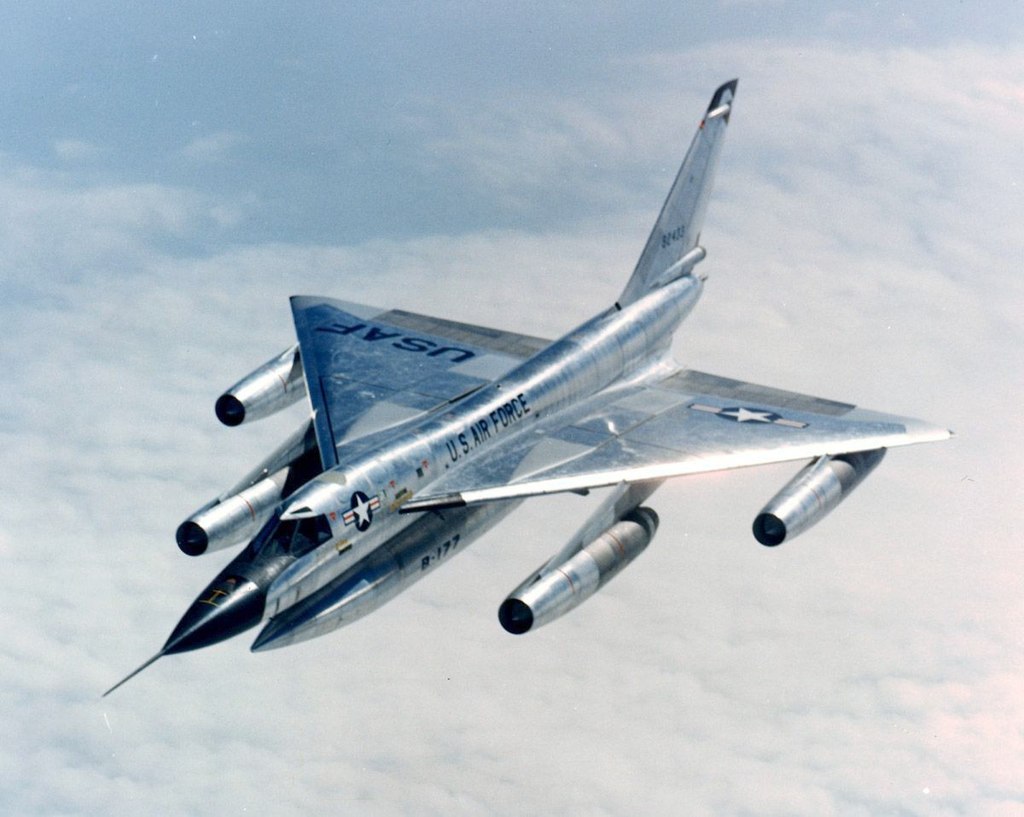
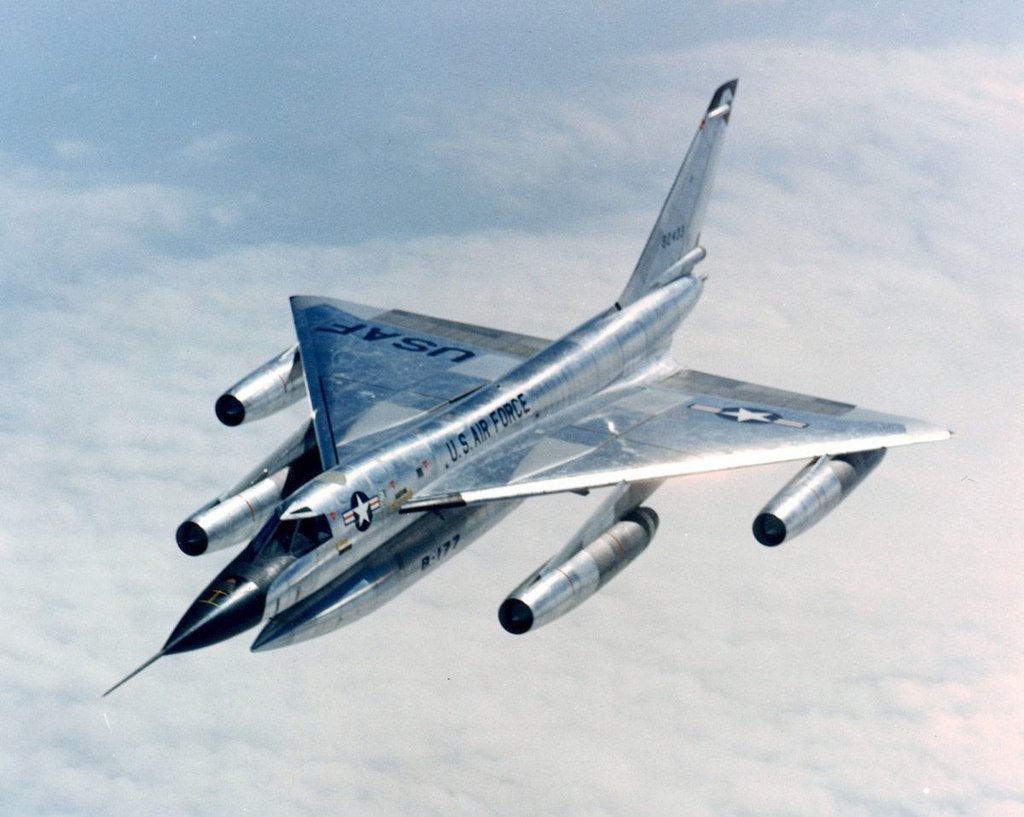
A second nordic stood on the extended ramp of a bi-convex saucer that stood on tripod landing gear on the landing strip. According to Charlie, there were Conviar B-58 Hustlers on the field even though the first one did not fly officially till 1956. These visitors said they came from another solar system.
Convair, previously Consolidated Vultee, was an American aircraft manufacturing company that later expanded into rockets and spacecraft. The company was formed in 1943 by the merger of Consolidated Aircraft and Vultee Aircraft. In 1953, it was purchased by General Dynamics, and operated as their Convair Division for most of its corporate history.
[Boeing tied to Nixon and JFK being killed (Boeing lost the TFX plane to General Dynamics)
nyone looking through the old tales of hookers and mobsters in Seymour Hersh’s new JFK book, Dark Side of Camelot will come to some interesting new information. Hersh reports that members of the security operation for General Dynamics broke into the apartment of Judith Exner Campbell in August 1962. According to Hersh, they used whatever they found there to black mail JFK into making a controversial award of the TFX (Tactical Experimental Fighter) plane development to General Dynamics. (The TFX later evolved into the F-111) Hersh claims all this became known because the FBI spied on the General Dynamics spies.
Such private covert ops as a tool of corporate control grew from practices like those of former Senator George Smathers, interviewed by the ABC television program based on Hersh’s book. In the 1950s, Smather’s law firm hired guards from a subsidiary of the security services apparatus of his friend George Wackenhut. The guards worked at the nuclear-bomb site in Nevada and Cape Canaveral, despite federal prohibition against such an arrangement between government and private police. The private group Wackenhut still supplies security to the US-owned Area 51. Steamshovel examines this issue in the book NASA, Nazis and JFK (click Steamshovel book cover above), and also makes available The Torbitt Document Supplement, with a longer article on Smathers.
Additionally, Steamshovel presents here JFK’s public statements as president on the TFX. It includes references to various dimensions of the controversy surrounding the contract with General Dynamics, the topic of Kennedy’s last speech on November 22, including early financial commitment to it from Australia, home of Pine Gap, the down-under version of Area 51.
News Conference, 3/21/63
Q. Mr. President, the TFX contract is causing a lot of controversy on Capitol Hill. Senator Symington told the Senate today that the investigation was affecting military morale and ought to be wound up quickly. How do you feel about it?THE PRESIDENT: I see nothing wrong with the Congress looking at these matters. My judgment is that the decision reached by Secretary McNamara was the right one, sound one, and any fair and objective hear- ing will bring that out. Mr. McNamara chose the plane he chose because he felt it most efficient, because he thought it would do the job and because he thought it would save the Government hundreds of millions of dollars. Everything I have read about the TFX and seen about it confirms my impression that Mr. McNamara was right. We have a very good, effective Secretary of Defense with a great deal of courage, who is willing to make hard decisions, and who doesn’t mind when they are made that a good many people don’t like it. This contract involves a large amount of money and naturally some people would prefer it to go another place than the place which the Secretary chose. I think the Secre tary did the right thing and I think this in- vestigation will bring that out, and I have no objection to anyone looking at the contract as long as they feel that a useful function is served.Q. Do you think the hearing that has been held has been fair and objective?THE PRESIDENT: I would think that-I’m confident that we all know a lot more about the TFX than we did before, and that’s a good thing. And my judgment is that the more this hearing goes on, the more con- vinced people are finally that Secretary McNamara is a very effective Secretary of Defense and that we’re lucky to have him. …
They posed detailed questions about our nuclear testing. [12]
Another ‘whistleblower’ who confirms that First Contact involved an extraterrestrial race being spurned for their principled stand on technology transfer is the son of the famous creator of the Lear Jet, William Lear.
John Lear is a former Lockheed L-1011 Captain who flew over 150 test aircraft and held 18 world speed records, and during the late 1960’s, 1970’s and early 1980’s was a contract pilot for the CIA.
Lear developed a close relationship with CIA Director (DCI) William Colby who was in charge of covert operations in Vietnam before becoming DCI.
According to Lear there had indeed been a warning from another race prior to an agreement being eventually signed, and he claimed they visited Muroc/Edward and the following occurred:
In 1954, President Eisenhower met with a representative of another alien species at Muroc Test Center, which is now called Edwards Airforce Base. This alien suggested that they could help us get rid of the Greys but Eisenhower turned down their offer because they offered no technology. [13]
Cooper’s and Lear’s idea of more than one extraterrestrial race interacting with the Eisenhower administration is supported by other whistleblowers such as former Master Sergeant Robert Dean who like Cooper, had access to top secret documents while working in the intelligence division for the Supreme Commander of a major US military command.
In Dean’s 27 year distinguished military career, he served at the Supreme Headquarters Allied Powers Europe where he witnessed these documents while serving under the Supreme Allied Commander of Europe.
Dean claimed:
The group at the time, there were just four that they knew of for certain and the Greys were one of those groups. There was a group that looked exactly like we do.
There was a human group that looked so much like us that that really drove the admirals and the generals crazy because they determined that these people, and they had seen them repeatedly, they had had contact with them, there had been abductions, there had been contacts…
Two other groups, there was a very large group, I say large, they were 6-8 maybe sometimes 9 feet tall and they were humanoid, but they were very pale, very white, didn’t have any hair on their bodies at all.
And then there was another group that had sort of a reptilian quality to them. We had encountered them, military people and police officers all over the world have run into these guys.
They had vertical pupils in their eyes and their skin seemed to have a quality very much like what you find on the stomach of a lizard.
There is some discrepancy in the testimonials as to which Air force base the spurned extraterrestrials met with President Eisenhower and/or Eisenhower administration officials.
Cooper claims this occurred at Homestead Air force base in Florida, and not Edwards. [15]
On the other hand Lear and Suggs suggest it occurred at Edwards. In his letter, Gerald Light pointed to intense disagreement amongst Eisenhower officials in responding to the extraterrestrials at the Edwards AFB meeting.
Such intense disagreement may predictably have occurred if national security officials were responding to an extraterrestrial request to abandon the pursuit of weapons technologies.
Given the intensity of the Cold War, the national security officials present may well have decided it was more prudent to seek better terms before agreeing to the extraterrestrials request. Light’s testimony implies that the meeting at Edwards did not result in an agreement, but instead resulted in intense disagreement between Eisenhower officials.
Consequently, I will conclude that the Lear and Suggs version is more accurate, and that the ‘First Contact’ meeting occurred at Edwards Air force base in February 20-21, 1954.
The Subsequent 1954 Agreement with Extraterrestrials
According to the testimonies examined so far, the February 20-21, 1954 meeting was not successful, and the extraterrestrials were spurned due to their refusal to enter into technology exchanges and insistence on nuclear disarmament by the US and presumably other major world powers.
Cooper describes the circumstances of a subsequent agreement that was reached after the failure of the first meeting.
While Cooper has a different version of dates and times for the 1954 meetings, he agrees that there were two sets of meetings involving different extraterrestrials meeting with President Eisenhower and/or Eisenhower administration officials. [16]
Later in 1954 the race of large nosed Gray Aliens which had been orbiting the Earth landed at Holloman Air Force Base.
A basic agreement was reached. This race identified themselves as originating from a Planet around a red star in the Constellation of Orion which we called Betelgeuse. They stated that their planet was dying and that at some unknown future time they would no longer be able to survive there. [17]
The meeting at Holloman Air force base in New Mexico has reportedly been the site of subsequent extraterrestrial meetings with the same extraterrestrials who it will be shown signed the 1954 treaty.
In 1972-73, for example, the producers Robert Emenegger and Allan Sandler, had allegedly been offered and witnessed actual Air force film footage of a meeting involving Grey extraterrestrials that occurred at Holloman Air force base in 1971. [18]
Cooper explained the terms of the 1954 treaty reached with the Grey extraterrestrials as follows:
The treaty stated that the aliens would not interfere in our affairs and we would not interfere in theirs. We would keep their presence on earth a secret. They would furnish us with advanced technology and would help us in our technological development.
They would not make any treaty with any other Earth nation.
They could abduct humans on a limited and periodic basis for the purpose of medical examination and monitoring of our development, with the stipulation that the humans would not be harmed, would be returned to their point of abduction, would have no memory of the event, and that the alien nation would furnish Majesty Twelve (MJ-12) with a list of all human contacts and abductees on a regularly scheduled basis. [19]
Another whistleblower source for a treaty having been signed is Phil Schneider, a former geological engineer that was employed by corporations contracted to build underground bases worked extensively on black projects involving extraterrestrials.
He revealed his own knowledge of the treaty in the following:
Back in 1954, under the Eisenhower administration, the federal government decided to circumvent the Constitution of the United States and form a treaty with alien entities. It was called the 1954 Grenada Treaty, which basically made the agreement that the aliens involved could take a few cows and test their implanting techniques on a few human beings, but that they had to give details about the people involved. [20]
Schneider’s knowledge of the treaty would have come from his familiarity with a range of compartmentalized black projects and interaction with other personnel working with extraterrestrials.
Yet another whistleblower source for an agreement being signed is Dr Michael Wolf, who claims to have served on various policy-making committees responsible for extraterrestrial affairs for twenty five years. [21]
He claims that the Eisenhower administration entered into the treaty with an extraterrestrial race and that this treaty was never ratified as constitutionally required. [22]
Significantly, a number of whistleblowers argue that the treaty that was signed involved some compulsion on the part of the extraterrestrials.
Don Phillips is a former Air force serviceman and employee on clandestine aviation projects who testified having seen documents describing the meeting between President Eisenhower and extraterrestrials, and the background to a subsequent agreement:
We have records from 1954 that were meetings between our own leaders of this country and ET’s here in California. And, as I understand it from the written documentation, we were asked if we would allow them to be here and do research.
I have read that our reply was well, how can we stop you? You are so advanced. And I will say by this camera and this sound, that it was President Eisenhower that had this meeting. [23]
Col. Phillip Corso, a highly decorated officer that served in Eisenhower’s National Security Council alluded to a treaty signed by the Eisenhower administration with extraterrestrials in his memoirs. He wrote:
“We had negotiated a kind of surrender with them [extraterrestrials] as long as we couldn’t fight them. They dictated the terms because they knew what we most feared was disclosure.” [24]
Corso’s claim of a ‘negotiated surrender’ suggests that some sort of agreement or ‘treaty’ was reached which he was not happy with.
What Do We Know of the Grey Extraterrestrials that signed the Treaty?
By 1955 it became obvious that the aliens had deceived Eisenhower and had broken the treaty…
It was suspected that the aliens were not submitting a complete list of human contacts and abductees to the Majesty Twelve and it was suspected that not all abductees had been returned. [25]
Similarly, Lear argued that the Grey extraterrestrials quickly broke the treaty and could not be trusted:
… a deal was struck that in exchange for advanced technology from the aliens we would allow them to abduct a very small number of persons and we would periodically be given a list of those persons abducted.
We got something less than the technology we bargained for and found the abductions exceeded by a million fold than what we had naively agreed to. [26]
Other whistleblowers also suggested that the extraterrestrials who signed the Treaty with Eisenhower couldn’t be trusted. Schneider claimed that despite the treaty’s provisions on the number of humans who would be ‘abducted’ for experiments,
“the aliens altered the bargain until they decided they wouldn’t abide by it at all.” [27]
As mentioned earlier, Col Phillip Corso similarly believed that the extraterrestrials that the Eisenhower administration entered into agreements with couldn’t be trusted.
Corso believed these forced a ‘negotiated surrender’ suggesting an extraterrestrial agenda that was suspect.
While General Douglas Macarthur didn’t directly mention any government treaty with extraterrestrials, he gave a famous warning in October 1955 suggesting that some extraterrestrial presence existed that threatened human sovereignty:
You now face a new world, a world of change. We speak in strange terms, of harnessing the cosmic energy, of ultimate conflict between a united human race and the sinister forces of some other planetary galaxy.”
“The nations of the world will have to unite, for the next war will be an interplanetary war. The nations of the earth must someday make a common front against attack by people from other planets. [28]
Macarthur may well have been alluding to the same extraterrestrials that Corso, Cooper and Lear believed had entered into an agreement with the Eisenhower administration.
Significantly, reports of contacts with extraterrestrials began to change once the alleged treaty began to be implemented.
The friendly ‘space brothers’ reports involving contactees of the 1950s changed as reports of abductions began to emerge after the first recorded case in 1961 involving Barney and Betty Hill:
Another apparent pattern that has occurred in Ufology is the dominance of the space brothers in the 1950’s who were kind, interacted with people who became known as contactees, and took people for rides in their space crafts.
This pattern changed dramatically with the abduction of Betty and Barney Hill in the early 1960’s.
The space brother human types of the 1950’s seemed to fade away, and they were replaced in the UFO literature with another type of alien. In the early sixties the first abduction of the Hills began a new pattern where the aliens were grey “evil” aliens who would abduct people against their will, and perform medical procedures on them.
There were, as far as this author is aware no confirmed cases of “classic” abductions in the 1950’s.
Unlike the “good” space brothers of the 1950’s these grey aliens were described by all, who were unfortunate enough to have met with them, as being distant and without emotions. [29]
According to Wolf, the extraterrestrials were Greys from the fourth planet of the star system Zeta Reticulum, while Cooper claims they were tall Greys from Betelgeuse, Orion.
Wolf’s and Cooper’s differing versions likely reflect a close relationship between Greys from Rigel and Betelguese, and that more than one species of extraterrestrials may have been covered in the treaty.
Wolf has described the Greys as having positive motivations in regard to their presence on Earth, but have been inhibited and targeted by rogue elements in the US military. [30] Similarly, Robert Dean believes that the extraterrestrials visiting Earth are friendly. [31]
This contrasts with the testimonies of Cooper, Lear, Schneider, Corso and arguably even Macarthur over the true motivations of the Greys. It is worth repeating Gerald Light’s claim of a “terrific conflict between the various ‘authorities’” on whether to inform the general public or not.
It is likely that these differing perspectives on the motivations of the Greys reflected an uncertainty that has continued to intensely divide policy makers up to the present on how to best respond to the extraterrestrial presence and what to tell the general public. [32]
Maintaining Secrecy and Witness Credibility
The uncertainty over the motivations and behavior of the Grey extraterrestrials appears to have played a large role in the government decision not to disclose the extraterrestrial presence and the treaty Eisenhower signed with them.
The following passage from an ‘alleged official document’ leaked to UFO researchers describes the official secrecy policy adopted in April 1954, two months after Eisenhower had ‘First Contact’ with extraterrestrials who were spurned by the Eisenhower administration:
Any encounter with entities known to be of extraterrestrial origin is to be considered to be a matter of national security and therefore classified TOP SECRET (see below images).
Under no circumstances is the general public or the public press to learn of the existence of these entities.
The official government policy is that such creatures do not exist, and that no agency of the federal government is now engaged in any study of extraterrestrials or their artifacts. Any deviation from this stated policy is absolutely forbidden. [33]
Penalties for disclosing classified information concerning extraterrestrials are quite severe.
In December 1953, the Joint Chiefs of Staff issued Army-Navy-Air Force publication 146 that made the unauthorized release of information concerning UFOs a crime under the Espionage Act, punishable by up to 10 years in prison and a $10,000 fine. [34]
According to Robert Dean, this draconian penalty is what prevents most former military servicemen from coming forward to disclose information. [35]
“Special Operations Manual, SOM1-01
Extraterrestrial Entities and Technology, Recovery and Disposal,”
April 1954 Part 2
Image n° 1
Image n° 2
Image n° 3
Image n° 4
Image n° 5
Image n° 6
Image n° 7
Image n° 8
Image n° 9
Image n° 10
Image n° 11
Image n° 12
The strategies for dealing with those former servicemen, corporate employees or witnesses brave or ‘foolish’ enough to come forward to reveal classified information is to intimidate, silence, eliminate or discredit these individuals.
This policy involves such strategies as removing all public records of former military service men or corporate employees, forcing individuals to make retractions, deliberately distorting statements of individuals, or discrediting individuals. Bob Lazar, for example, claimed to be a former physicist employed with reverse engineering extraterrestrial craft.
He described the disappearance of all his university and public records indicating how military-intelligence agencies actively discredit whistleblowers. [36]
In the cases of the witnesses cited so far, Cooper, Schneider, Lear, Wolf, all have been subjected to some or all of these strategies thereby making it difficult to reach firm conclusions about their testimonies.
Since the creation of controversy, uncertainty, and confusion is the modus operandi of military-intelligence agencies in maintaining secrecy of the extraterrestrial presence, then the testimonies of former officials/employees/witnesses need to be considered on their merits.
While issues of credibility, credentials, disinformation are important in the study of the extraterrestrial presence, a rigorous methodology for dealing with the efforts of military-intelligence agencies to discredit, intimidate or create controversy around particular witnesses, has yet to be developed.
For example, numerous efforts to discredit Cooper in particular by referring to inconsistencies in his statements, retractions, egregious behavior and stated positions, may be due in part or in whole to the policy of military-intelligence officials to discredit and/or intimidate Cooper from leaking classified information that he may very well have witnessed in his official capacities.
Since Cooper’s military record does indicate he did serve in an official capacity on the briefing team of the Commander of the Pacific Fleet, it is most likely that much of his testimony is credible.
Whatever inaccuracies exist in terms of his recollections of the timing of meetings between the Eisenhower administration and extraterrestrials may either have been due to memory lapses or perhaps deliberately introduced as a self-protective mechanism.
It has been pointed out by some ‘whistleblowers’ that making retractions or sowing inaccuracies in testimonies is sometimes essential in disseminating information without being physically harmed. [37]
The controversialCooperhad been subjected to undoubtedly the longest and most intense military-intelligence efforts to discredit or intimidate any whistleblower revealing classified information.
The non-disclosure policy developed for the extraterrestrial presence is most likely due to a profound policy dilemma on the part of responsible national security officials.
This dilemma comes from uncertainty over what the true benefits of the purported 1954 treaty were, and what the consequences of the treaty would be. While the signing of the treaty provided US national security agencies an opportunity to study extraterrestrial technologies, and to observe the extraterrestrial biological program with abducted civilians, it appeared the treaty was not as beneficial as was first thought due to excessive abductions of US civilians.
The subsequent behavior of the Greys in their interactions with US national security agencies was the most likely reason for deferring a decision to release news of the treaty and the extraterrestrial presence to the global public. According to Lights’ testimony, Eisenhower had indicated to those present on February 20-21, 1954, that an announcement would be made soon after the First Contact event.
Since this didn’t occur, and a treaty was eventually signed with a different group of extraterrestrials, the Greys, this suggested that the national security agencies were deeply divided over the wisdom of disclosing this information, and alarmed by the possible public reaction to the Grey activities.
At his farewell speech in 1961, President Eisenhower was possibly alluding to the growing power of national security agencies that dealt with the extraterrestrial presence and were gaining great power as a result of the dilemma over what to do with the extraterrestrial presence:
In the councils of government, we must guard against the acquisition of unwarranted influence, whether sought or unsought, by the military industrial complex.
The potential for the disastrous rise of misplaced power exists and will persist. We must never let the weight of this combination endanger our liberties or democratic processes. We should take nothing for granted.
Only an alert and knowledgeable citizenry can compel the proper meshing of the huge industrial and military machinery of defense with our peaceful methods and goals, so that security and liberty may prosper together.
If the President was dissatisfied with the non-disclosure of the extraterrestrial presence, then his speech was indicating that the responsible national security agencies were both dominating public policy and taking a ‘hard-line approach’ that was inconsistent with American democratic ideals.
In the subsequent decades, it appears that on a number of occasions, official disclosure was seriously contemplated. For example, Robert Emenegger and Allan Sandler claimed they were approached by the Pentagon in 1972 to produce an officially sanctioned video that would be used for official public disclosure of the extraterrestrial presence.
When the offer was later withdrawn, the reason given was that the time was no longer suitable due to the Watergate Scandal. While it is undoubtedly true that political factors would impact on making a formal disclosure announcement, it is more likely the case that non-disclosure was caused by lack of clarity over what the true motivations of the extraterrestrials were, and the impact an announcement would have on extraterrestrial activities.
Making any announcement of the extraterrestrial presence would naturally have lead to questions concerning the extraterrestrials’ motivations and activities. If officials couldn’t agree on appropriate answers, they most likely decided that it was better to defer disclosure rather than threaten national security by making inaccurate announcements.
The precise nature of the extraterrestrial abductions and the medical programs implemented by the Greys has been extensively researched and discussed by a number of UFO researchers.
Their conclusions vary widely suggesting that the deep disagreement among private UFO researchers over the motivations and activities of the Greys, very likely mirrors that of official government sources. [38]
As long as such uncertainty continues, it appears that disclosure may continue to be deferred until key global events no longer makes the non-disclosure policy viable.
Conclusion
An examination of the evidence presented in this paper in terms of whistleblower or witness testimonies raises tremendous problems in terms of coming to a conclusive opinion over:
first, the truth of the alleged ‘First Contact’ meeting between Eisenhower and extraterrestrials
second, claims of more than one set of extraterrestrials meeting with the Eisenhower administration
third, the various policy issues that arise from the meetings and subsequent treaty that was allegedly signed
Most perplexing is how to view the testimonies of whistleblowers who appear sincere, positively motivated and have plausible stories, yet are plagued by controversy, allegations of fraud, inconsistency and other irregularities.
Due to the official secrecy policy adopted towards the extraterrestrial presence, it may be concluded that some if not most of the controversy surrounding these individuals has been caused by military-intelligence agencies intent on discrediting whistleblower or witness testimonies.
While there continues to be uncertainty caused by the controversy surrounding whistleblower testimonies and the role of military-intelligence agencies in generating this controversy, the bulk of evidence points to a ‘First Contact’ meeting having occurred during Eisenhower’s Palm Spring vacation on February 20-21, 1954.
The testimonies suggest that the extraterrestrials in the First Contact event, a race of tall ‘Nordic’ extraterrestrials were spurned due to their reluctance to provide advanced technology in an agreement.
A subsequent meeting and treaty was then signed with a different set of extraterrestrials, commonly called Greys, who did not have the same reluctance in exchanging extraterrestrial technology as part of an agreement.
Most of the available evidence that has found its way into the public arena suggests that the extraterrestrial race with whom the treaty was signed, the Greys, are at best an enigma and at worst simply untrustworthy in their treatment of abducted civilians.
The subsequent shift in witness reports from friendly extraterrestrial ‘contacts’ to disturbing ‘abductions’, suggest that the Eisenhower administration had signed a treaty with extraterrestrials whose motivations and activities are an enigma as far as the general public interest is concerned.
The activities of the Grey extraterrestrials apparently continues to raise uncertainty for US national security agencies in terms of an appropriate strategic response. [39]
On the contrary, the friendly Nordic ‘space brothers’ faded from the scene since the Eisenhower administration saw them as not sufficiently motivated to serve the technological and strategic goals of US national security agencies.
The question of when disclosure of the treaty signed by Eisenhower and of the extraterrestrial presence might occur is one that has long been anticipated. A recent economic event might be a signal that some form of disclosure is possible in the near future.
According to Craig Copetas, Bloomberg News correspondent in Paris, the World Economic Forum at Davos Switzerland from January 21-25, 2004, discussed extraterrestrials at one or more closed sessions. In a story published on January 21, Copetas claimed that “forum officials maintain their five-day program on Partnering for Security and Prosperity requires an unambiguous examination of extraterrestrial presence on Earth.” [40]
The Davos Forum is a gauge for trends in the global economy and discusses various topics that have a long term effect on business. The inclusion of conspiracy theories of an extraterrestrial presence and technologies on the formal agenda has significance well beyond the hypothetical nature of the discussion.
Various national governments may well be tacitly letting the word out to their ‘friends in the business community’, that they had better start exploring how a future disclosure of an extraterrestrial presence and technologies will influence the business world.
Given the discussion at Davos on January 21, 2004, of a possible extraterrestrial presence, and the forthcoming 50th anniversary of Eisenhower’s treaty on February 20-21, it might be speculated that a disclosure announcement may soon be made.
As we approach the 50th anniversary of a First Contact meeting between the US and an extraterrestrial race, we must do so with wonder at the awesome nature of this occasion.
At the same time, we must do whatever necessary to make public the full details of the meeting, and the apparent spurning of what appears to be a principled extraterrestrial race that rejected technology transfers while dangerous weapons programs were in place in the US and elsewhere on the planet.
The subsequent signing of a treaty at a later date with an extraterrestrial race willing to trade technology in exchange for ‘limited medical experiments’ with civilians will surely go down in history as a deeply significant event whose effects continues to reverberate through human society.
Finally, we must be alert to the mounting evidence that while a treaty was signed after the 1954 ‘First Contact’ event, it may well have been with the ‘wrong extraterrestrials’, and that this might adversely impact on humanity if not dealt with in an open, transparent and truthful manner.
We live on the verge of a bold new future with many uncertainties over the secrecy surrounding the extraterrestrial presence, what best prepares us as this information enters into the public arena are our faith, democratic values, and dedication to truth.
ENDNOTES
[1] I sincerely thank H.M for his generous support of my research and providing the intellectually stimulating environment for many of the ideas in the paper to be developed. Grateful thanks also to George Arnold and two other librarians at American University’s Main Library who provided research assistance. I am also grateful to William Hamilton for permission to cite his personal notes of a 1991 interview with Sgt Charles L. Suggs.
[4] John Spencer, “Light, Gerald,” The UFO Encyclopedia: Inexplicable Sightings, Alien Abductions, Close Encounters, Brilliant Hoaxes (Avon Books, 1991) 188.
[5] “A Covenant With Death by Bill Cooper,” http://www.alienshift.com/id40.html Also in William Cooper, Behold a Pale Horse (Light Technology Publishing 1991), 203.
Fifty years ago tomorrow — on Feb. 20, 1954 — President Dwight Eisenhower interrupted his vacation in Palm Springs, Calif., to make a secret nocturnal trip to a nearby Air Force base to meet two extraterrestrial aliens. [Nevada Test Site where Nuclear Blast tests occured incluind in the tower my father James Paul Donegan stood in to watch the blast(s) go off.]
Ike and the Alien Ambassadors
By Peter Carlson
February 19, 2004
Fifty years ago tomorrow — on Feb. 20, 1954 — President Dwight Eisenhower interrupted his vacation in Palm Springs, Calif., to make a secret nocturnal trip to a nearby Air Force base to meet two extraterrestrial aliens.
Or maybe not. Maybe Ike just went to the dentist. There’s some dispute about this.
The Ike-met-with-ETs theory is advanced by Michael Salla, a former American University professor who now runs the Peace Ambassador Program at AU’s Center for Global Peace.
The Ike-went-to-the-dentist theory is advanced by the folks at the Dwight D. Eisenhower Library in Abilene, Kan. And by James M. Mixson, a dentist, professor of dentistry and historian of presidential dental work.
Just to make things more intriguing: On the night in question, the Associated Press reported this: “Pres. Eisenhower died tonight of a heart attack in Palm Springs.”
Or maybe not. Maybe Ike just went to the dentist. There’s some dispute about this.
The Ike-met-with-ETs theory is advanced by Michael Salla, a former American University professor who now runs the Peace Ambassador Program at AU’s Center for Global Peace.
The Ike-went-to-the-dentist theory is advanced by the folks at the Dwight D. Eisenhower Library in Abilene, Kan. And by James M. Mixson, a dentist, professor of dentistry and historian of presidential dental work.
Just to make things more intriguing: On the night in question, the Associated Press reported this: “Pres. Eisenhower died tonight of a heart attack in Palm Springs.”
Two minutes later, the AP retracted that bulletin and reported that Ike was still alive.
Indeed, Ike was alive. And he continued living until 1969. But in the decades since his death, his activities on the night of Feb. 20, 1954, have become fodder for strange theories about alien beings.
Some facts are beyond dispute: Eisenhower was on a golf vacation in Palm Springs on Feb. 20, 1954. After dinner that night, he made an unscheduled departure from the Smoking Tree Ranch, where he was staying. The next morning, he attended a church service in Los Angeles. Also that morning, his spokesman announced to the press that Ike had visited a dentist the previous night because he’d chipped a tooth while eating a chicken wing at dinner.
Salla, who has a PhD in government from the University of Queensland in his native Australia, doesn’t believe it. He figures the dentist trip is just a cover story. He believes Ike went to Edwards Air Force Base, where he met with two ETs with white hair, pale blue eyes and colorless lips.
These aliens — nicknamed “Nordics” in UFO circles because they resemble Scandinavian humans — traveled to Edwards from another solar system in a flying saucer and, Salla says, they spoke to Eisenhower.
“There was telepathic communication,” says Salla, 45, as he sits in his suburban Falls Church living room. “It’s as though you’re hearing a person but they’re not speaking.”
The “Nordics” offered to share their superior technology and their spiritual wisdom with Ike if he would agree to eliminate America’s nuclear weapons.
“They were afraid we might blow up some of our nuclear technology,” Salla says, “and apparently that does something to time and space and it impacts on extraterrestrial races on other planets.”
Ike declined the ETs’ offer, Salla says, because he did not want to give up the nukes.
Sometime later in 1954, Ike reached a deal with another race of extraterrestrials, known as the “Greys” — allowing them to capture earthling cattle and humans for medical experiments, provided that they returned the humans safely home. Since then, Salla says, the “Greys” have kidnapped “millions” of humans.
Salla, author of “The Hero’s Journey Toward a Second American Century,” published his ET theories in his new book, “Exopolitics: Political Implications of the Extraterrestrial Presence” and in an article on his “Exopolitics” Web site (www.exopolitics.org).
For much of the ’90s, Salla studied conflict resolution and tried unsuccessfully to apply that knowledge to prevent war in East Timor and the Balkans, he says. Frustrated, he began looking for an extraterrestrial connection to human misery and, he says, he found evidence of ET visitations — including the Ike encounter — on the Internet.
“There’s a lot of stuff on the Internet,” he says, “and I just went around and pieced it together.”
Meanwhile, he taught at the School of International Service at American University. In 2003 he founded the university’s Peace Ambassador Program, described on the AU Web site as a “summer program that combines study, meditative practices, and prayer ceremonies at selected Washington DC sites aimed at promoting individual self-empowerment and Divine Governance in Washington DC.”
Salla stresses that his ET research is not connected with his work at AU’s Center for Global Peace. The folks at the Center for Global Peace are also quite eager to stress that fact.
“The research that Michael Salla is doing is not research that he is conducting on behalf of the center or in collaboration with the center,” says Betty Sitka, associate director of the Center for Global Peace. “This is his own personal research.”
Meanwhile, the question remains: Did Ike really meet with ETs 50 years ago?
“Not to our knowledge,” says Jim Leyerzapf, an archivist at the Eisenhower Library. “There’s nothing in the archives that indicates that.”
Then Leyerzapf bursts out laughing.
He has heard this theory before. “We’ve had so many requests on that subject that we have a person who specializes in this.”
That person is archivist Herb Pankratz.
“He specialized in transportation,” Leyerzapf says, “and we decided to add UFOs to that. He does trains, planes, automobiles — and flying saucers.”
The library fielded dozens of questions about the alleged Ike-ET meeting in the late ’80s and early ’90s, when several UFO books advanced the theory, Pankratz says.
“It’s interesting how these stories have changed,” Pankratz noted in an e-mail. “Initially, the accounts claimed the President made a secret trip to Edwards Air Force Base to view the remains of aliens who had crashed at Roswell, N.M., in 1947. Later stories then claimed he had actually visited with live aliens.”
Pankratz doesn’t buy either theory. He believes the dentist story, and he cites James Mixson, the dental historian and professor at the University of Missouri-Kansas City School of Dentistry. Mixson’s article “A History of Dwight D. Eisenhower’s Oral Health” — published in the November 1995 issue of the Bulletin of the History of Dentistry — is the definitive work on Ike’s teeth.
Citing the U.S. surgeon general’s records on Ike’s medical and dental history, opened to researchers in 1991, Mixson reported that on the fateful night of Feb. 20, 1954, Ike chipped the porcelain cap of his “upper left central incisor” and it was repaired by Dr. Francis A. Purcell.
Alas, Purcell is unavailable for comment. He died in 1974, according to Pankratz.
“The lack of a dental record from Purcell’s office,” Mixson wrote, “has helped fuel belief in this UFO encounter.”
But, Mixson quickly added, “the President had well-documented difficulties with this crown.”
Indeed, the crown, which was installed in July 1952, was chipped and repaired in December 1952, the February in question, and again in July 1954, when the president’s dentist, Col. James M. Fairchild, replaced it with a “thin cast gold/platinum thimble crown.”
That may be more than you wanted to know about Ike’s dental work. If not, Mixson goes on at some length, quoting a long, lyrical passage written by Fairchild on this troublesome presidential incisor.
Meanwhile, there’s another perplexing question: Why did the AP report that Ike died that night?
“Somebody was fooling around and it went out,” Pankratz says. “It wasn’t supposed to go out but it did.”
Ike never made any public statement about meeting ETs, Pankratz says. But did he perhaps spill the beans to his family? Ike’s son, John S.D. Eisenhower, is a retired Army brigadier general and author of several books on history, including “General Ike: A Personal Reminiscence.”
Asked via e-mail if his father had ever mentioned meeting with aliens, Eisenhower responded with a short but emphatic reply:
“No.”
He declined to comment further.
Michael Salla’s new book advances his theory that, in 1954, President Eisenhower met secretly with extraterrestrial ambassadors.
Free Masons in the piple 1954
there is speculation suggesting that Thomas Jefferson was a Freemason; however, there is no record of him being initiated into any lodge, nor are there any references to Masonic membership in his personal papers.
George Washington 1st President (1732–1799) 1st • April 30, 1789 –March 4, 1797
Initiated on November 4, 1752, in Fredericksburgh Lodge No. 4, Fredericksburg, Virginia. Elected Worshipful Master on December 20, 1788.
James Monroe (1758–1831) 5th President • March 4, 1817 – March 4, 1825
Initiated on November 9, 1775, in Williamsburg Lodge No. 6, Williamsburg, Virginia at the age of 17 while he studied at the College of William & Mary.
Andrew Jackson (1767–1845) 7th PResident • March 4, 1829 – March 4, 1837 Member of St. Tammany (later Harmony) Lodge No. 1, Nashville, Tennessee. Elected Grand Master of Tennessee on October 7, 1822, and served until October 4, 1824.
James K. Polk (1795–1849) 11th President• March 4, 1845 – March 4, 1849 Initiated on June 5, 1820, in Columbia Lodge No. 31, Columbia, Tennessee.
James Buchanan (1791–1868) 15th President • March 4, 1857 – March 4, 1861 Initiated on December 11, 1816, in Lodge No. 43, Lancaster, Pennsylvania. Appointed District Deputy Grand Master for the counties of Lancaster, Lebanon and York in 1824. President Andrew Johnson.jpg
Andrew Johnson (1808–1875) 17th • April 15, 1865 – March 4, 1869 Initiated on May 5, 1851, in Greenville Lodge No. 119, Greenville, Tennessee.
James A. Garfield (1831–1881) 20th • March 4, 1881 – September 19, 1881 Initiated on November 19, 1861, in Magnolia Lodge No. 20, Columbus, Ohio and raised on November 22, 1864 in Columbus Lodge No. 30. Joined Garrettsville Lodge No. 246, Garrettsville, Ohio in 1866 and was its chaplain for the years 1868-69. Charter Member of Pentalpha Lodge No. 23, Washington, D.C.
William McKinley (1843–1901) 25th • March 4, 1897 – September 14, 1901 Initiated on May 1, 1865, in Hiram Lodge No. 21, Winchester, Virginia. Joined Canton Lodge No. 60, Canton, Ohio in 1867. Charter member of Eagle (later William McKinley) Lodge No. 431, also in Canton.
Theodore Roosevelt (1858–1919) 26th • September 14, 1901 – March 4, 1909 Initiated on January 2, 1901, in Matinecock Lodge No. 806, Oyster Bay, New York. Anders L. Zorn – William Howard Taft – Google Art Project.jpg
William H. Taft (1857–1930) 27th • March 4, 1909 – March 4, 1913 Made a Mason at Sight on February 18, 1909, in Kilwinning Lodge No. 356, Cincinnati, Ohio
Warren G. Harding (1865–1923) 29th • March 4, 1921 – August 2, 1923 Initiated on June 28, 1901, in Marion Lodge No. 70, Marion, Ohio. Raised on August 27, 1920 in that Lodge.
Franklin D. Roosevelt (1882–1945) 32nd • March 4, 1933 – April 12, 1945 Initiated on October 11, 1911, in Holland Lodge No. 8, New York City. Was made a Prophet-at-Sight in Tri-Po-Bed Grotto on October 30, 1931. Made Honorary Grand Master of the Order of DeMolay on April 13, 1934.
In addition to the individuals listed above, Lyndon B. Johnson was initiated into the first degree of Freemasonry – “Entered Apprentice”, October 30, 1937, in Johnson City Lodge No. 561, at Johnson City, Texas, but did not advance any further and did not become a full member of his lodge.
Harry S. Truman (1884–1972) 33rd • April 12, 1945 – January 20, 1953 Initiated on February 9, 1909, in Belton Lodge No. 450, Belton, Missouri. First Worshipful Master of Grandview Lodge No. 618, Grandview, Missouri in 1911. Elected Grand Master of Missouri on September 25, 1940 and served until October 1, 1941. Received the 33rd Degree on October 19, 1945. Made Honorary Grand Master of the Order of DeMolay on May 18, 1959.
Gerald Ford (1913–2006) 38th • August 9, 1974 – January 20, 1977 Initiated on September 30, 1949, in Malta Lodge No. 465, Grand Rapids, Michigan. Passed on April 20, 1951 and raised on May 18 of that year in Columbia Lodge No. 3, Washington, D.C. Received the 33rd Degree on September 26, 1962. Made Honorary Grand Master of the Order of DeMolay in April 1975.
Ronald Reagan was made an honorary Freemason, and as a youth, Bill Clinton was a member of the Order of DeMolay.
Truman and Ford look most likley to be along side Free Mason Donald Barr, J. Edgar Hoover, and others likely Cabell Rockefeller Rothschilds, Howard Hughes others.
Ford will be on Warren Commision and alter the report on where the bullet hit JFK and later by tied to Nixon as VP.
Franklin D. Roosevelt FDR 1944 Color Portrait.jpg Roosevelt’s official campaign portrait, 1944 32nd President of the United States In office March 4, 1933 – April 12, 1945 Vice President John Nance Garner (1933–1941) Henry A. Wallace (1941–1945) Harry S. Truman (January–April 1945) Preceded by Herbert Hoover Succeeded by Harry S. Truman
One of the most influential presidents of the USA FDR followed the Great Depression into the rise of Nazis and Berlin Olympics 1936, the The Anschluss also known as the Anschluß Österreichs was the annexation of the Federal State of Austria into the German Reich on 13 March 1938.
The attack on Pearl Harbor was a surprise military strike by the Imperial Japanese Navy Air Service upon the United States against the naval base at Pearl Harbor in Honolulu, Territory of Hawaii, just before 8:00 a.m. on Sunday, December 7, 1941. Wikipedia
Joseph Kennedy Sr. first met with Franklin D. Roosevelt when the latter was serving as Assistant Secretary of the Navy during the First World War. Kennedy had taken a position at the Fore River Shipyard at Quincy Point, Massachusetts. Kennedy didn’t need to work at the shipyard, he was already quite well-to-do from his successful investments in real estate and banking, but he wanted to support the American war effort, with an eye on a future political career. As an assistant supervisor, he was a member of a construction effort which delivered more than 70 destroyers to the US Navy over the course of the war.
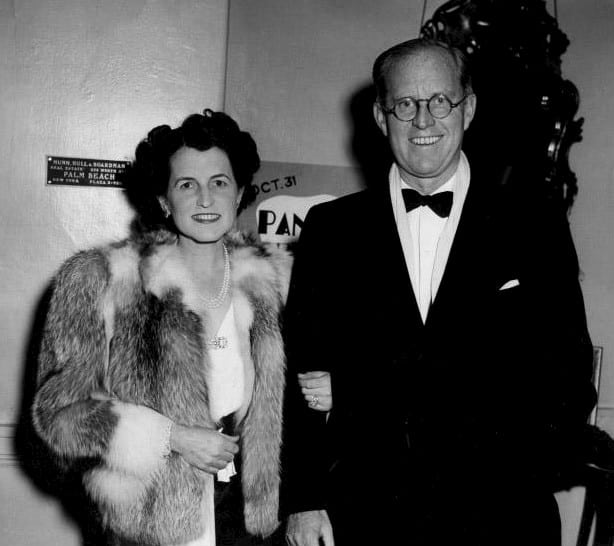
Rose and Joseph P. Kennedy in November, 1940. Wikimedia
Though he and FDR did not work closely together during World War One, subsequent events would bring them together again during the Great Depression. By then both men were well known for their wealth and the image of privilege which surrounded them. FDR, an athletic man during the First World War, had been stricken with polio and confined to a wheelchair. Kennedy was known for his affairs with Hollywood starlets, his real estate empire, and his uncanny ability to make huge sums of money through the stock market, all through the 1920s. Roosevelt had need of his services, and Kennedy had need of a political patron. Neither got exactly what they wanted.
John F. Fitzgerald, known as Honey Fitz, was Joseph Kennedy’s father-in-law and political patron. Wikimedia
1. Kennedy was born into a financially comfortable Boston family
Joe Kennedy’s father was a successful saloon owner and real estate investor when Joe was born, and though the family was shunned by Boston society for being Irish, they were financially well off. Joe was an indifferent student, though popular and athletic, and entered Harvard College, at which he lobbied hard to join the Hasty Pudding Club and played on the school’s baseball team. When he graduated it was with a bachelor’s degree in economics, in 1912. Two years later he surrendered his status as a bachelor when he married Rose, the daughter of John Fitzgerald, the mayor of Boston known by his nickname, Honey Fitz.
Following his graduation from Harvard, Kennedy first worked as an employee of the Commonwealth, serving as a bank examiner. His sharp eye for opportunity and astute financial judgment, as well as what in a later day, came to be called inside information presented him with his first business coup. Aware that Columbia Trust Bank was about to be taken over he borrowed the equivalent of $1.1 million dollars and purchased control of the bank, installing himself as its president, through an election held among the shareholders. He was just 25 at the time, and he boasted that he was the youngest bank president in the United States, an unconfirmed piece of bravado.
Joseph P. Kennedy was a bank president at the age of just 25. JFK Presidential Library
ADVERTISEMENT – CONTINUE READING BELOW
2. Joe Kennedy began investing in real estate while still working as a bank examiner
Kennedy’s position as a state bank examiner allowed him access to information which was nearly priceless from a standpoint as an investor. Examination of bank records gave him information on the financial condition of depositors, the status of mortgages and other loans, and which companies had been developing new products and services ready to bring to market. He bought control of a real estate firm in Boston called Old Colony Realty Associates. Through it, he purchased financially distressed properties in or near foreclosure, and resold them profitably. His investment in the firm paid substantial dividends.
The real estate investments led to a growing interest in the stock market following the First World War. The decade known as the Roaring Twenties, was a period during which many still believe and repeat that Kennedy was a bootlegger. There is simply no physical evidence that Kennedy participated in the illegal liquor trade, and the anecdotal evidence is all based on questionable sources. The stories didn’t begin to appear until the 1950s. During the 1930s, Kennedy was thrice confirmed by the Senate for government positions, following an investigation into his background, conducted by committees which included politicians’ hostile to the president. None of the committee records show any evidence he was suspected of bootlegging.
Kennedy was present but uninjured when a bomb struck Wall Street in 1920. Wikimedia
ADVERTISEMENT – CONTINUE READING BELOW
3. Manipulating the stock market was routine before the 1929 crash
Following the war, Kennedy joined the Boston brokerage firm of Hayden, Stone and Company. Stock manipulation, insider trading, and other activities later made illegal were all perfectly legal at the time, and astute brokers learned to recognize the signs when some entity was “playing the market”. Kennedy was in New York at the corner of Broad Street and Wall when a bomb exploded nearby on September 16, 1920. He was thrown to the ground by the force of the blast, but emerged uninjured. Italian anarchists were suspected, but the bombing has never been solved. Kennedy remained with Hayden, Stone until 1923.
While there he learned the methods of manipulating the market, driving down stock prices to purchase at lows, and driving them up to sell high. Journalists were often bribed to provide inaccurate information to the public. Pools were formed through which groups of investors controlled the activity of stock, with members of the pools reaping the profits. Kennedy left Hayden, Stone and Company in 1923, creating his own investment company. The large profits he made allowed him to become a major donor to the Democratic Party, which caught the attention of senior party officials. By then he was ready to invest in the booming film industry.
Actress Gloria Swanson was one of many women with whom Kennedy conducted extramarital affairs throughout his life. Library of Congress
ADVERTISEMENT – CONTINUE READING BELOW
4. Kennedy moved to Hollywood to make movies
Kennedy began investing in small movie studios while working as a broker, and in 1926 he moved to Hollywood, to acquire and operate movie studios and invest in films. In the 1920s film studios also owned, through subsidiaries, movie theater chains which showed their films. Kennedy executed a hostile takeover of one such chain, Keith – Albee – Orpheum Theaters Corporation (KAO). The over 700 theaters acquired were in many cases vaudeville houses, which were converted to movie theaters. Kennedy merged his film interests into a new company, Ralph – Keith – Orpheum (RKO) in 1928 in a deal in which he pocketed a large profit through the manipulation of the stocks involved.
During his period of investing in Hollywood Kennedy made an estimated $73 million in today’s money. His brash interactions with the press, particularly Hearst Newspapers, made him nationally famous. He also carried on an affair with the glamorous actress Gloria Swanson for more than three years. She was not his only indiscretion. Most of the money Kennedy made in Hollywood was invested in real estate, including Hialeah Race Track in Florida, the Chicago Merchandise Mart – then the largest building in the world – and commercial properties in New York and Boston. In 1929 the stock market crashed, but Kennedy’s fortune remained intact, and even expanded during the Great Depression.
Franklin Roosevelt steadies himself on the arm of his son James, a supporter of Kennedy’s. Wikimedia
ADVERTISEMENT – CONTINUE READING BELOW
5. Democratic Party politics brought Kennedy together with James Roosevelt, FDR’s son
During the 1932 presidential campaign, James Roosevelt served as FDR’s deputy in Massachusetts, where he had established a successful business in Boston. James became a protégé of Kennedy’s who helped guide him through the maze of Democratic alliances, and the Irish politics of Boston. James made more than 200 campaign appearances in Massachusetts on behalf of his father, who had lost the Democratic Primary in the state when the Irish Catholic vote largely went for Alfred E. Smith. Kennedy’s backing, both with money and in appearances, helped FDR appear more attractive to the Irish Catholic vote, and FDR carried the state in November.
Joe Kennedy and James Roosevelt then went to the United Kingdom, having formed a corporation called Somerset Importers. They carried with them licenses to import alcohol in limited quantities for medicinal purposes, legal under prohibition. In the UK they negotiated exclusive US distribution rights for several UK brands of scotch and gin, which began to be shipped into the United States when Prohibition ended in 1933 (the amendment was ratified before Kennedy returned). Kennedy again used information and connections to corner a large portion of the legal liquor market after Prohibition was no longer the law of the land.
Roosevelt was reluctant to appoint Kennedy to head the SEC, but was persuaded by advisors including his son James. FDR Presidential Library
ADVERTISEMENT – CONTINUE READING BELOW
6. Kennedy wanted a role in the Roosevelt Administration, and FDR found him one
In 1933, Roosevelt hastily passed a series of New Deal programs including among many the Securities Act of 1933. It offered some protections for investors, but lacked the enforcement mechanism necessary to ensure that the kind of manipulation and insider trading, as well as the propagation of false information to potential investors, was curtailed. The following year Congress passed the Securities Exchange Act of 1934. It established an enforcement arm for control of the nation’s financial markets, granted the authority to monitor trading and investigate irregularities, as well as the authority to subpoena witnesses and participants.
When FDR asked his advisors their recommendations of who was to lead the new agency, which was to be one of the most powerful of the federal government, he was provided a list, with Kennedy’s name at the top, “because of executive ability, knowledge of habits and customs of business to be regulated and ability to moderate different points of view on Commission”. FDR supposedly likened the appointment of Kennedy as an example of the adage “set a thief to catch a thief” though there are many different versions of the quote, in different times and places, and whether the president actually made the comment first is questionable, though the observation was certainly apt.
Wall Street financiers opposed the creation of the SEC, claiming they could regulate themselves. Wikimedia
ADVERTISEMENT – CONTINUE READING BELOW
7. Kennedy absorbed attacks which had been earlier directed toward Roosevelt
Richard Whitney became President of the New York Stock Exchange in 1930, serving in that role until 1935. He was one of the most vocal opponents of federal oversight of the exchanges, and established a base in Washington of like-minded financial leaders to fight the bill which created the SEC while it was debated in congress. They established themselves in a Georgetown building which became known in the press as the “Wall Street Embassy”. Arguing that Wall Street and the nation would be better off if it was allowed to regulate itself, they presented the bill as the forefront of communism in America’s financial system, and that it would prevent the economic recovery desired.
In truth, Roosevelt wavered over the appointment of Kennedy to the position for political reasons. He asked a Democratic operative, Frank Walker, to convince Kennedy to turn down the appointment. Kennedy, who was already disappointed that he had not been appointed to the President’s cabinet as Secretary of the Treasury, refused to withdraw his name. After political maneuvering among the President’s advisors and allies, as well as attacks from several opponents, including Scripps Newspapers, Kennedy was selected, subject to confirmation by the Senate. It was then up to Kennedy to bring to Wall Street the changed realities of American investments.
A crowd outside of the New York Stock Exchange in 1929 following the crash which triggered the Great Depression. Wikimedia
ADVERTISEMENT – CONTINUE READING BELOW
8. Kennedy won widespread praise for the reforms he established in the exchanges
When Kennedy entered the office of Chairman of the Securities and Exchange Commission it was under a six-month probationary period, after which he would be confirmed by the Senate or dismissed. In 1935 the Washington Post reported, “Kennedy has done one of the best jobs of anyone connected with the New Deal and has done it without bluster or publicity-seeking…” Editor John T. Flynn of the New Republic, one of the harshest critics of Kennedy receiving the appointment, changed his mind and called Kennedy one of the most useful members of the commission. Praise came from Wall Street as well, according to the Wall Street Journal in 1935.
Kennedy drew a larger wake through the Roosevelt Administration than the public realized. His success in creating and implementing the new regulations and safeguards in the nation’s exchanges reflected well on the man who appointed him – FDR. The president, beset with difficulties in several of the New Deal programs, began to frequently call on Kennedy for advice on issues, or to ask him to troubleshoot difficulties as they arose. Kennedy was at the White House (or Roosevelt visited him at his nearby estate) several times per week. He was widely considered a rising star within the Democratic Party, though for the time Roosevelt needed him where he was.
Catholic priest Charles Coughlin was an antisemitic demagogue broadcasting a nationwide radio program in the 1930s. Wikimedia
ADVERTISEMENT – CONTINUE READING BELOW
9. Silencing Father Coughlin was a tasked FDR assigned to Kennedy
Father Charles Coughlin was a former FDR supporter who turned against the president in 1934, excoriating him on radio broadcasts and newspapers and magazine articles as a “tool of the rich”. By 1934 Coughlin was broadcasting to his large audience, many of whom were Catholic and all of whom were far-right, antisemitic messages which also demanded the federal government nationalize the railroads, the financial industry, communications, and other industries. Near the end of the decade Coughlin, who like Kennedy was Irish-Catholic, was supporting many of the policies of the Nazis and the Fascists in Europe.
After Kennedy warned the president that Coughlin was becoming “very dangerous” FDR tasked him with finding a way to silence him. Kennedy approached then Auxiliary Bishop of Boston, Francis Spellman, who in turn contacted Cardinal Eugenio Pacelli, Secretary of State for the Vatican. Coughlin was finally silenced through a combination of Church orders and changes to broadcast licensing regulations which deemed the airwaves a “limited national resource”, regulated as publicly owned. Cardinal Pacelli later was elevated to the papacy, serving as Pope Pius XII.
Huey Long leaving the Senate after successfully filibustering one of FDR’s measures in 1935. Wikimedia
ADVERTISEMENT – CONTINUE READING BELOW
10. The New Deal created a wave of hatred among the press and the Congress
One of the nation’s most influential newspapers during the Great Depression years and beyond was the Chicago Tribune, run by Robert McCormick. McCormick despised Roosevelt, the New Deal, government regulation of Wall Street, and American intervention in European affairs. He supported the America First Movement and anybody who attacked Roosevelt. He was one of a legion of right-wingers who had the opportunity to attack Roosevelt through Kennedy by revealing illegal activities committed by the latter, yet he did not. There was simply no evidence to support such attacks.
Huey Long was another who would have seized the evidence of a Roosevelt administration official having committed illegal acts, though his attacks would have been launched from the far left. Though Long was far to the left he became an ally of Father Coughlin in the 1930s. Long wanted a system he dubbed Share our Wealth adopted, in which taxes on individual net assets would be collected and distributed equally to those most distressed by homelessness and unemployment. Hatred for Roosevelt (and Kennedy) was so strong that it reverberates in articles and websites in the 21st century.
SS America under construction in 1939, a project of the Maritime Commission. Wikimedia
ADVERTISEMENT – CONTINUE READING BELOW
11. The United States Maritime Commission
In 1936 Congress passed and Roosevelt signed into law the Merchant Marine Act of 1936, which created the United States Maritime Commission. FDR was interested in improving and modernizing America’s shipping industry, and his experience as Assistant Secretary of the Navy during World War One, when Kennedy had worked at Fore River Shipyard, impelled him to appoint Kennedy to the post of Chairman. The commission was established to monitor and modernize shipping and warehouse facilities in ports, shipyards, and their support facilities. The commission was also tasked with modernizing regulations and practices. Kennedy accepted the post.
One of the features of the Maritime Commission, included as part of the Second New Deal, was the authority to design and build 500 new ships, of several designs, over a period of ten years. Oilers, tankers, cargo ships, and passenger liners were all included, one of them being the transoceanic steamer SS America, which served in that capacity before being converted to a troopship during World War II. Both the US Navy and the US Merchant Marine were favorites of Roosevelt, who gave them his special attention, and his appointment of the post of Chairman was an indication of just how far Kennedy had risen in the president’s esteem over the course of his first term.
Joseph P. Kennedy Sr. in 1938, the year he was appointed Ambassador to Grear Britain. Wikimedia
ADVERTISEMENT – CONTINUE READING BELOW
12. Kennedy began to consider running for president in 1940
At the middle of Roosevelt’s second term, he had not yet indicated he would run for a third term in 1940. Leading Democrats began to jockey for position as the heir apparent, Kennedy among them. An appraisal of his resume revealed two weaknesses, one of which he could do little about. He was an Irish Catholic, and the nation had not to that time elected either. He also had little experience in foreign affairs, or with dealing officially with foreign governments. He did have some familiarity with leading British politicians, from his business dealings in England and Scotland in early 1933. He began to lobby Roosevelt for the appointment as Ambassador to the Court of St. James.
As the American representative at the Court of St. James, Kennedy would be able to monitor the situation in Europe, as well as gain extensive exposure to the government of Great Britain. The position was considered the most prestigious of the American Foreign Service, and Roosevelt appointed Kennedy to the post in 1938. Kennedy was at the time fifty years old, a millionaire many times over (he had established by then $1 million trusts for each of his nine children) and the first Irish American to be awarded the post. Once again the Senate confirmed his assignment, and Kennedy and his large family sailed to England to represent the interests of the United States.
King George VI received the new Ambassador from America, who supported the policyof his Prime Minister appeasing the Nazis. Wikimedia
ADVERTISEMENT – CONTINUE READING BELOW
13. England was divided over the Nazis in Germany when Kennedy arrived
In 1938 King George VI was in the second year of his reign, and his government was run by Prime Minister Neville Chamberlain. Chamberlain maintained a coalition which was largely concerned with the manner in which Great Britain and its Empire confronted the expansion of the German Reich in Europe. Hitler had revealed the German Luftwaffe to the world, renounced the treaty of Versailles, and had begun his acquisition of territories in Europe with German populations. Kennedy arrived in Great Britain in March, 1938. He found a British government focused on the policy of appeasing the territorial demands of the German dictator.
Earlier in the month, Kennedy took up his post, Great Britain conveyed an offer to Germany proposing a European consortium to rule Africa, with Germany taking a leading role. The offer was contingent upon Hitler agreeing to maintain the current borders within Europe. Hitler declined. The annexation of Austria took place just over a week later. Throughout the summer Kennedy attempted, through the British Ambassador to Germany, Nevile Henderson, to arrange a personal meeting with Hitler, which the German dictator also declined. War clouds gathered over the summer during the negotiations over Czechoslovakia, with French and Czech troops mobilizing in August.
Neville Chamberlain adopted a policy of appeasement dealing with German territorial expansion in Europe. Wikimedia
ADVERTISEMENT – CONTINUE READING BELOW
14. Kennedy supported the British Prime Minister’s position of appeasement
Whether Roosevelt knew of Kennedy’s attempts to arrange a meeting with Hitler at the time is unknown, but the American Ambassador to Germany, Hugh R. Wilson, was pro-Nazi and made several remarks to the American press praising Hitler. He also claimed Jewish influence in the American press was exaggerating the antisemitic activities of the Nazis, a position with to which Kennedy agreed privately. The Ambassador joined in with a group which called themselves the Cliveden Set, named for the home of Lady Nancy Astor, where they frequently met. Kennedy wrote to Lady Astor of his concern about “Jewish pundits in New York and Los Angeles”.
In May 1938, Kennedy met informally with the German Ambassador to Great Britain, Herbert von Dirksen. The talks were informal in that they had not been approved by the State Department. During the conversation, Kennedy explained that FDR’s position over the Nazis was skewed by Jewish influence, which kept the president misinformed over the true intentions of the Nazi Party and Adolf Hitler. Ambassador Dirksen informed Joaquin von Ribbentrop that Kennedy was Germany’s “best friend” in London, who would continue to support appeasement policies as Hitler moved forward to seize the Sudetenland in Czechoslovakia.
Joseph P. Kennedy Jr. agreed with his father’s view regarding the Jews in Germany and the United States prior to WW 2. JFK Presidential Library
ADVERTISEMENT – CONTINUE READING BELOW
15. Kennedy grew controversial in the American press
As Kennedy continued to support appeasement and presented the achievements of the Nazis in the recovering German economy, he ignored the Jewish situation unfolding in Germany. Roosevelt was hampered in his efforts to address the increasing harshness of antisemitic laws by his ineffective representation in Germany and in Great Britain. Both ambassadors believed the Germans were justified in removing Jewish people from civil service and other positions, and Joe Kennedy Sr. shared his views with his son, Joe Jr. The latter wrote after touring Germany, “The dislike of the Jews, however, was well-founded. They were at the heads of all big-business…”
The father responded in kind, informing his son that the majority of the critical attacks of his position (75%) were from “Jewish publishers and writers”, who, “in their zeal did not hesitate to resort to slander and falsehood to achieve their aims”. Kennedy was aware by the time of Munich (September, 1938) that Roosevelt was losing patience with him, and told a British reporter that he believed that Roosevelt would be out of office following the election of 1940. He added, “The Democratic policy of the United States is a Jewish production”, in reference to his political party, rather than the form of government.
The site of a synagogue destroyed during Kristallnacht. Wikimedia
ADVERTISEMENT – CONTINUE READING BELOW
16. The aftermath of Kristallnacht Kennedy clarified his position
Following the anti-Jewish rioting and destruction known as Kristallnacht, Roosevelt deferred a question on November 11 regarding America’s response to the State Department. At the time he was not yet fully informed of the extent of the violence and destruction which had occurred in Germany. On November 15, at another informal press conference (which he held nearly every day he was in the White House), he responded by announcing the American Ambassador to Germany was being recalled to Washington for “consultation”. He also stated that he “could scarcely believe that such things could occur in a twentieth-century civilization”.
Privately, Joseph Kennedy expressed his dismay as well, in a letter to Charles Lindbergh. Lindbergh had toured Nazi Germany several times, and even flown the Luftwaffe’s newest fighter airplane. Like Kennedy, he supported friendly relations between the United States and Germany. To the aviator Kennedy wrote in reference to Hitler’s government, “Isn’t there some way to persuade it is on a situation like this that the whole program of saving western civilization might hinge? It is more and more difficult for those seeking peaceful solutions to advocate any plan when the papers are filled with such horror”.
Herbert von Dirksen, Chamberlain, and Ribbentrop in Germany, September, 1938. Bundesarchiv
ADVERTISEMENT – CONTINUE READING BELOW
17. The Germans considered Kennedy an ally in London
While Kennedy served as Ambassador, and before Germany declared war on Great Britain, he met several times with the German Ambassador to Great Britain, Herbert von Dirksen. Following the war, captured documents included letters written by von Dirksen to the State Secretary of the German Foreign Ministry, Ernst Freiherr von Weizsacker. Von Dirksen reported to his superior that Kennedy understood what he (von Dirksen) called “the Jewish question”. According to von Dirksen, the Ambassador was more concerned with the manner in which the Germans were dealing with the issue, which gained negative public attention.
Von Dirksen quoted Kennedy in one letter as having said, “The President was not anti-German, but desired friendly relations with Germany”. Kennedy reportedly told the German Ambassador that the president’s advisors and others who had visited Germany were “afraid of the Jews and did not dare say anything good about Germany” (referring to Jewish influence in the American press, government, and finance). Kennedy also told von Dirksen that public opinion in the United States was largely shaped by the east coast press, and “that it was strongly influenced by the Jews”.
Prime Minister Chamberlain returned from Munich to announce “peace in our time” in 1938. Wikimedia
ADVERTISEMENT – CONTINUE READING BELOW
18. The Munich Pact widened the breach between Kennedy and Roosevelt
As the crisis over German annexation of the Sudetenland grew tense in September, 1938, Kennedy informed the British government that the American president, “had decided to go in with Chamberlain; whatever course Chamberlain desires to adopt he would think right”. The point under contention was whether Chamberlain should meet with Hitler in Munich and negotiate a settlement of the crisis. Roosevelt had not so decided to publicly endorse a negotiated settlement of the situation, which could (and did) result in the British and French conceding with Hitler’s demands, with American endorsement of the agreement.
Roosevelt was also communicating with Hitler during the crisis, including appeals for the negotiations to continue, in an effort to avoid war. His appeals were not answered by Hitler but the negotiations continued. Kennedy’s involvement in the Munich negotiations was separate from Roosevelt’s, for the most part, and was dominated by his relaying messages from the State Department. Roosevelt wanted it to appear the United States had not endorsed the swapping of European territory through a deal in which the country from which the territory was taken was not represented at the negotiations. Kennedy relayed to the British that the reality of the situation was that Roosevelt simply wanted to avoid war.
The idea of approaching Herman Goering’s financial advisor with the promise of a loan in gold did not originate with Kennedy. Wikimedia
ADVERTISEMENT – CONTINUE READING BELOW
19. Kennedy attempted to negotiate a payment in gold to the Nazis
In May, 1939, Kennedy met with Helmut Wohlthat in London. Wohlthat was a highly placed Nazi official and the Chief Economic Advisor to Reichsmarshal Herman Goering, then the second highest ranking Nazi official in Germany, after Adolf Hitler. Kennedy had previously learned from James Mooney, General Motors Corporation chief overseas director, that during a meeting between Mooney and Wohlthat the latter had expressed Germany would be open to an arrangement through which trade between the United States, Germany, and Great Britain could be normalized. The arrangement was contingent upon a loan to Germany in gold.
Washington rejected the notion out of hand, but Kennedy, no doubt relying on his belief in his business and negotiating abilities, was intrigued. Though FDR had already rejected the plan, Kennedy arranged to meet with Wohlthat. They met secretly in London on May 9, and Wohlthat returned to Germany, undoubtedly conveying the results to Goering. As a result of the meeting, British agents began spying on Kennedy, concerned that he was a Nazi sympathizer and in league with German financiers. No further meetings were conducted concerning the loan of gold to the German government.
Winston Churchill grew increasingly distrustful of Kennedy, and communicated directly with Roosevelt. Imperial War Museum
ADVERTISEMENT – CONTINUE READING BELOW
20. Kennedy became isolated when Great Britain declared war on Germany
On September 3, 1939, Great Britain declared war on Nazi Germany and Winston Churchill was appointed as First Lord of the Admiralty, a post he had held during World War I. Churchill began, with the knowledge of Chamberlain’s War Cabinet, a correspondence with FDR which eventually ran to over 2,000 letters and telegrams. The future Prime Minister had by then developed a profound distrust in the American Ambassador to Great Britain, Joseph Kennedy. Churchill considered Kennedy a Nazi sympathizer and anti-British. Kennedy began sending reports to the United States which expressed growing doubt in Britain’s ability to defeat the Germans.
In May, 1940, as the Germans swept into France and the Low Countries, the Chamberlain government fell and after negotiations between political factions designated Churchill as most likely to be able to form a government, King George VI asked him to do so. Churchill began a campaign to have Kennedy removed in response to the latter’s continued speeches and interviews which both discouraged excessive American aid to Britain and were pessimistic regarding Great Britain prevailing in the war. He was also negative about the British war effort in private correspondence, which grew considerably worse as the war shifted to the skies over Great Britain.
Kennedy grew convinced that English resistance to the Germans was futile. Wikimedia
ADVERTISEMENT – CONTINUE READING BELOW
21. Kennedy remained in London during the early stages of the Battle of Britain and the Blitz
When the Germans began bombing British airfields, and later cities during the Battle of Britain, Kennedy sent back to his superiors in Washington increasingly pessimistic reports of the British resistance. At the same time, Roosevelt was receiving reports from special missions he dispatched to Britain, as well as from Churchill, which encouraged the president to provide aid to the British. In a letter to his son John, written in September, 1940 in London, Kennedy described the ease with which German bombers arrived from their bases in France, and hinted that they could increase the bombing at will. He hinted that only the belief in American aid was keeping Britain in the war.
The father also told the son that the British people were not being told the truth about the progress of the war. “There is no question but what they are covering up a great deal in the English press”, he wrote, adding that much was being censored entirely. “It is things like that which give me great doubts as to the complete reliability of the reports out of here”, he added. Kennedy acknowledged to his son that he didn’t think German reports were completely reliable either, and the same doubts expressed to his son in a private letter were readily apparent in his official reports and communications with the State Department.
In Kennedy’s view, neither the British nor the American public were being told the truth about the war in Europe. Wikimedia
ADVERTISEMENT – CONTINUE READING BELOW
22. Kennedy believed the war in Europe was not about saving democracy
As the Battle of Britain raged, Ambassador Kennedy reiterated his views that the war being fought against the Germans and Italians was not about saving democracy. He believed it was about saving the British Empire and the existing world hegemony. In late 1940 Kennedy granted an interview to two reporters, Ralph Coglan (St. Louis Post-Dispatch) and Louis Lyons (Boston Globe). The interview covered a wide variety of subjects, including antisemitism. In it, Kennedy expressed a sense of urgency over the war and Britain’s ability to withstand the German onslaught, claiming it was essential for the United States to buy time.
“As long as she (Britain) is in there, we have time to prepare”, he was quoted as having said, stating that the crux of the issue was the ensuing six months. He added, “It isn’t that she’s fighting for democracy. That’s the bunk. She’s fighting for self-preservation, just as we will if it comes to us…” Kennedy also claimed that the American people were being misled regarding the causes and fighting of the war. “I know more about the European situation than anybody else, and it’s up to me to see that the country gets it”. When he then made the claim that democracy was dead in Britain, Roosevelt had had enough.
By the fall of 1940 FDR was fed up with his Ambassador to Great Britain. Wikimedia
ADVERTISEMENT – CONTINUE READING BELOW
23. Kennedy was recalled and fired as Ambassador to Great Britain in November, 1940
When Roosevelt announced he was going to run for a third consecutive term as president, then unprecedented, Kennedy committed the unpardonable political sin of giving him an endorsement which was less than enthusiastic. The combination of gaffes was too much for Roosevelt to endure and though Kennedy was allowed to resign there was little question that FDR had fired him. Officially, Kennedy was said to be retired. Churchill was pleased, until Kennedy refused to go away quietly. In January, 1941 Kennedy gave a speech reported by the Associated Press in newspapers across the country, arguing against several aspects of the proposed Lend Lease bill before Congress.
Kennedy stated that he supported aid to Great Britain, but that it “should not and must not go to the point where war becomes inevitable”. Kennedy also stated that the lend-lease bill proposed by Roosevelt gave the president, “authority unheard of in our history”. The former Ambassador argued that America should rearm itself first. “The more we rearm, the larger our arsenal, the more we shall have available for England”. He also claimed that “The American people want to avoid war” and indicated that aid to Great Britain should be in the form of outright gifts, questioning the British ability to repay loans.
FDR had no further use for Kennedy politically for the rest of his administration. Wikimedia
ADVERTISEMENT – CONTINUE READING BELOW
24. Kennedy’s political career ended with his resignation in 1940
Ambassador to the Court of St. James was the last political position held by Joseph Kennedy Sr. He did not completely fade from the political scene, in 1941 he testified during congressional hearings over lend-lease. Kennedy made clear that he favored aid to the British, but not at the expense of weakening America’s own defenses. He also argued against expanding the power of the presidency. When Roosevelt announced his intention of running for a fourth term Joe Kennedy Jr. refused to support the nomination.
In 1944 Kennedy and virtually everyone who knew Roosevelt could see that the president was but a shell of the man who had entered office in 1933, weak, infirm, and painfully thin. To nearly all, but kept from the American public, it was clear that the chances of Roosevelt surviving a fourth term were slim. Truman was shocked when he met with the president at his unhealthy appearance. Kennedy offered his services to the war effort in a variety of posts and though Roosevelt remained friendly on a personal level, there was no effort to solicit further service from the former ambassador. His money though was welcomed in numerous Democratic campaigns.
Joe Kennedy and his family in Hyannisport in 1931, before the start of his political career. JFK Presidential Library
ADVERTISEMENT – CONTINUE READING BELOW
25. Joseph Kennedy Sr. remains a controversial and enigmatic figure today
Joseph Kennedy, like all members of the extended family of which he was the patriarch, is a highly controversial and polarizing figure today. He is often condemned as a criminal, a womanizer, an irresponsible father who had his daughter lobotomized and then institutionalized, and many other things. Some are true, some are exaggerated, and some are the smears of those who simply hate the name Kennedy. A search for truth that penetrates the veil of hatred and the myths it created reveals a far more complex portrait of the man. He was certainly no saint, but neither was he Satan in Irish disguise.
His personal papers remain in the care of the John F. Kennedy Presidential Library, where few have had unfettered access to them (biographer Doris Kearns Goodwin is one) and where they are likely to remain for the foreseeable future. The American Library of Congress contains much of his correspondence from his various government posts, as does the FDR Presidential Library, the State Department Archives, and the National Archives. The true story of the man is available for those willing to dispel preconceived notions and myths. It is far more interesting than the idea of Kennedy simply having been the man known as Bootlegger Joe.
Where do we find this stuff? Here are our sources:
The Mystic Order of Veiled Prophets of the Enchanted Realm, also known as M.O.V.P.E.R. or The Grotto, after its lodge equivalent, is an appendant body in Freemasonry.[1]
It is a social organization for Master Masons, and as such, all Master Masons are welcome to join. It encourages renewed interest in the Blue Lodges, though it makes no claim to be a part of Symbolic Craft Masonry.[2]
Members are distinguished by a black fez with a red tassel and a Mokanna head in the middle.[3]
The members Hamilton Lodge No. 120, Free and Accepted Masons, of Hamilton, NY, were planning a Royal Arch Degree that would be held under the auspices of Cyrus Chapter No. 50, Royal Arch Masons. The group found that they got along splendidly and continued to meet, even after the degree had been conferred. Soon, the men began playing friendly pranks on each other, which only heightened their fellowship. With this kind of jollity taking hold, it wasn’t long before other nearby Brothers wished to join the group which, by that time, had taken on the name of “The Fairchild Deviltry Committee,” in honor of the ringleader, Bro. Leroy Fairchild, who was a local merchant and business man.[4]
From 1902 on, the Supreme Council would elect and transition power to officers on a yearly basis.
[5][6][7] of FDR seems no problem or the youth masonary group.
Civil libertarian and biographer of my own and other OSS CIA Cold War families tied to the Kennedy assasinatinos and related air disasters (UAL 553, TWA 800)
View more posts