The North American Aviation XB-70 Valkyrie was the prototype version of the planned B-70 nuclear-armed, deep-penetration supersonic strategic bomber for the United States Air Force Strategic Air Command. Designed in the late 1950s by North American Aviation (NAA), the six-engined Valkyrie was capable of cruising for thousands of miles at Mach 3+ while flying at 70,000 feet (21,000 m).
e would not do himself.
In July 1957 General LeMay returned to Washington as vice chief of staff of the U.S. Air
Force under Gen. Thomas D. White. LeMay became chief of staff of the U.S. Air Force in July
1961, and in that role he tangled with Secretary of Defense Robert McNamara over plans to
cut back on manned bombers for ballistic missiles. McNamara had denied LeMay the B–70 bomber—which the general wanted as the successor to the B–52—and forced him to accept
the F–111 fighter-bomber. General LeMay also disagreed with McNamara’s restraints on U.S.
air power in Vietnam, a sore point for a former combat pilot who believed in and had fought in
all-out war. After LeMay retired he announced that McNamara’s plans “may be signaling the
end of the country.”
CURTIS EMERSON LeMAY was born in Columbus, Ohio, on November 15, 1906.
He recalled being happiest as a child when prowling the countryside with a gun and
bowie knife. The son of an ironworker, LeMay worked in a foundry at night so he
could attend Ohio State University.
After receiving a reserve commission in the Army field artillery in 1928, he left school to
enter flight training at Kelly Field, Texas. When he received his pilot’s wings, he transferred to
the Air Corps and obtained a regular commission in January 1930. Two years later he received
his bachelor’s degree in civil engineering from Ohio State.
Lieutenant LeMay’s first tour of duty was with the 27th Pursuit Squadron at Selfridge
Field, Michigan. He served in various assignments in fighter operations before he transferred
to bomber aircraft in 1937 as a member of the 2d Bomb Group at Langley Field, Virginia. In
1937 and 1938 he was the lead navigator on two mass flights of B–17 Flying Fortresses to
South America. The group received the Mackay Trophy in 1938 for that outstanding aerial
achievement, the first such mass flight in history. Prior to the U.S. entry into World War II,
LeMay pioneered air routes over the South Atlantic to Africa and over the North Atlantic to
England. He was promoted to major in 1941, to lieutenant colonel in January 1942, and to
colonel in March 1942.
After he was named commanding officer of the 305th Bombardment Group, LeMay
trained it in California and then led it and its B–17 Flying Fortress bombers to Europe and into
combat. One of his most famous acts of the war occurred when he ordered his men to stop tak-
ing evasive maneuvers while over the target. He doubted that such maneuvers did any good
and was sure they threw off bombing accuracy. With his cigar firmly in place, he personally
led the next raid, coming in straight and level through heavy antiaircraft fire to strike at the
submarine pens at St. Nazaire. The flight became legendary. LeMay pioneered battle forma-
tions of B–17s to provide better defensive power against enemy fighters. He took command of
the 3d Bombardment Division and led a famous shuttle mission in August 1943 during which
bombers took off from bases in England, struck deep into Germany against the Messerschmitt
plant at Regensburg, and landed in North Africa. Although promoted to brigadier general a
month later, he never lost the ability to identify with enlisted men. During World War II, he
131
amended a series of seemingly endless Allied Command memos forbidding fights between
U.S. and British servicemen by noting that he endorsed the order and he wanted it known that
if his men did fight, they were to win.
In July 1944 LeMay was transferred to the Pacific to direct the B–29 heavy bombardment
operations of the XX Bomber Command in the China–Burma–India theater. He later com-
manded the XXI Bomber Command with headquarters on Guam and still later became chief
of staff of the Strategic Air Forces in the Pacific. On March 9, 1945, he shifted the tactics of
the bomber force from high-altitude precision attacks to low-altitude nighttime operations
using incendiary bombs. A formation of more than three hundred B–29s set Tokyo ablaze, and
other firebombing strikes followed. Preparations for the atomic bombings of Hiroshima and
Nagasaki took place under his command, but LeMay had predicted that the firebombing
would destroy every worthwhile target in Japan by November 1945 and that the atomic strikes
would not be necessary. At the conclusion of World War II, he returned to the United States
piloting a B–29 Superfortress on a nonstop, record-making flight from Hokkaido, Japan, to
Chicago, Illinois.
In December 1945 LeMay became deputy chief of air staff for research and development.
In October 1947 he was chosen to command the U.S. Air Forces in Europe, with headquarters
at Wiesbaden, Germany. He organized air operations for the famous Berlin Airlift—a remark-
able exhibition of logistical air power that impressed the world and left the Soviets utterly
defeated in their attempt to starve West Berlin into submission. General LeMay was a more-
than-occasional pilot during the airlift, claiming that he had to be in Berlin “for a conference”
and saying he might as well fly a much-needed transport rather than travel as a VIP passenger.
In 1946 LeMay was named commanding general of Strategic Air Command (SAC), and
over the nearly ten years that he held the position, he built the organization into a global strik-
ing force that was the most efficient and feared nuclear arm of the 1950s and 1960s. Indeed,
he made SAC into a proud elite force that kept waves of nuclear-armed bombers aloft twenty-
four hours a day. He perfected aerial refueling and boasted a force that with nearly twenty
bases worldwide was ready to strike anywhere at any time. One of the many legendary stories
about General LeMay was that he once found a SAC sentry who had put down his weapon to
eat a sandwich. “This afternoon I found a man guarding a hangar with a ham sandwich. There
will be no more of that,” he raged in a memo. Yet he was known also for his concern for the
physical well-being and comfort of his men. He was as demanding of the brass as he was of
his pilots and men and was known as a general who would not order his men to do something
he would not do himself.
In July 1957 General LeMay returned to Washington as vice chief of staff of the U.S. Air
Force under Gen. Thomas D. White. LeMay became chief of staff of the U.S. Air Force in July
1961, and in that role he tangled with Secretary of Defense Robert McNamara over plans to
cut back on manned bombers for ballistic missiles. McNamara had denied LeMay the B–70
Strategic Air Command Role – Convential and Nuclear Bombing
Strategic bombing[edit]
In the years leading up to World War II, the United States Army Air Corps had developed a doctrine of strategic air bombardment, which was promulgated by the Air Corps Tactical School.[20] The experience of strategic bombing during World War II revealed major flaws in the Air Corps’ precision bombing doctrine.
Unescorted bombers were found to be highly vulnerable to fighters, and took high losses. Improvements in anti-aircraft guns drove the bombers to higher altitudes, from which accurate bombing was difficult. None of the principal targets of the bombing offensive in Europe was destroyed or even suffered severe disruption, and only the oil campaign was ultimately regarded as successful.[21] Air raids on Japan encountered weather and flying conditions that made daylight precision bombing from high altitude even more difficult than in Europe, resulting in a switch of tactics to low-level area bombing of cities with incendiaries.[22] The wartime Chief of the USAAF, General of the Army Henry H. Arnold, contended that the conventional bombing had destroyed Japan’s ability to wage war, and the atomic bombing of Hiroshima and Nagasaki had given the Emperor of Japan an excuse to end the war.[23]
The United States Army Air Corps (USAAC) was the aerial warfare service component of the United States Army between 1926 and 1941. After World War I, as early aviation became an increasingly important part of modern warfare, a philosophical rift developed between more traditional ground-based army personnel and those who felt that aircraft were being underutilized and that air operations were being stifled for political reasons unrelated to their effectiveness. The USAAC was renamed from the earlier United States Army Air Service on 2 July 1926, and was part of the larger United States Army. The Air Corps became the United States Army Air Forces (USAAF) on 20 June 1941, giving it greater autonomy from the Army’s middle-level command structure. During World War II, although not an administrative echelon, the Air Corps (AC) remained as one of the combat arms of the Army until 1947, when it was legally abolished by legislation establishing the Department of the Air Force.[1]
).
“Tell us how you won the war ‘Bombing the sh*t out of Europe’ Col Shannon”
The advent of nuclear weapons gave the strategic bombardment theorists encouragement that the factors that had limited the effectiveness of strategic bombing during the war could be overcome.[24] Colonel Dale O. Smith wrote that:
[T]he most effective air siege will result by concurrently attacking every critical element of the enemy’s economy at the same time. This will result in a general disintegration of all industry that will, in turn, prevent reconstruction. Oil, transportation, power, vital end products, and weapon factories, if destroyed concurrently, would leave a nation in such a devastated state as to preclude repair, since the capability for repair would have been lost as well. When our bombs were constructed of puny TNT this concept was questionable because we did not have sufficient power and we were forced to look for panacea targets, Achilles’ heels, and short cuts … If all the critical industrial systems could be destroyed at one blow, so that recuperation were impossible within any foreseeable time, there seems little question but that a nation would die just as surely as a man will die if a bullet pierces his heart and his circulatory system is stopped.[25][26]
The bombing campaign called for in the war plans was both nuclear and conventional. By June 1948, components for about fifty Fat Man and two Little Boy bombs were on hand.[27] These had to be assembled by specially trained Armed Forces Special Weapons Project assembly teams.[28] Only Silverplate Boeing B-29 Superfortress bombers were capable of delivering nuclear weapons, and of the 65 that had been made, only 32 were operational at the start of 1948, all of which were assigned to the 509th Bombardment Group, which was based at Roswell Army Airfield in New Mexico.[29][30]
Trained crews were also in short supply; at the beginning of 1948 only six crews were qualified to fly atomic bombing missions, although enough personnel had been trained to assemble an additional fourteen in an emergency.[31] But up to 20 percent of the target cities in the war plan were beyond the 3,000-nautical-mile (5,600 km) range of the B-29, requiring a one-way mission, which would expend the crew, bomb and aircraft.[32][33] There were also doubts about the ability of the B-29 to penetrate Soviet air space; as a propeller-driven bomber, it was highly vulnerable to the new Soviet jet fighters, even at night.[34]
President Harry S. Truman with Secretary of the Air Force Stuart Symington and Chief of Staff of the Air Force Hoyt Vandenberg
The B-29 was the mainstay of the bomber fleet in 1948, but that year the Convair B-36 Peacemaker was introduced into service.[35] German victories in the early part of World War II had led to apprehension that the United Kingdom might be overrun. The Air Corps therefore invited design proposals for an intercontinental bomber that could reach Germany from bases in the United States. From this came the B-36. The aircraft pushed the state of the art at the time, but soon ran into development and schedule problems, and lost priority to the B-29.[36] It was not canceled, and in 1943 when it looked like bases in China — the only ones in Allied hands at the time within B-29 range of Japan — might be overrun, an order was placed for 100 B-36s. Most aircraft orders were cut back or canceled in 1945, but the B-36 order was left untouched.[37]
Many air force officers were skeptical of the value of the B-36,[38] but in tests conducted between April and June 1948, the B-36 outperformed the Boeing B-50 Superfortress, the improved model of the B-29, in long-range cruising speed, load capacity and combat radius. The commencement of the Berlin Blockade in June 1948 led to increased concerns about the aggressive stance taken by the Soviet Union, and demands for an intercontinental bomber.[39] The B-36 was not yet atomic capable; deliveries of atomic-capable B-36s commenced in 1949.[35] In service, it suffered from a host of problems, as was usual for new aircraft. An intrinsic one was that it was a piston-engine aircraft in the era of jets. It was therefore accepted as an interim aircraft, pending the introduction of the jet Boeing B-52 Stratofortress, but this was not expected to occur before 1952.[40]
The 80th Congress adjourned in August 1948 without passing a bill authorizing a 70-group peacetime air force, but the Chief of Staff of the Air Force, General Hoyt Vandenberg, took the provision of a first increment of funds for the purpose as a mandate, and commenced the acquisition process for the 2,201 aircraft required with the funds on hand. This included the remaining 95 B-36s from the original contract, along with 10 of the new Boeing B-47 Stratojet bombers, 132 B-50s, 1,457 jet fighters and 147 transport planes. In 1948, the services began preparing their budget submissions for fiscal year 1950. The Air Staff requested $8 billion, which would cover the 70-group program. But after word got around that budgets would be cut proportionately, Symington arbitrarily increased the submission to $11 billion.[41] The resulting service requests, when tallied in July, came to $29 billion.[42]
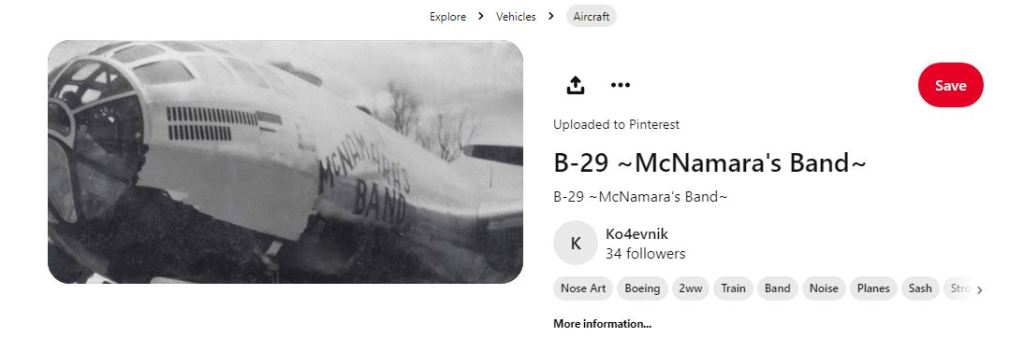
report on how the B–29 campaign was going.
LeMay talked with his group commanders and
mentioned to General Arnold that at the rate this
campaign was proceeding, the Japanese would certainly be on the ropes by October 1945.
LeMay was the heroic general and flew dangerous missions in the lead aircraft, McNamara was a high level Bomb Damage Assetsment (to the enemy) Efficiency Expert on bombing runs and crew performance) and Strategic Analayst for how to dissable European and Japanese war time industrial economic resources.
Scientific management is a theory of management that analyzes and synthesizes workflows. Its main objective is improving economic efficiency, especially labor productivity. It was one of the earliest attempts to apply science to the engineering of processes to management. Scientific management is sometimes known as Taylorism after its pioneer, Frederick Winslow Taylor.[1]
Taylor began the theory’s development in the United States during the 1880s and 1890s within manufacturing industries, especially steel. Its peak of influence came in the 1910s.[2] Although Taylor died in 1915, by the 1920s scientific management was still influential but had entered into competition and syncretism with opposing or complementary ideas.
Although scientific management as a distinct theory or school of thought was obsolete by the 1930s, most of its themes are still important parts of industrial engineering and management today. These include: analysis; synthesis; logic; rationality; empiricism; work ethic; efficiency through elimination of wasteful activities (as in muda, muri and mura); standardization of best practices; disdain for tradition preserved merely for its own sake or to protect the social status of particular workers with particular skill sets; the transformation of craft production into mass production; and knowledge transfer between workers and from workers into tools, processes, and documentation.
Curtis Emerson LeMay (November 15, 1906 – October 1, 1990) was an American Air Force general who implemented a controversial strategic bombing campaign in the Pacific theater of World War II. He later served as Chief of Staff of the U.S. Air Force, from 1961 to 1965.
LeMay joined the U.S. Army Air Corps, the precursor to the U.S. Air Force, in 1929 while studying civil engineering at Ohio State University. He had risen to the rank of major by the time of Japan’s Attack on Pearl Harbor in December 1941 and the United States’s subsequent entry into World War II. He commanded the 305th Operations Group from October 1942 until September 1943, and the 3rd Air Division in the European theatre of World War II until August 1944, when he was transferred to the China Burma India Theater. He was then placed in command of strategic bombing operations against Japan, planning and executing a massive fire bombing campaign against Japanese cities and Operation Starvation, a crippling minelaying campaign in Japan’s internal waterways.
After the war, he was assigned to command USAF Europe and coordinated the Berlin Airlift. He served as commander of the Strategic Air Command (SAC) from 1948 to 1957, where he presided over the transition to an all-jet aircraft force that had a strong emphasis on the delivery of nuclear weapons in the event of war. As Chief of Staff of the Air Force, he called for the bombing of Cuban missile sites during the Cuban Missile Crisis and sought a sustained bombing campaign against North Vietnam during the Vietnam War.
Cold War[edit]
Berlin Airlift[edit]
General Curtis E. LeMay
After World War II, LeMay was briefly transferred to The Pentagon as deputy chief of Air Staff for Research & Development. In 1947, he returned to Europe as commander of USAF Europe,[24] heading operations for the Berlin Airlift in 1948 in the face of a blockade by the Soviet Union and its satellite states that threatened to starve the civilian population of the Western occupation zones of Berlin. Under LeMay’s direction, Douglas C-54 Skymasters that could each carry 10 tons of cargo began supplying the city on July 1. By the fall, the airlift was bringing in an average of 5,000 tons of supplies a day with 500 daily flights. The airlift continued for 11 months, with 213,000 flights operated by six countries bringing in 1.7 million tons of food and fuel to Berlin. Faced with the failure of its blockade, the Soviet Union relented and reopened land corridors to the West. Though LeMay is sometimes publicly credited with the success of the Berlin Airlift, it was, in fact, instigated by General Lucius D. Clay when General Clay called LeMay about the problem. LeMay initially started flying supplies into Berlin, but then decided that it was a job for a logistics expert and he found that person in Lt. General William H. Tunner,[25] who took over the operational end of the Berlin Airlift.
Strategic Air Command[edit]
General LeMay flying a Boeing KC-135 Stratotanker during his tenure as Commander-in-Chief of the Strategic Air Command
In 1948, he returned to the U.S. to head the Strategic Air Command (SAC) at Offutt Air Force Base, replacing Gen George Kenney. When LeMay took over command of SAC, it consisted of little more than a few understaffed B-29 bombardment groups left over from World War II. Less than half of the available aircraft were operational, and the crews were undertrained. Base and aircraft security standards were minimal. Upon inspecting a SAC hangar full of US nuclear strategic bombers, LeMay found a single Air Force sentry on duty, unarmed.[26] After ordering a mock bombing exercise on Dayton, Ohio, LeMay was shocked to learn that most of the strategic bombers assigned to the mission missed their targets by one mile or more. “We didn’t have one crew, not one crew, in the entire command who could do a professional job”, noted LeMay.[27]
A meeting in November 1948, with Air Force Chief of Staff Hoyt Vandenberg, found the two men agreeing the primary mission of SAC should be the capability of delivering 80% of the nation’s atomic bombs in one mission. At the Dualism Conference in December 1948, the Air Force high command rallied behind LeMay’s position that the service’s highest priority was to deliver the SAC atomic offensive “in one fell swoop telescoping mass and time”.[28] “To LeMay, demolishing everything was how you win a war.”[29] Towards this aim, LeMay delivered the first SAC Emergency War Plan in March 1949 which called for dropping 133 atomic bombs on 70 cities in the USSR within 30 days. LeMay predicted that World War III would last no longer than 30 days.[30] Air power strategists called this type of pre-emptive strike “killing a nation”.[31] However, the Harmon committee released their unanimous report two months later stating such an attack would not end a war with the Soviets and their industry would quickly recover. This committee had been specifically created by the Joint Chiefs of Staff to study the effects of a massive nuclear strike against the Soviet Union. Nevertheless, within weeks, an ad hoc Joint Chiefs committee recommended tripling America’s nuclear arsenal, and Chief of Staff Vandenberg called for enough bombs to attack 220 targets, up from the previous 70.[32]
Upon receiving his fourth star in 1951 at age 44, LeMay became the youngest American four-star general since Ulysses S. Grant. He would also become the longest serving person in that rank in American military history.[33]
In 1954 LeMay remarked to pilot Hal Austin, whose plane had been damaged by a MiG-17 while on a reconnaissance mission over the Soviet Union, “Well, maybe if we do this overflight right, we can get World War III started”. Hal Austin assumed that LeMay was joking, but years later, after LeMay retired, Austin saw him again and “brought up the subject of the mission we had flown. And he remembered it like it was yesterday. We chatted about it a little bit. His comment again was, ‘Well, we’d have been a hell of a lot better off if we’d got World War III started in those days.'”[34]
In 1956 and 1957 LeMay implemented tests of 24-hour bomber and tanker alerts, keeping some bomber forces ready at all times. LeMay headed SAC until 1957, overseeing its transformation into a modern, efficient, all-jet force. LeMay’s tenure was the longest over an American military command in nearly 100 years.[35]
The “Airpower Battle”[edit]
USAF airpower development and LeMay’s style[edit]
Air Force Vice Chief of Staff General Curtis LeMay greeted by Secretary of the Air Force James H. Douglas Jr. and Chairman of The Joint Chiefs of Staff General Nathan F. Twining at Washington National Airport, upon LeMay’s return from Boeing KC-135 StratoTanker non-stop flight from Buenos Aires, Argentina in November 15, 1957
LeMay was instrumental in SAC’s acquisition of a large fleet of new strategic bombers, establishment of a vast aerial refueling system, the formation of many new units and bases, development of a strategic ballistic missile force, and establishment of a strict command and control system with an unprecedented readiness capability. All of this was protected by a greatly enhanced and modernized security force, the Strategic Air Command Elite Guard. LeMay insisted on rigorous training and very high standards of performance for all SAC personnel, be they officers, enlisted men, aircrews, mechanics, or administrative staff, and reportedly commented, “I have neither the time nor the inclination to differentiate between the incompetent and the merely unfortunate”.
A famous legend often used by SAC flight crews to illustrate LeMay’s command style concerned his famous ever-present cigar.[36] In the first known published account of the story, Life magazine reporter Ernest Havemann related that LeMay once took the co-pilot’s seat of a SAC bomber to observe the mission, complete with lit cigar.[37] When asked by the pilot to put the cigar out, LeMay demanded to know why. When the pilot explained that fumes inside the fuselage could ignite the airplane, LeMay reportedly growled, “It wouldn’t dare”.[37] The incident was used as the basis for a fictional scene in the 1955 film Strategic Air Command. In his highly controversial and factually disputed[38][39] memoir War’s End, Major General Charles Sweeney related an alleged 1944 incident that may have been the basis for the “It wouldn’t dare” comment.[40]
Despite his uncompromising attitude regarding performance of duty, LeMay was also known for his concern for the physical well-being and comfort of his men.[41] LeMay found ways to encourage morale, individual performance, and the reenlistment rate through a number of means: encouraging off-duty group recreational activities,[42][43] instituting spot promotions based on performance, and authorizing special uniforms, training, equipment, and allowances for ground personnel[44] as well as flight crews.
On LeMay’s departure, SAC was composed of 224,000 airmen, close to 2,000 heavy bombers, and nearly 800 tanker aircraft.[45]
LeMay was appointed Vice Chief of Staff of the United States Air Force in July 1957, serving until 1961.
Chief of Staff of the United States Air Force, 1961–1965[edit]
Air Force Chief of Staff General Curtis E. LeMay with U.S. President John F. Kennedy and Strategic Air Command’s Commander General Thomas S. Power at Offutt Air Force Base, Nebraska.
Following service as USAF Vice Chief of Staff (1957–1961), LeMay was made the fifth Chief of Staff of the United States Air Force on the retirement of Gen Thomas White. His belief in the efficacy of strategic air campaigns over tactical strikes and ground support operations became Air Force policy during his tenure as chief of staff.
As Chief of Staff, LeMay clashed repeatedly with Secretary of Defense Robert McNamara, Air Force Secretary Eugene Zuckert, and the chairman of the Joint Chiefs of Staff, Army General Maxwell Taylor. At the time, budget constraints and successive nuclear war fighting strategies had left the armed forces in a state of flux. Each of the armed forces had gradually jettisoned realistic appraisals of future conflicts in favor of developing its own separate nuclear and nonnuclear capabilities. At the height of this struggle, the U.S. Army had even reorganized its combat divisions to fight land wars on irradiated nuclear battlefields, developing short-range atomic cannon and mortars in order to win appropriations. The United States Navy in turn proposed delivering strategic nuclear weapons from supercarriers intended to sail into range of the Soviet air defense forces. Of all these various schemes, only LeMay’s command structure of SAC survived complete reorganization in the changing reality of Cold War-era conflicts.
LeMay was not an enthusiast of the ICBM program, considering ballistic missiles to be little more than toys and no substitute for the strategic nuclear bomber force.
Though LeMay lost significant appropriation battles for the Skybolt ALBM and the Boeing B-52 Stratofortress replacement, the North American XB-70 Valkyrie, he was largely successful at expanding Air Force budgets. Despite LeMay’s disdain for missiles, he did strongly support the use of military space programs to perform satellite reconnaissance and gather electronic intelligence. For comparison, the US Army and Navy frequently suffered budgetary cutbacks and program cancellations by Congress and Secretary McNamara.
Cuban Missile Crisis[edit]
General LeMay conversed with President Kennedy at the Oval Office, White House in October 1962.
During the Cuban Missile Crisis in 1962, LeMay clashed again with U.S. President John F. Kennedy and Defense Secretary McNamara, arguing that he should be allowed to bomb nuclear missile sites in Cuba. He opposed the naval blockade and, after the end of the crisis, suggested that Cuba be invaded anyway, even after the Soviets agreed to withdraw their missiles. Kennedy refused LeMay’s requests, and the naval blockade was successful.[31]
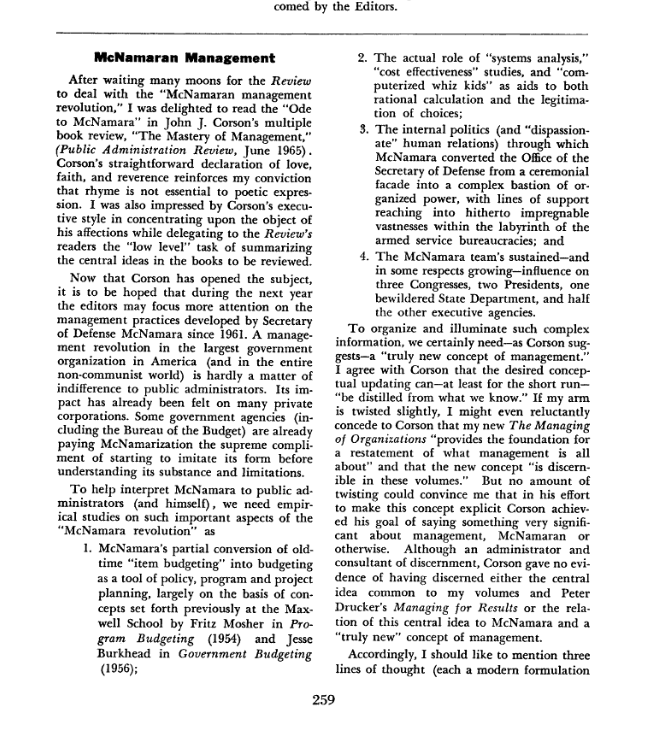
Robert S. McNamara and the Evolution of Modern Management
by
From the Magazine (December 2010)
Summary. Reprint: R1012G When the name Robert S. McNamara is mentioned, one thought usually springs to mind: the tragedy of Vietnam. But McNamara’s career was brilliant long before he served as secretary of defense under presidents Kennedy and Johnson—and long…more
Click here for a timeline of Robert McNamara’s legacy.
Every generation of managers wrestles with questions about its purpose. In the 1950s and 1960s, to be an able manager was to do four things well: plan, organize, direct, and control. Leading business thinkers conceived of managers as rational actors who could solve complex problems through the power of clear analysis. That view shaped the developing profession, but many questions were left unanswered. Planning and directing were essential, yes, but toward what ends? Organizing and controlling, of course, but in whose interest?
By the 1980s and 1990s, one answer had come to dominate popular thinking: The purpose of management was to enrich a company’s owners. Shareholder value creation had the advantage of being precisely and objectively measurable—and made CEOs like Roberto Goizueta, Sandy Weill, and Jack Welch legends. Yet as a managerial mission, the pursuit of financial wealth has proved to be unsatisfactory. In the past decade, as evidence that markets are far from efficient has mounted and much of the wealth created has been wiped out, basic questions about management have resurfaced. Today the focus has shifted to how management should contribute to society, provide for environmental sustainability, and improve the lives of people at the bottom of the pyramid. The fundamental purpose of management is being debated at leading business schools, where students consider the merits of taking professional oaths that would commit them to pursue goals beyond financial performance.
For those who have chosen management as their livelihood, these are not academic questions. They speak to the ultimate question that confronts us all: Has my life’s work been important? As we consider the various purposes to which managers’ talents could be applied, and how their contributions may come to be judged, we may gain useful insights by examining the life of one man who grappled with these issues for more than 50 years.
The career of Robert S. McNamara spanned academia, private enterprise, government, and humanitarian service. He was a professor at Harvard Business School in the early 1940s; an executive at Ford Motor Company for 15 years, becoming its president in 1960; the secretary of defense for seven years under presidents Kennedy and Johnson; and the president of the World Bank for 13 years. In the eyes of many, of course, McNamara’s accomplishments were overshadowed by the tragedy of Vietnam. When he died in 2009, at age 93, the New York Times’ obituary headline described him simply as the “architect of a futile war.” Because of his role in it, he tends to be caricatured as smart but not wise, obsessed with narrow quantitative measures but lacking in human understanding. The controversies surrounding Vietnam are complex and will endure, but it would be a mistake not to draw any other lessons from his remarkable career. Perhaps more than anyone else, Robert McNamara personified management in the 20th century. In his legacy we see the triumphs of modern management as well as its most troubling limitations.
Analytical Whiz Kid
McNamara was born in San Francisco in 1916 and came of age during the Great Depression. As a youth he witnessed labor unrest in local shipyards and massive unemployment. After high school he enrolled at the University of California, Berkeley, where he majored in economics because he felt it offered the most useful tools for addressing society’s largest problems. From the outset he thought of management as a means of bringing positive change to the world, not as a means of financial gain for himself or a company’s owners.
After graduating in 1937, McNamara entered Harvard Business School. According to Jeffrey Cruikshank’s history of the school, this was a time when the field of management was on the cusp of great progress. One required course, Business Statistics, had begun to teach methods of quantitative decision making. Its professor, Edmund Learned, later recalled: “We sought to train our men for positions of responsibility that required statistical facts and analyses for diagnosis or action purposes. We wanted men to develop judgment in the use of figures [and] contribute to an intelligent solution of the problem under discussion.” HBS’s accounting courses had been moving in a similar direction. In 1936, Professor Ross Walker offered a course called Aspects of Budgetary Control, which focused on practical aspects of planning and decision making. The curriculum covered the techniques of modern professional management: cost accounting, control systems, management information systems, and decision science. McNamara was an eager and receptive student of the new methods. After earning his master’s of business administration, in 1939, he returned to San Francisco for a year, before accepting an offer to join Harvard Business School as a faculty member. At age 24, he became its youngest assistant professor.
During World War II, McNamara taught in the Army Air Forces’ statistical school and then took unpaid leave from Harvard to serve in the Army’s Department of Statistical Control. Aircraft were playing an increasingly important role in warfare, but no system had been developed to track planes and their crews, monitor spare parts, or allocate fuel. The complexity of the modern war machine had surpassed the ability to manage it. McNamara helped bring the rigor of statistical analysis to the war effort, improving logistical efficiency and mission planning. His biographer Deborah Shapley found evidence of his influence in an army report from the era: “Much of the success of the system has been due to the Harvard method which stresses the ‘meaning of figures’—the power to analyze something for oneself.”
In 1946, rather than returning to academia, McNamara became part of an elite team from Statistical Control that joined Ford. They were nicknamed the Whiz Kids. The firm’s young president, Henry Ford II, charged them with overhauling the once-proud company, now in disarray and losing money. McNamara’s star rose as he brought the discipline of rational analysis to Ford’s sprawling bureaucracy, emphasizing facts and figures. Austere and formal, with rimless glasses and neatly slicked-back hair, McNamara projected a no-nonsense air. The financial turnaround at Ford was remarkable, yet he did not focus only on shareholder returns. He went about his work with an acute sense of social responsibility. Unlike most automobile executives, he was an early champion of passenger safety. He later recalled, “The prevailing idea in the auto industry was that if you talked about safety, you’d scare the public.” Under McNamara’s leadership, Ford’s 1956 models featured padded instrument panels and safer steering wheels, and were the first passenger cars with seat belts. Rivals scoffed: “McNamara sells safety, Chevrolet sells cars.” Yet he persisted, guided by his sense of responsibility to the public.
The Portable Professional
Selected by President John F. Kennedy to serve as secretary of defense, McNamara arrived in Washington in January 1961. He epitomized the confidence of the American Century: He was a technocrat free of ideological blinders, focusing on the facts and deducing the truth from statistics. BusinessWeek described him as a “prize specimen of a remarkable breed in U.S. industry—the trained specialist in the science of business management who is also a generalist moving easily from one technical area to another.” Once again, McNamara’s sense of public service was strong. He had been among the highest-paid executives in the world, earning $410,000 a year in salary and bonuses at Ford, and gave it up to become a cabinet secretary with a salary of $25,000. More significantly, to avoid even the appearance of a conflict of interest, he chose not to exercise options on 30,000 shares of Ford stock, valued at $47 a share.
At the Pentagon, McNamara applied his usual rigorous approach to the management of the vast military establishment. Until then, each branch of the service had had its own budget and pushed its preferred weapons systems. The result was massive inefficiency and questionable effectiveness. McNamara set out to optimize the nation’s arsenal, to provide the best military capability in the most efficient manner, subordinating the parochial interests of the individual services. He also overhauled U.S. military strategy, replacing the potentially catastrophic doctrine of massive retaliation with a doctrine of flexible response, which insisted on proportionality and sought to avert escalation. Congress was highly impressed. Republican Barry Goldwater called McNamara “one of the best secretaries ever, an IBM machine with legs.”
Barry Goldwater called McNamara “one of the best secretaries ever, an IBM machine with legs.”
Even during the most difficult days of the Vietnam War—which would eventually overwhelm him and President Lyndon Johnson—McNamara did not lose sight of the goal that had inspired him as a youth: contributing to the greater good. In a remarkable 1967 speech at Millsaps College, in Mississippi, he offered a stirring vision of management. (See the sidebar “Management Is the Most Creative of Arts.”) He spoke, too, about the growing gap between rich and poor nations. National security was inextricably linked to global security, and global security to closing that gap. As the Nobel Prize–winning economist Amartya Sen would later observe, economic development is freedom—and conversely, without it, there is no freedom. After leaving the Pentagon and becoming president of the World Bank, a post he held from 1968 to 1981, McNamara turned his energies toward expanding funding for development. He shifted the bank’s focus toward poverty reduction, dramatically increasing the financial support for projects in health, nutrition, and education. He relied, once again, on a fact-driven approach—measuring well-being and funneling loans to the most effective development programs.
“Management Is the Most Creative of Arts”
In a 1967 convocation address at Millsaps College, in Jackson, Mississippi, Secretary of Defense McNamara set out his …
By the 1980s, McNamara’s star had fallen, and not just because of his role in the Vietnam debacle. American business seemed to have lost its way, and the management methods he exemplified were being questioned. In their landmark 1980 Harvard Business Review article, “Managing Our Way to Economic Decline,” Robert H. Hayes and William J. Abernathy blamed slumping U.S. fortunes on the rise of professional managers. They charged: “What has developed, in the business community as in academia, is a preoccupation with a false and shallow concept of the professional manager, a ‘pseudoprofessional’ really—an individual having no special expertise in any particular industry or technology who nevertheless can step into an unfamiliar company and run it successfully through strict application of financial controls, portfolio concepts, and a market-driven strategy.”
Yet it was precisely the ability to apply managerial logic that had allowed McNamara to achieve improvements that insiders could not, or would not, produce. At Ford it took someone from outside the auto industry to provide analytical clarity as well as to focus on passenger safety. At the Department of Defense, it took an outsider to bring coherence to the management of the American military establishment, subordinating the interests of each branch to the overall purposes of the nation. McNamara’s skills were precisely what had been needed in sprawling organizations staffed by insiders.
Though it was easy to condemn the shortsightedness of professional management for the slump, the truth was more complex. America’s rise to leadership in the first place had been due in large part to the success of modern management. To blame management for the nation’s failure to maintain the lead reflects a misunderstanding of the ebbs and flows of relative performance, as countries improve and gaps narrow. Furthermore, U.S. carmakers might have fared better against foreign competition from efficient companies with economical cars if McNamara’s views had prevailed. When he’d left for Washington, his plans for the Cardinal—an inexpensive car to be built at lower-cost facilities abroad—were scrapped.
Focused to a Fault
Whether at Ford or in the military, in business or pursuing humanitarian objectives, McNamara’s guiding logic remained the same: What are the goals? What constraints do we face, whether in manpower or material resources? What’s the most efficient way to allocate resources to achieve our objectives? In filmmaker Errol Morris’s Academy Award–winning documentary The Fog of War, McNamara summarized his approach with two principles: “Maximize efficiency” and “Get the data.”
Yet McNamara’s great strength had a dark side, which was exposed when the American involvement in Vietnam escalated. The single-minded emphasis on rational analysis based on quantifiable data led to grave errors. The problem was, data that were hard to quantify tended to be overlooked, and there was no way to measure intangibles like motivation, hope, resentment, or courage. Much later, McNamara understood the error: “Uncertain how to evaluate results in a war without battle lines, the military tried to gauge its progress with quantitative measurements,” he wrote in his 1995 memoir, In Retrospect. “We failed then—as we have since—to recognize the limitations of modern, high-technology military equipment, forces, and doctrines in confronting highly unconventional, highly motivated people’s movements.”
Equally serious was a failure to insist that data be impartial. Much of the data about Vietnam were flawed from the start. This was no factory floor of an automobile plant, where inventory was housed under a single roof and could be counted with precision. The Pentagon depended on sources whose information could not be verified and was in fact biased. Many officers in the South Vietnamese army reported what they thought the Americans wanted to hear, and the Americans in turn engaged in wishful thinking, providing analyses that were overly optimistic. At first, being likened to a computer was meant as a compliment; later, it became a criticism. In the wake of Vietnam, McNamara was derided for his coldness and scorned as one of the so-called best and brightest who had led the country into a quagmire through arrogance.
Yet in this dark episode, too, the career of Robert McNamara lets us appreciate how management thinking has taken important steps forward. We know today that people are not the rational creatures suggested by conventional economic theory but exhibit systematic biases of judgment. We know, as well, that organizational processes have their own dynamics—such as the escalation of a commitment to a losing course of action, and the tendency to silence dissenting views—that can lead to flawed decisions. (See the sidebar “What the Whiz Kids Missed.”)
What the Whiz Kids Missed: The Later Breakthroughs
After the heyday of Robert McNamara, management thinking began to reflect a broader understanding of …
Reflection and the Search for Wisdom
The career of Robert McNamara offers more than an overview of modern management and its successes and limitations. It also illustrates that managers have the capacity for reflection and the ability to gain wisdom. In McNamara’s case, the need for introspection and insight was particularly acute. The historian Margaret MacMillan has written that “McNamara spent much of his life trying to come to terms with what went wrong with the American war in Vietnam.” He sought to understand the sources of errors, hoping to square what he earnestly believed were good intentions with the massive waste and tragic loss.
When, after many years of silence about Vietnam, McNamara published his memoirs, he admitted: “We were wrong, terribly wrong.” Many people, their lives scarred by the trauma of Vietnam, found such a statement too little, too late. Yet McNamara had insisted that the subtitle to In Retrospect be “The Tragedy and Lessons of Vietnam” because he believed that tragedies could be avoided if lessons were learned. In fact, the willingness to question oneself and learn from experience may be Robert McNamara’s greatest legacy as a manager. At 85, he told Errol Morris, “I’m at an age where I can look back and derive some conclusions about my actions. My rule has been: Try to learn. Try to understand what happened. Develop the lessons and pass them on.”
That quest guided McNamara’s later years. He traveled to Cuba and met with Fidel Castro, to understand more fully the 1962 missile crisis and find ways of avoiding future nuclear confrontations. He visited Vietnam and met with Vo Nguyen Giap, commander of the North Vietnamese forces, to discover where things had gone awry in that conflict. One key insight: that it was crucial to empathize with one’s enemies, to attempt to see the world as they did. He concluded that the Cuban Missile Crisis had been resolved peacefully because U.S. diplomats were able to understand Premier Khrushchev’s thinking. But in the case of Vietnam, he admitted, the adversary’s motivations and priorities were misunderstood. McNamara recalled: “We saw Vietnam as an element of the Cold War, not what they saw it as, a civil war.” It was a tragic error that “reflected our profound ignorance of the history, culture, and politics of the people in the area and the personalities and habits of their leaders.”
Yet it would be misleading to suggest that McNamara had abandoned the belief in rational analysis. Indeed, the greatest challenges we face today—from global warming, to water pollution, to health care, to economic development—clearly demand the power of logical analysis in service of human ends. At organizations as disparate as the Centers for Disease Control and the Bill & Melinda Gates Foundation, idealism and rational analysis are not at cross-purposes at all. In a 1995 interview, McNamara returned to this theme: “I don’t believe there’s a contradiction between a soft heart and hard head. Action should be founded on contemplation.”
It’s tempting to think of today’s problems as qualitatively different from those that confronted past generations. Surely, the threats to our environment are greater than ever, the pressures of globalization are more intense, and the technologies we use were unimagined even a few years ago. Yet many of the broader questions about the purpose and aims of management remain the same, and managers today confront many of the same dilemmas as their forebears did.
In 2005, months before his 89th birthday, McNamara returned to Harvard Business School and spoke with students on the subject of decision making. Among the lessons he stressed: That for all its power, rationality alone will not save us. That humans may be well-intentioned but are not all-knowing. That we must seek to empathize with our enemies, rather than demonize them, not only to understand them but also to probe whether our assumptions are correct.
A man often accused of lacking empathy urged us to empathize with our adversaries. A man who prided himself on rationality concluded that humanity cannot be saved by rationality alone—for none of us makes decisions in a completely rational manner—and that systems must therefore be made resistant to the irrationality in each of us. The final measure of a manager, more than amassing wealth or seeking to follow an oath, may be the willingness to examine one’s own actions and seek a measure of wisdom.
Robert McNamara’s Leadership (including cancelling the TFX)
Posted July 9, 2009
Robert S. McNamara (1916-2009) was the most powerful American Secretary of Defense in history and in many ways the architect of the modern war on terror. He was an immensely talented and successful man, whose career went up like a rocket from the beginning. Born in San Francisco, he was an Eagle Scout and President of the Rigma Lions boys club in 1933. He attended the University of California, Berkeley, where he studied economics, mathematics, and philosophy, was elected to Phi Beta Kappa in his sophomore year, and earned a varsity letter in crew. After receiving a master’s degree from the Harvard Graduate School of Business Administration in 1939, he worked for Price Waterhouse for a year. He then joined the Harvard faculty as the youngest and highest paid Assistant Professor at the university. He joined the Army Air Force in 1943 and worked in the Office of Statistical Control, where he analyzed the accuracy and effectiveness of US bombing missions, and made powerful connections.
In 1946, McNamara and 9 other former officers joined Ford Motor Company with a mandate to stop its financial and administrative chaos using modern planning and management control systems. He again advanced rapidly, and in November, 1960 became the first president of the company who was not a member of the Ford family. A few weeks later, President-elect John F. Kennedy recruited him to be Secretary of Defense. Kennedy described McNamara as the smartest man he had ever met.
Kennedy first directed McNamara to plan the Bay of Pigs invasion, which was a disaster, and then asked him to develop even more elaborate plans to overthrow Castro. In 1962, McNamara began implementing the modern strategy of counterinsurgency warfare to combat terrorism; he created special forces like the Green Berets, and sponsored secret paramilitary operations throughout Asia and Latin America. In 1963, again in response to the President’s request, he began a troop build-up in South Vietnam. After Kennedy’s assassination in November, 1963, President Lyndon Johnson asked him to stay on as Defense Secretary, and in essence turned the conduct of foreign policy over to him. Johnson, in awe of McNamara, commented “He is like a jackhammer….He drives too hard. He is too perfect.” In 1964, Johnson asked him to be his Vice-Presidential running mate, but McNamara declined.
McNamara prosecuted the Vietnam War with his usual diligence, but had doubts about it being winnable. In 1967, he sent President Johnson a long memo urging him to begin negotiating with the North Vietnamese rather than escalating the war. Johnson decided that McNamara was plotting against him on behalf of the Kennedys, fired him as Secretary of Defense, and anointed him as President of the World Bank where he served from April, 1968 to June, 1981, when he retired.
The Vietnam War is widely regarded as the greatest foreign policy mistake in U.S. history. Over 54,000 American troops died, millions of Vietnamese were killed, and nothing was resolved. In 1995, McNamara published a memoir in which he said his conduct of the war was “wrong, terribly wrong”. In reply, Howell Raines, the editor of the New York Times, wrote an editorial in which he noted: “Surely he must in every quiet and prosperous moment hear the ceaseless whispers of those poor boys in the infantry, dying in the tall grass, platoon by platoon, for no purpose. What he took from them cannot be repaid by prime-time apology and stale tears, three decades late.”
Analysis
At each point in his career—as a student, academic, business executive, Cabinet Secretary, and public figure—Robert McNamara was fabulously successful. He substantially rebuilt Ford Motor Company, as Defense Secretary, he was instrumental in putting in place wide ranging reforms to streamline the Pentagon and make it more effective, and he transformed the World Bank from an old boy’s club to an instrument for third world economic development. And then there is the Vietnamese war—an unmitigated disaster. How are we to understand this?
The answer concerns how we think about leadership. The academic literature defines leadership in terms of the ability to ascend to the top of a hierarchy, and McNamara was superbly equipped to do this. He was very smart, very hard working, great with numbers and details, clear-minded, logical, and very, very eager to please his superiors. This is the recipe for success in a bureaucracy.
In contrast with the academic literature, I think the essence of leadership concerns being able to build a team, being able to unite a group and act toward a common goal. McNamara was ruthlessly dismissive of subordinates who challenged him (he had no peers). His talent was for fixing inefficiencies and implementing processes. He had no talent for anticipating or even considering the human costs of his processes. His concern about the Vietnam war was that it was unwinnable from a technical perspective, not that lives were being wasted. He was an immensely successful bureaucrat but not a gifted leader.
There is a sense in which Robert McNamara was a train wreck waiting to happen. He was an exquisitely tooled bureaucratic instrument, who could and would deliver results for whoever happened to be his boss. As Secretary of Defense, his first boss was the callow and impulsive John Kennedy, who ordered him to begin what ultimately became our war on terror—covert and illegal operations in Latin America and Southeast Asia. He second boss was Lyndon Johnson, a skilled and ruthless legislator who knew nothing about international relations, and whose staff feared he was insane. Kennedy foolishly invaded South Vietnam, Johnson inherited the project, and vowed not to be the first American President “to cut and run.” McNamara’s ambition and eagerness to please authority prevented him from opposing these policies and the rest is history. As for moral culpability, he was just following orders.


