“Hooverville” became a common term for shacktowns and homeless encampments during the Great Depression. There were dozens in the state of Washington, hundreds throughout the country, each testifying to the housing crisis that accompanied the employment crisis of the early 1930s.
“Hooverville” was a deliberately politicized label, emphasizing that President Herbert Hoover and the Republican Party were to be held responsible for the economic crisis and its miseries.
Seattle’s main Hooverville was one of the largest, longest-lasting, and best documented in the nation. It stood for ten years, 1931 to 1941.
Covering nine acres of public land, it housed a population of up to 1,200, claimed its own community government including an unofficial mayor, and enjoyed the protection of leftwing groups and sympathetic public officials until the land was needed for shipping facilities on the eve of World War II.
Seattle is fortunate to have the kind of detailed documentation of its Hooverville that other cities lack, and we have compiled these unique resources here. Included are photographs, city documents, a 1934 sociological survey of residents, a short memoir written by the former “mayor” of Hooverville, and more. We are grateful to the Seattle Municipal Archives, King County Archives, and the University of Washington Library Special Collections for permission to incorporate materials in their collections.
Republican President Warren G. Harding appointed Hoover as Secretary of Commerce in 1920, and he continued to serve under President Calvin Coolidge after Harding died in 1923. Hoover was an unusually active and visible Cabinet member, becoming known as “Secretary of Commerce and Under-Secretary of all other departments”. He was influential in the development of air travel and radio. He led the federal response to the Great Mississippi Flood of 1927. Hoover won the Republican nomination in the 1928 presidential election, and defeated Democratic candidate Al Smith in a landslide. In 1929 Hoover assumed the presidency during a period of widespread economic stability. However, during his first year in office, the stock market crashed, signaling the onset of the Great Depression. The Great Depression dominated Hoover’s presidency and he responded by pursuing a series of economic policies in an attempt to lift the economy. Hoover scapegoated Mexicans for the Depression, instituting policies and sponsoring programs of repatriation and deportation to Mexico.
In the midst of the economic crisis, Hoover was decisively defeated by Democratic nominee Franklin D. Roosevelt in the 1932 presidential election. Hoover’s retirement was over 31 years long, one of the longest presidential retirements. He authored numerous works and became increasingly conservative in retirement. He strongly criticized Roosevelt’s foreign policy and New Deal domestic agenda. In the 1940s and 1950s, public opinion of Hoover improved largely due to his service in various assignments for presidents Harry S. Truman and Dwight D. Eisenhower, including chairing the influential Hoover Commission. Critical assessments of his presidency by historians and political scientists generally rank him as a significantly below-average president, although Hoover has received praise for his actions as a humanitarian and public official.[1][2][
The Democrat Party in the Great Dustbowl, Stock Market Crash, and other ecomic crisis of the late 1920s into WWII
The New Deal was a series of programs, public work projects, financial reforms, and regulations enacted by Democrat President Franklin D. Roosevelt in the United States between 1933 and 1939. Wikipedia
Among the Democrat coat-tails operatives of FDR was Joseph Kennedy Sr and according to Roger Stone and co-author in The Case Against LBJ Joseph Kennedy Sr was highly compliant with party politics and goals of FDR, a reliable functionary. (per Stone and his sources J. Edgar Hoover recommended Bobby Kennedy as DOJ AG thinking Bobby would parrrellel his father and follow party instructions.)
In fact John F. Kennedy would differ too. Though a London School of Economics student and close to the Windsor family through Joseph Sr., John would grow contemptuous of both British Imperialism and Texas Oil Barrell Politics.
JFK was an anti-communist as most Christians were. I Edward Donegan have always pointed out social control can come from the Church, or State, or a fusion of them such as Christian Kings or Islamic Imamans and Ayatholas.
The Catholic Church in Latin America and elsewhere were in defense against both Nazis and Socialists Communists, the latter having no interest in meddling religious figures.
Other theories against Communism like property rights were important to Christians too.
JFK as staunchly anti-communist.
Much of the difference between the Southern Democrats and New England Democrats were protestantism versus Roman Catholicism and finesse, the New England types looking down on cattle ranchers and oil wild catters, those like Mac Namara and Jaqueline Onasis Kennedy like smart intellectual aristocratic Catholics, such as Ted Sorrensone and Robert macnama and the rest of the Irish JFK built into his administration, the rest concessions to LBJ in cabinet choices.
The Roman Catholics in Boston AND ESLEWHRE (Los Angeles, bombing of the Times newspaper) had a beef with big money, often poor and in unions.
Bobby Kennedy wasn’t anti union, he was anti mafia. many Irish were poor workers hoping unions could protect them, the type of belief James Paul Donegan had, distrusting as Brandes did the Robber Barron or Banking concentrated power of big business.
So the Kennedy Family was an FDR umbrella spoke. The GOP was mostly Rockefeller based umbrella spokes and included Nixon, Ford, and them coming from Dwight D Eisenhower who was a Republican.
Neither one had much interest in Communism succeeding.
Brothers John J. (“J.J.”) and James Barnabas (“J.B.”) McNamara were arrested in April 1911 for the bombing. Their trial became a cause célèbre for the American labor movement. J.B. admitted to setting the explosive, and was convicted and sentenced to life imprisonment. J.J. was sentenced to fifteen years in prison for bombing a local iron manufacturing plant, and returned to the IW as an organizer.
It has been claimed that in 1908 John McNamara developed a policy of carrying out dynamite attacks on non-union businesses. These bombings were part of a campaign to intimidate bosses who were refusing to employ union workers. It is believed that McNamara employed his brother, Jamesto carry out some of these bombings. On 9th May, 1909, a new bridge was bombed that was being built over the Ohio River.
Harrison Gray Otis, the owner of the Los Angeles Times, was a leading figure in the fight to keep the trade unions out of Los Angeles. This was largely successful but on 1st June, 1910, 1,500 members of the International Union of Bridge and Structural Workers went on strike in an attempt to win a $0.50 an hour minimum wage. Otis, the leader of the Merchants and Manufacturers Association (M&M), managed to raise $350,000 to break the strike. On 15th July, the Los Angeles City Council unanimously enacted an ordinance banning picketing and over the next few days 472 strikers were arrested.
On 1st October, 1910, a bomb exploded by the side of the newspaper building. The bomb was supposed to go off at 4:00 a.m. when the building would have been empty, but the clock timing mechanism was faulty. Instead it went off at 1.07 a.m. when there were 115 people in the building. The dynamite in the suitcase was not enough to destroy the whole building but the bombers were not aware of the presence of natural gas main lines under the building. The blast weakened the second floor and it came down on the office workers below. Fire erupted and spread quickly through the three-story building, killing twenty-one of the people working for the newspaper.
The next day unexploded bombs were found at the homes of Harrison Gray Otis and of F. J. Zeehandelaar, the secretary of the Merchants and Manufacturers Association. The historian, Justin Kaplan, has pointed out: “Harrison Gray Otis accused the unions of waging warfare by murder as well as terror…. In editorials that were echoed and amplified across a country already fearful of class conflict, Otis vowed that the supposed dynamiters, who had committed the ‘Crime of the Century,’ must surely hang and the labor movement in general.”
William J. Burns, the detective who had been highly successful working in San Francisco, was employed to catch the bombers. Otis introduced Burns to Herbert S. Hockin, a member of the union executive who was a paid informer of the (M&M). Information from Hockin resulted in Burns discovering that union member Ortie McManigal had been handling the bombing campaign on orders from John J. McNamara. McManigal was arrested and Burns convinced him that he had enough evidence to get him convicted of the Los Angeles bombing. McManigal agreed to tell all he knew in order to secure a lighter prison sentence, and signed a confession implicating the McNamara brothers. Other names on the list included Frank M. Ryan, president of the Iron Workers Union. According to Ryan the list named “nearly all those who have served as International officers since 1906.”
The investigative journalist, Lincoln Steffens, went to see McNamara in prison: “There were J. B. McNamara, who was charged with actually placing and setting off the dynamite in Ink Alley that blew up part of the Times building and set fire to the rest, bringing about the death of twenty-one employees, and J. J. McNamara, J. B.’s brother, who was indicted on some twenty counts for assisting at explosions as secretary of the Structural Iron Workers’ Union, directing the actual dynamiters. He was supposed in labor circles to be the commanding man, the boss; he looked it; a tall, strong, blond, he was a handsome figure of health and personal power. But his brother, Jim, who looked sick and weak, soon appeared as the man of decision. I had never met them before, but when they came out of their cells they greeted and sat down beside me as if I were an old friend.”
Some believed that it was another attempt to damage the reputation of the emerging trade union movement. It was argued that Harrison Gray Otis and his agents had framed the McNamaras, the object being to cover up the fact that the explosion had really being caused by leaking gas. Charles Darrow, who had successfully defended, William Hayward, the leader of the Industrial Workers of the World (IWW), when he had been falsely charged with the murder of Frank R. Steunenberg, in 1906, was employed by Samuel Grompers, head of the American Federation of Labor, to defend the McNamara brothers. One of Darrow’s assistants was Job Harriman, a former preacher turned lawyer.
On 19th November 1911, Lincoln Steffens and Charles Darrow was asked to meet with Edward Willis Scripps at his Miramar ranch in San Diego. According to Justin Kaplan, the author of Lincoln Steffens: A Biography (1974): “Darrow arrived at Miramar with the sure prospect of defeat. He had failed, in his own investigations, to breach the evidence against the McNamaras; on his own, he had even turned up fresh evidence against them; and, in desperation, hoping for a hung jury and a mistrial…. Steffens, who had interviewed the McNamaras in their cell that week, asking for permission to write about them on the assumption that they were guilty; he had even talked to them about changing their plea. Darrow, too, was approaching the same stage in his reasoning. It was tragic, he had to agree with the other two, that the case could not be tried on its true issues, not as murder, but as a ‘social crime’ that was in itself an indictment of a society in which men believed they had to destroy life and property in order to get an hearing.”
Scripps suggested that the McNamaras had committed a selfless act of insurgency in the unequal warfare between workers and owners; after all, what weapons did labour have in this warfare except “direct action”. The McNamaras were as “guilty” as John Brown had been guilty at Harper’s Ferry. Scripps argued that “Workingmen should have the same belligerent rights in labour controversies that nations have in warfare. There had been war between the erectors and the ironworkers; all right, the war is over now; the defeated side should be granted the rights of a belligerent under international law.”
Lincoln Steffens agreed with Scripps and suggested that the “only way to avert class struggle was to offer men a vision of society founded on the Golden Rule and on faith in the fundamental goodness of people provided that they were given half a chance to be good”. Steffens offered to try and negotiate a settlement out of court. Darrow accepted the offer as he valued Steffens for “his intelligence and tact, and his acquaintance with people on both sides”. This involved Steffens persuading the brothers to plead guilty. Steffens later wrote: “I negotiated the exact terms of the settlement. That is to say, I was the medium of communication between the McNamaras and the county authorities”. Steffens met with the district attorney, John D. Fredericks. It was agreed the brothers would change their plea to guilty but offer no confession; the state would withdraw its demand for the death penalty, agree to impose only moderate prison terms, and also agree that there would be no further pursuit of other suspects in the case.
Charles Darrow argued in his autobiography, The Story of My Life (1932): “The one reason that made me most anxious to save their lives was my belief that there was never any intention to kill any one. The Times building was not blown up; it was burned down by a fire started by an explosion of dynamite, which was put in the alley that led to the building. In the statement that was made by J. B. McNamara, at the demand of the State’s attorney before the plea was entered, he said that he had placed a package containing dynamite in the alley, arranged the contraption for explosion, and went away. This was done to scare the employees of The Times and others working in non-union shops. Unfortunately, the dynamite was deposited near some barrels standing in the alley that happened to contain ink, which was immediately converted into vapor by the explosion, and was scattered through the building, carrying the fire in every direction.”
He was born in Baltimore, Maryland, and was educated in Columbus, Ohio. As a young man, Burns performed well as a Secret Service Agent and parleyed his reputation into the William J. Burns International Detective Agency, now a part of Securitas Security Services USA. A combination of natural ability as a detective combined with an instinct for publicity made Burns a national figure. His exploits made national news, the gossip columns of New York City newspapers, and the pages of detective magazines, in which he published “true” crime stories based on his exploits.
In 1903, officials of U.S. Steel and the American Bridge founded the National Erectors’ Association (NEA), a coalition of steel and iron industry employers. The primary goal of the NEA was to promote the open shop and assist employers in busting the unions in their industries. Employers used labor spies, agents provocateur, private detective agencies, and strike breakers to engage in a campaign against the unions. Local, state, and federal law enforcement agencies generally cooperated in this campaign, which often used violence against union members.
Hard pressed by the open shop campaign, the IW reacted by electing the militant Frank M. Ryan president and J.J. McNamara the secretary-treasurer in 1905.[5] In 1906, the IW struck at American Bridge in an attempt to retain their contract.[5][6][7] However, the open shop campaign was a significant success. By 1910, U.S. Steel had almost succeeded in driving all unions out of its plants. Unions in other iron manufacturing companies also vanished. Only the IW held on (though the strike at American Bridge continued).[8]
Union officials used violence to counter the setbacks they had suffered. Beginning in late 1906, national and local officials of the IW launched a dynamiting campaign. Between 1906 and 1911, the union blew up 110 iron works, though only a few thousand dollars in damages was done.[5][6] The NEA was well aware who was responsible for the bombings, since Herbert S. Hockin, a member of the IW’s executive board, was their paid spy.[5] These hundreds of bombings were later described as perhaps the largest domestic terrorism campaign in U.S. history.[9]
Employers in Los Angeles had been successfully resisting unionization for nearly half a century. Harrison Gray Otis, publisher of the Los Angeles Times, was vehemently anti-union. Otis first joined and then seized control of the local Merchants Association in 1896, renaming it the Merchants and Manufacturers’ Association (colloquially known as the M&M), and used it and his newspaper’s large circulation to spearhead a twenty-year campaign to end the city’s few remaining unions.[5][10] Without unions to keep wages high, open shop employers in Los Angeles were able to undermine the wage standards set in heavily unionized San Francisco. Unions in San Francisco feared that employers in their city would also soon begin pressing for wage cuts and start an open shop drive of their own. The only solution they saw was to re-unionize Los Angeles.[11][12]
The San Francisco unions relied heavily on the IW, one of the few strong unions remaining in Los Angeles. The unionization campaign began in the spring of 1910. On June 1, 1910, 1,500 union members struck iron manufacturers in the city to win a $0.50 an hour minimum wage ($13.26 in 2018 dollars) and overtime pay. The M&M raised $350,000 ($9.3 million in 2018 dollars) to break the strike. A superior court judge issued a series of injunctions which all but banned picketing. On July 15, the Los Angeles City Council unanimously enacted an ordinance banning picketing and “speaking in public streets in a loud or unusual tone”, with a penalty of fifty days in jail, a $100 fine, or both. Most union members refused to obey the injunctions or ordinance, and 472 strikers were arrested. The strike, however, proved effective: by September, thirteen new unions had formed, increasing union membership in the city by almost sixty percent.[13]
In 1903, officials of U.S. Steel and the American Bridge founded the National Erectors’ Association (NEA), a coalition of steel and iron industry employers. The primary goal of the NEA was to promote the open shop and assist employers in busting the unions in their industries. Employers used labor spies, agents provocateur, private detective agencies, and strike breakers to engage in a campaign against the unions. Local, state, and federal law enforcement agencies generally cooperated in this campaign, which often used violence against union members.
Hard pressed by the open shop campaign, the IW reacted by electing the militant Frank M. Ryan president and J.J. McNamara the secretary-treasurer in 1905.[5] In 1906, the IW struck at American Bridge in an attempt to retain their contract.[5][6][7] However, the open shop campaign was a significant success. By 1910, U.S. Steel had almost succeeded in driving all unions out of its plants. Unions in other iron manufacturing companies also vanished. Only the IW held on (though the strike at American Bridge continued).[8]
Union officials used violence to counter the setbacks they had suffered. Beginning in late 1906, national and local officials of the IW launched a dynamiting campaign. Between 1906 and 1911, the union blew up 110 iron works, though only a few thousand dollars in damages was done.[5][6] The NEA was well aware who was responsible for the bombings, since Herbert S. Hockin, a member of the IW’s executive board, was their paid spy.[5] These hundreds of bombings were later described as perhaps the largest domestic terrorism campaign in U.S. history.[9]
Employers in Los Angeles had been successfully resisting unionization for nearly half a century. Harrison Gray Otis, publisher of the Los Angeles Times, was vehemently anti-union. Otis first joined and then seized control of the local Merchants Association in 1896, renaming it the Merchants and Manufacturers’ Association (colloquially known as the M&M), and used it and his newspaper’s large circulation to spearhead a twenty-year campaign to end the city’s few remaining unions.[5][10] Without unions to keep wages high, open shop employers in Los Angeles were able to undermine the wage standards set in heavily unionized San Francisco. Unions in San Francisco feared that employers in their city would also soon begin pressing for wage cuts and start an open shop drive of their own. The only solution they saw was to re-unionize Los Angeles.[11][12]
The San Francisco unions relied heavily on the IW, one of the few strong unions remaining in Los Angeles. The unionization campaign began in the spring of 1910. On June 1, 1910, 1,500 union members struck iron manufacturers in the city to win a $0.50 an hour minimum wage ($13.26 in 2018 dollars) and overtime pay. The M&M raised $350,000 ($9.3 million in 2018 dollars) to break the strike. A superior court judge issued a series of injunctions which all but banned picketing. On July 15, the Los Angeles City Council unanimously enacted an ordinance banning picketing and “speaking in public streets in a loud or unusual tone”, with a penalty of fifty days in jail, a $100 fine, or both. Most union members refused to obey the injunctions or ordinance, and 472 strikers were arrested. The strike, however, proved effective: by September, thirteen new unions had formed, increasing union membership in the city by almost sixty percent.[13]https://books.openedition.org/purh/7760?lang=en
J Edgar Hoover in a postive description would be a preemptive protector of the political realm
John Edgar Hoover was born on New Year’s Day 1895 in Washington, D.C., to Anna Marie (née Scheitlin; 1860–1938) and Dickerson Naylor Hoover (1856–1921), chief of the printing division of the U.S. Coast and Geodetic Survey, formerly a plate maker for the same organization.[6] Dickerson Hoover was of English and German ancestry. Hoover’s maternal great-uncle, John Hitz, was a Swiss honorary consul general to the United States.[7] Among his family, he was the closest to his mother, who was their moral guide and disciplinarian.[8]
Hoover was born in a house on the present site of Capitol Hill United Methodist Church, located on Seward Square near Eastern Market in Washington’s Capitol Hill neighborhood.[9] A stained glass window in the church is dedicated to him. Hoover did not have a birth certificate filed upon his birth, although it was required in 1895 in Washington. Two of his siblings did have certificates, but Hoover’s was not filed until 1938 when he was 43.[7]
Hoover lived his entire life in Washington, D.C. He attended Central High School, where he sang in the school choir, participated in the Reserve Officers’ Training Corps program, and competed on the debate team.[4] During debates, he argued against women getting the right to vote and against the abolition of the death penalty.[10] The school newspaper applauded his “cool, relentless logic.”[11] Hoover stuttered as a boy, which he later learned to manage by teaching himself to talk quickly—a style that he carried through his adult career. He eventually spoke with such ferocious speed that stenographers had a hard time following him.[12]
Hoover was 18 years old when he accepted his first job, an entry-level position as messenger in the orders department at the Library of Congress. The library was a half mile from his house. The experience shaped both Hoover and the creation of the FBI profiles; as Hoover noted in a 1951 letter: “This job … trained me in the value of collating material. It gave me an excellent foundation for my work in the FBI where it has been necessary to collate information and evidence.”[13]
Immediately after getting his LL.M. degree, Hoover was hired by the Justice Department to work in the War Emergency Division.[17] He accepted the clerkship on July 27, 1917, aged 22. The job paid $990 a year ($20,900 in 2022 dollars) and was exempt from the draft.[17]
He soon became the head of the Division’s Alien Enemy Bureau, authorized by President Woodrow Wilson at the beginning of World War I to arrest and jail allegedly disloyal foreigners without trial.[11] He received additional authority from the 1917 Espionage Act. Out of a list of 1,400 suspicious Germans living in the U.S., the Bureau arrested 98 and designated 1,172 as arrestable.[18]
In August 1919, the 24-year-old Hoover became head of the Bureau of Investigation’s new General Intelligence Division, also known as the Radical Division because its goal was to monitor and disrupt the work of domestic radicals.[18] America’s First Red Scare was beginning, and one of Hoover’s first assignments was to carry out the Palmer Raids.[19]
In 1920 the 25 year-old Edgar Hoover was initiated as a Freemason[25][26][27] at D.C.’s Federal Lodge No. 1 in Washington D.C. He went on to join the Scottish Rite in which he was made a 33rd Degree Inspector General Honorary in 1955.[28]
In 1921, Hoover rose in the Bureau of Investigation to deputy head, and in 1924 the Attorney General made him the acting director. On May 10, 1924, President Calvin Coolidge appointed Hoover as the fifth Director of the Bureau of Investigation, partly in response to allegations that the prior director, William J. Burns, was involved in the Teapot Dome scandal.[29][30] When Hoover took over the Bureau of Investigation, it had approximately 650 employees, including 441 Special Agents.[31] Hoover fired all female agents and banned the future hiring of them.[32]
Hoover was sometimes unpredictable in his leadership. He frequently fired Bureau agents, singling out those he thought “looked stupid like truck drivers,” or whom he considered “pinheads.”[33][page needed] He also relocated agents who had displeased him to career-ending assignments and locations. Melvin Purvis was a prime example: Purvis was one of the most effective agents in capturing and breaking up 1930s gangs, and it is alleged that Hoover maneuvered him out of the Bureau because he was envious of the substantial public recognition Purvis received.[34]
Hoover often praised local law-enforcement officers around the country, and built up a national network of supporters and admirers in the process. One whom he often commended for particular effectiveness was the conservativesheriff of Caddo Parish, Louisiana, J. Howell Flournoy.[35]
In 1933, Hoover learned of a namesake, John Edgar Hoover, who had failed to pay a debt of $900 to a store in Washington. As Hoover was particular about paying his bills on time and so did not want to be associated with this disreputable behavior, he changed his name to “J. Edgar Hoover”.[37]
In the early 1930s, criminal gangs carried out large numbers of bank robberies in the Midwest. They used their superior firepower and fast getaway cars to elude local law enforcement agencies and avoid arrest. Many of these criminals frequently made newspaper headlines across the United States, particularly John Dillinger, who became famous for leaping over bank cages, and repeatedly escaping from jails and police traps. The gangsters enjoyed a level of sympathy in the Midwest, as banks and bankers were widely seen as oppressors of common people during the Great Depression.
The robbers operated across state lines, and Hoover pressed to have their crimes recognized as federal offenses so that he and his men would have the authority to pursue them and get the credit for capturing them. Initially, the Bureau suffered some embarrassing foul-ups, in particular with Dillinger and his conspirators. A raid on a summer lodge in Manitowish Waters, Wisconsin, called “Little Bohemia,” left a Bureau agent and a civilian bystander dead and others wounded; all the gangsters escaped.
Hoover realized that his job was then on the line, and he pulled out all stops to capture the culprits. In late July 1934, Special Agent Melvin Purvis, the Director of Operations in the Chicago office, received a tip on Dillinger’s whereabouts that paid off when Dillinger was located, ambushed, and killed by Bureau agents outside the Biograph Theater.[38]
Hoover was credited for overseeing several highly publicized captures or shootings of outlaws and bank robbers. These included those of Machine Gun Kelly in 1933, of Dillinger in 1934, and of Alvin Karpis in 1936, which led to the Bureau’s powers being broadened.
In 1935, the Bureau of Investigation was renamed the Federal Bureau of Investigation (FBI). It was not simply a name change. A lot of basic restructuring was done. In fact, Hoover visited the lab of Canadian forensic scientist Wilfrid Derome twice – in 1929 and 1932 – in order to plan the foundation of his own FBI laboratory in the USA.[39] It was the insight gained from these visits which helped him transform the BI into FBI in 1935.
In 1939, the FBI became pre-eminent in the field of domestic intelligence, thanks in large part to changes made by Hoover, such as expanding and combining fingerprint files in the Identification Division, to compile the largest collection of fingerprints to date,[40][41] and Hoover’s help to expand the FBI’s recruitment and create the FBI Laboratory, a division established in 1932 to examine and analyze evidence found by the FBI.
During the 1930s, Hoover persistently denied the existence of organized crime, despite numerous gangland shootings as Mafia groups struggled for control of the lucrative profits deriving from illegal alcohol sales during Prohibition, and later for control of prostitution, illegal drugs and other criminal enterprises.
[42] Many writers believe Hoover’s denial of the Mafia’s existence and his failure to use the full force of the FBI to investigate it were due to Mafia gangsters Meyer Lansky and Frank Costello‘s possession of embarrassing photographs of Hoover in the company of his protégé, FBI Deputy Director Clyde Tolson.[43][page needed] Other writers believe Costello corrupted Hoover by providing him with horseracing tips, passed through a mutual friend, gossip columnistWalter Winchell.
[44] Hoover had a reputation as “an inveterate horseplayer”, and was known to send Special Agents to place $100 bets for him.[45] Hoover once said the Bureau had “much more important functions” than arresting bookmakers and gamblers.[45]
Although Hoover built the reputation of the FBI arresting bank robbers in the 1930s, his main interest had always been Communist subversion, and during the Cold War he was able to focus the FBI’s attention on these investigations. From the mid-1940s through the mid-50s, he paid little attention to criminal vice rackets such as illegal drugs, prostitution, and extortion and flatly denied the existence of the Mafia in the United States. In the 1950s, evidence of the FBI’s unwillingness to investigate the Mafia became a topic of public criticism.
After the Apalachin meeting of crime bosses in 1957, Hoover could no longer deny the existence of a nationwide crime syndicate. At that time Cosa Nostra‘s control of the Syndicate’s many branches operating criminal activities throughout North America was heavily reported in popular newspapers and magazines.[46] Hoover created the “Top Hoodlum Program” and went after the syndicate’s top bosses throughout the country.[47][48]
Hoover was concerned about what he claimed was subversion, and under his leadership, the FBI investigated tens of thousands of suspected subversives and radicals. According to critics, Hoover tended to exaggerate the dangers of these alleged subversives and many times overstepped his bounds in his pursuit of eliminating that perceived threat.[4]William G. Hundley, a Justice Department prosecutor, joked that Hoover’s investigations had actually helped the American communist movement survive, as Hoover’s “informants were nearly the only ones that paid the party dues.”[49] Due to the FBI’s aggressive targeting, by 1957 CPUSA membership had dwindled to less than 10,000, of whom some 1,500 were informants for the FBI.[50]
The FBI investigated rings of German saboteurs and spies starting in the late 1930s, and had primary responsibility for counter-espionage. The first arrests of German agents were made in 1938 and continued throughout World War II.[51] In the Quirin affair, during World War II, German U-boats set two small groups of Nazi agents ashore in Florida and on Long Island to cause acts of sabotage within the country. The two teams were apprehended after one of the agents contacted the FBI and told them everything – he was also charged, and convicted.[52]
During this time period President Franklin D. Roosevelt, out of concern over Nazi agents in the United States, gave “qualified permission” to wiretap persons “suspected … [of] subversive activities”. He went on to add, in 1941, that the United States Attorney General had to be informed of its use in each case.[53]
The Attorney General Robert H. Jackson left it to Hoover to decide how and when to use wiretaps, as he found the “whole business” distasteful. Jackson’s successor at the post of Attorney General, Francis Biddle, did turn down Hoover’s requests on occasion.[54]
In the late 1930s, President Franklin D. Roosevelt gave Hoover the task to investigate both foreign espionage in the United States and the activities of domestic communists and fascists. When the Cold War began in the late 1940s, the FBI under Hoover undertook the intensive surveillance of communists and other left-wing activists in the United States.[5]
The FBI also participated in the Venona project, a pre-World War II joint project with the British to eavesdrop on Soviet spies in the UK and the United States. They did not initially realize that espionage was being committed, but the Soviets’ multiple use of one-time pad ciphers (which with single use are unbreakable) created redundancies that allowed some intercepts to be decoded. These established that espionage was being carried out.
Plans for expanding the FBI to do global intelligence[edit]
After World War II, Hoover advanced plans to create a “World-Wide Intelligence Service”. These plans were shot down by the Truman administration. Truman objected to the plan, emerging bureaucratic competitors opposed the centralization of power inherent in the plans, and there was a considerable aversion to creating an American version of the “Gestapo.”[57]
In 1946, Attorney General Tom C. Clark authorized Hoover to compile a list of potentially disloyal Americans who might be detained during a wartime national emergency. In 1950, at the outbreak of the Korean War, Hoover submitted a plan to President Truman to suspend the writ of habeas corpus and detain 12,000 Americans suspected of disloyalty. Truman did not act on the plan.[58]
In 1956, Hoover was becoming increasingly frustrated by U.S. Supreme Court decisions that limited the Justice Department’s ability to prosecute people for their political opinions, most notably communists. Some of his aides reported that he purposely exaggerated the threat of communism to “ensure financial and public support for the FBI.”[59] At this time he formalized a covert “dirty tricks” program under the name COINTELPRO.[60] COINTELPRO was first used to disrupt the Communist Party USA, where Hoover ordered observation and pursuit of targets that ranged from suspected citizen spies to larger celebrity figures, such as Charlie Chaplin, whom he saw as spreading Communist Party propaganda.[61]
COINTELPRO’s methods included infiltration, burglaries, setting up illegal wiretaps, planting forged documents, and spreading false rumors about key members of target organizations.[62] Some authors have charged that COINTELPRO methods also included inciting violence and arranging murders.[63][64]
This program remained in place until it was exposed to the public in 1971, after the burglary by a group of eight activists of many internal documents from an office in Media, Pennsylvania, whereupon COINTELPRO became the cause of some of the harshest criticism of Hoover and the FBI. COINTELPRO’s activities were investigated in 1975 by the United States Senate Select Committee to Study Governmental Operations with Respect to Intelligence Activities, called the “Church Committee” after its chairman, Senator Frank Church (D–Idaho); the committee declared COINTELPRO’s activities were illegal and contrary to the Constitution.[65]
Hoover amassed significant power by collecting files containing large amounts of compromising and potentially embarrassing information on many powerful people, especially politicians. According to Laurence Silberman, appointed Deputy Attorney General in early 1974, FBI Director Clarence M. Kelley thought such files either did not exist or had been destroyed. After The Washington Post broke a story in January 1975, Kelley searched and found them in his outer office. The House Judiciary Committee then demanded that Silberman testify about them.
Did the Lavender Scare leave many like JD Tippit link to homosexuality by historians subject to black opps where activities and hirings were not regular government operations?
The attorney Roy Cohn served as general counsel on the Senate Permanent Subcommittee on Investigations during Senator Joseph McCarthy‘s tenure as chairman and assisted Hoover during the 1950s investigations of Communists[147] and was generally known to be a closeted homosexual.[148][147] According to Richard Hack, Cohn’s opinion was that Hoover was too frightened of his own sexuality to have anything approaching a normal sexual or romantic relationship.[87] Gossip columnist Liz Smith claimed that Roy Cohn “was the source of all those delicious tales about Hoover in smart frocks. He told these tales while Hoover was alive and after he died in 1972, during the fall of Richard Nixon.”[149] Some of Cohn’s former clients, including Bill Bonanno, son of crime boss Joseph Bonanno, also cite photographs of Hoover in drag allegedly possessed by Cohn.[150][134][151]
During the Lavender scare, Cohn and McCarthy further enhanced anti-Communist fervor by suggesting that Communists overseas had convinced several closeted homosexuals within the U.S. government to leak important government information in exchange for the assurance that their sexual identity would remain a secret.[147][152] A federal investigation that followed convinced President Dwight D. Eisenhower to sign Executive Order 10450 on April 29, 1953, that barred homosexuals from obtaining jobs at the federal level.[153]
In his 2004 study of the event, historian David K. Johnson attacked the speculations about Hoover’s homosexuality as relying on “the kind of tactics Hoover and the security program he oversaw perfected: guilt by association, rumor, and unverified gossip.” He views Rosenstiel as a liar who was paid for her story, whose “description of Hoover in drag engaging in sex with young blond boys in leather while desecrating the Bible is clearly a homophobic fantasy.” He believes only those who have forgotten the virulence of the decades-long campaign against homosexuals in government can believe reports that Hoover appeared in compromising situations.[154]
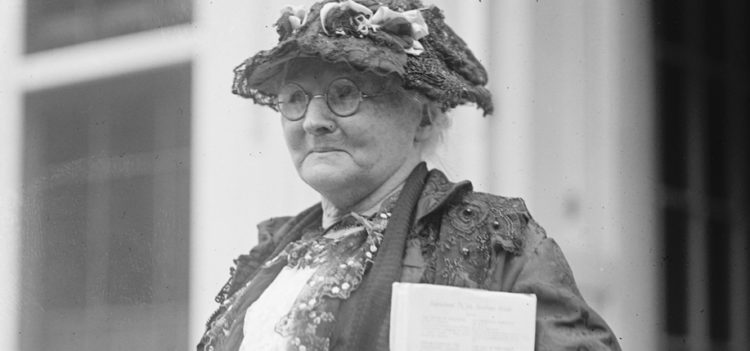
Irish Ships and Shipping Mother Jones at the White House, September 26, 1924. (Photo: Library of Congress)
Teddy Gleason: The Great Negotiator
For almost a quarter of a century, spearheading a period of immense growth and change, Teddy Gleason headed up the International Longshoremen’s Association. In his book Dreamers of Dreams, Donal O’Donovan wrote: “Whatever the marks of a shrewd and talented negotiator, Teddy Gleason has them.” After Gleason’s death in 1992, ILA president John Bowers said: “We have lost a great leader and a great man. I’ve noted before that Teddy Gleason will go down in history as the president who was able to get the most for his members. His memory will long endure.”
Born November 8, 1900 in New York City to Thomas Gleason and Mary Quinn, immigrants from Nenagh, Co. Tipperary and Omagh, Co. Tyrone respectively, Thomas W. Gleason was quickly nicknamed Teddy to distinguish him from his father and grandfather.
By age 15 he was working alongside his father on the West Side piers in Manhattan, the start of a career that was to span 77 years. Gleason worked various jobs on the docks, all the while further cementing his close ties to the ILA. His union activity saw him cut off from his job during the Great Depression, and he was forced to take on two jobs to support his wife and young family.
With the arrival of President Franklin D. Roosevelt’s “New Deal” and the increasing respect for unions, Gleason was able to pick up his career as a longshoreman and labor leader. He rose steadily in union ranks and became president of the ILA in 1963. The International Transport Workers’ Federation later elected him as vice president.
Gleason’s achievements in the ILA include securing a guaranteed annual income for workers hurt by increasing automation. He was also vice president on the executive council of the AFL-CIO and his expertise was often called on around the world to help out in labor disputes. His investigation into the movement of war-time cargo in Vietnam earned him a Medal of Merit in 1967 from the U.S. Veterans of Foreign Wars. He received countless other awards from such bodies as the United Seamen’s Service, the Catholic Youth Organization and The Carmelite Sisters for the Aged and Infirm. A true Irishman, however, he was most proud of being chosen as Grand Marshal of the New York St. Patrick’s Day Parade in 1984. Gleason said at the time: “It took me 80 years to get from 12th Avenue to 5th Avenue.”
Gleason was married to Emma Martin, and the couple had three sons, Thomas, Jr., John and Robert. He died on December 24, 1992 at the age of 92.
____________________
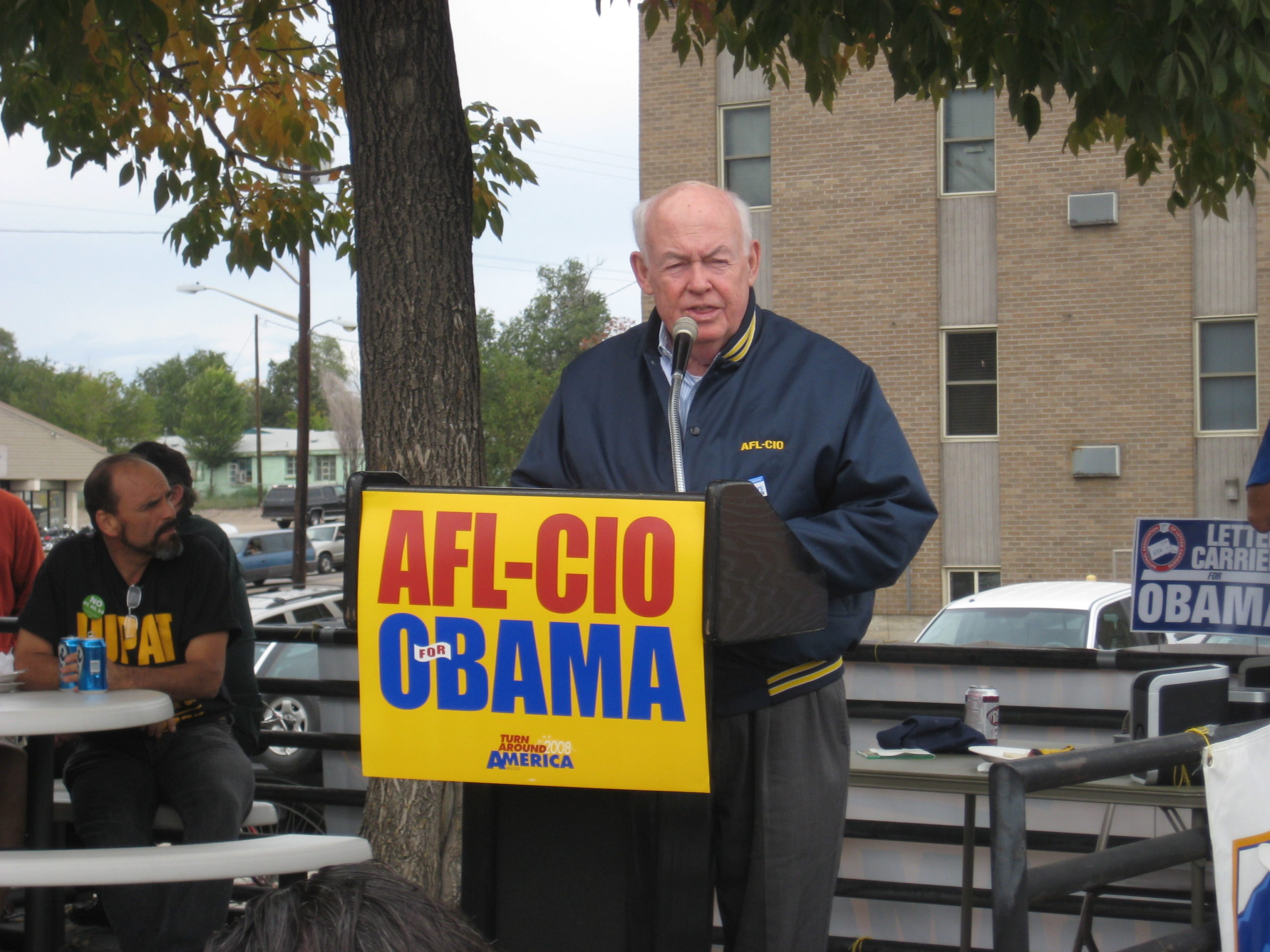
John Sweeney at the 2008 International Labor Leader Walk. (AFL-CIO / Wikimedia Commons)
John Sweeney: Labor Leader
John J. Sweeney became president emeritus of the AFL-CIO at the federation’s constitutional convention in September 2009, stepping down after five terms as president of America’s largest labor union. Sweeney has long been active in Irish affairs, and is a member of several Irish organizations. In 1995, he accompanied President Clinton on his first visit to Ireland.
Sweeney’s election as president of the American Federation of Labor-Congress of Industrial Organizations (AFL-CIO) in 1995 ushered in a new era in the labor movement. On the day of his electoral win, he led an impromptu march up Manhattan’s Fashion Avenue protesting wages and work conditions in the garment industry. Within weeks, he had established a multi-million-dollar fund to finance television and radio commercials, town rallies and telephone campaigns to hammer away at the evils of wage discrimination, job insecurity and union-busting corporations.
Born May 5, 1934 in New York’s Bronx to Irish immigrants from Leitrim, Sweeney studied economics at Iona College, and took a job at IBM after graduating. He had worked at a union job to pay his way through school and soon left IBM to take a lower-paying job with the International Ladies Garment Workers Union, a move that would set the course for his life’s work.
As president of the Service Employees International Union (SEIU) from 1980 until taking his current position, Sweeney doubled union membership and recorded countless other successes. Since his election to the helm of the AFL-CIO, he created new management posts to create leadership positions for women and minorities, all part of his goal to abolish the long-held concept of the labor movement as the domain of white males. In 1996, he wrote a book titled America Needs a Raise: Fighting for Economic Security and Social Justice. He also co-authored Solutions for the New Work Force in 1989. He and his wife, Maureen Power, have a son John and daughter Patricia. He was Irish American of the Year in 2004.
____________________
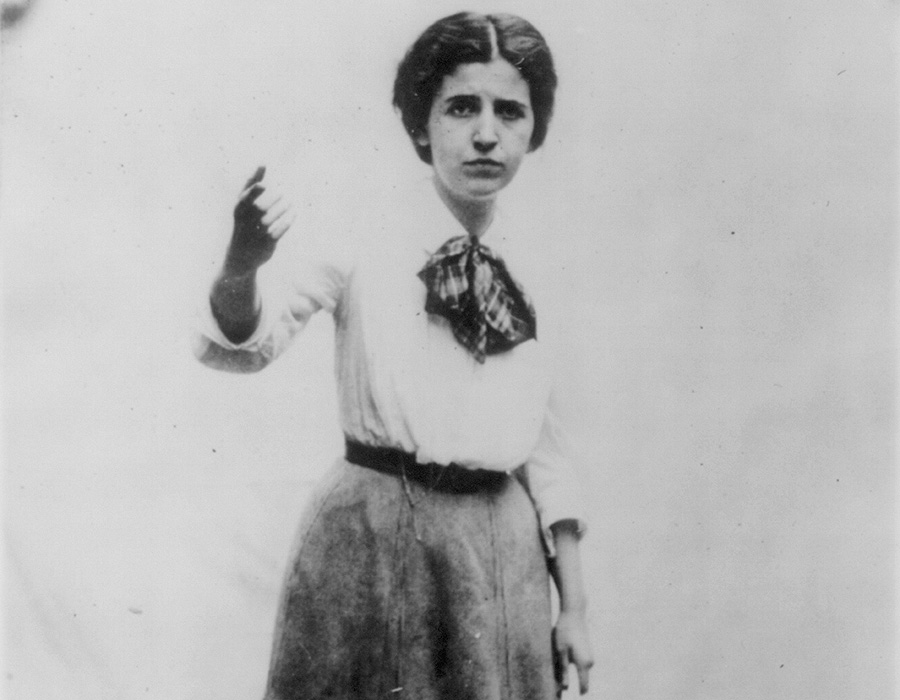
Elizabeth Gurley Flynn. (libcom.org)
Elizabeth Gurley Flynn: Powerhouse
Born to Galway native, Annie Gurley, and Tom Flynn whose roots lay in Mayo, Elizabeth Gurley Flynn was the oldest of four children. Raised on a strict diet of her father’s socialist and Marxist principles, it’s hardly surprising that she turned out to be both an active labor organizer and later a Communist official.
Talking about her ancestors, Gurley Flynn said all of her great-grandfathers had been United Irishmen. Her great-grandfather Flynn was deeply involved with the “Races of Castlebar,” and led General Humbert’s French troops from Ballina to Castlebar. His son, one of 18 children, was Gurley Flynn’s grandfather. He left his native Ireland during the Famine era for Maine, from where he later took part in the Fenian invasion of Canada.
Gurley Flynn was born in Concord, New Hampshire on August 7, 1890, and later moved with her family to the South Bronx. A bright student, she showed promise as a public speaker, and on leaving school turned to socialism and labor agitation. One magazine editor dubbed her “an East Side Joan of Arc.”
A stalwart of the Industrial Workers of the World, Gurley Flynn traveled from Montana to Washington to Chicago, speaking on behalf of workers everywhere and earning herself a spell behind bars in Spokane for her troubles. She was behind two huge demonstrations, one in Massachusetts in 1912, the other in New Jersey the following year. Her first marriage and a later common-law relationship failed. Gurley Flynn had two children, one of whom died shortly after birth.
It was in the last three decades of her life that Gurley Flynn took up her second cause, that of Communism. Elected to the party’s national committee in 1938, she wrote a regular column for the Daily Worker. A second prison sentence was to follow in the 1950s when Gurley Flynn was convicted under the Smith Act which made it illegal to advocate forceful overthrow of the government. She served over two years at the Federal Penitentiary for Women in Alderson, Virginia. Never one to waste time, she used the jail term to write her autobiography, a record of her fast 36 years. A memoir of her time in prison, The Alderson Story, was also published after her release.
In 1961, Gurley Flynn became the first woman chairperson of the American Communist party. A planned second volume of her autobiography never came to fruition, due to her untimely death in Moscow on September 4, 1964. In a final fitting tribute, the woman who embraced Communism with all her heart was accorded a state funeral in Red Square.
____________________
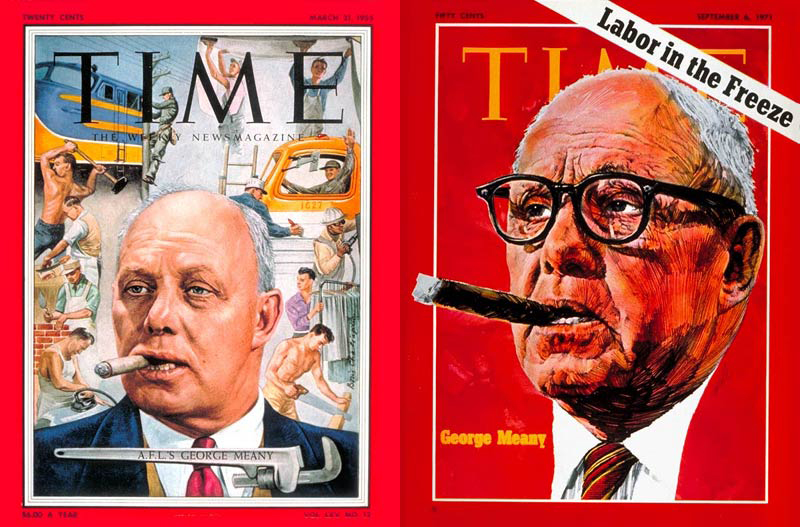
George Meany on the cover of TIME March 21, 1955 (left) and September 6, 1971 (right).
George Meany: Labor of Love
Bronx native George Meany followed his father into the plumbing trade, but he saw the work only as a means to an end. His real ambition was to become involved in the labor movement, a goal he achieved with spectacular results. By the time he died, at age 85 and only weeks after he retired, Meany had held the top positions of both the American Federation of Labor (AFL) and its eventual incarnation on merging with the Congress of Industrial Organizations, the AFL-CIO. His name is synonymous with the labor movement in the U.S., and especially in his beloved New York City.
Born August 16, 1894, Meany was one of ten children, and the grandson of Irish immigrants from Counties Longford and Westmeath. His father Michael Meany was president of Local Two of the plumbers’ union, but was adamantly opposed to having his sons follow in his footsteps. His antipathy was lost on George who became an apprentice in his teens, and soon followed on to membership of Local Two. After his father died, and his older brother enlisted in the army, Meany became the family breadwinner, a fact which delayed his wedding to Eugenie McMahon by a couple of years.
By 1952, Meany was president of the AFL, and subsequently he led the AFL-CIO. He was widely admired as a plain-speaking, scrupulously honest man, with a remarkable memory and a tough, forceful personality. He is also remembered for his tireless rooting out of corruption.
The years which preceded his election as president of the AFL involved lobbying for the New York State Federation of Labor, of which he served as president for a term in 1934. In his position as president of the AFL-CIO he was accustomed to dealing with the U.S. presidents of the time, including Eisenhower, Kennedy, Johnson and Carter. He retired in November of 1979, and died less than two months later.
____________________
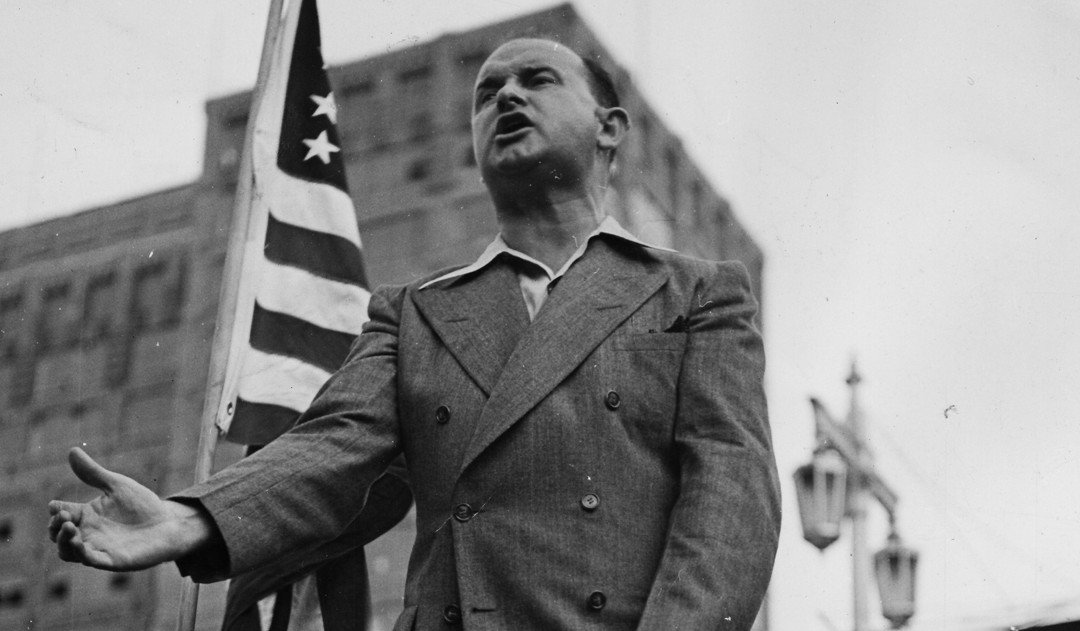
Mike Quill in 1941. TWU Local 100
Mike Quill: Himself
It was to become one of the most powerful unions in America but when the Transport Workers Union (TWU) was established in New York City in 1934 its prospects looked bleak. Conditions were terrible for the workers, who often had to work a seven-day week in dreadful conditions. Few gave it any hope of succeeding.
But the bosses reckoned with the willpower of its nucleus of founders who comprised a core group of eight or nine IRA veterans from the Irish Civil War including 29-year-old Kerry native Michael Joseph Quill. The following year, Quill was elected president of the new union.
Quill and his family in Ireland were well known in their local village for their staunch support of republicanism, and tales of young Mike’s daring exploits in foiling the Black and Tans were legendary. Several members of the family joined anti-treaty forces in the Irish civil war, and were forced to leave their native land when the war ended.
Born September 18, 1905, Quill left for America when he was just 19. He worked at various odd jobs — doorman, elevator operator, sandhog — before gaining employment with the New York subway system as a ticket clerk. Although the transport body was deeply resistant to organized labor, Quill and his fellow Irishmen persisted and succeeded in forming the TWU.
On the occasion of the 25th anniversary of the TWU, Quill remarked that he considered its greatest successes to be “the restoration of the rights of citizenship and dignity to the individual worker…I mean freedom from fear, freedom from want, freedom to speak one’ s mind.” Throughout his long association with the TWU, and organized labor in general, Quill remained an active and outspoken advocate of workers’ rights. His work helped secure better working hours and conditions for the union’s laborers. He also served as a member of the New York City Council at various times during his life.
In 1959, Quill’s wife of 22 years, Mary Theresa “Mollie” O’Neill, died of cancer. He married Shirley Uzin in 1961 and almost 20 years after his death her biography of him, Mike Quill: Himself, was released.
In 1965, Quill led a massive strike against New York’s bus and subway lines. His efforts brought the city to a standstill for 12 days and resulted in him being sent to prison. While behind bars, he suffered a heart attack, not his first, and he died less than a year later. Friends and admirers from Monsignor Charles Owen Rice to the Reverend Martin Luther King, Jr., lined up to pay tribute to his memory.
King described him as a pioneer of the modern trade movement and a pioneer in race relations. Said King: “He was a fighter for decent things all his life — Irish independence, labor organization and racial equality…When the totality of a man’s life is consumed with enriching the lives of others, this is a man the ages will remember — this is a man who has passed on but who has not died.”
____________________
Terry O’Sullivan (LiUNA)
Terry O’Sullivan: Innovator
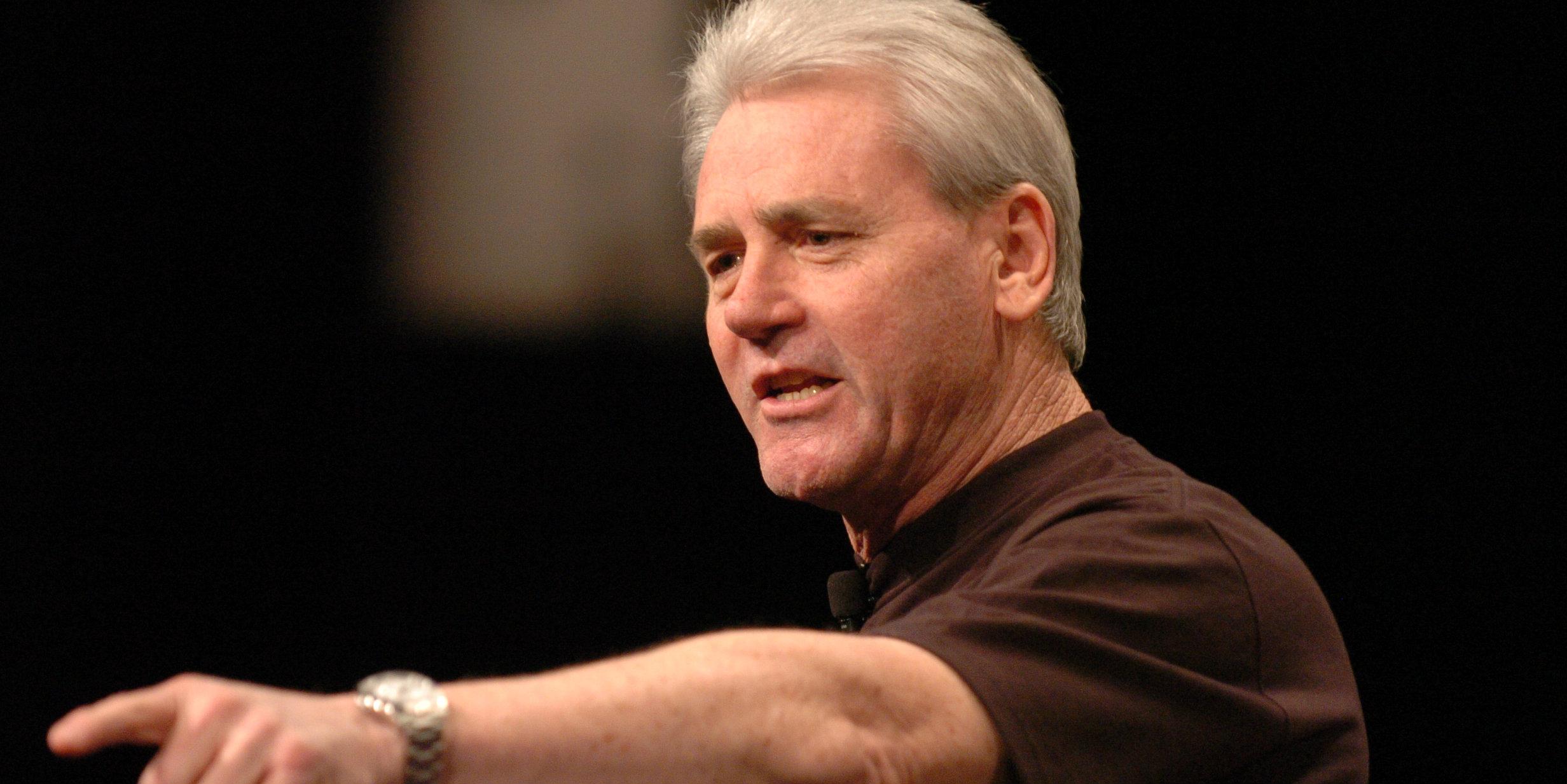
Terry O’Sullivan became the tenth General President of the Laborers’ International Union of North America (LiUNA) on January 1, 2000, and is dedicated to growing his union’s membership and market share. O’Sullivan’s mantra is “organize or die.” Under his leadership, the union also has significantly expanded its efforts in, and commitment to, member activism, capital strategies, grassroots politics, labor-management cooperation, journeyworker upgrade training, apprenticeship, and leadership education. Recognizing that labor and management share many of the same concerns and interests, he has built alliances with a wide range of owners, contractors, and business groups.
In 2011, O’Sullivan led delegates at the union’s 24th International Convention to pass a resolution that significantly increased LiUNA members’ investment in political action. The resolution has raised more than $10 million per election cycle to ensure that elected officials hear the voices of LiUNA members in the halls of Congress, and “Feel the Power” of LiUNA at the ballot box. The union’s PAC has raised its profile, and is now one of the top PACs in the country, working to help elect politicians who support issues of importance to the proud men and women of LiUNA.
In 2006, O’Sullivan led delegates at the 23rd International Convention to pass one of the most important resolutions in the union’s history, devoting to LiUNA’s organizing efforts 25 cents for every hour worked by a Laborer. This has enabled the union to invest more than $80 million per year in its organizing efforts – more than almost any other union in North America.
A fiery orator who is never afraid to speak his mind, Terry O’Sullivan can rally and inspire a crowd of Laborers one moment, then meet with top corporate leaders the next. He is equally at home on a construction site as he is in a board room.
Terry O’Sullivan and LiUNA have taken leading roles in pushing for comprehensive immigration reform, long-term highway funding, fair contracting, pension reform, fair postal reform, and many other issues of importance to LiUNA members and their families. O’Sullivan is an outspoken and unapologetic advocate for a diverse, realistic, all-of-the-above energy policy that meets North America’s energy needs safely and responsibly. He is a staunch and ardent supporter of the critically important, but long-delayed, Keystone XL Pipeline.
A long-time, vocal supporter of Sinn Féin and its work to secure a peaceful, just, and united Ireland, Terry O’Sullivan serves as President of New York Friends of Ireland and Chairman of DC Friends of Ireland.
A proud native of San Francisco, California, Terry O’Sullivan joined LiUNA in 1974, and is a long-time member of LiUNA Local Union 1353 in Charleston, West Virginia. (LiUNA). He was inducted into the Irish America Hall of Fame in March 2017.
____________________
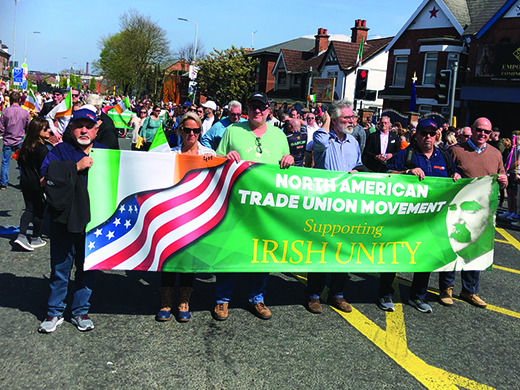
Sean McGarvey, President of NABTU (center in green shirt) marching in the Easter Parade in Belfast 2019.
Sean McGarvey: The Builder
Sean McGarvey started his career with the International Union of Painters and Allied Trades (IUPAT) in 1981 in Philadelphia. He subsequently worked his way up through various IUPAT leadership positions. In 2005, Sean was elected Secretary-Treasurer of NABTU, and in 2012, he was unanimously elected to NABTU’s office of president. Sean is a respected union construction voice among labor, government, corporate, and private sector leaders. His strategic focus gives the livelihoods and career opportunities of current and future rank and file members and their families primacy, and has strengthened NABTU’s impact and value to owners, contractors and whole communities.
A graduate and proponent of construction registered apprenticeship, Sean has led the development of Apprenticeship Readiness Programs, which focus on recruiting communities of color, women and veterans into the building trades. Alongside his governing board of presidents, he established Capital Strategies, a program to advance high-road standards in procurement practices and grow partnerships with top Wall Street and Bay Street investment firms supporting job-creating enterprises in commercial, industrial, and residential construction and public-private infrastructure. His bipartisan approach to policy and politics have navigated the building trades through some of the toughest fights to protect and advance labor, training, and industry standards, lower barriers to entry for new energy infrastructure and promote investment in rebuilding public infrastructure.
Sean serves on a number of national and international workforce boards, including the National Workforce Policy Advisory Board, Gates Foundation Post-Secondary Value Commission, and U.S. Council on Competitiveness. He chairs energy industry labor committees for American Petroleum Institute, American Chemical Council, Southern Company Power and Gas, Nuclear Power LMCC, Secretary of Energy Advisory Board (SEAB), among others. He chairs the boards of Helmets to Hardhats, CPWR’s Center for Construction Research and Training, the National Coordinating Committee for Multi-Employer Plans (NCCMP) and Diabetes Research Institute. Sean has a Bachelor’s degree in Business Administration and is a graduate of Harvard University’s Trade Union Program. Married to his lovely wife, Shari, Sean has two daughters, two step-daughters, and two grandchildren named Lucas and Leah.
McGarvey is fourth-generation Irish American — on his mother’s side his great-grandmother is from County Derry and his great-grandfather is from County Tyrone. He was inducted into the Irish America Hall of Fame in March 2020.
____________________
Mary Kay Henry (SEIU)
Mary Kay Henry: Born to Serve
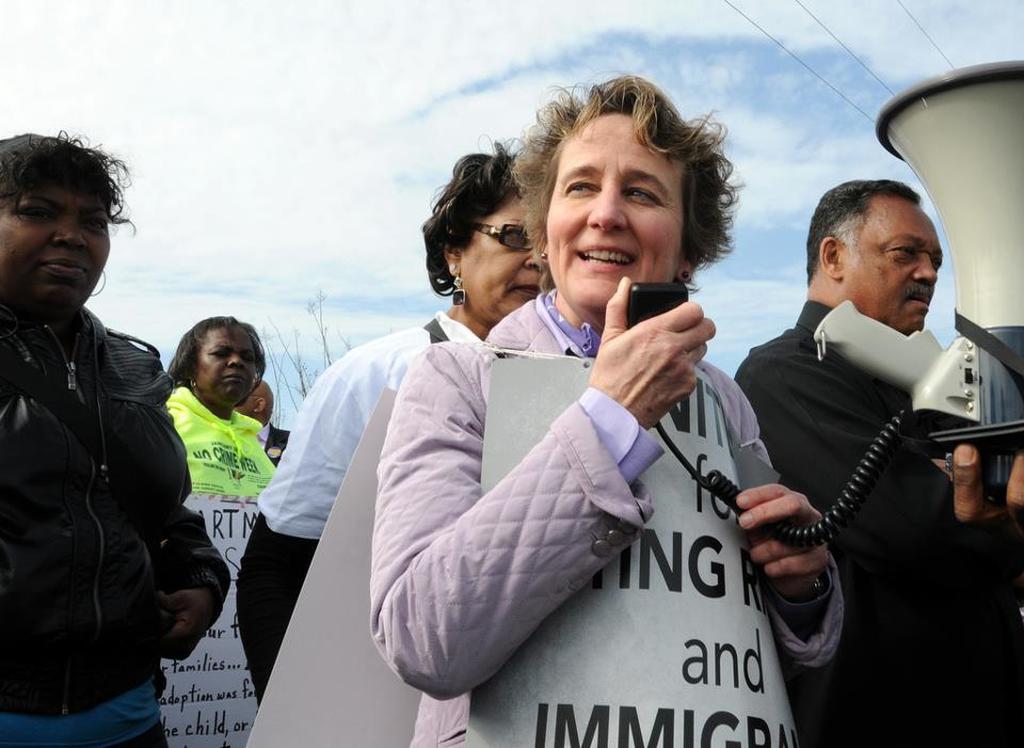
Mary Kay Henry is the International President of the Service Employees International Union (SEIU), which unites 2 million workers in healthcare, public and property services. She is the first woman to serve in this position, having been elected in 2010 by a unanimous decision. She has devoted her life to helping North America’s workers form unions and strengthen their voice at work about the quality of the goods and services they provide, and the quality of care they are able to deliver.
The daughter of a salesman and a teacher, Henry, whose ancestors hail from Tipperary, is the eldest daughter of 10. Henry grew up in a suburb of Detroit at a time when working people had a strong union voice that they used to build the middle class. Her childhood experiences in Detroit and her deep faith as a Roman Catholic instilled in her a deep commitment to opening the doors to opportunity for everyone and not just the few at the top.
Since joining SEIU’s staff in 1979, Henry has stood side by side with nursing home workers in Fresno, Calif., who fought for time to treat seniors with the dignity and respect they deserve, and suburban janitors in the Twin Cities, who wanted full-time work to support their families on a living wage. She has also worked with California state employees who sought to cut out waste and inefficiency from government, and registered nurses in Seattle, who wanted a partnership with management to improve the cost and quality of care throughout the state.
Under her leadership, more than a million healthcare workers nationwide, including registered nurses, technicians, doctors, and hospital and clinic workers are now united in SEIU Healthcare.
Henry’s commitment to confront income inequality and social injustice is embodied in the historic “Fight for 15” movement and in SEIU’s continued dedication to holding politicians accountable to working families, and achieving justice for immigrants and communities across our country. (SEIU)
____________________
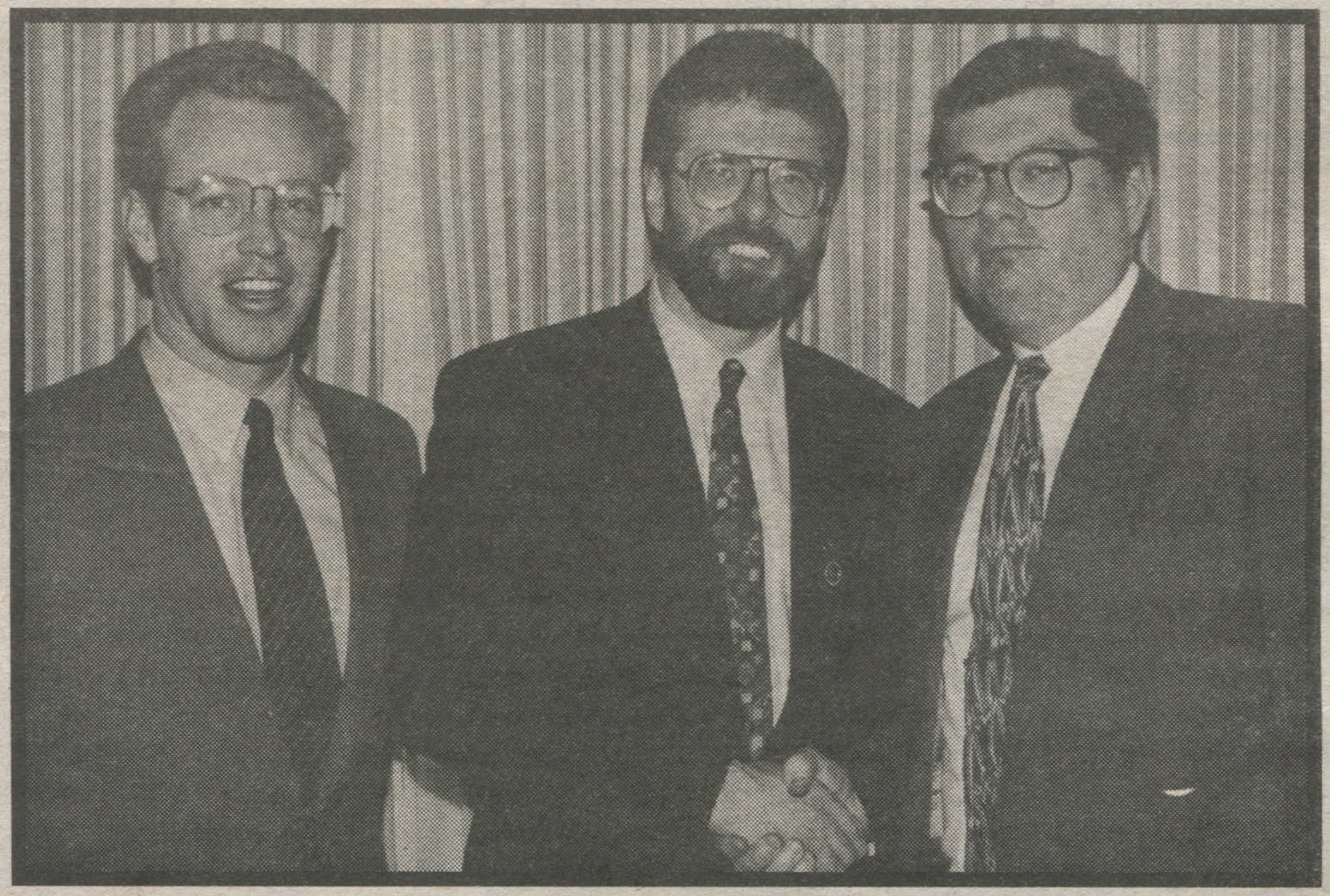
Bill Lenahan (left) and Joe Jamison (right) with Gerry Adams in 1994. (Irish Voice)
Joe Jamison and Bill Lenahan: Peacemakers
Joe Jamison and Bill Lenahan were members of the Irish American Labor Coalition when they were asked to join the 1994 IRA peace talks by Bruce Morrison, serving as director and assistant director respectively. (Jamison now serves as president.) An ALF-CIO affiliated group that deals specifically with human rights and labor issues in Northern Ireland, the IALC, helmed by Jamison and Lenahan, was instrumental in bringing about the backdoor negotiations that led to the August 31, 1994 IRA ceasefire.
At the time, Jamison, whose background is both Irish Catholic and Protestant, likened Loyalists to “Irish Afrikaners,” telling the Irish Voice, “They simply have to behave differently than the way they are behaving. They will be politically isolated and they will be in the dog house of international opinion. in conditions of a ceasefire, the world will see that it isn’t Irish Republicanism that’s the problem, it’s the Loyalists.”
Lenahan, who comes from a large Long Island Irish family joined the IALC in 1991 with a background in community organizing. Jamison, born and raised in New York City, was one of the principle co-founders of the IALC, then called the Irish American Labor Committee for Human Rights in Northern Ireland, built through a combination of Jamison’s involvement in the Civil Rights Movement in the north, and labor leaders from the U.S., including Tom Donoghue, then president of the AFL-CIO, and John Sweeney, then of the Service Employee’s Union.
“The impetus was the hunger strikes in the North of Ireland in the early 80’s which created a great emotional upsurge here in Irish America, including among trade unionists and trade union officials,” he said. “The Irish have always been well represented in the labor movement and a few key people got together to form a committee.”
Throughout the 80s and early 1990s, the IALC led vocal campaigns challenging the use of plastic bullets in the North, advocating for fair housing and employment practices, and putting their full weight behind the MacBride principles. Soon, the IALC offices in New York became known as a place where Irish trade unionists and activists can arrange meetings and set up contacts through the IALC with other groups in the U.S.
But it was during the 1992 election that the Coalition’s political clout was sealed. They convinced the Irish American community that conditions in the North would improve if Clinton was elected, and convinced Clinton to pledge in his campaign the guarantee of a visitor’s visa to Gerry Adams if elected. Clinton was, and made good on his promise, and that visit paved the way for Jamison and Lenahan’s inclusion in the ultimately successful 1994 ceasefire talks. ♦
Ed Donegan interjects. Not only did I love Bobby Sands from early as I could rember, I loved Irish union workers and street and dock gangs. I had always heard and even seen references in movies this was a deep well of tough Irish Power.
This was probaly what the FBI feared though. One reference I remember.
The series follows four young Roman CatholicIrish-American brothers in New York City‘s Hell’s Kitchen neighborhood and their involvement with petty and organized crime, specifically the Irish Mob.[1] Set in the present day, the show draws heavily upon Irish-American history and iconic themes. The pilot episode illustrates a clear tension and rivalry between Irish and Italians. The episodes are narrated by a childhood friend, Joey “Ice Cream”, whom the show depicts as an unreliable narrator.[2]
The term “Black Irish” has been in circulation among Irish emigrants and their descendants for centuries. Yet, as a subject of historical discussion, it is almost never referred to in Ireland.
There are a number of different claims as to the origin of the term, none of which are possible to entirely prove or disprove.
The term is commonly used to describe people of Irish origin who have dark features, black hair, a dark complexion and dark eyes.
In creating the show, Haggis, a native of London, Ontario, strongly referenced his hometown’s local history about the real-life Black Donnellys and the massacre associated with their name. In the pilot episode, Joey says the neighborhood is populated primarily by “Black Irish“, whom he calls “a race of dark-haired people” the Celts had failed to wipe out in Ireland. Hell’s Kitchen in the series is also a fairly faithful depiction—a traditionally working-class neighborhood with a deeply entrenched ethnic Irish population and an Irish Mob with control over illegal gambling and loansharking, and heavy involvement in the unions.
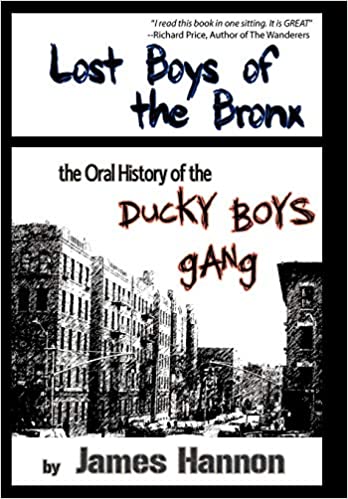
The Ducky Boys gang was a purported Irish gang from the Bronx, New York.
According to Richard Price’s book (and movie) The Wanderers (1979 film), The Ducky Boys were “stunted Irish madmen, none of them over 5 foot 6”. They were also portrayed as soul-less killers who never said a word.
For many Bronxites, the Ducky Gang was one of those mythical gangs that many people heard of, but not many people saw. I have heard references to them as “the Boogeymen of the Bronx” – where everyone was afraid of them, but nobody ever saw them…
Most of the Ducky Boys and Ducky Girls that I have spoken to get quite a kick out of those portrayals of them. The Ducky gang were quite human – they weren’t all short, they weren’t all Irish, they weren’t killers, and many of them have no problems speaking up.
The Duckys are a group of many whose main turf was Norwood, Bronx and in places like the New York Botanical Garden and Bronx Park near French Charlie’s field, specifically the Balcony at E 204th off Webster Ave, The Tunnels (under Theodore Kazimiroff Blvd), Twin Lakes, and PS 46 schoolyard.
They were big in the area from their young start at the “Duck” Pond (Twin Lakes in Botanical Gardens) in the early 60’s to their eventual fading out circa 1972. Over the years many kids passed through the Ducky Boys. Sadly not all of them grew up and they will forever be known as the “Lost Boys of the Bronx”.
There were a few things people found out if they were unlucky enough to get on the bad side of the Ducky’s – They were great with slingshots, and there were a LOT of them. The one thing that most say the Wanderers got right was that when they fought, there were usually huge numbers.
They were also a fiercely loyal bunch of friends that always believed “Hurt one of us, Hurt us all”
As of late-2007, there is a documentary on the real Ducky Boys gang in production. It is being directed by James Hannon and is scheduled to be released in early 2008
Straight from the streets of the mid-1960s Bronx comes a book about one of the borough’s most feared gangs – The Ducky Boys. While their unusual name alone might contradict their reputation, in the Norwood/Bainbridge section of the Bronx their appearances provoked an ominous dread. So much so, that when Richard Price needed inspiration for a terrifying gang in his novel (and later movie) The Wanderers, he knew exactly which gang to choose. Lost Boys of the Bronx tells the story of the Ducky Boys in their own words. It is a story of how a few pre-teen kids in the Botanical Gardens turned into a gang of hundreds – and a gang so alarming that rumors of their arrival would shut down local schools. This is also a study of the mostly Irish Bronx neighborhood in which the Ducky Boys were born, and where so many of the Ducky kids got caught up in the tumultuous times of the ’60s where their fierce loyalty was the only thing that got them through. This is not your typical gang book. It neither praises nor demonizes the gang for the things they did, but rather simply reports what happened – warts and all. You’ll see the truth behind the Ducky Boys’ gang – their lives, their loves, their pranks and crimes, and so much more. To borrow from a particular product’s slogan – with a name like the Ducky Boys, you knew they HAD to be tough.
Rocky Balboa Fighter of meager income supplements income at the docks for a loan shark Tony Gazzo.
Robert “Rocky” Balboa was born in Philadelphia, Pennsylvania, on July 6, 1945. He was the only child in a Roman CatholicItalian-American or Italian immigrant family. However, the surname Balboa (Italian pronunciation: [balˈbɔːa]; roughly meaning “beautiful valley”) originates from a Galician-speaking town in northwestern Spain. When Rocky is spoken to by his Italian priest, Father Carmine, it is apparent that Rocky understands Italian very well or fluently, including in a scene in which he translates Italian into English for Tommy Gunn. However, it is undetermined how well he actually speaks the language, as his responses are always in English.
During the scene in which Rocky takes Adrianna “Adrian” Pennino skating on Thanksgiving, he tells her, “Yeah – My old man, who was never the sharpest, told me I weren’t born with much brain, so I better use my body.” This encouraged him to take up boxing. He trained very hard so he could grow up to be like his idol Rocky Marciano. Unable to live on the low pay of club fights, and being unable to find work anywhere else, Rocky got a job as a collector for Tony Gazzo, the local loan shark, just to make ends meet. By the end of 1975, Rocky had fought in 64 fights, winning 44 (38 KO’S) and losing 20. Rocky was proud that he never had his nose broken in any of his amateur fighting career. His nickname is “The Italian Stallion”, spawning from his Italian-American heritage.
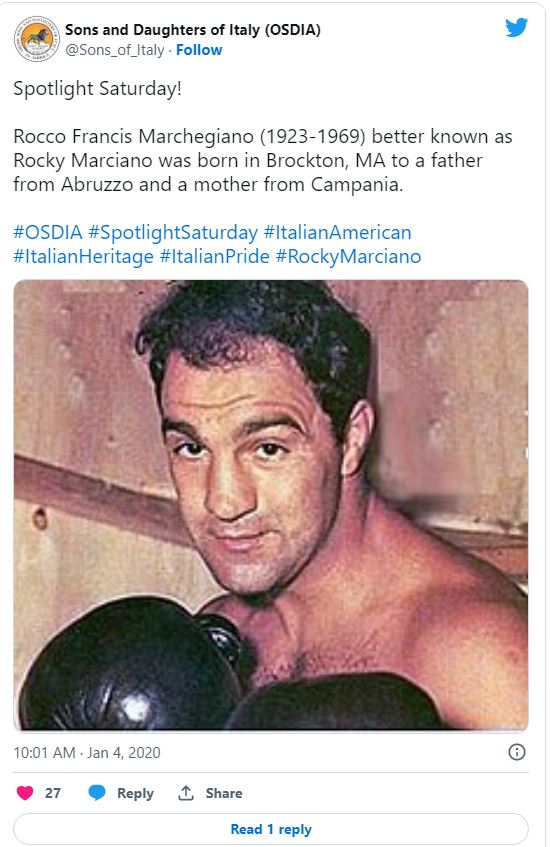
Rocco Francis Marchegiano (September 1, 1923 – August 31, 1969; Italian pronunciation: [markeˈdʒaːno]), better known as Rocky Marciano real fighter the role model for fictional Rocky Balboa was also Italian Roman Catholic. (/mɑːrsiˈɑːnoʊ/, Italian: [marˈtʃaːno]), was an American professional boxer who competed from 1947 to 1955, and held the world heavyweight title from 1952 to 1956. He is the only heavyweight champion to have finished his career undefeated.[4] His six title defenses were against Jersey Joe Walcott (from whom he had taken the title), Roland La Starza, Ezzard Charles (twice), Don Cockell and Archie Moore.
Born Rocco Francis Marchegiano, he was raised on the south side of Brockton, Massachusetts to Pierino Marchegiano and Pasqualina Picciuto.[8][9]
Brockton is a city in Plymouth County, Massachusetts, United States; the population is 105,643 as of the 2020 United States Census. Along with Plymouth, it is one of the two county seats of Plymouth County.[2] It is the sixth-largest city in Massachusetts and is sometimes referred to as the “City of Champions”, due to the success of native boxers Rocky Marciano and Marvin Hagler, as well as its successful Brockton High School sports programs. Two villages within it are Montello and Campello, both of which have MBTA Commuter Rail Stations and post offices. Campello is the smallest neighborhood, but also the most populous. Brockton hosts a baseball team, the Brockton Rox. It is the second-windiest city in the United States, with an average wind speed of 14.3 mph (23.0 km/h).[3]
Same place as the Kennedy’s and Donegans.
Both of his parents were immigrants from Italy.[8] His father was from Ripa Teatina, Abruzzo, while his mother was from San Bartolomeo in Galdo, Campania. Rocky had two brothers, Louis (aka Sonny) and Peter, and three sisters, Alice, Concetta and Elizabeth. When he was about 18 months old, Marciano contracted pneumonia, from which he almost died.
Known for his relentless fighting style, formidable punching power, stamina, and exceptionally durable chin, Marciano is considered one of the greatest heavyweight boxers of all time.[5]
A Legacy Built on Family and the desire for recognition
“Marciano felt pressured to make something special of himself and rescue his family. As the eldest, good son, Marciano felt compelled to honorably lift them from their family’s impoverished and limited lifestyle in their modest section of an old and immigrant-filled city of Brockton. He had a burning desire to succeed and make his Italian parents proud: family first, the most important Italian mantra, honorably accepted by the oldest, first-generation son…
Marciano was on a ‘no-lose’ mission to achieving greatness, and he did so by simply outworking and out-conditioning all fighting foes. For starters, he ran seven miles a day through the streets of Brockton, sometimes eating fresh fruit tossed to him from the native Italian grocers, cheering him on in Italian for his next fight that he always won.”
Marciano remains the only fighter to have stopped every opponent he ever faced for the world heavyweight title, and shares, with Joe Louis, the highest knockout-to-win percentage in world heavyweight title fights at 85.71%.[6] His career knockout-to-win percentage of 87.8% remains one of the highest in heavyweight boxing history. Marciano is ranked #14 in The Ring magazine’s list of the 100 greatest punchers of all time.[7]
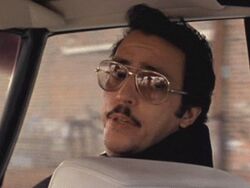
Tony Gazzo (28 October 1936 – 13 January 1989) was a loan shark who employed Rocky Balboa before his boxing career took off in the first film. Rocky was a good club fighter but his purses were often meager, and as such, insufficient to support himself. To augment his income, Rocky sought out whatever work he could and caught the attention of Gazzo who hired Rocky as muscle. Rocky was responsible for collecting the debts but, despite his fearsome reputation, was reluctant to use violence outside the ring. Rocky once refused Gazzo’s orders to break the fingers of one debtor, instead collecting a partial payment. When Gazzo angrily asked why Rocky failed to follow orders, Rocky protests that had he broken the man’s fingers, he would not have been able to work and earn the money to repay the rest of the debt. Gazzo, more concerned about reputation than collection, tells Rocky to “leave the thinking to me”. Rocky’s employment with Gazzo was also a bone of contention for Mickey, who banned him from his gym saying he had potential, but Rocky “fought like an ape” and his was a hired goon for “that loan shark”.
Gazzo returns in Rocky II, where he is one of the guests at the small simple wedding of Adrian and Rocky. A humorous dialogue occurs when Gazzo proposes that Rocky squirrel away some of the cash he made from the purse he got from the first fight with Apollo by becoming a minority investor in real estate investments made. Gazzo proposes Rocky invests in condominiums, saying they are low-risk, whereas Rocky mistook it for a similar word and says it is against his Catholic faith. When married life proves tough for Rocky, as he goes through a dry period of no work, Gazzo says his door is always open for Rocky as they are old friends, and Gazzo is obligated to help out. However, soon afterwards Apollo Creed announces his rematch with Rocky, and Rocky recommends his brother-in-law Paulie Pennino to do his old collection job. During the championship fight with Creed, Gazzo and his girlfriend are in the audience, and proudly cheer Rocky when he wins the belt.
Personality
Despite Gazzo being selfish, money hungry and sometimes downright criminal. Gazzo is also quite caring about Rocky, even lending him money so he can take Adrian out somewhere nice for the first date. He supported Rocky both times during his fights with Apollo and seems to be very proud of him, showing that Gazzo is not all bad.
Death
In the novel version of Rocky IV, it is revealed that Gazzo was killed sometime before Rocky traveled to Russia to prepare for his fight with Drago. This also resulted in the death of Gazzo’s bodyguard, as he took his own life, either out of extreme guilt for failure to protect his boss or sorrow at losing a friend. However, the novelization differs considerably from the events of the film.
An early concept (that ultimately failed to get shot) for Rocky V was that after Rocky loses all his assets and has his house and car repossessed, Rocky attempts to reestablish his working relationship with Gazzo only to be told that Gazzo has died. Rocky attempts to work for another loan shark, but this falls flat on its face as this man has none of the patience nor rapport that Gazzo established with Rocky.
Civil libertarian and biographer of my own and other OSS CIA Cold War families tied to the Kennedy assasinatinos and related air disasters (UAL 553, TWA 800)
View more posts