Donald Barr (August 8, 1921 – February 5, 2004) was an American educator, writer, and Office of Strategic Services (OSS) agent.
Donald Barr is closely tied to England, Scottish Rites, and his son William Pelham Barr who destroyed CIA records of MKULTRA.
Columbia University is a private university whose main campus lies in the Morningside Heights neighborhood of the Borough of Manhattan in New York City. It is one of the eight Ivy League universities and among the most prestigious institutions of higher education in the world. The institution was established by the Church of England, receiving a royal charter in 1754 as King’s College from George II of Great Britain, and is one of the oldest institutions of higher education in the United States. During the early years of its history, Alexander Hamilton, John Jay, Gouverneur Morris, and Robert Livingston studied at King’s College.
The university is also affiliated with: Barnard College (BC), an undergraduate liberal arts college for women and one of the Seven Sisters; the Jewish Theological Seminary; and the Union Theological Seminary, all located nearby in Morningside Heights. A joint undergraduate program is available through the Juilliard School. the University has produced leaders in all walks of life. It has maintained high standards of scholarship, often challenging traditional assumptions and helping to establish new paradigms, distancing itself over the passage of time from the establishment roots of the original College. https://www.newworldencyclopedia.org/entry/Columbia_University
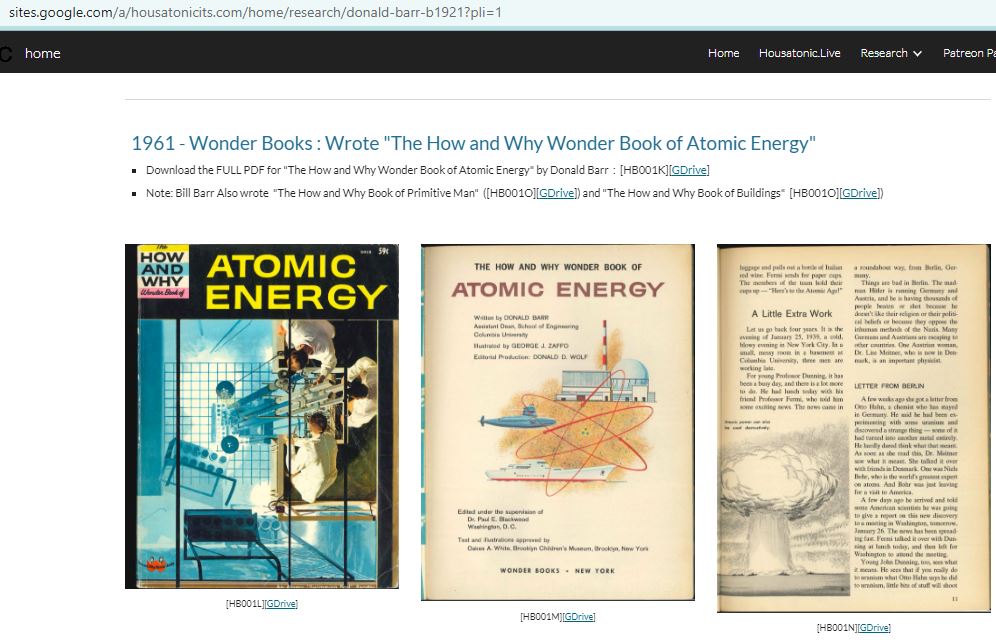
As an author Donald Barr wrote space paradigms about what amounts to League of Nations “rule of the plants” by High Ranking Alien Overerseers though those who are in the Overseers role prefer to keep their identity and even existence a secret. This theme was written into Star Trek Gari7, Mary Popins with Dick Vandyke rooftops workers who say all, etc.,
Ghost Riders in the Sky managing from above. In many nations familial connections insure power by Familial Right. In the USA familial connections eliminate power because of Conflict of Interest on Familial basis.
This is the Secret Society of the Special Relationship between elite families of England and the world and the USA who have legacy familial traits of leadership alaway being honed, orver generations.
The League of Nations was an international diplomatic group developed after World War I as a way to solve disputes between countries before they erupted into open warfare. A precursor to the United Nations, the League achieved some victories but had a mixed record of success, sometimes putting self-interest before becoming involved with conflict resolution, while also contending with governments that did not recognize its authority. The League effectively ceased operations during World War II.
The League of Nations has its origins in the Fourteen Points speech of President Woodrow Wilson, part of a presentation given in 1918 outlining of his ideas for peace after the carnage of World War I. Wilson envisioned an organization that was charged with resolving conflicts before they exploded into bloodshed and warfare.
By December of the same year, Wilson left for Paris to transform his Fourteen Points into what would become the Treaty of Versailles. Seven months later, he returned to the United States with a treaty that included the idea for what became the League of Nations.
Republican Congressman from Massachusetts Henry Cabot Lodge led a battle against the treaty. Lodge believed both the treaty and the League undercut U.S. autonomy in international matters.
In response, Wilson took the debate to the American people, embarking on a 27-day train journey to sell the treaty to live audiences but cut his tour short due to exhaustion and sickness. Upon arriving back in Washington, D.C., Wilson had a stroke.
Congress did not ratify the treaty, and the United States refused to take part in the League of Nations. Isolationists in Congress feared it would draw the United Sates into international affairs unnecessarily.
THe
Paris Peace Conference
In other countries, the League of Nations was a more popular idea.
Under the leadership of Lord Cecil, the British Parliament created the Phillimore Committee as an exploratory body and announced support of it. French liberals followed, with the leaders of Sweden, Switzerland, Belgium, Greece, Czechoslovakia and other smaller nations responding in kind. https://www.history.com/topics/world-war-i/league-of-nations
Henry Cabot Lodge will be a key player in the Kennedy administration doubtful of Englands teaching of the USA Espionage techniques of keeping “trade federation” type independent nations from leaving the Thousand Years Empire of Colonialism Europe.
Edward Donegan; For many the United Nations is an affront to world peace. I recently read and laughed along with a post on a conservative site that Saudi Arabia was now to the Women’s Rights Commission.
Saudi Arabia was today elected to the U.N. Commission on the Status of Women for a four-year term beginning in March 2023, at the first meeting of the body’s 68th session, and expiring in March 2027, at the close of its 71st session.
“Electing Saudi Arabia to a women’s rights commission is like making a pyromaniac into the town fire chief,” said Hillel Neuer, executive director of the independent non-governmental organization UN Watch, based in Geneva, Switzerland.
The Commission on the Status of Women, according to its website, is the “principal global intergovernmental body exclusively dedicated to the promotion of gender equality and the empowerment of women.”
The Commission describes itself as “instrumental in promoting women’s rights, documenting the reality of women’s lives throughout the world, and shaping global standards on gender equality and the empowerment of women.”
U.N. Elects Saudi Arabia to Women’s Rights Commission
UNWATCH is not the same thing as UN.
Debate is what makes good policy. The imperial does not want dissent. Saudi Arabia can be outvoted easily especially with behind the scenes diplomacy asking them to withdraw vetoes if they have such power on the commission or even statements or votes.
For Donald Barr and others unpolluted Great Brittian is the ally of the USA, not the United Nations.
The difference in viewpoint is narrow but important.
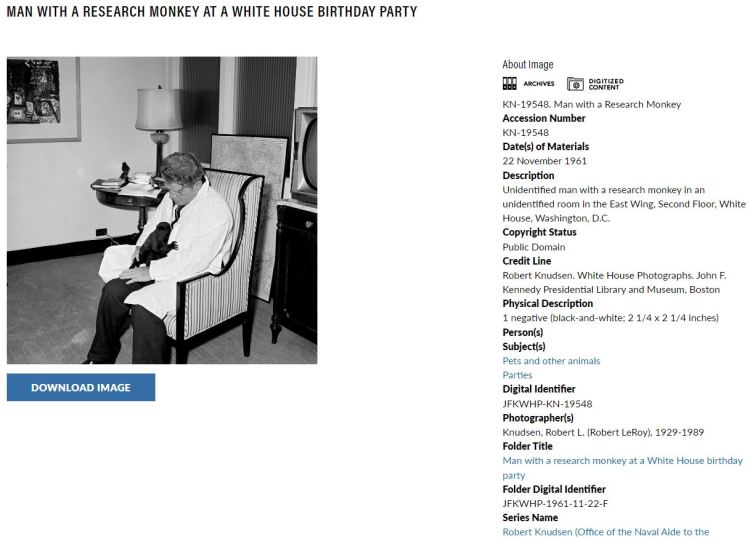
There are really five key dates 1) His being born into Columbia University Brain and Psychology Research, 2) February 20 1961 fertilization with JFK following the progress alog with Thorkill Kristensen and George Ball likely conferenced into CIA Weapons Lab and United Fruit Company home Mary’s CIA Lab and Mary’s Monkey, 3) November 18 about 9 months later JFK is present at Santa Monica Manhattan Beach Venice Beach area with Brother In Lawford house, birth certificate November 19 1961 022-46-3234 for Barrack Obama Jr, 4) November 23 1961 back at the Whitehouse Washington DC with experimental monkey having a birthday party. 5) 21st Century Expo with Windsor’s and Military Industrial Complex in Seatle discussing findings of IVF, likely the first.
Barr served in the Office of Strategic Services (OSS) during World War II. Following the conflict, he returned to Columbia, where he earned an M.A. in English in 1950 and completed course requirements for a Ph.D. in the discipline while also teaching in the English department.[4][8] During this period, he also taught “courses with field work in sociology and political science at the School of Engineering” and wrote “science and mathematics texts for elementary and junior high school students.” He initiated the Columbia University Science Honors Program in 1958 and was its director (as an assistant dean at the School of Engineering) until 1964. From 1963 to 1964, he also administered the National Science Foundation Cooperative College-School Program.[4]
He was headmaster of the Dalton School from 1964 to 1974.[9] During his time as Dalton’s headmaster, Barr is alleged to have had a role in hiring future financier and convicted sex offender Jeffrey Epstein as a math teacher despite the fact that Epstein (who graduated from high school at the age of 16 and secured a full scholarship to Cooper Union) had failed to complete his degree and was only 21 years old at the time.[10][11] In 1973, Barr published Space Relations, a science fiction novel about a planet ruled by oligarchs who engage in child sex slavery. It has been noted that the plot of the novel anticipates the crimes of Epstein and his alleged accomplice, Ghislaine Maxwell.[12]
Department of Justice
Office of Public Affairs
FOR IMMEDIATE RELEASE
Saturday, August 10, 2019
Statement from Attorney General William P. Barr on the Death of Jeffrey Epstein
Attorney General William P. Barr issued the following statement:
“I was appalled to learn that Jeffrey Epstein was found dead early this morning from an apparent suicide while in federal custody. Mr. Epstein’s death raises serious questions that must be answered. In addition to the FBI’s investigation, I have consulted with the Inspector General who is opening an investigation into the circumstances of Mr. Epstein’s death.”
Office of the Attorney General William Pellham Barr Press Release Number: 19-855 Updated August 10, 201
William Barr rules Epstein death Suicide.
Barr also reviewed books for The New York Times.[4][8] In addition to his two science fiction novels, he sold two stories to The Magazine of Fantasy and Science Fiction; one of these (the 2002 “Sam”) was reprinted in the 2003 anthology Year’s Best Fantasy 3.
In 1983 President Ronald Reagan nominated Donald Barr to be a member of the National Council on Educational Research.[13]
Early life and education[edit]
Barr was born in New York City in 1950. His father, Donald Barr, taught English literature at Columbia University before becoming headmaster of the Dalton School in Manhattan and later the Hackley School in Tarrytown, New York, both members of the Ivy Preparatory School League. Barr’s mother, Mary Margaret (née Ahern), also taught at Columbia.[12] Barr’s father was Jewish and raised in Judaism but later converted to Christianity and joined the Catholic Church. His mother is of Irish ancestry. Barr was raised as a Catholic.[13][14] Barr was the second of four sons, and his younger brother Stephen Barr is a professor of physics at the University of Delaware.[15]
Barr grew up on New York City’s Upper West Side. As a child, he attended a Catholic grammar school, Corpus Christi School, and then the non-sectarian Horace Mann School. After high school, he attended Columbia University, where he majored in government and graduated with a Bachelor of Arts in 1971. Barr was also an active member in the Sigma Nu fraternity. He did two additional years of graduate study at Columbia, receiving a Master of Arts in government and Chinese studies in 1973. While at Columbia, Barr opposed anti-Vietnam War occupation protests by students on campus.[16]
After moving to Washington, D.C., William Pellham Barr went to work as an intelligence analyst for the Central Intelligence Agency (CIA), Barr entered the evening student program at George Washington University Law School. He graduated in 1977 with a Juris Doctor with highest honors.[17][18]
Heavily drawn from and copied from https://sites.google.com/a/housatonicits.com/home/research/donald-barr-b1921?pli=1
1930 Census – New York
Donald “E” Barr is 8 years old. https://sites.google.com/a/housatonicits.com/home/research/donald-barr-b1921?pli=1
Full Census form : [HS0019][GDrive]
Father is Simon Pelham Barr (born 1892) , age 37. The census form says Simon was a “writer”, working for “General Practice”. He was born in England; his father and mother were born in Poland.
Mother is “Estelle De Y” (actually it is ” Estelle de Young Barr (born 1893) “) , age 36. The census form says Estelle was born in New York; her father was born in Connecticut, and mother was born in Holland. Note that the census form says her career is “None”, but we know that Estelle was working with Columbia University professionals in the 1920s and the 1930s, and that she was a doctor of psychology.
Their servant was Paula Schubaur (spelling could be wrong), who was born in Germany.
Their address was 450 Riverside Drive, in New York. City . 450 Riverside Drive (NYC) is across the street from Columbia University. [Edward Paul Donegan suspects British beachead in the USA is Columbia University and it has been invovlved in Brain Research with Great Brittian, Canada, Australia, US since 1902. Donald Barr will later work with Jeffery Epstein in brain researh Virgin Island Brain Institute-Foundation and also with test births for new groomed leaders holding and experimental monkey who the Indonesians may one day worship as a god,]
Below, the realization of the Prophecy at about 11 (November) in the Whitehouse they will all meet again. With Donald Barr to be holding the experimental monkey IN the Whitehouse
1942-1944 – With US Army in World War II
- [Donald Barr] “served with the U.S. Army as an Italian interpreter in a POW camp.” [HN00JU][GDrive]
- During WW2, [Donald Barr] }taught higher math to anti-aircraft gunnery students at an Army camp in Hulen, Texas”. [HN00JQ][GDrive]
- It was during his time with the army in WW2 that Donald Barr learned Italian. Donald Barr said “I knew if I didnt make it, I’d be made a combat engineer in the South pacific where if I didnt get shot, I’d catch marlia or down. Boy, did I learn Italian.” [HN00K3][GDrive]
- 1945 – Joins Office of Strategic Service (OSS) in Germany
- In 1945, [Donald Barr] “joined the 🌐Office of Strategic Services (OSS) in Germany, aiding in de-Nazifying companies and industry. He also investigated German industrialists and SS men who had fled to South America.” [HN00JQ][GDrive]
- The 🌐Office of Strategic Services (OSS) was the predecessor to the Central Intelligence Agency (CIA). [HK0013][GDrive]
- In addition to working with the OSS Germany, it is documented that Donald Barr also served with the Office of Strategic Services in Washington DC.
- Some references describe this time differently. One source says that in 1945 Donald Barr joined the English department at Columbia and remained there for 10 years, taking an M.A. in English. [HN00JU][GDrive] Does this mean Donald Barr was only in Berlin for a few months? Or, does it mean that “aiding in de-Nazifying companies” is part of the job at Columbia University’s English program?
- Thus, it is not clear how long Donald Barr was with the OSS.
- 1946 (April 22) – Married Mary Margaret Ahern
- Donald Barr marries at age 25. Marriage date here : [HB000Z][GDrive] . Mary Maraget Ahern was born in Connecticut on August 14, 1918. See [HL0029][GDrive] . Information on where this wedding took place is needed.
- Mary Margaret (Ahern) Barr has been identified as a Columbia University professor / faculty member [HG001T][GDrive] . Details and additional verification is pending.
- 1947 – First son Christopher James born
- See [HB000Z][GDrive]
- 1948 – Father (Simon Pelham Barr) passes
- See Simon Pelham Barr (born 1892) .
- 1951 – Completes master’s degree
- […] Donald Barr taught in the English department while getting his master’s degree in 1951 and completing course requirements for a Ph.D. [By] then he was teaching courses with field work in sociology and political science at the School of Engineering and writing science and mathematics texts for elementary and junior high school students. [HN00JO][GDrive]
- 1955 – 1959
- “In 1955 the engineering school asked him to oversee its efforts to spot promising elementary and secondary science students, including girls, and enlist them for advanced training at the school to help them rise to the college level. Joining the engineering dean’s office, he then developed the Science Honors Program, which got the attention and support of the National Science Foundation.” [HN00JO][GDrive]
- In 1956 he moved to the school of engineering at Columbia University, where he became assistant dean and started and directed the science honors programs. [HN00JU][GDrive]
- Mr. Barr became assistant dean of the Faculty of Engineering and Applied Science in 1959, and the foundation eventually asked him to administer its entire Cooperative College-School Program. He did so beginning in 1963, continuing until he became headmaster at Dalton the following year.
“Donald Barr was in the OSS (now CIA) during WWII, serving in Germany. Around 1959, he also had a habit of sending fake letters to NYT under the name Charles Danforth Rossiter, and penned under his secretary’s fake name Mary Lou Ten Eyck.” – Dave Troy on Twitter @davetroy this tweet
The Office of Strategic Services (OSS) was the intelligence agency of the United States during World War II. The OSS was formed as an agency of the Joint Chiefs of Staff (JCS)[3] to coordinate espionage activities behind enemy lines for all branches of the United States Armed Forces. Other OSS functions included the use of propaganda, subversion, and post-war planning.
The OSS was dissolved a month after the end of the war. Intelligence tasks were shortly later resumed and carried over by its successors the Department of State‘s Bureau of Intelligence and Research (INR), and the independent Central Intelligence Agency (CIA).
On December 14, 2016, the organization was collectively honored with a Congressional Gold Medal.
Prior to the formation of the OSS, the various departments of the executive branch, including the State, Treasury, Navy, and War Departments conducted American intelligence activities on an ad hoc basis, with no overall direction, coordination, or control. The US Army and US Navy had separate code-breaking departments: Signal Intelligence Service and OP-20-G. (A previous code-breaking operation of the State Department, the MI-8, run by Herbert Yardley, had been shut down in 1929 by Secretary of State Henry Stimson, deeming it an inappropriate function for the diplomatic arm, because “gentlemen don’t read each other’s mail.”[5]) The FBI was responsible for domestic security and anti-espionage operations.
President Franklin D. Roosevelt was concerned about American intelligence deficiencies. On the suggestion of William Stephenson, the senior British intelligence officer in the western hemisphere, Roosevelt requested that William J. Donovan draft a plan for an intelligence service based on the British Secret Intelligence Service (MI6) and Special Operations Executive (SOE). Donovan envisioned a single agency responsible for foreign intelligence and special operations involving commandos, disinformation, partisan and guerrilla activities.[6] After submitting his work, “Memorandum of Establishment of Service of Strategic Information”, he was appointed “coordinator of information” on July 11, 1941, heading the new organization known as the office of the Coordinator of Information (COI).
Thereafter the organization was developed with British assistance; Donovan had responsibilities but no actual powers and the existing US agencies were skeptical if not hostile. Until some months after Pearl Harbor, the bulk of OSS intelligence came from the UK. British Security Co-ordination (BSC) trained the first OSS agents in Canada, until training stations were set up in the US with guidance from BSC instructors, who also provided information on how the SOE was arranged and managed. The British immediately made available their short-wave broadcasting capabilities to Europe, Africa, and the Far East and provided equipment for agents until American production was established.[7]
The Office of Strategic Services was established by a Presidential military order issued by President Roosevelt on June 13, 1942, to collect and analyze strategic information required by the Joint Chiefs of Staff and to conduct special operations not assigned to other agencies. During the war, the OSS supplied policymakers with facts and estimates, but the OSS never had jurisdiction over all foreign intelligence activities. The FBI was left responsible for intelligence work in Latin America, and the Army and Navy continued to develop and rely on their own sources of intelligence.
General William J. Donovan reviews Operational Group members in Bethesda, Maryland prior to their departure for China in 1945.
OSS proved especially useful in providing a worldwide overview of the German war effort, its strengths and weaknesses. In direct operations it was successful in supporting Operation Torch in French North Africa in 1942, where it identified pro-Allied potential supporters and located landing sites. OSS operations in neutral countries, especially Stockholm, Sweden, provided in-depth information on German advanced technology. The Madrid station set up agent networks in France that supported the Allied invasion of southern France in 1944. Most famous were the operations in Switzerland run by Allen Dulles that provided extensive information on German strength, air defenses, submarine production, and the V-1 and V-2 weapons. It revealed some of the secret German efforts in chemical and biological warfare. Switzerland’s station also supported resistance fighters in France, Austria and Italy, and helped with the surrender of German forces in Italy in 1945.[8]
For the duration of World War II, the Office of Strategic Services was conducting multiple activities and missions, including collecting intelligence by spying, performing acts of sabotage, waging propaganda war, organizing and coordinating anti-Nazi resistance groups in Europe, and providing military training for anti-Japanese guerrilla movements in Asia, among other things.[9] At the height of its influence during World War II, the OSS employed almost 24,000 people.[10]
From 1943–1945, the OSS played a major role in training Kuomintang troops in China and Burma, and recruited Kachin and other indigenous irregular forces for sabotage as well as guides for Allied forces in Burma fighting the Japanese Army. Among other activities, the OSS helped arm, train, and supply resistance movements in areas occupied by the Axis powers during World War II, including Mao Zedong‘s Red Army in China (known as the Dixie Mission) and the Viet Minh in French Indochina. OSS officer Archimedes Patti played a central role in OSS operations in French Indochina and met frequently with Ho Chi Minh in 1945.[11]
One of the greatest accomplishments of the OSS during World War II was its penetration of Nazi Germany by OSS operatives. The OSS was responsible for training German and Austrian individuals for missions inside Germany. Some of these agents included exiled communists and Socialist party members, labor activists, anti-Nazi prisoners-of-war, and German and Jewish refugees. The OSS also recruited and ran one of the war’s most important spies, the German diplomat Fritz Kolbe.
From 1943 the OSS was in contact with the Austrian resistance group around Kaplan Heinrich Maier. As a result, plans and production facilities for V-2 rockets, Tiger tanks and aircraft (Messerschmitt Bf 109, Messerschmitt Me 163 Komet, etc.) were passed on to Allied general staffs in order to enable Allied bombers to get accurate air strikes. The Maier group informed very early about the mass murder of Jews through its contacts with the Semperit factory near Auschwitz. The group was gradually dismantled by the German authorities because of a double agent who worked for both the OSS and the Gestapo. This uncovered a transfer of money from the Americans to Vienna via Istanbul and Budapest, and most of the members were executed after a People’s Court hearing.[12][13]
OSS 1st Lieutenant George Musulin behind enemy lines in German-occupied Serbia, as a Chetnik, during his first mission in November 1943. His second mission was Operation Halyard.
In 1943, the Office of Strategic Services set up operations in Istanbul.[14] Turkey, as a neutral country during the Second World War, was a place where both the Axis and Allied powers had spy networks. The railroads connecting central Asia with Europe, as well as Turkey’s close proximity to the Balkan states, placed it at a crossroads of intelligence gathering. The goal of the OSS Istanbul operation called Project Net-1 was to infiltrate and extenuate subversive action in the old Ottoman and Austro-Hungarian Empires.[14]
The head of operations at OSS Istanbul was a banker from Chicago named Lanning “Packy” Macfarland, who maintained a cover story as a banker for the American lend-lease program.[15] Macfarland hired Alfred Schwarz, a Czechoslovakian engineer and businessman who came to be known as “Dogwood” and ended up establishing the Dogwood information chain.[16] Dogwood in turn hired a personal assistant named Walter Arndt and established himself as an employee of the Istanbul Western Electrik Kompani.[16] Through Schwartz and Arndt the OSS was able to infiltrate anti-fascist groups in Austria, Hungary, and Germany. Schwartz was able to convince Romanian, Bulgarian, Hungarian, and Swiss diplomatic couriers to smuggle American intelligence information into these territories and establish contact with elements antagonistic to the Nazis and their collaborators.[17] Couriers and agents memorized information and produced analytical reports; when they were not able to memorize effectively they recorded information on microfilm and hid it in their shoes or hollowed pencils.[18] Through this process information about the Nazi regime made its way to Macfarland and the OSS in Istanbul and eventually to Washington.
While the OSS “Dogwood-chain” produced a lot of information, its reliability was increasingly questioned by British intelligence. By May 1944, through collaboration between the OSS, British intelligence, Cairo, and Washington, the entire Dogwood-chain was found to be unreliable and dangerous.[18] Planting phony information into the OSS was intended to misdirect the resources of the Allies. Schwartz’s Dogwood-chain, which was the largest American intelligence gathering tool in occupied territory, was shortly thereafter shut down.[19]
The OSS purchased Soviet code and cipher material (or Finnish information on them) from émigré Finnish army officers in late 1944. Secretary of State Edward Stettinius, Jr., protested that this violated an agreement President Roosevelt made with the Soviet Union not to interfere with Soviet cipher traffic from the United States. General Donovan might have copied the papers before returning them the following January, but there is no record of Arlington Hall receiving them, and CIA and NSA archives have no surviving copies. This codebook was in fact used as part of the Venona decryption effort, which helped uncover large-scale Soviet espionage in North America.[20]
RYPE was the codename of the airborne unit who was dropped in the Norwegian mountains of Snåsa on March 24, 1945 to carry out sabotage actions behind enemy lines. From the base at the Gjefsjøen mountain farm, the group conducted successful railroad sabotages, with the intention of preventing the withdrawal of German forces from northern Norway. Operasjon Rype was the only U.S. operation on German-occupied Norwegian soil during WW2. The group consisted mainly of Norwegian Americans recruited from the 99th Infantry Battalion. Operasjon Rype was led by William Colby.[21]
The OSS sent four teams of two under Captain Stephen Vinciguerra (codename Algonquin, teams Alsace, Poissy, S&S and Student), with Operation Varsity in March 1945 to infiltrate and report from behind enemy lines, but none succeeded. Team S&S had two agents in Wehrmacht uniforms and a captured Kϋbelwagon; to report by radio. But the Kϋbelwagon was put out of action while in the glider; three tires and the long-range radio were shot up (German gunners were told to attack the gliders not the tow planes).
On September 20, 1945, President Truman signed Executive Order 9621, terminating the OSS.[68] The State Department took over the Research and Analysis Branch; it became the Bureau of Intelligence and Research, The War Department took over the Secret Intelligence (SI) and Counter-Espionage (X-2) Branches, which were then housed in the new Strategic Services Unit (SSU). Brigadier General John Magruder (formerly Donovan’s Deputy Director for Intelligence in OSS) became the new SSU director. He oversaw the liquidation of the OSS and managed the institutional preservation of its clandestine intelligence capability.[69]
In January 1946, President Truman created the Central Intelligence Group (CIG),[70] which was the direct precursor to the CIA. SSU assets, which now constituted a streamlined “nucleus” of clandestine intelligence, were transferred to the CIG in mid-1946 and reconstituted as the Office of Special Operations (OSO). The National Security Act of 1947 established the Central Intelligence Agency, which then took up some OSS functions. The direct descendant of the paramilitary component of the OSS is the CIA Special Activities Division.[71]
Today, the joint-branch United States Special Operations Command, founded in 1987, uses the same spearhead design on its insignia, as homage to its indirect lineage. The Defense Intelligence Agency currently manages the OSS’ mandate to provide strategic military intelligence to the Joint Chiefs of Staff and the Secretary of Defense and to coordinate human espionage activities across the United States Armed Forces (through the Defense Clandestine Service) and was awarded status as an OSS Heritage organization by the OSS Society.
As far as what Barr is hoping to do with his canvas, Gerson says he is committed to the “hierarchical” and “authoritarian” premise that “a top-down ordering of society will produce a more moral society.” That isn’t too far away from what Barr himself articulated in a 2019 speech at the University of Notre Dame. In Barr’s view, piety lay at the heart of the founders’ model of self-government, which depended on religious values to restrain human passions. “The founding generation were Christians,” Barr said. Goodness flows from “a transcendent Supreme Being” through “individual morality” to form “the social order.” Reason and experience merely serve to confirm the infallible divine law. That law, he said, is under threat from “militant secularists,” including “so-called progressives,” who call on the state “to mitigate the social costs of personal misconduct and irresponsibility.” At their feet, Barr places mental illness, drug overdoses, violence and suicide. All these things, he said, are getting worse. All are “the bitter results of the new secular age.”
Barr started his career in the C.I.A. as an analyst, working on China and other matters. When I asked about the origin of his interest in the intelligence service, he responded indirectly, with an anecdote about telling his high school guidance counselor that he wanted to be C.I.A. director. It was tempting to link Barr’s career and conservatism with his father, Donald Barr, who served in the Office of Strategic Services, the C.I.A.’s forerunner, during World War II. In 1940, as an undergraduate at Columbia, Donald wrote a controversial editorial for The Columbia Review, defending a speech by the university president that called upon the faculty to support the American war effort. “Most liberals,” he wrote, “do not think precisely.” As tempting as it was to see the son as part of some epigenetic chain of old-line conservatism, Barr cautioned me not to make such assumptions. “My father was like: ‘Do what you want to do. Do what you enjoy. Do something that you’re really interested in, because that’s what you’ll do best in.’”
Barr’s parents met at the University of Missouri in the early 1940s. Donald, who already spoke three languages, had been sent there by the Army to learn Italian. He spotted Mary Ahern, a young Irish-Catholic woman who had a master’s degree in English from Yale, through an open doorway, teaching Shakespeare to undergraduates, and was smitten. Ahern took some courting. She thought Donald was a “New York wolf,” Barr told me, and his background was also an issue; he was raised without much religion, but his father, William’s grandfather, was born a secular Jew. Upon joining the Army, Donald gave his religion as Dutch Reformed. He converted to Catholicism after he and Mary wed.
Donald Barr’s 26-page O.S.S. file, obtained from the National Archives, gives a detailed account of his transition from the military to intelligence work. In 1944, he shipped off to Europe. He suffered from hay fever and 20/200 vision; much of his time overseas was spent hospitalized with allergies. The next year, he was assigned to the O.S.S. His interviewer found him to be “a quiet, unassuming person … matured beyond his age.” In late 1945, he moved to Washington to begin work at the Interim Research and Intelligence Service, which would become the State Department’s in-house intelligence bureau.
William, the couple’s second son, was born in 1950. By age 8, he had taken up the bagpipes, which would become a lifelong hobby. He attended the Horace Mann School in New York, where his classmates remembered his conservatism, the delight he took in making an argument and his sense of humor. The yearbook praised him as an “incomparable master of facial contortions.” https://www.nytimes.com/2020/06/01/magazine/william-barr-attorney-general.html
James Jesus Angleton in Italy WWII with Donald Barr and the Vatican
WILDERNESS OF MIRRORS
Documents Reveal the Complex Legacy of James Angleton, CIA Counterintelligence Chief and Godfather of Mass Surveillance
ETERAN CIA OFFICER Cleveland Cram was nearing the end of his career in 1978, when his superiors in the agency’s directorate of operations handed him a sensitive assignment: Write a history of the agency’s Counterintelligence Staff. Cram, then 61, was well qualified for the task. He had a master’s and Ph.D. in European History from Harvard. He had served two decades in the clandestine service, including nine years as deputy chief of the CIA’s station in London. He knew the senior officialdom of MI-5 and MI-6, the British equivalents of the FBI and CIA, the agency’s closest partners in countering the KGB, the Soviet Union’s effective and ruthless intelligence service.
Cram was assigned to investigate a debacle. The Counterintelligence Staff, created in 1954, had been headed for 20 years by James Jesus Angleton, a legendary spy who deployed the techniques of literary criticism learned at Yale to find deep patterns and hidden meanings in the records of KGB operations against the West. But Angleton was also a dogmatic and conspiratorial operator whose idiosyncratic theories paralyzed the agency’s operations against the Soviet Union at the height of the Cold War, and whose domestic surveillance operations targeting American dissidents had discredited the CIA in the court of public opinion.
In December 1974, CIA Director William Colby fired Angleton after the New York Times revealed the then-unknown counterintelligence chief had overseen a massive program to spy on Americans involved in anti-war and black nationalist movements, a violation of the CIA’s charter. Coming four months after the resignation of Richard Nixon, Angleton’s fall was the denouement of the Watergate scandal, propelling Congress to probe the CIA for the first time. A Senate investigation, headed by Sen. Frank Church, exposed a series of other abuses: assassination conspiracies, unauthorized mail opening, collaboration with human rights abusers, infiltration of news organizations, and the MKULTRA mind-control experiments to develop drugs for use in espionage.
[Colby wanting to expose the CIA Family Jewels program would later die alone on the Potomac after having disappeared days earlier while boating.]
The exposure of Angleton’s operations set off a political avalanche that engulfed the agency in 1975 and after. The post-Watergate Congress established the House and Senate intelligence committees to oversee covert operations. The passage of the Foreign Intelligence Surveillance Act required the CIA to obtain warrants to spy on Americans. And for the first time since 1947, the agency’s annual appropriation was slashed.
Cram’s mission — and he chose to accept it — was to soberly answer the questions that senior CIA officials were asking in their private moments: What in the name of God and national security had Jim Angleton been doing when he ran the Counterintelligence Staff from 1954 to 1974? Did his operations serve the agency’s mission? Did they serve the country?
In 1931 Hugh Angleton moved his family to Milan, for business reasons. He was very impressed with Benito Mussolini and his friend, Max Corvo, commented “Hugh Angleton… was ultra-conservative, a sympathizer with Fascist officials. He was certainly not unfriendly with the Fascists.” (5) In 1933 Angleton was sent to Malvern College. (6) “He learned all about snobbery, prejudice, and school beatings. Before he left three years later he had served as a prefect, a corporal in the Officers’ Training Corps, and joined the Old Malvern Society. He seems to have become more English than the English, a useful ruse perhaps for Malvern’s lone half-Mexican Yank.” (7) Angleton later recalled: “I was brought up in England in one of my formative years and I must confess that I learned, at least I was disciplined to learn, certain features of life, and what I regarded as duty.” (8)
James Jesus Angleton entered Yale University in 1937: “Angleton had already developed a distinctive personal style. He spoke with a slight English accent (probably not an affection after three years in the country), and was tall, athletic, bright, and handsome… By conventional standards he was a poor student, frequently missing class, excelling only in those subjects that interested him, and occasionally failing those that didn’t.” (9) A fellow student, Reed Whittemore, later commented: “All through Yale, Jim was backward at completing school papers… It may be that he was just lazy – or maybe he had a psychological problem. He had the class record for incompletes, but he could invariably whitewash over these missing grades because he had a favorable presence with the teachers, who for the most part liked him a lot.” (10)
Angleton and Whittemore edited a quarterly of original poetry, called Furioso, financed mostly by subscriptions raised by Whittemore’s aunt. Angleton and Whittemore were both promising poets and other contributors included Archibald MacLeish, Ezra Pound, E.E. Cummings and William Carlos Williams. Whittemore later commented: “When we were short of money, which was most of the tune, we paid off our poets with fine Italian cravats from the stock that the Angleton haberdasher in Italy kept replenishing.” (11)
In the autumn of 1941 Angleton moved on to Harvard Law School. Soon afterwards he met Cicely Harriet d’Autremont: “There was nothing in the room except a large reproduction of El Greco’s View of Toledo. It showed a huge unearthly green sky. Jim was standing underneath the picture. If anything went together, it was him and the picture. I fell madly in love at first sight. I’d never met anyone like him in my life. He was so charismatic. It was as if the lightning in the picture had suddenly struck me. He had an El Greco face. It was extraordinary.” (12) They became engaged in April 1943, a few weeks after Angleton had been drafted into the United States Army. Hugh Angleton, disapproved of the relationship but the wedding took place quietly three months later on 17th July, in Battle Creek, Michigan. (13)
James Hugh Angleton became a senior figure in the Office of Strategic Services (OSS) and was on the staff of Colonel William Donovan. It had been created by President Franklin D. Roosevelt soon after the outbreak of the Second World War. The OSS replaced the former American intelligence system, Office of the Coordinator of Information (OCI) that was considered to be ineffective. The OSS had responsibility for collecting and analyzing information about countries at war with the United States. It also helped to organize guerrilla fighting, sabotage and espionage.
James Jesus Angleton in London
On 28th December, 1943, James Jesus Angleton, arrived in London to work for the Italian section of X-2 C.I. Soon after arriving in England he met Kim Philby, who was head of MI6’s Iberian section. It was the start of a long friendship: “Once I met Philby, the world of intelligence that had once interested me consumed me. He had taken on the Nazis and Fascists head-on and penetrated their operations in Spain and Germany. His sophistication and experience appealed to us… Kim taught me a great deal.” (16) Phillip Knightley, the author of Philby: KGB Masterspy (1988), has pointed out: “Philby was one of Angleton’s instructors, his prime tutor in counter-intelligence; Angleton came to look upon him as an elder-brother figure.” (17)
Angleton impressed his senior officers and within six months he was promoted to the rank of second lieutenant and was appointed as chief of the Italian Desk for the European Theater of Operations. A colleague, John Raymond Baine, later remembered him as a well-respected officer: “His voice and manner were always on the quiet side. He never laughed loudly or acted in a boisterous way. Both his talk and his laughter were always soft. He was captivating, and had the ability to dominate a conversation without ever lifting his voice.” (18)
OSS Officer in Rome
In October 1944 Angleton was transferred to Rome as commanding officer of Special Counter-Intelligence Unit Z. In March 1945, he was promoted to first lieutenant and became head of X-2 for the whole of Italy. At the age of twenty-seven, he was the youngest X-2 Branch chief in all of OSS. According to Charles J.V. Murphy: “His (Angleton) unit uncovered some of the secret correspondence between Hitler and Mussolini that was later introduced into the Nuremberg trials as proof of their conspiracy.” (19) Raymond Rocca was his senior staff officer. The two men were to remain close friends for the next thirty years. (20)
After the war Angleton and Rocca remained in Italy. They worked closely “with Italian counterintelligence to uncover reams of data about Soviet operations”. (21) Angleton’s biographer, Tom Mangold, has pointed out: “As Italian fascism collapsed and the German retreat quickened, Angleton found himself targeting subtle new enemies, including lingering Fascists and, more importantly for him, nascent Communist networks. The young Counterintelligence chief was now in his element: recently declassified documents show Angleton at the zenith of his wartime career… His unit’s top secret intelligence sources… burgled their way across the open city with seeming impunity.” (22)
Cicely Angleton gave birth to a son, James Charles, in August, 1944. James Jesus Angleton did not return to the United States until November 1945. Tom Mangold has claimed that: “It had now been nearly two years since he left for Europe. The long-awaited reunion, during a two-day stopover in New York, was a total disaster. The couple had become casualties of the protracted separation.” (23)
(If you find this article useful, please feel free to share. You can follow John Simkin on Twitter, Google+ & Facebook or subscribe to our monthly newsletter.)
Cicely claimed: “We just didn’t know each other anymore. Jim was wishing we were not married, but he was too nice to say it. He thought the situation was hopeless. He was all caught up in his career. We had both changed. He was typical of a war marriage. It was exactly what his father had warned us about in 1943… Jim no longer cared about our relationship, he just wanted to get back to Italy – back to the life he knew and loved. He didn’t want a family. The marriage seemed to be annihilated then and there.” (24) Cicely moved back to Tucson to live with her family. A few months later initiated divorce proceedings against her husband on grounds of desertion. However, Angleton did not want a divorce and he refused to sign the necessary documents.
Angleton now returned to Italy. It is claimed that William Donovan, the head of the Office of Strategic Services asked Angleton to “help the provisional Italian government beat off a threatened Communist takeover”. Angleton discovered documents to show that communist parties in Europe were following instructions from the Soviet Union. Angleton was also able to forecast the break-up of the relationship between Joseph Stalin and Josip Tito. “He (James Jesus Angleton) and his principal associate for all of his career, Raymond Rocca… ferreted out the exchange of correspondence between Stalin and Tito that foreshadowed the 1948 breach between them.” (25)
Central Intelligence Agency
In December 1947 Angleton returned to the United States. He met up with his wife, Cicely Angleton, and they agreed to make another effort to save their marriage. “He had calmed down a little, we got back together, we rediscovered each other. But he was a nervous wreck, nervous about family responsibilities, and his health had suffered badly. He was eager to make a go of it and I needed to be with him.” (26) They lived in Tucson until they moved to Washington in June 1948 to begin his career with the recently established Central Intelligence Agency.
Angleton’s first post was as a senior advisor to Frank Wisner, the director of the Office of Special Operations (OSO). The OSO had responsibility for espionage and counter-espionage. (27) Wisner was told to create an organization that concentrated on “propaganda, economic warfare; preventive direct action, including sabotage, anti-sabotage, demolition and evacuation measures; subversion against hostile states, including assistance to underground resistance groups, and support of indigenous anti-Communist elements in threatened countries of the free world”. Angleton’s job was to oversee special studies involving all countries where the CIA was operating. He later explained that his experiences in Europe meant that he was “sharply aware of the Soviet long-term objectives in subversion.” (28)
In January 1949 James Jesus Angleton had to travel to Europe on CIA business. He obviously believed that the mission was dangerous as he made out a three-page “Last Will and Testament”. His biographer, Tom Mangold, has argued that it provides “a rare insight into the private man”. (29) Angleton left most of his “real and personal property” to his wife. He bequeathed his precious fishing tackle to his young son, James Charles Angleton, “in order that he might have some small inclination to follow this sport – whether it will in fact be a satisfaction to him is material since no two humans need to seek the same retreat.” Angleton also left small mementos to Allen Dulles, Richard Helms, Raymond Rocca and Norman Holmes Pearson. (30)
Georgetown
James and Cicely Angleton associated with a group of people who lived in Georgetown. They were mainly journalists, CIA officers and government officials. This included Mary Pinchot Meyer, Cord Meyer, Anne Truitt, James Truitt, Frank Wisner, Thomas Braden, Richard Bissell, Desmond FitzGerald, Wistar Janney, Joseph Alsop, Tracy Barnes, Philip Graham, Katharine Graham, David Bruce, Ben Bradlee, Antoinette Pinchot Bradlee, Clark Clifford, Walt Rostow, Eugene Rostow, Chip Bohlen and Paul Nitze.
Nina Burleigh, the author of A Very Private Woman (1998) has pointed out: “The younger families – the Meyers, Janneys, Truitts, Pittmans, Lanahans, and Angletons – spent a great deal of leisure time together. There were evening get-togethers, and sometimes the families took weekend camping trips to nearby beaches or mountains when husbands could get away… On Saturday mornings in the fall, the adults got together and played touch football in a park north of Georgetown while their children biked around the sidelines, then all retired to someone’s house for lunch and drinks… The Janneys had a pool, and on hot summer nights the parties were aloud, drunken affairs, filled with laughter, dancing, and the sound of breaking glass and people being pushed into the pool.” (31) Ben Bradlee recalls in his autobiography, The Good Life (1995) that he was also part of the same group. “Socially our crowd consisted of young couples, around thirty years old, with young kids, being raised without help by their mothers, and without many financial resources.” (32)
Kim Philby
In 1949 Angleton’s old friend, Kim Philby, became MI6’s representative in Washington, as the top British Secret Service officer working in liaison with the CIA and FBI. He also handled secret communications between the British prime minister, Clement Attlee and President Harry S. Truman. According to Ray Cline, it had been left to the Americans to select their preferred candidate and it was James Jesus Angleton who was the main person advocating appointing Philby. (33) Philby wrote in My Secret War (1968): “At one stroke, it would take me right back into the middle of intelligence policy making and it would give me a close-up view of the American intelligence organisations.” (34)
Philby’s home in Nebraska Avenue became a gathering place for Washington’s intelligence elite. This included James Jesus Angleton, Walter Bedell Smith (Director of the CIA), Allen Dulles (Deputy Director of the CIA), Frank Wisner (head of the Office of Policy Coordination), William K. Harvey (CIA counter-intelligence) and Robert Lamphere (FBI Soviet Section). Philby made a point of dropping in on the offices of American intelligence officers in the late afternoon, knowing that his hosts would sooner or later “suggest drifting out to a friendly bar for a further round of shop talk.” (35) As one CIA officer pointed out: “Intelligence officers talk trade among themselves all the time… Philby was privy to a hell of a lot beyond what he should have known.” (36)
Philby was especially close to Angleton. Philby later explained they had lunch at Harvey’s Restaurant every week: “We formed the habit of lunching once a week at Harvey’s where he demonstrated regularly that overwork was not his only vice. He was one of the thinnest men I have ever met, and one of the biggest eaters. Lucky Jim! After a year of keeping up with Angleton, I took the advice of an elderly lady friend and went on a diet, dropping from thirteen stone to about eleven in three months. Our close association was, I am sure, inspired by genuine friendliness on both sides. But we both had ulterior motives. Angleton wanted to place the burden of exchanges between CIA and SIS on the CIA office in London – which was about ten times as big as mine. By doing so, he could exert the maximum pressure on SIS’s headquarters while minimizing SIS intrusions into his own. As an exercise in nationalism, that was fair enough. By cultivating me to the full, he could better keep me under wraps. For my part, I was more than content to string him along. The greater the trust between us overtly, the less he would suspect covert action. Who gained most from this complex game I cannot say. But I had one big advantage. I knew what he was doing for CIA and he knew what I was doing for SIS. But the real nature of my interest was something he did not know. (37)
Burgess & Maclean
In 1950 Guy Burgess was appointed the first secretary at the British embassy in Washington. Kim Philby suggested to Aileen Philby that Burgess should live in the basement of their house. Nicholas Elliott explained that Aileen was completely opposed to the idea. “Knowing the trouble that would inevitably ensue – and remembering Burgess’s drunken and homosexual orgies when he had stayed with them in Instanbul – Aileen resisted this move, but bowed in the end (and as usual) to Philby’s wishes… The inevitable drunken scenes and disorder ensued and tested the marriage to its limits.” (38)
To meet in the “Oval Office” later.
February 20 1961
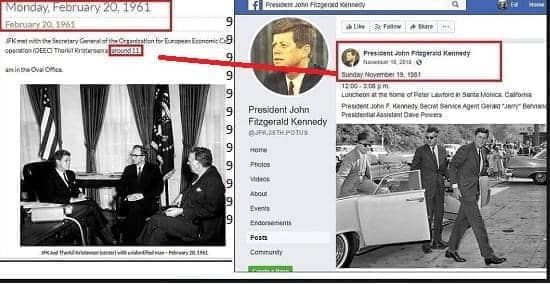
Thorkil Kristensen was elected to the Danish Parliament 1945 and became finance minister under Knud Kristiansen (1945–1947) and Erik Eriksen (1950–1953). Throughout his life he worked with difficult economic problems. Among people of his own party and opposing parties, he enjoyed great respect because of his broad knowledge of economics.
He came to disagree on economic policy with his party, Venstre, and left the party in 1960.
After his exit from politics, he was secretary general of the OECD from 1960-1969. He was the founder of the Copenhagen Institute for Futures Studies (CIFS), making it one of the first futures research institutes on the European continent. He was managing director at CIFS from 1970–1988.
He participated in the Club of Rome which attracted considerable public attention with its report, Limits to Growth, which has sold 30 million copies in more than 30 translations, making it the best selling environmental book in world history.
Selected publications[edit]
- Kristensen, Thorkil. The economic world balance. The economic world balance. (1960).
- Kristensen, Thorkil. The brain drain and development planning. No. 29. International Institute for Educational Planning, 1968.
- Kristensen, Thorkil. The food problem of developing countries. Organisation for Economic Cooperation and Development, 1968.
- Kristensen, Thorkil. Development in rich and poor countries: a general theory with statistical analyses. Praeger, 1974.’
Articles, a selection
- Kristensen, Thorkil. “Five Years of OECD.” European Yearbook 13 (1967): 1000-113.
I think Donald Barr (later I will make the argument with Rockefeller Psychiatry) and Thorkill Kristensen follow this path.
Donald Barr George Ball Thorkill Kristensen plan Barrack Obama Jr fertilized February 20 1961 delivered Novermber 18 1961 St Jospehs Daniel Freeman memorial hospital Manhattan Beach City (home of the North American Aviation P-51 Inglewood where I was born and near Edwards Air Force Base).
Its all long going CIA brain research tied to FOXP2 and non-FOXP2 are cherry-picked by the CIA to groom as CIA backed politicians and media.
Enrico Fermi
Enrico Fermi was an Italian physicist and the creator of the world’s first nuclear reactor, the Chicago Pile-1. He has been called the “architect of the nuclear age” and the “architect of the atomic bomb”. He was one of very few physicists to excel in both theoretical physics and experimental physics. Wikipedia
Born: September 29, 1901, Rome, Italy
Died: November 28, 1954, Chicago, IL
Education: Leiden University (1923–1924), MORE
Awards: Nobel Prize in Physics, Matteucci Medal, Max Planck Medal, Hughes Medal, Franklin Medal, Rumford Prize
Children: Giulio Fermi, Nella Fermi
Spouse: Laura Fermi (m. 1928–1954)
Nationality: American, Italian
What was Enrico Fermi’s theory?
In 1934, he evolved the beta-decay theory, coalescing previous work on radiation theory with Pauli’s idea of the neutrino. Following the discovery by Curie and Joliot of artificial radioactivity that year, Fermi demonstrated that nuclear transformation occurs in almost every element subjected to neutron bombardment.
People also ask
What is Enrico Fermi most famous for?
The Nobel Prize for Physics was awarded to Fermi for his work on the artificial radioactivity produced by neutrons, and for nuclear reactions brought about by slow neutrons.
Who invented the atomic bomb Fermi?
Enrico Fermi
Enrico Fermi (Italian: [enˈriːko ˈfermi]; 29 September 1901 – 28 November 1954) was an Italian (later naturalized American) physicist and the creator of the world’s first nuclear reactor, the Chicago Pile-1. He has been called the “architect of the nuclear age” and the “architect of the atomic bomb”.
Who first invented nuclear power?
The idea of nuclear power began in the 1930s, when physicist Enrico Fermi first showed that neutrons could split atoms. Fermi led a team that in 1942 achieved the first nuclear chain reaction, under a stadium at the University of Chicago.Mar 26, 2019
How did Fermi split the atom?
In October 1934, Fermi was leading a small team in Rome to create radioactive elements by bombarding various elements with neutrons, the heavy neutral particles sitting in the nucleus of most atoms. In doing so he split the uranium atom.Jan 17, 2019
Who is the father of nuclear engineering?
In addition to being a theoretical physicist of the first rank, Eugene Wigner (1902–95) was the founder of nuclear engineering.
Why was splitting the atom so important?
The splitting of atoms, also known as nuclear fission, produces radiation and radioactivity. Dr Lise Meitner discovered how radioactivity could be produced in 1939. She found that firing a small particle called a neutron into another atom could cause radiation to be released.Mar 14, 2022
Shockwaves and radiation[edit]
The dominant effect of a nuclear weapon (the blast and thermal radiation) are the same physical damage mechanisms as conventional explosives, but the energy produced by a nuclear explosive is millions of times more per gram and the temperatures reached are in the tens of megakelvin. Nuclear weapons are quite different from conventional weapons because of the huge amount of explosive energy that they can put out and the different kinds of effects they make, like high temperatures and nuclear radiation.
The devastating impact of the explosion does not stop after the initial blast, as with conventional explosives. A cloud of nuclear radiation travels from the hypocenter of the explosion, causing an impact to life forms even after the heat waves have ceased.
Enrico Fermi (Italian: [enˈriːko ˈfermi]; 29 September 1901 – 28 November 1954) was an Italian (later naturalized American) physicist and the creator of the world’s first nuclear reactor, the Chicago Pile-1. He has been called the “architect of the nuclear age“[1] and the “architect of the atomic bomb”.[2] He was one of very few physicists to excel in both theoretical physics and experimental physics. Fermi was awarded the 1938 Nobel Prize in Physics for his work on induced radioactivity by neutron bombardment and for the discovery of transuranium elements. With his colleagues, Fermi filed several patents related to the use of nuclear power, all of which were taken over by the US government. He made significant contributions to the development of statistical mechanics, quantum theory, and nuclear and particle physics.
Fermi’s first major contribution involved the field of statistical mechanics. After Wolfgang Pauli formulated his exclusion principle in 1925, Fermi followed with a paper in which he applied the principle to an ideal gas, employing a statistical formulation now known as Fermi–Dirac statistics. Today, particles that obey the exclusion principle are called “fermions“. Pauli later postulated the existence of an uncharged invisible particle emitted along with an electron during beta decay, to satisfy the law of conservation of energy. Fermi took up this idea, developing a model that incorporated the postulated particle, which he named the “neutrino“. His theory, later referred to as Fermi’s interaction and now called weak interaction, described one of the four fundamental interactions in nature. Through experiments inducing radioactivity with the recently discovered neutron, Fermi discovered that slow neutrons were more easily captured by atomic nuclei than fast ones, and he developed the Fermi age equation to describe this. After bombarding thorium and uranium with slow neutrons, he concluded that he had created new elements. Although he was awarded the Nobel Prize for this discovery, the new elements were later revealed to be nuclear fission products.
Fermi left Italy in 1938 to escape new Italian racial laws that affected his Jewish wife, Laura Capon. He emigrated to the United States, where he worked on the Manhattan Project during World War II. Fermi led the team at the University of Chicago that designed and built Chicago Pile-1, which went critical on 2 December 1942, demonstrating the first human-created, self-sustaining nuclear chain reaction. He was on hand when the X-10 Graphite Reactor at Oak Ridge, Tennessee, went critical in 1943, and when the B Reactor at the Hanford Site did so the next year. At Los Alamos, he headed F Division, part of which worked on Edward Teller‘s thermonuclear “Super” bomb. He was present at the Trinity test on 16 July 1945, where he used his Fermi method to estimate the bomb’s yield.
After the war, Fermi served under J. Robert Oppenheimer on the General Advisory Committee, which advised the Atomic Energy Commission on nuclear matters. After the detonation of the first Soviet fission bomb in August 1949, he strongly opposed the development of a hydrogen bomb on both moral and technical grounds. He was among the scientists who testified on Oppenheimer’s behalf at the 1954 hearing that resulted in the denial of Oppenheimer’s security clearance. Fermi did important work in particle physics, especially related to pions and muons, and he speculated that cosmic rays arose when material was accelerated by magnetic fields in interstellar space. Many awards, concepts, and institutions are named after Fermi, including the Enrico Fermi Award, the Enrico Fermi Institute, the Fermi National Accelerator Laboratory (Fermilab), the Fermi Gamma-ray Space Telescope, and the synthetic element fermium, making him one of 16 scientists who have elements named after them. Fermi tutored or directly influenced no fewer than eight young researchers who went on to win Nobel Prizes.[3][4]
Early life[edit]
Fermi was born in Rome at Via Gaeta 19.
Plaque at Fermi’s birthplace
Enrico Fermi was born in Rome, Italy, on 29 September 1901. He was the third child of Alberto Fermi, a division head in the Ministry of Railways, and Ida de Gattis, an elementary school teacher.[5][6] His sister, Maria, was two years older, his brother Giulio a year older. After the two boys were sent to a rural community to be wet nursed, Enrico rejoined his family in Rome when he was two and a half.[7] Although he was baptized a Roman Catholic in accordance with his grandparents’ wishes, his family was not particularly religious; Enrico was an agnostic throughout his adult life. As a young boy, he shared the same interests as his brother Giulio, building electric motors and playing with electrical and mechanical toys.[8] Giulio died during an operation on a throat abscess in 1915[9] and Maria died in an airplane crash near Milan in 1959.[10]
At a local market in Campo de’ Fiori Fermi found a physics book, the 900-page Elementorum physicae mathematicae. Written in Latin by Jesuit Father Andrea Caraffa [it], a professor at the Collegio Romano, it presented mathematics, classical mechanics, astronomy, optics, and acoustics as they were understood at the time of its 1840 publication.[11][12] With a scientifically inclined friend, Enrico Persico,[13] Fermi pursued projects such as building gyroscopes and measuring the acceleration of Earth’s gravity.[14]
In 1914, Fermi, who used to often meet with his father in front of the office after work, met a colleague of his father called Adolfo Amidei, who would walk part of the way home with Alberto. Enrico had learned that Adolfo was interested in mathematics and physics and took the opportunity to ask Adolfo a question about geometry. Adolfo understood that the young Fermi was referring to projective geometry and then proceeded to give him a book on the subject written by Theodor Reye. Two months later, Fermi returned the book, having solved all the problems proposed at the end of the book, some of which Adolfo considered difficult. Upon verifying this, Adolfo felt that Fermi was “a prodigy, at least with respect to geometry”, and further mentored the boy, providing him with more books on physics and mathematics. Adolfo noted that Fermi had a very good memory and thus could return the books after having read them because he could remember their content very well.[15]
Scuola Normale Superiore in Pisa[edit]
Enrico Fermi as a student in Pisa
Fermi graduated from high school in July 1918, having skipped the third year entirely. At Amidei’s urging, Fermi learned German to be able to read the many scientific papers that were published in that language at the time, and he applied to the Scuola Normale Superiore in Pisa. Amidei felt that the Scuola would provide better conditions for Fermi’s development than the Sapienza University of Rome could at the time. Having lost one son, Fermi’s parents only reluctantly allowed him to live in the school’s lodgings away from Rome for four years.[16][17] Fermi took first place in the difficult entrance exam, which included an essay on the theme of “Specific characteristics of Sounds”; the 17-year-old Fermi chose to use Fourier analysis to derive and solve the partial differential equation for a vibrating rod, and after interviewing Fermi the examiner declared he would become an outstanding physicist.[16][18]
At the Scuola Normale Superiore, Fermi played pranks with fellow student Franco Rasetti; the two became close friends and collaborators. Fermi was advised by Luigi Puccianti, director of the physics laboratory, who said there was little he could teach Fermi and often asked Fermi to teach him something instead. Fermi’s knowledge of quantum physics was such that Puccianti asked him to organize seminars on the topic.[19] During this time Fermi learned tensor calculus, a technique key to general relativity.[20] Fermi initially chose mathematics as his major, but soon switched to physics. He remained largely self-taught, studying general relativity, quantum mechanics, and atomic physics.[21]
In September 1920, Fermi was admitted to the Physics department. Since there were only three students in the department—Fermi, Rasetti, and Nello Carrara—Puccianti let them freely use the laboratory for whatever purposes they chose. Fermi decided that they should research X-ray crystallography, and the three worked to produce a Laue photograph—an X-ray photograph of a crystal.[22] During 1921, his third year at the university, Fermi published his first scientific works in the Italian journal Nuovo Cimento. The first was entitled “On the dynamics of a rigid system of electrical charges in translational motion” (Sulla dinamica di un sistema rigido di cariche elettriche in moto traslatorio). A sign of things to come was that the mass was expressed as a tensor—a mathematical construct commonly used to describe something moving and changing in three-dimensional space. In classical mechanics, mass is a scalar quantity, but in relativity, it changes with velocity. The second paper was “On the electrostatics of a uniform gravitational field of electromagnetic charges and on the weight of electromagnetic charges” (Sull’elettrostatica di un campo gravitazionale uniforme e sul peso delle masse elettromagnetiche). Using general relativity, Fermi showed that a charge has a weight equal to U/c2, where U was the electrostatic energy of the system, and c is the speed of light.[21]
The first paper seemed to point out a contradiction between the electrodynamic theory and the relativistic one concerning the calculation of the electromagnetic masses, as the former predicted a value of 4/3 U/c2. Fermi addressed this the next year in a paper “Concerning a contradiction between electrodynamic and the relativistic theory of electromagnetic mass” in which he showed that the apparent contradiction was a consequence of relativity. This paper was sufficiently well-regarded that it was translated into German and published in the German scientific journal Physikalische Zeitschrift in 1922.[23] That year, Fermi submitted his article “On the phenomena occurring near a world line” (Sopra i fenomeni che avvengono in vicinanza di una linea oraria) to the Italian journal I Rendiconti dell’Accademia dei Lincei [it]. In this article he examined the Principle of Equivalence, and introduced the so-called “Fermi coordinates“. He proved that on a world line close to the timeline, space behaves as if it were a Euclidean space.[24][25]
fter Wolfgang Pauli announced his exclusion principle in 1925, Fermi responded with a paper “On the quantization of the perfect monoatomic gas” (Sulla quantizzazione del gas perfetto monoatomico), in which he applied the exclusion principle to an ideal gas. The paper was especially notable for Fermi’s statistical formulation, which describes the distribution of particles in systems of many identical particles that obey the exclusion principle. This was independently developed soon after by the British physicist Paul Dirac, who also showed how it was related to the Bose–Einstein statistics. Accordingly, it is now known as Fermi–Dirac statistics.[29] After Dirac, particles that obey the exclusion principle are today called “fermions“, while those that do not are called “bosons“.[30]
Professor in Rome[edit]
Fermi and his research group (the Via Panisperna boys) in the courtyard of Rome University’s Physics Institute in Via Panisperna, c. 1934. From left to right: Oscar D’Agostino, Emilio Segrè, Edoardo Amaldi, Franco Rasetti and Fermi
Professorships in Italy were granted by competition (concorso) for a vacant chair, the applicants being rated on their publications by a committee of professors. Fermi applied for a chair of mathematical physics at the University of Cagliari on Sardinia, but was narrowly passed over in favor of Giovanni Giorgi.[31] In 1926, at the age of 24, he applied for a professorship at the Sapienza University of Rome. This was a new chair, one of the first three in theoretical physics in Italy, that had been created by the Minister of Education at the urging of Professor Orso Mario Corbino, who was the university’s professor of experimental physics, the Director of the Institute of Physics, and a member of Benito Mussolini‘s cabinet. Corbino, who also chaired the selection committee, hoped that the new chair would raise the standard and reputation of physics in Italy.[32] The committee chose Fermi ahead of Enrico Persico and Aldo Pontremoli,[33] and Corbino helped Fermi recruit his team, which was soon joined by notable students such as Edoardo Amaldi, Bruno Pontecorvo, Ettore Majorana and Emilio Segrè, and by Franco Rasetti, whom Fermi had appointed as his assistant.[34] They soon nicknamed the “Via Panisperna boys” after the street where the Institute of Physics was located.[35]
Fermi married Laura Capon, a science student at the university, on 19 July 1928.[36] They had two children: Nella, born in January 1931, and Giulio, born in February 1936.[37] On 18 March 1929, Fermi was appointed a member of the Royal Academy of Italy by Mussolini, and on 27 April he joined the Fascist Party. He later opposed Fascism when the 1938 racial laws were promulgated by Mussolini in order to bring Italian Fascism ideologically closer to German Nazism. These laws threatened Laura, who was Jewish, and put many of Fermi’s research assistants out of work.[38][39][40][41][42]
During their time in Rome, Fermi and his group made important contributions to many practical and theoretical aspects of physics. In 1928, he published his Introduction to Atomic Physics (Introduzione alla fisica atomica), which provided Italian university students with an up-to-date and accessible text. Fermi also conducted public lectures and wrote popular articles for scientists and teachers in order to spread knowledge of the new physics as widely as possible.[43] Part of his teaching method was to gather his colleagues and graduate students together at the end of the day and go over a problem, often from his own research.[43][44] A sign of success was that foreign students now began to come to Italy. The most notable of these was the German physicist Hans Bethe,[45] who came to Rome as a Rockefeller Foundation fellow, and collaborated with Fermi on a 1932 paper “On the Interaction between Two Electrons” (German: Über die Wechselwirkung von Zwei Elektronen).[43]
At this time, physicists were puzzled by beta decay, in which an electron was emitted from the atomic nucleus. To satisfy the law of conservation of energy, Pauli postulated the existence of an invisible particle with no charge and little or no mass that was also emitted at the same time. Fermi took up this idea, which he developed in a tentative paper in 1933, and then a longer paper the next year that incorporated the postulated particle, which Fermi called a “neutrino“.[46][47][48] His theory, later referred to as Fermi’s interaction, and still later as the theory of the weak interaction, described one of the four fundamental forces of nature. The neutrino was detected after his death, and his interaction theory showed why it was so difficult to detect. When he submitted his paper to the British journal Nature, that journal’s editor turned it down because it contained speculations which were “too remote from physical reality to be of interest to readers”.[47] Thus Fermi saw the theory published in Italian and German before it was published in English.[34]
In the introduction to the 1968 English translation, physicist Fred L. Wilson noted that:
Fermi’s theory, aside from bolstering Pauli’s proposal of the neutrino, has a special significance in the history of modern physics. One must remember that only the naturally occurring β emitters were known at the time the theory was proposed. Later when positron decay was discovered, the process was easily incorporated within Fermi’s original framework. On the basis of his theory, the capture of an orbital electron by a nucleus was predicted and eventually observed. With time, experimental data accumulated significantly. Although peculiarities have been observed many times in β decay, Fermi’s theory always has been equal to the challenge.
The consequences of the Fermi theory are vast. For example, β spectroscopy was established as a powerful tool for the study of nuclear structure. But perhaps the most influential aspect of this work of Fermi is that his particular form of the β interaction established a pattern that has been appropriate for the study of other types of interactions. It was the first successful theory of the creation and annihilation of material particles. Previously, only photons had been known to be created and destroyed.[48]
In January 1934, Irène Joliot-Curie and Frédéric Joliot announced that they had bombarded elements with alpha particles and induced radioactivity in them.[49][50] By March, Fermi’s assistant Gian-Carlo Wick had provided a theoretical explanation using Fermi’s theory of beta decay. Fermi decided to switch to experimental physics, using the neutron, which James Chadwick had discovered in 1932.[51] In March 1934, Fermi wanted to see if he could induce radioactivity with Rasetti’s polonium–beryllium neutron source. Neutrons had no electric charge, and so would not be deflected by the positively charged nucleus. This meant that they needed much less energy to penetrate the nucleus than charged particles, and so would not require a particle accelerator, which the Via Panisperna boys did not have.[52][53]
Enrico Fermi between Franco Rasetti (left) and Emilio Segrè in academic dress
Fermi had the idea to resort to replacing the polonium-beryllium neutron source with a radon-beryllium one, which he created by filling a glass bulb with beryllium powder, evacuating the air, and then adding 50 mCi of radon gas, supplied by Giulio Cesare Trabacchi.[54][55] This created a much stronger neutron source, the effectiveness of which declined with the 3.8-day half-life of radon. He knew that this source would also emit gamma rays, but, on the basis of his theory, he believed that this would not affect the results of the experiment. He started by bombarding platinum, an element with a high atomic number that was readily available, without success. He turned to aluminium, which emitted an alpha particle and produced sodium, which then decayed into magnesium by beta particle emission. He tried lead, without success, and then fluorine in the form of calcium fluoride, which emitted an alpha particle and produced nitrogen, decaying into oxygen by beta particle emission. In all, he induced radioactivity in 22 different elements.[56] Fermi rapidly reported the discovery of neutron-induced radioactivity in the Italian journal La Ricerca Scientifica on 25 March 1934.[55][57][58]
The natural radioactivity of thorium and uranium made it hard to determine what was happening when these elements were bombarded with neutrons but, after correctly eliminating the presence of elements lighter than uranium but heavier than lead, Fermi concluded that they had created new elements, which he called hesperium and ausonium.[59][53] The chemist Ida Noddack suggested that some of the experiments could have produced lighter elements than lead rather than new, heavier elements. Her suggestion was not taken seriously at the time because her team had not carried out any experiments with uranium or built the theoretical basis for this possibility. At that time, fission was thought to be improbable if not impossible on theoretical grounds. While physicists expected elements with higher atomic numbers to form from neutron bombardment of lighter elements, nobody expected neutrons to have enough energy to split a heavier atom into two light element fragments in the manner that Noddack suggested.[60][59]
Beta decay. A neutron decays into a proton, and an electron is emitted. In order for the total energy in the system to remain the same, Pauli and Fermi postulated that a neutrino ({\displaystyle {\bar {\nu }}_{e}}
The Via Panisperna boys also noticed some unexplained effects. The experiment seemed to work better on a wooden table than a marble tabletop. Fermi remembered that Joliot-Curie and Chadwick had noted that paraffin wax was effective at slowing neutrons, so he decided to try that. When neutrons were passed through paraffin wax, they induced a hundred times as much radioactivity in silver compared with when it was bombarded without the paraffin. Fermi guessed that this was due to the hydrogen atoms in the paraffin. Those in wood similarly explained the difference between the wooden and the marble tabletops. This was confirmed by repeating the effect with water. He concluded that collisions with hydrogen atoms slowed the neutrons.[61][53] The lower the atomic number of the nucleus it collides with, the more energy a neutron loses per collision, and therefore the fewer collisions that are required to slow a neutron down by a given amount.[62] Fermi realised that this induced more radioactivity because slow neutrons were more easily captured than fast ones. He developed a diffusion equation to describe this, which became known as the Fermi age equation.[61][53]
In 1938, Fermi received the Nobel Prize in Physics at the age of 37 for his “demonstrations of the existence of new radioactive elements produced by neutron irradiation, and for his related discovery of nuclear reactions brought about by slow neutrons”.[63] After Fermi received the prize in Stockholm, he did not return home to Italy but rather continued to New York City with his family in December 1938, where they applied for permanent residency. The decision to move to America and become US citizens was due primarily to the racial laws in Italy.[38][64]
Manhattan Project[edit]
Fermi arrived in New York City on 2 January 1939.[65] He was immediately offered positions at five universities, and accepted one at Columbia University,[66] where he had already given summer lectures in 1936.[67] He received the news that in December 1938, the German chemists Otto Hahn and Fritz Strassmann had detected the element barium after bombarding uranium with neutrons,[68] which Lise Meitner and her nephew Otto Frisch correctly interpreted as the result of nuclear fission. Frisch confirmed this experimentally on 13 January 1939.[69][70] The news of Meitner and Frisch’s interpretation of Hahn and Strassmann’s discovery crossed the Atlantic with Niels Bohr, who was to lecture at Princeton University. Isidor Isaac Rabi and Willis Lamb, two Columbia University physicists working at Princeton, found out about it and carried it back to Columbia. Rabi said he told Enrico Fermi, but Fermi later gave the credit to Lamb:[71]
I remember very vividly the first month, January, 1939, that I started working at the Pupin Laboratories because things began happening very fast. In that period, Niels Bohr was on a lecture engagement at the Princeton University and I remember one afternoon Willis Lamb came back very excited and said that Bohr had leaked out great news. The great news that had leaked out was the discovery of fission and at least the outline of its interpretation. Then, somewhat later that same month, there was a meeting in Washington where the possible importance of the newly discovered phenomenon of fission was first discussed in semi-jocular earnest as a possible source of nuclear power.[72]
Noddack was proven right after all. Fermi had dismissed the possibility of fission on the basis of his calculations, but he had not taken into account the binding energy that would appear when a nuclide with an odd number of neutrons absorbed an extra neutron.[60] For Fermi, the news came as a profound embarrassment, as the transuranic elements that he had partly been awarded the Nobel Prize for discovering had not been transuranic elements at all, but fission products. He added a footnote to this effect to his Nobel Prize acceptance speech.[71][73]
Diagram of Chicago Pile-1, the first nuclear reactor to achieve a self-sustaining chain reaction. Designed by Fermi, it consisted of uranium and uranium oxide in a cubic lattice embedded in graphite.
The scientists at Columbia decided that they should try to detect the energy released in the nuclear fission of uranium when bombarded by neutrons. On 25 January 1939, in the basement of Pupin Hall at Columbia, an experimental team including Fermi conducted the first nuclear fission experiment in the United States. The other members of the team were Herbert L. Anderson, Eugene T. Booth, John R. Dunning, G. Norris Glasoe, and Francis G. Slack.[74] The next day, the Fifth Washington Conference on Theoretical Physics began in Washington, D.C. under the joint auspices of George Washington University and the Carnegie Institution of Washington. There, the news on nuclear fission was spread even further, fostering many more experimental demonstrations.[75]
French scientists Hans von Halban, Lew Kowarski, and Frédéric Joliot-Curie had demonstrated that uranium bombarded by neutrons emitted more neutrons than it absorbed, suggesting the possibility of a chain reaction.[76] Fermi and Anderson did so too a few weeks later.[77][78] Leó Szilárd obtained 200 kilograms (440 lb) of uranium oxide from Canadian radium producer Eldorado Gold Mines Limited, allowing Fermi and Anderson to conduct experiments with fission on a much larger scale.[79] Fermi and Szilárd collaborated on a design of a device to achieve a self-sustaining nuclear reaction—a nuclear reactor. Owing to the rate of absorption of neutrons by the hydrogen in water, it was unlikely that a self-sustaining reaction could be achieved with natural uranium and water as a neutron moderator. Fermi suggested, based on his work with neutrons, that the reaction could be achieved with uranium oxide blocks and graphite as a moderator instead of water. This would reduce the neutron capture rate, and in theory make a self-sustaining chain reaction possible. Szilárd came up with a workable design: a pile of uranium oxide blocks interspersed with graphite bricks.[80] Szilárd, Anderson, and Fermi published a paper on “Neutron Production in Uranium”.[79] But their work habits and personalities were different, and Fermi had trouble working with Szilárd.[81]
Fermi was among the first to warn military leaders about the potential impact of nuclear energy, giving a lecture on the subject at the Navy Department on 18 March 1939. The response fell short of what he had hoped for, although the Navy agreed to provide $1,500 towards further research at Columbia.[82] Later that year, Szilárd, Eugene Wigner, and Edward Teller sent the letter signed by Einstein to US president Franklin D. Roosevelt, warning that Nazi Germany was likely to build an atomic bomb. In response, Roosevelt formed the Advisory Committee on Uranium to investigate the matter.[83]
Fermi’s ID photo from Los Alamos
The Advisory Committee on Uranium provided money for Fermi to buy graphite,[84] and he built a pile of graphite bricks on the seventh floor of the Pupin Hall laboratory.[85] By August 1941, he had six tons of uranium oxide and thirty tons of graphite, which he used to build a still larger pile in Schermerhorn Hall at Columbia.[86]
The S-1 Section of the Office of Scientific Research and Development, as the Advisory Committee on Uranium was now known, met on 18 December 1941, with the US now engaged in World War II, making its work urgent. Most of the effort sponsored by the committee had been directed at producing enriched uranium, but Committee member Arthur Compton determined that a feasible alternative was plutonium, which could be mass-produced in nuclear reactors by the end of 1944.[87] He decided to concentrate the plutonium work at the University of Chicago. Fermi reluctantly moved, and his team became part of the new Metallurgical Laboratory there.[88]
The possible results of a self-sustaining nuclear reaction were unknown, so it seemed inadvisable to build the first nuclear reactor on the University of Chicago campus in the middle of the city. Compton found a location in the Argonne Woods Forest Preserve, about 20 miles (32 km) from Chicago. Stone & Webster was contracted to develop the site, but the work was halted by an industrial dispute. Fermi then persuaded Compton that he could build the reactor in the squash court under the stands of the University of Chicago’s Stagg Field. Construction of the pile began on 6 November 1942, and Chicago Pile-1 went critical on 2 December.[89] The shape of the pile was intended to be roughly spherical, but as work proceeded Fermi calculated that criticality could be achieved without finishing the entire pile as planned.[90]
This experiment was a landmark in the quest for energy, and it was typical of Fermi’s approach. Every step was carefully planned, every calculation was meticulously done.[89] When the first self-sustained nuclear chain reaction was achieved, Compton made a coded phone call to James B. Conant, the chairman of the National Defense Research Committee.
I picked up the phone and called Conant. He was reached at the President’s office at Harvard University. “Jim,” I said, “you’ll be interested to know that the Italian navigator has just landed in the new world.” Then, half apologetically, because I had led the S-l Committee to believe that it would be another week or more before the pile could be completed, I added, “the earth was not as large as he had estimated, and he arrived at the new world sooner than he had expected.”
“Is that so,” was Conant’s excited response. “Were the natives friendly?”
“Everyone landed safe and happy.”[91]
Ernest O. Lawrence, Fermi, and Isidor Isaac Rabi
To continue the research where it would not pose a public health hazard, the reactor was disassembled and moved to the Argonne Woods site. There Fermi directed experiments on nuclear reactions, reveling in the opportunities provided by the reactor’s abundant production of free neutrons.[92] The laboratory soon branched out from physics and engineering into using the reactor for biological and medical research. Initially, Argonne was run by Fermi as part of the University of Chicago, but it became a separate entity with Fermi as its director in May 1944.[93]
When the air-cooled X-10 Graphite Reactor at Oak Ridge went critical on 4 November 1943, Fermi was on hand just in case something went wrong. The technicians woke him early so that he could see it happen.[94] Getting X-10 operational was another milestone in the plutonium project. It provided data on reactor design, training for DuPont staff in reactor operation, and produced the first small quantities of reactor-bred plutonium.[95] Fermi became an American citizen in July 1944, the earliest date the law allowed.[96]
In September 1944, Fermi inserted the first uranium fuel slug into the B Reactor at the Hanford Site, the production reactor designed to breed plutonium in large quantities. Like X-10, it had been designed by Fermi’s team at the Metallurgical Laboratory and built by DuPont, but it was much larger and was water-cooled. Over the next few days, 838 tubes were loaded, and the reactor went critical. Shortly after midnight on 27 September, the operators began to withdraw the control rods to initiate production. At first, all appeared to be well, but around 03:00, the power level started to drop and by 06:30 the reactor had shut down completely. The Army and DuPont turned to Fermi’s team for answers. The cooling water was investigated to see if there was a leak or contamination. The next day the reactor suddenly started up again, only to shut down once more a few hours later. The problem was traced to neutron poisoning from xenon-135 or Xe-135, a fission product with a half-life of 9.1 to 9.4 hours. Fermi and John Wheeler both deduced that Xe-135 was responsible for absorbing neutrons in the reactor, thereby sabotaging the fission process. Fermi was recommended by colleague Emilio Segrè to ask Chien-Shiung Wu, as she prepared a printed draft on this topic to be published by the Physical Review.[97] Upon reading the draft, Fermi and the scientists confirmed their suspicions: Xe-135 indeed absorbed neutrons, in fact it had a huge neutron cross-section.[98][99][100] DuPont had deviated from the Metallurgical Laboratory’s original design in which the reactor had 1,500 tubes arranged in a circle, and had added 504 tubes to fill in the corners. The scientists had originally considered this over-engineering a waste of time and money, but Fermi realized that if all 2,004 tubes were loaded, the reactor could reach the required power level and efficiently produce plutonium.[101][102]
The FERMIAC, an analog computer invented by Fermi to study neutron transport
In April 1943, Fermi raised with Robert Oppenheimer the possibility of using the radioactive byproducts from enrichment to contaminate the German food supply. The background was fear that the German atomic bomb project was already at an advanced stage, and Fermi was also skeptical at the time that an atomic bomb could be developed quickly enough. Oppenheimer discussed the “promising” proposal with Edward Teller, who suggested the use of strontium-90. James B. Conant and Leslie Groves were also briefed, but Oppenheimer wanted to proceed with the plan only if enough food could be contaminated with the weapon to kill half a million people.[103]
In mid-1944, Oppenheimer persuaded Fermi to join his Project Y at Los Alamos, New Mexico.[104] Arriving in September, Fermi was appointed an associate director of the laboratory, with broad responsibility for nuclear and theoretical physics, and was placed in charge of F Division, which was named after him. F Division had four branches: F-1 Super and General Theory under Teller, which investigated the “Super” (thermonuclear) bomb; F-2 Water Boiler under L. D. P. King, which looked after the “water boiler” aqueous homogeneous research reactor; F-3 Super Experimentation under Egon Bretscher; and F-4 Fission Studies under Anderson.[105] Fermi observed the Trinity test on 16 July 1945 and conducted an experiment to estimate the bomb’s yield by dropping strips of paper into the blast wave. He paced off the distance they were blown by the explosion, and calculated the yield as ten kilotons of TNT; the actual yield was about 18.6 kilotons.[106]
Along with Oppenheimer, Compton, and Ernest Lawrence, Fermi was part of the scientific panel that advised the Interim Committee on target selection. The panel agreed with the committee that atomic bombs would be used without warning against an industrial target.[107] Like others at the Los Alamos Laboratory, Fermi found out about the atomic bombings of Hiroshima and Nagasaki from the public address system in the technical area. Fermi did not believe that atomic bombs would deter nations from starting wars, nor did he think that the time was ripe for world government. He therefore did not join the Association of Los Alamos Scientists.[108]
Postwar work[edit]
Fermi became the Charles H. Swift Distinguished Professor of Physics at the University of Chicago on 1 July 1945,[109] although he did not depart the Los Alamos Laboratory with his family until 31 December 1945.[110] He was elected a member of the US National Academy of Sciences in 1945.[111] The Metallurgical Laboratory became the Argonne National Laboratory on 1 July 1946, the first of the national laboratories established by the Manhattan Project.[112] The short distance between Chicago and Argonne allowed Fermi to work at both places. At Argonne he continued experimental physics, investigating neutron scattering with Leona Marshall.[113] He also discussed theoretical physics with Maria Mayer, helping her develop insights into spin–orbit coupling that would lead to her receiving the Nobel Prize.[114]
The Manhattan Project was replaced by the Atomic Energy Commission (AEC) on 1 January 1947.[115] Fermi served on the AEC General Advisory Committee, an influential scientific committee chaired by Robert Oppenheimer.[116] He also liked to spend a few weeks of each year at the Los Alamos National Laboratory,[117] where he collaborated with Nicholas Metropolis,[118] and with John von Neumann on Rayleigh–Taylor instability, the science of what occurs at the border between two fluids of different densities.[119]
Laura and Enrico Fermi at the Institute for Nuclear Studies, Los Alamos, 1954
After the detonation of the first Soviet fission bomb in August 1949, Fermi, along with Isidor Rabi, wrote a strongly worded report for the committee, opposing the development of a hydrogen bomb on moral and technical grounds.[120] Nonetheless, Fermi continued to participate in work on the hydrogen bomb at Los Alamos as a consultant. Along with Stanislaw Ulam, he calculated that not only would the amount of tritium needed for Teller’s model of a thermonuclear weapon be prohibitive, but a fusion reaction could still not be assured to propagate even with this large quantity of tritium.[121] Fermi was among the scientists who testified on Oppenheimer’s behalf at the Oppenheimer security hearing in 1954 that resulted in denial of Oppenheimer’s security clearance.[122]
In his later years, Fermi continued teaching at the University of Chicago, where he was a founder of what later became the Enrico Fermi Institute
The Life of Enrico Fermi
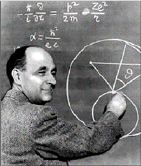
Click for a story about the photograph
On December 2, 1942, Enrico Fermi and his team of scientists harnessed the atom and opened the door to new scientific and technological realms. His achievement allowed the U.S. to produce the atomic bomb that helped end World War II. Now, more than fifty years later, nuclear energy provides a significant part of the world’s electrical power, and radioactive materials are used for hundreds of industrial, agricultural, and medical applications-from food preservation to cancer therapy, checking the integrity of welds in pipelines and bridge supports, and gauges that measure the thickness of coatings applied to paper.
Fermi was born in Rome in 1901 and received his doctorate from the University of Pisa in 1922. During 1923 to 1924, he studied in Göttingen, Germany, with Max Born, and in Leiden, The Netherlands, with Paul Ehrenfest. From 1924 to 1926, Fermi lectured in mathematical physics and mechanics at the University of Florence. He became the first professor of theoretical physics at the University of Rome, where he taught for 12 years.
In 1938, Fermi traveled to Stockholm to receive the Nobel Prize “for his identification of new radioactive elements produced by neutron bombardment and his discovery, made in connection with this work, of nuclear reactions effected by slow neutrons.” Fermi’s wife Laura, in her book Atoms in the Family*, wrote, “Four years of patient researches; the broken and the unbroken tubes full of beryllium powder and radon; the strenuous races along the hall of the physics building to rush element after element to the Geiger counters; the efforts to understand nuclear processes, and the many tests to prove the theories … these had won the Nobel Prize for Enrico.”*
By 1938, Fascist Italy had become intolerable to Fermi. He used his trip to Stockholm as an opportunity to flee. He and his family sailed directly to the United States, where he had visited many times before. In the months before his Stockholm trip, he had sought teaching positions in America and had received offers from five universities. He chose a professorship in Physics at Columbia University. There, in 1939, he confirmed the discovery of the fission process and began striving to attain a nuclear chain reaction.
From 1942 to 1944, Fermi worked at the Metallurgical Laboratory of the University of Chicago. In a makeshift laboratory under Stagg Field Stadium, he designed and built the first nuclear reactor and led the epochal experiment that demonstrated the first self-sustained chain reaction. More than any individual, he was responsible for developing a means for the controlled release of nuclear energy.
Fermi became a U.S. citizen in 1944. From 1944 to 1945, he became Associate Director of the Los Alamos National Laboratory in New Mexico. In 1946, he returned to the University of Chicago as a professor at the Institute of Nuclear Studies, which now bears his name–Fermi Institute. He resumed his fundamental research interests in nuclear and elementary particle physics and also, beginning in 1950, served as one of the first members of the General Advisory Committee of the Atomic Energy Commission.
On November 16, 1954, President Eisenhower and the Atomic Energy Commission gave Fermi a special award for his lifetime of accomplishments in physics and, in particular, for the development of atomic energy. Fermi’s other research resulted in the Fermi-Dirac particle statistics, the theory of beta-decay, the Thomas-Fermi model of the atom, and a theory of the origin of cosmic rays.
Fermi died on November 28, 1954, and the Enrico Fermi Award was established in 1956 to perpetuate the memory of his brilliance as a scientist and to recognize others of his kind-inspiring others by his example.
The Manhattan Project would get its name from Enrico Fermi in his office at Columbia University New York looking over Manhattan Island, thus he made up the (let’s call it) “the pass code word” for building the atomic bomb “The Manhattan Project”
MKULTRA really began (getting musicians, scientists, military, rocekteers) from Europe following the Berlin Olympics as Nazi and Non Nazi sides were forming up.
This was not just a post WWII phenomena.
All during WWII and before there was an exodus of Nation-States that fell under Nazi control.
I continue to insist the Maria Kutschera 1926 was in that underground railroad, and that Italian, German, Austrian, and other CIA were part of that, and that the call of Lee Harvey Oswald (rather attempted call to Durham North Carolina Army Intelligence was about Kutscherea in the USA.
Why this matters is the Nation-State of Great Brittian and its Commonwealths including England.
The USA was so close to England and other Commonwealths of Great Brittian the USA fell back into being one.
Part of this was elite families of Europe, like the Winsors, coping with what could no longer be covered up, ADHD like symptoms that ran in certain families.
The hope was under phone names the non registry relatives of Tigers Blood as some call it could be tracked by Dr Cameron, Tavistock, Rockefeller Psychiatry, the CIA, and others, secretly, quietly.
One major problem was if FOXP2 was known it might “out” certain family lines that wished to be anonymouse like the LODON KING EDWARD VI London KE Famly of Fox Protein-2 Gene.
Barr Epstien and Saudi Arabia
Epstein attended local public schools, first attending Public School 188, and then Mark Twain Junior High School nearby.[25] In 1967, Epstein attended the National Music Camp at the Interlochen Center for the Arts.[28] He began playing the piano when he was five.[29] He graduated in 1969 from Lafayette High School at age 16, having skipped two grades.[30][31] Later that year, he attended classes at Cooper Union until he changed colleges in 1971.[30] From September 1971, he attended the Courant Institute of Mathematical Sciences at New York University, but left without receiving a degree in June 1974.[30]
The Courant Institute of Mathematical Sciences (commonly known as Courant or CIMS) is the mathematics research school of New York University (NYU), and is among the most prestigious mathematics schools and mathematical sciences research centers in the world.[1] Founded in 1935, it is named after Richard Courant, one of the founders of the Courant Institute and also a mathematics professor at New York University from 1936 to 1972, and serves as a center for research and advanced training in computer science and mathematics.[2] It is located on Gould Plaza next to the Stern School of Business and the economics department of the College of Arts and Science.
[Edward Paul Donegan interjecting here. I can tell you from just one course in Business Statistics you can learn so much that has so many applications. Bayes Theorum.
In probability theory and statistics, Bayes’ theorem (alternatively Bayes’ law or Bayes’ rule), named after Thomas Bayes, describes the probability of an event, based on prior knowledge of conditions that might be related to the event.[1] For example, if the risk of developing health problems is known to increase with age, Bayes’ theorem allows the risk to an individual of a known age to be assessed more accurately (by conditioning it on their age) than simply assuming that the individual is typical of the population as a whole.
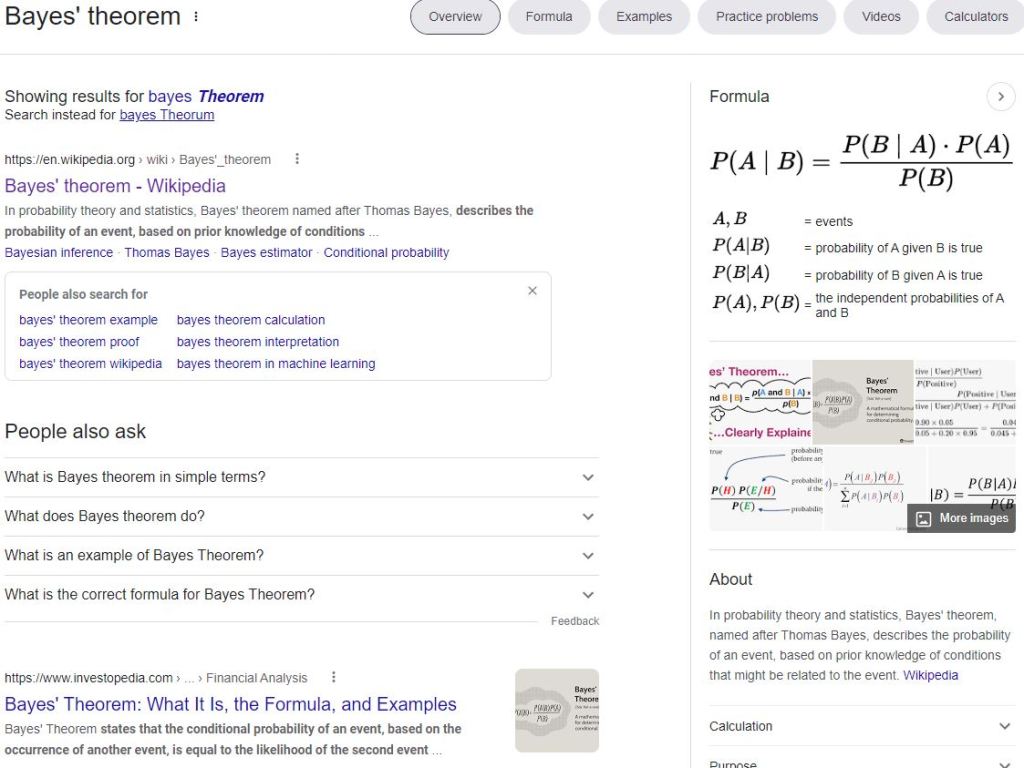
One of the many applications of Bayes’ theorem is Bayesian inference, a particular approach to statistical inference. When applied, the probabilities involved in the theorem may have different probability interpretations. With Bayesian probability interpretation, the theorem expresses how a degree of belief, expressed as a probability, should rationally change to account for the availability of related evidence. Bayesian inference is fundamental to Bayesian statistics, being considered “to the theory of probability what Pythagoras’s theorem is to geometry.”[2]
Much of this type of work know is called Artificial Intelligence. Deriving information from cumulative surveillance of data yields information about the data that can become “laws” or “probabilities” of the functioning of a model.
One a model is created and operates according to laws, becomes predictable, randomness of events is overwritten by an understanding. In fact you can view this as the Natural Scientist’s goal, to create understanding, find Natural Laws of how the world or some parts of it work, so it can be understood predicated and possibly even altered in accordance with the calculus of its laws such that certain variables can be optimized if other certain variables are manipulated.
The CIA and banks and geneticists and data miners would love this guy. Probably over the head of most kids though.
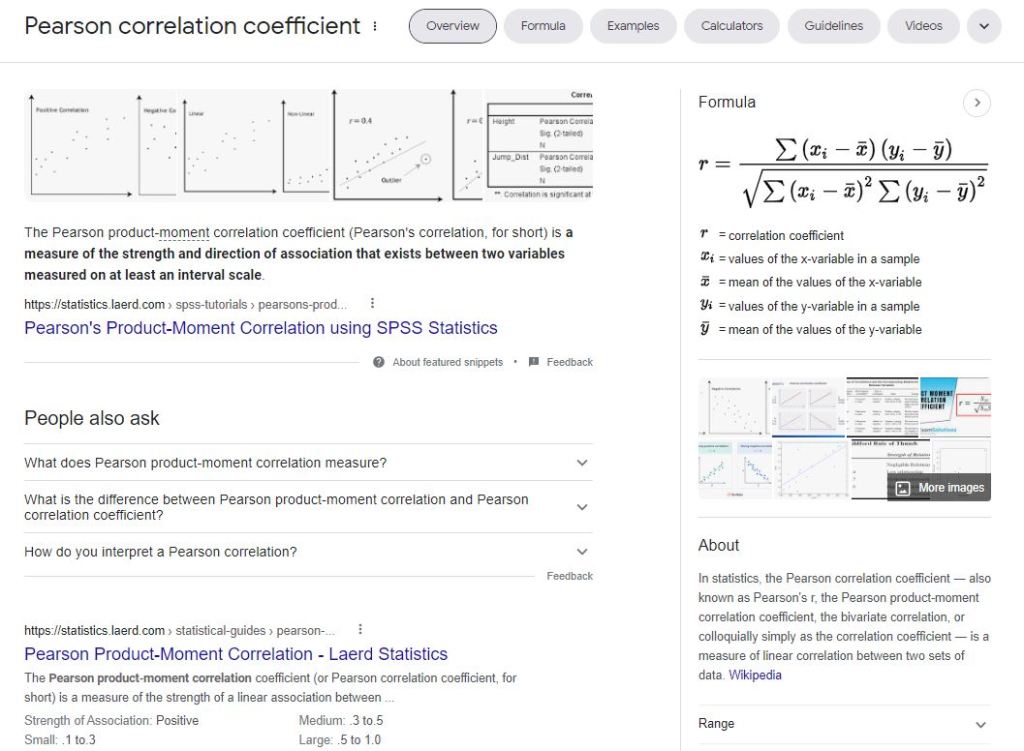
The Pearson product-moment correlation coefficient (Pearson’s correlation, for short) is a measure of the strength and direction of association that exists between two variables measured on at least an interval scale.
NYU is ranked #1 in applied mathematics in the US (as per US News),[3] #5 in citation impact worldwide, and #12 in citation worldwide. It is also ranked #19 worldwide in computer science and information systems.[4] On the Faculty Scholarly Productivity Index, it is ranked #3 with an index of 1.84.[5] It is also known for its extensive research in pure mathematical areas, such as partial differential equations, probability and geometry, as well as applied mathematical areas, such as computational biology, computational neuroscience, and mathematical finance. The Mathematics Department of the institute has 15 members of the United States National Academy of Sciences (joint third globally with Princeton University, and after the University of California at Berkeley and Harvard University who are joint first globally with 17 members each, and just ahead of other topnotch research universities like Stanford University which has 14 members) and five members of the National Academy of Engineering. Four faculty members have been awarded the National Medal of Science, one was honored with the Kyoto Prize, and nine have received career awards from the National Science Foundation. Courant Institute professors Peter Lax, S. R. Srinivasa Varadhan, Mikhail Gromov, Louis Nirenberg won the 2005, 2007, 2009 and 2015 Abel Prize respectively for their research in partial differential equations, probability and geometry.[6] Louis Nirenberg also received the Chern Medal in 2010, and Subhash Khot won the Nevanlinna Prize in 2014. In addition, Jeff Cheeger was also awarded the Shaw Prize in Mathematical Sciences in 2021.[7]
The director of the Courant Institute directly reports to New York University’s provost and president and works closely with deans and directors of other NYU colleges and divisions respectively.[8] The undergraduate programs and graduate programs at the Courant Institute are run independently by the institute, and formally associated with the NYU College of Arts and Science, NYU Tandon School Of Engineering, and NYU Graduate School of Arts and Science respectively.
Epstein in 1980
In August 1981, Epstein founded his own consulting firm, Intercontinental Assets Group Inc. (IAG),[45] which assisted clients in recovering stolen money from fraudulent brokers and lawyers.[29]
Epstein described his work at this time as being a high-level bounty hunter. He told friends that he worked sometimes as a consultant for governments and the very wealthy to recover embezzled funds, while at other times he worked for clients who had embezzled funds.[29][46] Spanish actress and heiress Ana Obregón was one such wealthy client, whom Epstein helped in 1982 to recover her father’s millions in lost investments, which had disappeared when Drysdale Government Securities collapsed because of fraud.[47]
Epstein also stated to some people at the time that he was an intelligence agent.[48] During the 1980s, Epstein possessed an Austrian passport that had his photo, but with a false name. The passport showed his place of residence in Saudi Arabia.[49][50] In 2017 “a former senior White House official” reported that Alexander Acosta, the U.S. Attorney for the Southern District of Florida who had handled Epstein’s criminal case in 2008, had stated to Trump transition interviewers, that “I was told Epstein ‘belonged to intelligence’ and to ‘leave it alone'”, and that Epstein was “above his pay grade”.[51][52]
During this period, one of Epstein’s clients was the Saudi Arabian businessman Adnan Khashoggi, who was the middleman in transferring American weapons from Israel to Iran, as part of the Iran–Contra affair in the 1980s.[6]
Khashoggi was one of several defense contractors that he knew.[29][48] In the mid-1980s, Epstein traveled multiple times between the United States, Europe, and Southwest Asia.[49][50] While in London, Epstein met Steven Hoffenberg. They had been introduced through Douglas Leese, a defense contractor, and John Mitchell, the former U.S. Attorney General.[29]
Repeat
NYU is ranked #1 in applied mathematics in the US (as per US News),[3] #5 in citation impact worldwide, and #12 in citation worldwide. It is also ranked #19 worldwide in computer science and information systems.[4] On the Faculty Scholarly Productivity Index, it is ranked #3 with an index of 1.84.[5] It is also known for its extensive research in pure mathematical areas, such as partial differential equations, probability and geometry,
well that’s one aspect of what we do oh come on I mean that is what you do you guys handle 80% of the intelligence workload you’re seven times the size ofthe CIA we don’t like to brag about that well but you’re exactly right so the way I see it the question isn’t why should you work for the NSA the question is why shouldn’t you but I’ll take a shot say I’m working at the NSA and somebody puts a code on my desk something no one else can break maybe I take a shot at it maybe I break it I’m real happy with myself cuz I did my job well but maybe that code was the location of some rebel army in North Africa or the Middle East and once they had that location they bombed the village where the rebels are hiding fifteen hundred people that I never met never had no problem with get killed now the politicians are saying Oh sending the Marines to secure the area cuz they don’t give a I won’t be that kid over there getting shot just like it wasn’t them when then I’m a god called because they were all pulling at or in the national guide it’ll be some kid from Southie over there taking shrapnel in the ass he comes back to find at the planning used to work at got exported to the country he just got back from and the guy who put the shrapnel in his ass got his old job cuz it worked for fifteen cents a day and no bathroom breaks meanwhile he realizes the only reason he was over there in the first place was so that we could install a government that would sell us oil at a good price and of course the oil companies use a little skirmish over that a scare up domestic oil prices acute little ancillary benefit for them but it ain’t helping my buddy at 250 a gallon they’re taking their sweet time bringing the oil back of course maybe they even took the liberty of hiring an alcoholic skipper who likes to drink martinis and play slalom with the icebergs it ain’t so long till he hits one spills the oil and kills all the sea life in the North Atlantic so now my buddies out of work he can’t afford to drive so he’s walking to the job interviews which sucks because the shrapnel in his ass has given him chronic hemorrhoids and meanwhile he’s stabbing because every time he tries to get a bite to eat the only blue-plate special– they’re serving is North Atlantic squad with Quaker State so what did I think I’m holding out for something better I figure it while I’m at it why not just shoot my buddy take his job give it to his sworn enemy hike up gas prices bomb a village club a baby seal hit the hash and joined the national guide I could be elected president
English (auto-generated)
Watch on YouTube
Star Trek VI: The Undiscovered Country is a 1991 American science fiction film directed by Nicholas Meyer, who directed the second Star Trek film, The Wrath of Khan. It is the sixth feature film based on the 1966–1969 Star Trek television series. Taking place after the events of Star Trek V: The Final Frontier, it is the final film featuring the entire main cast of the television series. The destruction of the Klingon moon Praxis leads the Klingon Empire to pursue peace with their longtime adversary, the Federation; the crew of the Federation starship USS Enterprise must race against unseen conspirators with a militaristic agenda.
Star Trek VI: The Undiscovered Country
“I’ve confirmed the location of Praxis, but…”
“What is it?”
“I cannot confirm the existence of Praxis.“
Lieutenant Commander Dimitri Valtane was a male Human Starfleet science officer who lived during the late 23rd century.
From 2290 to 2293, Valtane served on the USS Excelsior under Captain Hikaru Sulu for its three-year mission cataloging gaseous planetary anomalys in the Beta Quadrant. His living quarters was on deck 7, along with bunk-mate Ensign Tuvok and two others, who all worked during the gamma shift. (Star Trek VI: The Undiscovered Country; VOY: “Flashback“)
On their return, the Excelsior was hit from a shockwave while Valtane was on duty. He located the source, Qo’noS‘ moon, Praxis, and found it had exploded. https://memory-alpha.fandom.com/wiki/Praxis
– Dimitri Valtane and Hikaru Sulu, 2293 (Star Trek VI: The Undiscovered Country)
Praxis was a natural moon of the Klingon homeworld, Qo’noS. It was the only moon of that planet and was inhabited. Praxis was used as the Klingon Empire‘s key energy-production facility in the 23rd century. (DIS: “Will You Take My Hand?“; Star Trek VI: The Undiscovered Country; VOY: “Flashback“)
DARPA and the Brain and Psychiatry
I think the Windsors and others are working to do sequenced genome work to study comorbid psychiatric symptons that are nto always consisent or intuitively related but do appear to be in the FOXP2 families.
Forming a atypical expressions map of clinically observable phonemon and trying to overly that with sequenced brain genes (and how brain genes interopate with each other in complex coginitive and nueral-motoral tasks of writing a spoken expression in language from memory into a written script of letters that form the words using the same grammar as spoken into writing is part of PAPERCLIP and other CIA work of SIdney Gottlieb and others.
The Jeffrey Epstein VI Foundation was[1] a private foundation established in 2000 by New York convicted sex offender and financier[2] Jeffrey Epstein.[3] Officially registered as J. Epstein VI Foundation, the “VI” stands for Virgin Islands, where the foundation was based and Epstein owned a private island. The foundation’s board included Cecile de Jongh, wife of the former governor of the United States Virgin Islands, John de Jongh.
Activity
In 2003, the foundation pledged $30 million to Harvard University[4] to establish the Program for Evolutionary Dynamics, directed by Martin Nowak, a professor of mathematics and biology.[5] The university received only $6.5 million of this pledge.[6] The foundation also supported NEURO.tv, a video series featuring experts discussing topics related to the brain,[7] and the OpenCog project, an open-source software initiative for Artificial intelligence.[8][9][10]
Over the years, the foundation convened many of these scientists in conferences to discuss the consensus on fundamental science topics such as gravity, global threats to the Earth and language.[11]
As a representative of the foundation, Epstein sat on the Mind, Brain and Behavior Advisory Committee at Harvard University, and been involved in the Santa Fe Institute, the Theoretical Biology Initiative at the Institute for Advanced Study at Princeton, and the Quantum Gravity Program at the University of Pennsylvania.[12] Epstein also served on the Trilateral Commission and the Council on Foreign Relations.[4]


