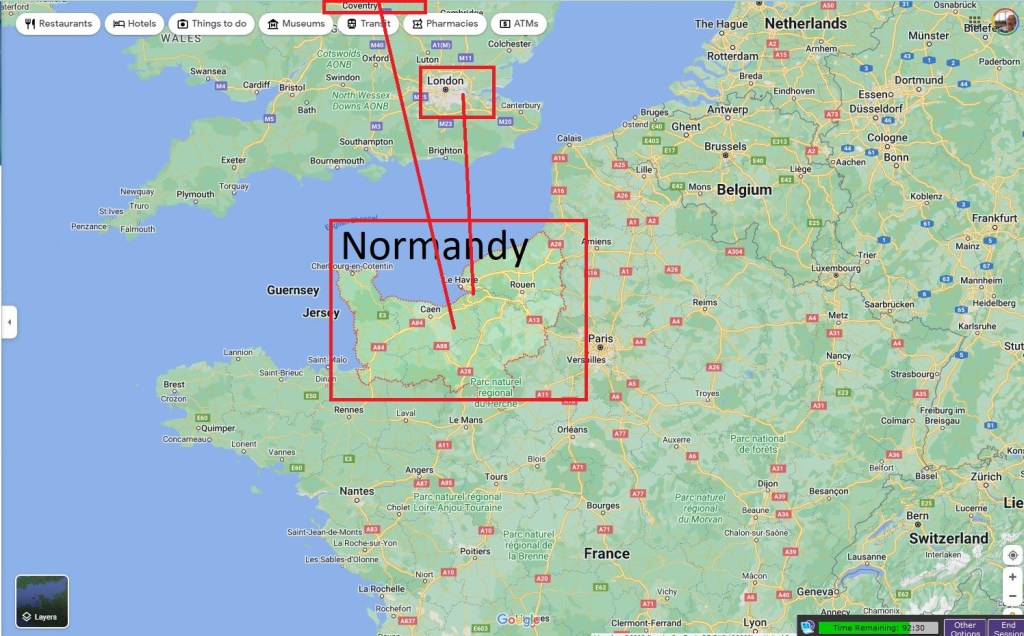
The Battle of France is over [it has fallen] The Battle of [for] Brittian begins over Coventry then to the skies of Europe to weakne, then retake Europe and defeat the Axis via D-Day invasion
The Battle of France (French: bataille de France) (10 May – 25 June 1940), also known as the Western Campaign (Westfeldzug), the French Campaign (German: Frankreichfeldzug, campagne de France) and the Fall of France, was the German invasion of France during the Second World War. On 3 September 1939, France declared war on Germany following the German invasion of Poland. In early September 1939, France began the limited Saar Offensive and by mid-October had withdrawn to their start lines. German armies invaded Belgium, Luxembourg and the Netherlands on 10 May 1940. Italy entered the war on 10 June 1940 and attempted an invasion of France. France and the Low Countries were conquered, ending land operations on the Western Front until the Normandy landings on 6 June 1944.
https://en.wikipedia.org/wiki/Battle_of_France
D-Day and the Aerial Battle for Normandy
How the Allied Strategic Bomber Forces supported D-Day and the Battle for Normandy.
Allied Air Supremacy
Before June 1944, Allied military strategy had been focused on the Mediterranean.
It was here, as Anglo-American armies advanced in North Africa, Sicily and Italy that Allied ‘tactical’ air forces rose to dominance over the battlefield.
Fighter-bombers proved to be the most effective in this vital ground support role, able to respond quickly and decisively against hidden and fleeting targets when called in by forward controllers.
Light and medium bombers also proved their worth striking at enemy troop positions and communications behind the lines.

© IWM (C 4332) Vertical photographic-reconnaissance aerail showing severe damage to the St Pierre des Corps marshalling yards at Tours, France, after the raid by 180 Avro Lancasters of No. 5 Group, Bomber Command, on the night of 10/11 April 1944.
Attention now turned to the coming invasion of France, for which a new Allied Expeditionary Air Force (AEAF) was set up, commanded by Air Chief Marshal Sir Trafford Leigh-Mallory.
This formation would support the Allied armies invading Europe, and later deploy to the continent and keep pace with the advance.
But while the role of the AEAF’s fighters and tactical bombers was clear, there was less certainty over how best to employ the ‘heavies’ of RAF Bomber Command and the United States Army Air Forces (USAAF), which represented the most powerful air striking force of all.
Overlord Objectives
At the beginning of 1944, with preparations for the invasion of Europe (Operation ‘Overlord’) well underway, Allied planners sought to identify suitable objectives for the heavy bomber force.
These included the German air force (Luftwaffe) in the west, particularly its fighter aircraft, the rail transport network along which German reinforcements would have to pass, and the enemy’s defences on the shores of ‘Fortress Europe’.
It was surmised that later on, with the troops ashore, the bombers could be called upon by army commanders for use against battlefield objectives.
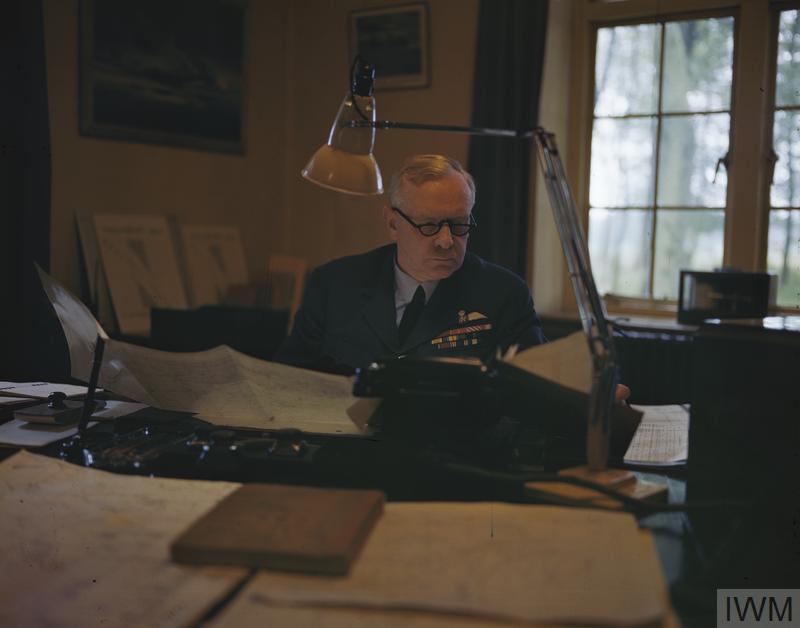
© IWM (TR 1093) Air Chief Marshal Sir Arthur T Harris, Commander in Chief of Royal Air Force Bomber Command, at his desk.
None of this found favour with Air Chief Marshal Sir Arthur Harris, the man in charge of RAF Bomber Command.
Harris had his own view on what his bombers should be doing, namely ‘area attacks’ on German industrial cities.
This had been his mantra since taking command in February 1942. The Americans, already committed to precision daylight attacks against key German industries like U-boats, ball-bearings and oil, were also hostile to a diversion of effort, although in their case the Luftwaffe was already a key objective.

© IWM (A 14136) Lt General Arnold, Commanding the US Army AIR FORCE, and Air Chief Marshal Sir Charles Portal.
Combined Bomber Offensive
RAF Bomber Command and the USAAF Eighth Air Force were supposed to be co-operating closely. The ‘Pointblank’ directive, issued after the conference of Allied leaders at Casablanca at the beginning of 1943, had instructed the RAF and USAAF strategic bomber forces to co-ordinate their efforts in an air campaign intended to fatally weaken Germany’s military, industrial and economic structure prior to an Allied invasion.
Destruction of the Luftwaffe fighter force and its manufacturing base was the most important element. Bombing attacks would be too costly, and D-Day itself would fail, unless Allied air superiority was achieved.
But Harris paid only lip-service to the plan, choosing to concentrate on city attacks as before, and ‘Pointblank’ became in effect an American project.
Unescorted raids in 1943 saw hundreds of bombers shot down, but by the beginning of 1944 the Americans had been reinforced, and were now protected by long-range P-51 fighters.
The tide was about to turn in their favour.
In February 1944 the USAAF launched Operation ‘Argument’, or as it became known, ‘Big Week’. This was a series of systematic attacks on aircraft assembly plants. The factories proved more resilient than expected and production was only partially affected, but results in the air were better. The Luftwaffe, already pulled back from France and other fronts to defend Reich airspace, was now being decimated by free-ranging US fighters.

© FRE 12388 Two P-51 Mustangs of the 364th Fighter Squadron, 357th Fighter Group fly in formation.
German pilot casualties started to rise alarmingly, and the trainees who replaced them lacked the experience to survive for long in this hostile environment.
From this point on, Luftwaffe losses became unsustainable. Lieutenant-General Carl Spaatz, in charge of American strategic bomber forces in Europe, thought it vital that the pressure be maintained, and was also keen to target Germany’s oil industry and fuel supplies which he saw as the best way to cripple Hitler’s forces.
Bomber Command against Berlin
Harris, meanwhile, had been pressing ahead with his night area attacks. In the winter of 1943/44 Bomber Command concentrated on Berlin. Harris had promised to win the war by wrecking the capital ‘from end to end’. But the results were poor and losses high. Some of the RAF attacks in this period, to cities in the south of Germany associated with aircraft manufacture such as Leipzig and Augsburg, did indeed fit within the framework of the ‘Pointblank’ directive. But whether aircraft, ball bearings or oil, Harris saw no point concentrating on such ‘panacea’ targets, as he described them.
In his opinion only the systematic degrading of Germany’s entire industrial fabric could achieve decisive results, and assist the invasion. Any cessation of attacks would allow German output to recover. Moreover, he believed that his force, trained to operate at night and unable to hit pinpoint targets, would be of little use against tactical targets, and might cause catastrophic casualties among French civilians.

© IWM (TR 207) The Commander of American Forces in the European Theatre, Major General Dwight Eisenhower, at his desk.
Shaef takes over
Thus for different reasons both Harris and Spaatz were hostile to having their forces diverted to invasion support.
They were particularly opposed to serving under Leigh-Mallory, formerly head of Fighter Command and with no experience of bombing operations. They were backed by other Allied commanders who thought that tactical objectives were best dealt with by the light bombers of the AEAF.
But Overlord was too important to let such dissent persist. On 14 April 1944 both RAF Bomber Command and the US Strategic Air Forces in Europe (USSAFE – which now included the Eighth Air Force in Britain and the Fifteenth AF in Italy) were formally placed under the direction of General Dwight D Eisenhower and Supreme Headquarters Allied Expeditionary Force (SHAEF).
The man effectively in charge was Eisenhower’s deputy, Air Chief Marshal Sir Arthur Tedder, who had a lot of experience of ground to air co-operation in the Mediterranean and a man who Harris in particular respected.
D-Day Directive
On 17 April 1944 the Allied Supreme Headquarters issued a directive which stated the primary mission of the heavy bombers prior to Overlord, namely the destruction of the Luftwaffe’s air combat strength and the disruption of rail communications to isolate the designated invasion area in Normandy. Both Harris and Spaatz were free to continue attacks on German targets when commitments and the weather permitted.

© IWM (EA 31796) A B-17G of the 100th Bomb Group bombing beach defences near Boulogne, as part of the ‘Overlord’ deception plan, 5 June 1944.
The first of these objectives was already well on the way to being achieved, thanks to aggressive tactics by USAAF escort fighters over Germany.
Luftwaffe fighter squadrons in France and Belgium had been stripped to provide reinforcements, and could now offer only token resistance to the overwhelming numbers of Allied aircraft supporting the invasion.

© IWM (C 4438) Vertical photographic-reconnaissance aerial taken over the railway yards at Saintes, France, following an attack by aircraft of Bomber Command on the night of 23/24 June 1944.
The Transportation Plan
Despite his opposition Harris was already carrying out attacks on rail targets, to test the feasibility of the ‘Transportation Plan’. The first was against the Trappes railway yards on the outskirts of Paris on the night of 6/7 March. In the same month his bombers hit similar targets at Le Mans and Amiens. The results augured well, as RAF losses were light and Harris’s fears over accuracy were misplaced.
New target marking techniques ensured that his crews were able to deliver their bombs with much greater precision than expected. From the first five operations French casualties numbered approximately 110. Allied leaders were encouraged and the bombing stepped up, with the Americans now joining in too.
Winston Churchill was one of those still worried about loss of life, and insisted that locations where more than 150 French or Belgian casualties might be expected from a single raid were excluded.
Success at a cost
In all, RAF and USAAF bombers carried out operations against 72 separate rail centres in France, Belgium and western Germany before D-Day – locomotive depots, repair facilities and marshalling yards. The 37 assigned to Harris’s force were all destroyed or seriously damaged. Bomber Command’s night attacks proved more accurate than American daylight strikes – a fact Harris was keen to trumpet. The rail yards at Juvisy and La Chapelle near Paris were completely destroyed after single attacks on each, with minimal collateral damage.

© IWM (CL 2557) Part of the locomotive shop of the Krupps AG works at Essen, Germany, seriously damaged by Bomber Command in 1943, and further wrecked in the daylight raid of 11 March 1945
A total of 198 RAF bombers were lost – an acceptable rate of loss. Sadly, the civilian casualty rate in some cases far exceeded the prescribed limit of 100-150 each.
At Lille on 9/10 April 456 civilians died and in Ghent on 10/11 April it was 428.
But large numbers of locomotives were wrecked, and wagon numbers reduced from 70,000 to 10,000.
When combined with attacks carried out by tactical aircraft of the AEAF on bridges and local lines, it meant that German reinforcements, especially the panzer divisions which were heavily dependent on rail transport, had a much harder job reaching the front once the Allies were ashore.
Pinpoint Attacks
Although the railway system was the priority in April and May 1944, there were also attacks on airfields and aircraft factories in France. Again, the accuracy of RAF night attacks was impressive. One spectacular success was a raid on an aircraft factory at Toulouse on 5/6 April, which was destroyed after aircraft of 617 Squadron – the famous ‘Dambusters’ – carried out accurate low-level marking in advance of the main force of bombers.

© IWM (CL 344) Avro Lancasters carpet bomb a road junction near Villers Bocage, Normandy, France
Other targets were military depots and ammunition dumps.
A raid on a military depot at Mailly-le-Camp on 3/4 May destroyed many tanks and vehicles, although German night-fighters shot down 42 RAF bombers.
Minelaying operations continued too. This had always been an important but unsung part of Bomber Command’s work, and in the run-up to D-Day 2,198 sorties were flown to sow mines in enemy waters either side of the invasion corridor, and at the mouths of harbours sheltering German motor-torpedo boats (E-boats) and submarines.
Battlefield Support
With Allied troops ashore in Normandy and the build-up continuing, the bombers were frequently called upon to assist the ground forces. Targets included enemy troop positions, supply depots and lines of communications. Allied air superiority meant that many of these operations could now take place in daylight. 617 Squadron, the precision specialists, carried out another ‘spectacular’ on 8/9 June when it used huge ‘Tallboy’ bombs to penetrate and collapse a railway tunnel near Saumur, blocking the passage of a German armoured division attempting to reach the battle area.
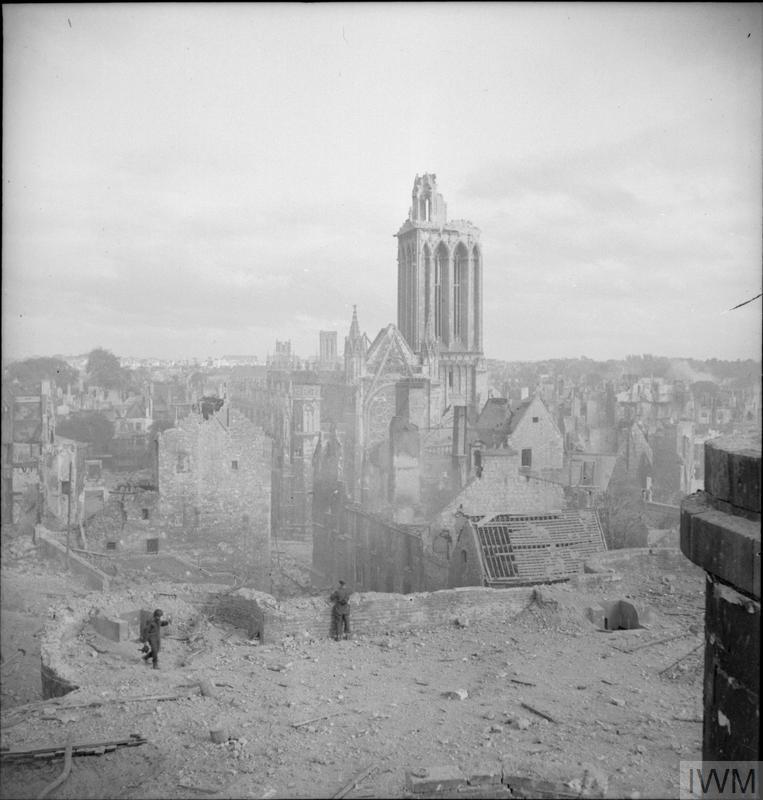
© IWM (B 6714) A general view of Caen showing the extensive damage caused by Allied bombing, 9 July 1944.
A raid on Le Havre on 14 June was another major success, and eliminated the threat to shipping supplying the beachhead posed by E-boats.
However, massive strikes to soften up enemy positions prior to Allied ground offensives were not without risk to friendly forces or French civilians, and in some cases caused huge material damage for little gain.
The city of Caen, a D-Day objective not attained until late July, was almost destroyed and suffered heavy casualties as a result of Allied bombing.
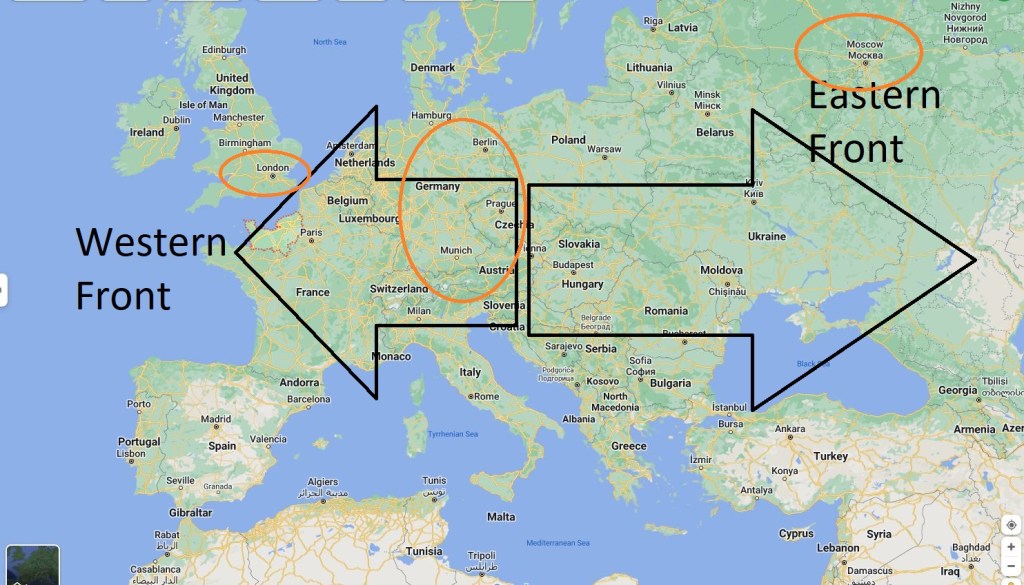
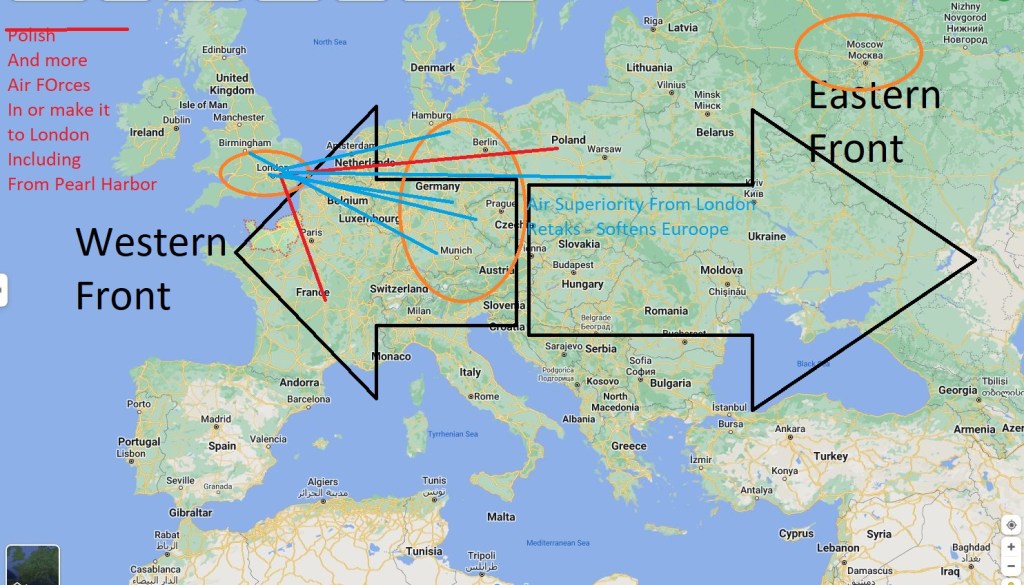
Nazi Germany held the land of Europe including Spain and France. Spain would produce a version of the Messerchmidt under Nazi control.
THen Comes DDAY into Normandy France
The Bill of Rights is best understood as the enactment of a philosophy of individual natural rights that dominated American political thought in the Eighteenth Century. Natural rights philosophy emerged in the Seventeenth Century as an explanation of the proper function of government that was in sharp contrast to the philosophy that had prevailed in the Middle Ages. During that time, Europe was ruled by kings who had acquired power basically by invading countries, defeating the natives in battle, and ruling them by force of arms. Kings soon found propaganda useful in subduing their subjects and there was no shortage of intellectuals who would curry favor with the king by announcing in obscure treatises that kings ruled by divine right and their authority was absolute.
Along about the Seventeenth Century, however, certain authors like John Locke offered an alternative explanation of the basis for political authority. Locke and others less famous argued that individuals possessed certain rights by virtue of their nature as rational human beings. They had the rights to life, liberty and property, for example. To secure these rights, governments were established, whose powers were delegated to them by the people for the limited purposes of maintaining order and protecting natural rights. While governments were to protect rights, these philosophers emphasized that the rights belonged to individuals by nature, and were not granted by the government.
The philosophy of natural rights was a powerful ideological weapon against kings and tyrants during the Seventeenth and Eighteenth Centuries in England. During that time King Charles I lost his head and later kings lost much of their authority to an elected parliament.
Throughout the Eighteenth Century, radical political tracts published in England made their way over to America and the highly literate colonists devoured them and passed them along to their neighbors. Historians now say that the two most influential writers of that period were the Englishmen John Trenchard and Thomas Gordon. 138 of their essays were collected and published in the colonies as Cato’s Letters, after the Roman statesman who committed suicide over the death of the Roman Republic.
James Ostrowski

