Attallah is the eldest of Malcolm X’s daughters and was born on the 16th of November, 1958,
Their first baby is born Nov. 16, 1958. Spring: Malcolm begins a month-long speaking tour of Los Angeles to establish NOI base on the west coast.
Shabazz was born in Brooklyn, New York, on November 16, 1958. Shabazz says her name is Arabic for “the gift of God” and she is not named after Attila the Hun as her father’s autobiography states.[1][2][3]
In February 1965, her sister Qubilah woke the family in the middle of the night with her screams; the house was on fire.[4] Shabazz recalled that night in a 1989 interview: “I almost didn’t realize how dangerous it was—my father was that calm, that together a parent. My eyes were burning, I was coughing, but before you knew it, he had us all out of there, and we were safe at a friend’s house. My mother’s like that too. Together.”[1]
A week later, Shabazz was at Manhattan‘s Audubon Ballroom, with her mother and sisters, when her father was assassinated.[5] She was six at the time and reportedly the only one of his children who has clear memories of him.[6] In 2005, she told journalist Gabe Pressman that she remembered the events of that day “vividly”:[7]
Betty Shabazz (born Betty Dean Sanders;[2] May 28, 1934/1936 [a] – June 23, 1997), also known as Betty X, was an American educator and civil rights advocate. She was married to Malcolm X.
Shabazz grew up in Detroit, Michigan, where her foster parents largely sheltered her from racism. She attended the Tuskegee Institute in Alabama, where she had her first encounters with racism. Unhappy with the situation in Alabama, she moved to New York City, where she became a nurse. It was there that she met Malcolm X and, in 1956, joined the Nation of Islam. The couple married in 1958.
Along with her husband, Shabazz left the Nation of Islam in 1964. She witnessed his assassination the following year. Left with the responsibility of raising six daughters as a widow, Shabazz pursued higher education, and went to work at Medgar Evers College in Brooklyn, New York.
Following the 1995 arrest of her daughter, Qubilah, for allegedly conspiring to murder Louis Farrakhan, Shabazz took in her ten-year-old grandson Malcolm. In 1997, he set fire to her apartment. Shabazz suffered severe burns and died three weeks later as a result of her injuries.
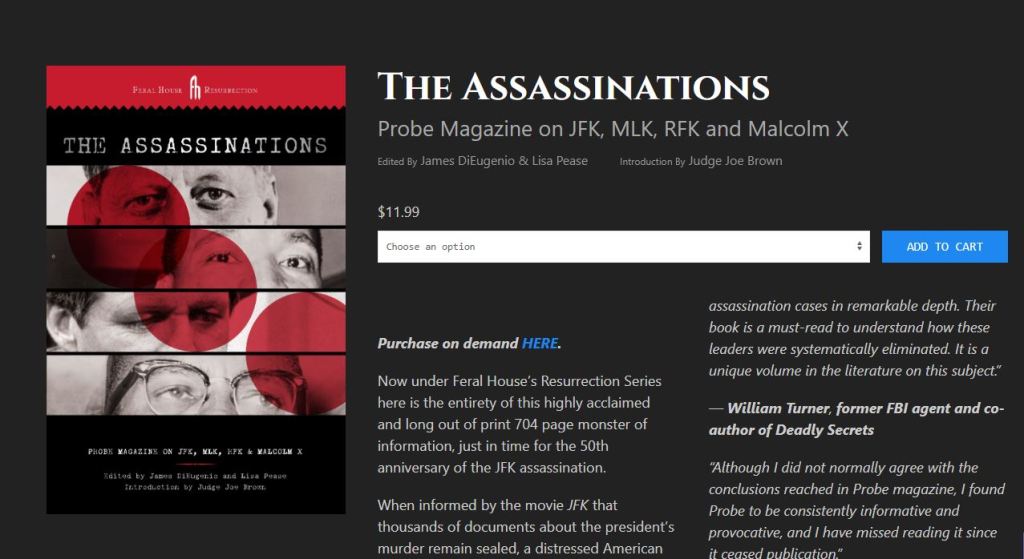
Probe Magazine on JFK, MLK, RFK and Malcolm X
Edited By James DiEugenio & Lisa Pease
Introduction By Judge Joe Brown
Now under Feral House’s Resurrection Series here is the entirety of this highly acclaimed and long out of print 704 page monster of information, just in time for the 50th anniversary of the JFK assassination.
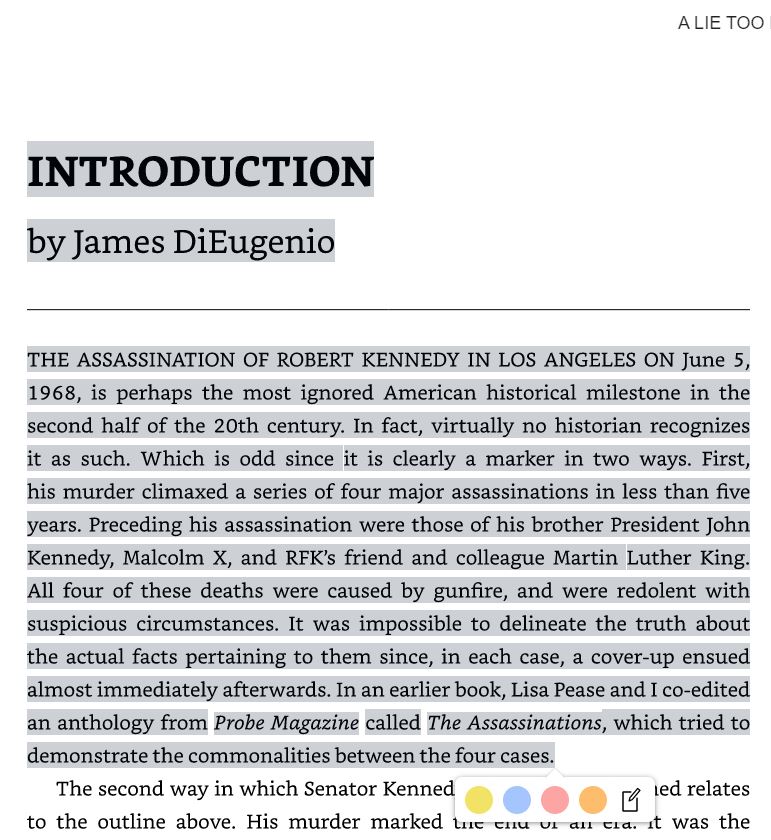
When informed by the movie JFK that thousands of documents about the president’s murder remain sealed, a distressed American public motivated Congress to create the Assassinations Records Review Board, which declassified and released many — but not all — previously withheld files. A journal named Probe was created in 1992 to report on and consider this cascade of new material, as well as continuing disinformation, regarding the assassinations of President Kennedy, Martin Luther King, Robert Kennedy and Malcolm X.
Coinciding with the 40th anniversary of JFK’s death, The Assassinations presents some of Probe’s most fascinating articles, in addition to material written after the well-regarded journal ceased publication. (Probe’s website continues to present new information.)
“Throughout the ‘90s, Lisa Pease and Jim DiEugenio covered the issues and reported on new developments in the JFK, MLK and RFK assassination cases in remarkable depth. Their book is a must-read to understand how these leaders were systematically eliminated. It is a unique volume in the literature on this subject.”
— William Turner, former FBI agent and co-author of Deadly Secrets
“Although I did not normally agree with the conclusions reached in Probe magazine, I found Probe to be consistently informative and provocative, and I have missed reading it since it ceased publication.”
— Vincent Bugliosi, author of Helter-Skelter and The Betrayal of America
“Jim DiEugenio and Lisa Pease are archaeologists of our secret history. This volume of collected articles from Probe is a revelation to the uninitiated, a necessary witness for the rest of us, and a lasting testament to their research and courage over the years.”
— Oliver Stone, director of JFK
Click HEREto read our blog post Killing JFK: The 50th Anniversary Game which gives more information about the PDFs below which were suppressed from publication in James DiEugenio’s new book Reclaiming Parkland: Tom Hanks, Vincent Bugliosi, and the JFK Assassination in the New Hollywood.
6 x 9 | 677 Pages | ISBN: 0-922915-82-2
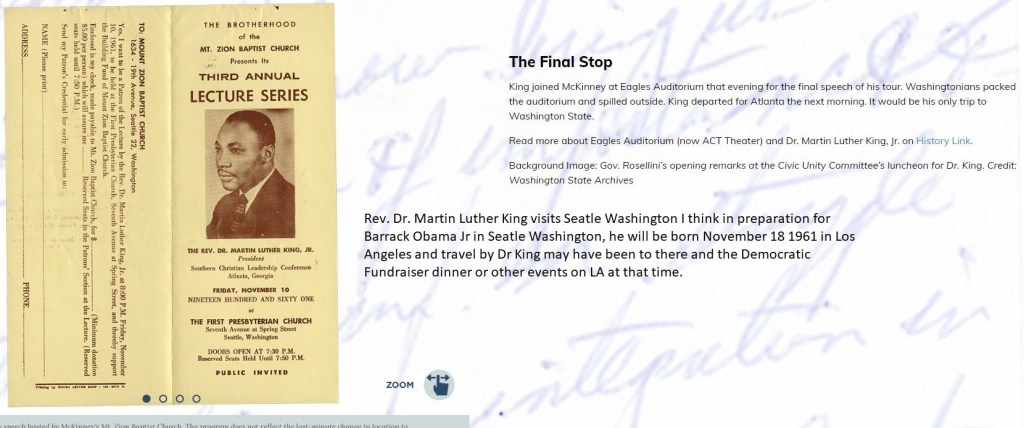
Rev. Dr. Martin Luther King visits Seatle Washington I think in preparation for Barrack Obama Jr in Seatle Washington, he will be born November 18 1961 in Los Angeles and travel by Dr King may have been to there and the Democratic Fundraiser dinner or other events on LA at that time.
Martin Luther King’s Controversial Visit to Seattle
Rev. Samuel B. McKinney Tells the Story
At the invitation of his friend, Reverend Samuel B McKinney, Dr. Martin Luther King Jr. came to Seattle in November 1961. The visit proved to be much more controversial than expected. Rev. McKinney tells the story in a dramatic video interview. Click the video player caption to start.
Reverend Samuel B McKinney, pastor of Mt Zion Baptist Church, had been King’s classmate at Morehouse College. In 1961 he invited the civil rights leader to Seattle and arranged for him to speak at First Presbyterian Church, a larger facility than Mt. Zion Baptist. But at the last minute, First Presbyterian leaders changed their minds, offering a variety of excuses. Civil Rights organizations denounced the decision and Rev. McKinney was forced to locate an alternative venue.
This sudden turn of events added to the controversy surrounding the visit. McKinney found other venues. On November 9, Dr. King to spoke on the UW campus where more 2,000 people heard him talk on “Segregation and the Civil Liberties: Implications for Students.” That night he was at Temple de Hirsch and the next day spoke at Garfield High School and finally to a huge audience at the Eagles auditorium downtown.
Years later, as Rev. McKinney explains, First Presbyterian apologized.
Here is a lesson plan for teaching about Dr. King’s visit to Seattle.
See the rest of Reverend Samuel McKinney’s interview here.
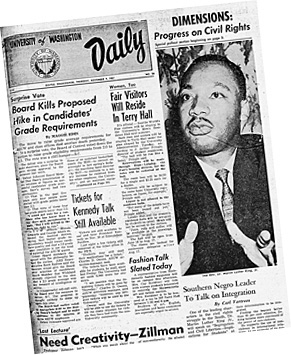
Photo: Columns Magazine, June 2000, image from UW Daily.
Civil libertarian and biographer of my own and other OSS CIA Cold War families tied to the Kennedy assasinatinos and related air disasters (UAL 553, TWA 800)
View more posts