McNamara’s last weeks as Secretary proved traumatic. The administration claimed that its search-and-destroy operations in South Vietnam were making slow but steady progress.
Yet on 30 January 1968, as the Tet holiday started, the communists launched a country-wide offensive.
The enemy suffered heavy losses, but Tet’s impact upon US public opinion was profound; many Americans could see no end to the war. On 29 February, in a ceremony marred by mishaps but charged with emotion, McNamara left the Pentagon.6
[in the DNC Primaries to face Nixon] President Johnson now faced strong opposition in the presidential primaries from anti-war Senators Eugene McCarthy and Robert F. Kennedy.
Lives in Dublin, IrelandAuthor has 1.5K answers and 3.8M answer viewsUpdated 1y
Would Robert F Kennedy have defeated Richard Nixon in the 1968 election?
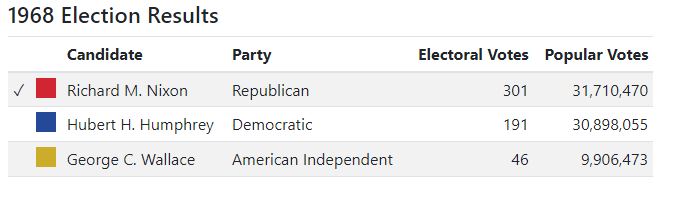
Quite probably! Humphrey finished the election on 191, 79 short of the magic 270.
If you look at the state-by-state breakdown, there were 9 states where Humphrey lost by less than 5% of the vote, including such insignificant gains as California, Ohio, Illinois and New Jersey. That much of a swing would have gained the Dems 150 votes and turned it into a blue landslide.
Even a 3% swing, easily within the bounds of a charismatic candidate like Bobby facing an animated piece of lumber like Tricky Dick, would have won six states and seen Nixon on the wrong side of a 315:177 result.
Humphrey served three terms in the Senate from 1949 to 1964, and was the Senate Majority Whip for the last four years of his tenure. During this time, he was the lead author of the Civil Rights Act of 1964, introduced the first initiative to create the Peace Corps, and chaired the Select Committee on Disarmament. He unsuccessfully sought his party’s presidential nomination in 1952 and 1960. After Lyndon B. Johnson acceded to the presidency, he chose Humphrey as his running mate, and the Democratic ticket won a landslide victory in the 1964 election.
In March 1968, Johnson made his surprise announcement that he would not seek reelection, and Humphrey launched his campaign for the presidency. Loyal to the Johnson administration’s policies on the Vietnam War, he received opposition from many within his own party and avoided the primaries to focus on winning the delegates of non-primary states at the Democratic National Convention. His delegate strategy succeeded in clinching the nomination, and he chose Senator Edmund Muskie as his running mate. In the general election, he nearly matched Nixon’s tally in the popular vote but lost the electoral vote by a wide margin. After the defeat, he returned to the Senate and served from 1971 until his death in 1978. He ran again in the primaries but lost to George McGovern and declined to be McGovern’s running mate.[2] From 1977 to 1978, he served as Deputy President pro tempore of the United States Senate.
The United States presidential election of 1968 was the 46th quadrennial United States presidential election. It was a wrenching national experience, conducted against a backdrop that included the assassination of civil rights leader Martin Luther King, Jr. and subsequent race riots across the nation, the assassination of presidential candidate Robert F. Kennedy, widespread demonstrations against the Vietnam War across American university and college campuses, and violent confrontations between police and anti-war protesters at the 1968 Democratic National Convention.
On November 5, 1968, the Republican nominee, former Vice President Richard Nixon won the election over the Democratic nominee, Vice President Hubert Humphrey. Nixon ran on a campaign that promised to restore “law and order”. Some consider the election of 1968 a realigning election that permanently disrupted the New Deal Coalition that had dominated presidential politics for 36 years. It was also the last election in which two opposing candidates were vice-presidents.
On June 4, 1968, Robert F. Kennedy won the California and South Dakota primary elections. He addressed his campaign supporters in the Ambassador Hotel’s Embassy Room ballroom. After leaving the podium, and exiting through a kitchen hallway, he was mortally wounded by multiple shots fired by Sirhan.
Kennedy wasn’t certain McCarthy would be a strong enough candidate to compete against the presumed Republican nominee, former Vice President Richard Milhous Nixon, in the fall election, so he considered throwing his hat in the ring. He was still undecided when his friend (and John Kennedy’s former speechwriter) Richard Goodwin put on a recording of the recent Tony Award-winning musical Man of La Mancha. When the song “The Impossible Dream” came on, Kennedy shouted from another room, “Turn that damn thing off. If you keep playing it, I might run for president.”7 Kennedy formally entered the race on March 16, 1968. Two weeks later, President Johnson stunned the nation by saying that he would neither seek nor accept the nomination.
In early February 1968, after the Tet Offensive in Vietnam, Kennedy received an anguished letter from writer Pete Hamill, noting that poor people in the Watts area of Los Angeles had hung pictures of Kennedy’s brother, President John F. Kennedy, in their homes. Hamill’s letter reminded Robert Kennedy that he had an “obligation of staying true to whatever it was that put those pictures on those walls.”[6] There were other factors that influenced Kennedy’s decision to enter the presidential primary race. On February 29, 1968, the Kerner Commission issued a report on the racial unrest that had affected American cities during the previous summer. The Kerner Commission blamed “white racism” for the violence, but its findings were largely dismissed by the Johnson administration.[6] Concerned about President Johnson’s policies and actions, Kennedy asked his advisor, historian Arthur M. Schlesinger Jr.: “How can we possibly survive five more years of Lyndon Johnson?”[3] Disagreement amongst Kennedy’s friends, political advisors, and family members further complicated his decision to launch a primary challenge against the incumbent Johnson. Kennedy’s wife Ethel supported the idea, but his brother Ted had been opposed to the candidacy. Ted did lend his support once Kennedy entered the race.[3][7]
By late February or early March 1968, Kennedy had finally made the decision to enter the race for president.[4] On March 10, Kennedy traveled to California, to meet with civil rights activistCésar Chávez, at the end of a 25-day hunger strike.[8] En route to California, Kennedy told his aide, Peter Edelman, that he had decided to run and had to “figure out how to get McCarthy out of it.”[4] The weekend before the New Hampshire primary, Kennedy told several aides that he would run if he could persuade little-known Senator Eugene McCarthy of Minnesota to withdraw from the presidential race.[9] Kennedy agreed to McCarthy’s request to delay an announcement of his intentions until after the New Hampshire primary.[4] On March 12, when Johnson won an astonishingly narrow victory in the New Hampshire primary against McCarthy, who polled 42 percent of the vote, Kennedy knew it would be unlikely that the Minnesota senator would agree to withdraw. He moved forward with his plans to announce his candidacy.[10]
On March 16, Kennedy declared, “I am today announcing my candidacy for the presidency of the United States. I do not run for the presidency merely to oppose any man, but to propose new policies. I run because I am convinced that this country is on a perilous course and because I have such strong feelings about what must be done, and I feel that I’m obliged to do all I can.”[11] Kennedy made this announcement from the same spot in the Senate Caucus Room where John F. Kennedy had announced his presidential candidacy in January 1960.[12][13] McCarthy supporters angrily denounced Kennedy as an opportunist.[14] With Kennedy joining the race, liberal Democrats thought that votes among supporters of the anti-war movement would now be split between McCarthy and Kennedy.[4]
On March 31, President Johnson stunned the nation by dropping out of the presidential race. He withdrew from the election during a televised speech, where he also announced a partial halt to the bombing of Vietnam and proposed peace negotiations with the North Vietnamese.[15]Vice PresidentHubert Humphrey, long a champion of labor unions and civil rights, entered the race on April 27, with support from the party “establishment”—including the Democratic members of Congress, mayors, governors, and labor unions.[16][17] Although he was a write-in candidate in some of the contests, Humphrey had announced his candidacy too late to be a formal candidate in most of the primaries. Despite late entry into the primary race, Humphrey had the support of the president and many Democratic insiders, which gave him a better chance at gaining convention delegates in the non-primary states.[18][19] In contrast, Kennedy, like his brother before him, had planned to win the nomination through popular support in the primaries. Because Democratic party leaders would influence delegate selection and convention votes, Kennedy’s strategy was to influence the decision-makers with crucial wins in the primary elections. This strategy had worked for John F. Kennedy in 1960, when he beat Hubert Humphrey in the West Virginia democratic primary.[4]
Kennedy delivered his first campaign speech on March 18 at Kansas State University, where he had previously agreed to give a lecture honoring former Kansas governor and Republican Alfred Landon.[4] At Kansas State, Kennedy drew a “record-setting crowd of 14,500 students” for his Landon Lecture. In his speech, Kennedy apologized for early mistakes and attacked President Johnson’s Vietnam policy saying, “I was involved in many of the early decisions on Vietnam, decisions which helped set us on our present path.”[4] He further acknowledged that “past error is not excuse for its own perpetration.”[4] Later that day at the University of Kansas Kennedy spoke to an audience of 19,000—one of the largest in the university’s history. During that speech he said, “I don’t think that we have to shoot each other, to beat each other, to curse each other and criticize each other, I think that we can do better in this country. And that is why I run for President of the United States.”[4][20] From Kansas, Kennedy went on to campaign in the Democratic primaries in Indiana, Washington, DC, Nebraska, Oregon, South Dakota, and California.[4]
Civil libertarian and biographer of my own and other OSS CIA Cold War families tied to the Kennedy assasinatinos and related air disasters (UAL 553, TWA 800)
View more posts