Disney World might be the happiest place on Earth, but just like any fantasy, there’s a little dark magic hiding under the theme park’s shiny exterior. And that’s exactly what the guys at Stuff They Don’t Want You To Know want you to know about. In the episode of the podcast, “Building Disney: the Magic Kingdom and the CIA” Matt Frederick, Ben Bowlin and Noel Brown could end up tarnishing some of your favorite childhood memories as they tell the truth behind the astonishing conspiracy of how Walt Disney enlisted the help of CIA agents to build his famous park.
Disney movie written alongside Julie Andrews by the Sherman Brothers and others and Walt Disney himself as editorially involved wrote of Scribe Dick Van Dyke who magically skillfullyi sketched scene of the world into sidewalks that they could jump onto then into like Northern Ireland v Republic of Ireland.
Dick Van Dyke seems a mere chimney sweep but like minature horse breeders or something the Sweeps up on top on the chimenys then roofs see all from above the roof of the 32nd floor and secretly seem to run the world well connected.
Lehman’s first and only choice for Maria was Julie Andrews.[29] When Wise joined the project, he made a list of his choices for the role, which included Andrews as his first choice, Grace Kelly, and Shirley Jones.[30] Wise and Lehman went to Disney Studios to view footage from Mary Poppins, which was not yet released. A few minutes into the film, Wise told Lehman, “Let’s go sign this girl before somebody else sees this film and grabs her!”[29] Andrews had some reservations—mainly about the amount of sweetness in the theatrical version—but when she learned that her concerns were shared by Wise and Lehman and what their vision was, she signed a contract with Fox to star in The Sound of Music and one other film for $225,000 (equivalent to $1,970,000 in 2021).[31] Wise had a more difficult time casting the role of the Captain. A number of actors were considered for the part, including Bing Crosby, Yul Brynner, Sean Connery, and Richard Burton.[32] Wise had seen Christopher Plummer on Broadway and wanted him for the role, but the stage actor turned down the offer several times. Wise flew to London to meet with Plummer and explained his concept of the film; the actor accepted after being assured that he could work with Lehman to improve the character.[33]
A Maria Kutschera Singing Nanny influence for strict Goerge’s household of military level discipline, a bankers. George same Goerge Ritter Von Trapp needing a non regimental singing nanny?
Lyrics
Mr.Banks: I feel a surge of deep satisfaction Much as a king astride his noble steed When I return from daily strife to heart and wife How pleasant is the life I lead!
Mrs. Banks: [Spoken] Dear, it’s about the children…
Mr. Banks: Yes, yes, yes!
I run my home precisely on schedule At 6:01, I march through my door My slippers, sherry, and pipe are due at 6:02 Consistent is the life I lead!
It’s grand to be an Englishman in 1910 King Edward’s on the throne; It’s the age of men I’m the lord of my castle The sov’reign, the liege! I treat my subjects: servants, children, wife With a firm but gentle hand Noblesse oblige!
It’s 6:03 and the heirs to my dominion Are scrubbed and tubbed and adequately fed And so I’ll pat them on the head And send them off to bed Ah! Lordly is the life I lead!
A British nanny must be a gen’ral! The future empire lies within her hands And so the person that we need to mold the breed Is a nanny who can give commands!
A British bank is run with precision A British home requires nothing less! Tradition, discipline, and rules must be the tools Without them – disorder! Catastrophe! Anarchy! – In short, we have a ghastly mess!
Georg Ludwig Ritter von Trapp[a][3][4] (4 April 1880 – 30 May 1947) was an officer in the Austro-Hungarian Navy who later became the patriarch of the Trapp Family Singers. Trapp was the most successful Austro-Hungarian submarine commander of World War I,[b] sinking 11 Allied merchant ships totaling 47,653 GRT and two Allied warships displacing a total of 12,641 tons.[5] His first wife Agathe Whitehead died of scarlet fever in 1922, leaving behind seven children. Trapp hired Maria Augusta Kutschera to tutor one of his daughters and married Maria in 1927. When he lost most of his wealth in the Great Depression, the family turned to singing as a way of earning a livelihood. Trapp declined a commission in the German Navy after the Anschluss and settled in the United States.[1]
Mary Poppins In Edwardian eraLondon, in the spring of 1910, George Banks returns home, at number 17 Cherry Tree Lane, to learn from his wife, Winifred, that the babysitter Katie Nanna has left their service after their children, Jane and Michael, had ran away, “For the fourth time this week,” (“Life I Lead”). They are returned home shortly after by Constable Jones, who reveals the children were chasing after a lost kite. The children ask their father to help them build a better kite, but he dismisses them. Taking it upon himself to hire a new nanny, Mr. Banks advertises for a stern, no-nonsense nanny. In contrast, Jane and Michael present their own advertisement for a kinder, sweeter nanny. (“Perfect Nanny”) Winifred-(who strongly agrees with the children) tries to keep the peace. After ordering Jane and Michael to go to bed, Mr. Banks rips up the letter and throws the scraps in the fireplace, but a strong wind draws the fragments up through the chimney and into the air.
The next day, a number of elderly, sour-faced nannies wait outside the Banks’ home for Ellen to show them all in, but a strong gust of wind blows them away. Jane and Michael then witness a young magical nanny descending from the sky using her umbrella. Presenting herself to Mr. Banks, Mary Poppins calmly produces the children’s restored advertisement and agrees with its requests but promises the astonished banker that she will be firm with his children. As Mr. Banks puzzles over the advertisement’s return, Mary Poppins hires herself, and she convinces him it was originally his idea. She meets the children and helps them magically tidy their nursery by snapping her fingers, before heading out for a walk in the park (“Spoonful of Sugar“).
Under President Franklin D. Roosevelt in the 1940s, the United States government adopted the Good Neighbor Policy. Its aim was to strengthen ties between the U.S. and Latin America, but a more immediate goal was to curb Nazi influence in the region. In particular, the U.S. was worried about Argentina, Brazil and Chile, where there were large numbers of German immigrants.
As part of the policy, a new governmental department that produced films and sent celebrities on goodwill tours was created. It was called the CIAA, or Coordinator of Inter-American Affairs. But regardless of CIAA efforts, early attempts at gaining favor in Latin America were often failures all around. For example, a film made at the time inspired by the CIAA’s policies called “Argentine Nights,” caused a riot when it opened in Argentina. Locals took offense at the Cuban-style songs and clothing featured in the film, claiming they reflected nothing of Argentine culture.
At that same time, Walt Disney was at the peak of his career. The success of “Snow White” led him to greatly expand his studio and plan on more ambitious features. Yet, as the studio grew larger, wages remained stagnant. Disney’s relationship to his animators grew tense, and in May of 1941, hundreds of animators went on strike after Disney refused to recognize their attempts to unionize. The strike, coupled with the closure of much of Europe’s market due to World War II, put Disney in a tough spot. These market misses made him less attractive to financiers.
And this is where the federal government stepped in. The CIAA reached out to the movie magnate, and under proposed conditions, Disney agreed not only to go on a goodwill tour but also to make several features based on research he would gather in Latin America. These features would be underwritten by the U.S. government. One result of this trip was a film released in 1943 called “Saludos Amigos.”
In this segment, we learn about what Disney discovered while south of the border and whether his film was successful in creating a closer tie between the U.S. and Latin America.
hen someone mentions “Disney,” several things probably come to mind: comical, animated mice, fairytales full of princesses and happily ever afters and maybe even Luke Skywalker and Darth Vader. More than likely though, CIA ops and shell corporations were not anywhere near the top of that list. From 1901 to 1966, entrepreneur Walt Disney made a lasting mark on the world, revolutionizing cartoons and introducing the world to Disney, which still lives on today as one of the most relevant entertainment companies in the nation. Also continuing Walt Disney’s legacy is theme park Walt Disney World, the product of efforts he was not alive to finish.
With its Magic Kingdom advertised as “the most magical place on Earth,” Disney World has served as a family destination for nearly fifty years, composed of four theme parks and hundreds of attractions, drawing in crowds from all over the world and racking up an average yearly attendance of 58 million people. The park’s cheerful forefront exists in contrast with its roots, a calculated effort by Walt Disney to accumulate the land needed to fulfill his vision for what was then referred to as the “Florida Project” and later, E.P.C.O.T.
After opening Disneyland in California, Disney wanted to progress one step further and envisioned, not only another theme park, but an entire utopian city in Orlando, Florida. To purchase the land he would require for this massive project at the lowest price possible, Disney enlisted the help of … you guessed it: the CIA.
No, Walt Disney did not actually hire the CIA to help him build Disney World. Well, not exactly. He did, however, hire two CIA members, Paul Helliwell and William [Wild Bill] Donavan to help him strategically acquire real estate under the names of numerous fake companies and maintain the utmost control over the property he acquired. Donavan’s law firm set up fake companies like the “Reedy Creek Ranch Corporation” to purchase the land, enabling Disney to buy the entirety of the property for an average of only a few hundred dollars an acre, making most of the purchases in cash. Disney wanted to be able to hold as much control as possible over legislation involving these properties to speed development, so with Helliwell’s help, he created phantom cities, selected employees as residents and used another fake company, Reedy Creek Improvement District, to maintain waste, fire control and other government responsibilities, making this massive property exempt from the typical land and zoning laws. This provided Disney with utter control over development.
This summer marks the 75th anniversary of Walt Disney and his hand-picked team’s Southern California departure for their “goodwill tour” of South America. The U.S. government was hoping Walt’s presence would help to quell budding Nazi sympathy, while Walt was eager to gather material for future films. By Walt being Walt, he managed to do both.
In 1940, a newly-formed government post known as the Coordinator of Inter-American Affairs (CIAA) began asking prominent members of Hollywood to visit various countries in Latin America and/or infuse Latin American themes into their films, as part of the Good Neighbor Program. The intent was, as Nazi influence began to creep its way into South America, to generate goodwill between the Americas. Most of the goodwill attempts had fallen flat, however, some going so poorly that they actually produced the opposite result. By spring of 1941, South America had already had its fill of U.S. ambassadors’ half-hearted attempts at garnering favor.
The U.S. government then called upon Walt Disney.
At first Walt spurned the notion, citing he wasn’t good at just shaking hands. When it was suggested that he instead focus on research and content for films, he changed his position. It was a difficult time for Walt, with WWII all but cutting off film profits from the European market, and the painfully bitter animators’ strike casting a shadow over everything he had built. The government promised to underwrite the trip, which added further incentive for the Studios. The contract was signed in early August, but Walt had already selected who he would bring with him by late July.
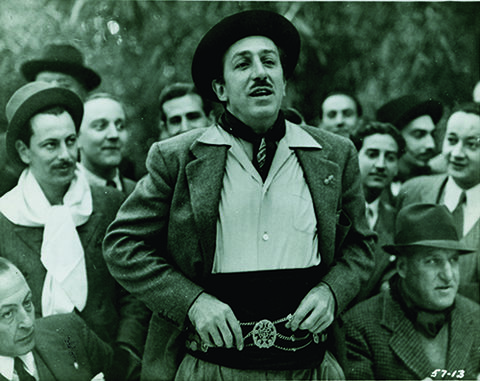
The 18 members who made up the Disney group consisted of 15 studio employees, two employees’ wives (one of them Walt’s), and, of course, Walt himself. They didn’t all travel together, however; when Walt’s flight landed in Rio de Janeiro on August 17, 1941, his party was the last to arrive, and the goodwill tour was officially underway.
Due to a mix-up and subsequent hotel shortage, the Disney group had to split up. Walt, his wife Lillian, and four others stayed at the Copacabana Palace Hotel, while the rest of the group stayed at the Hotel Glória. Legend has it, it was at the Hotel Glória where the group came up with their nickname. When Walt’s party would call over there, the bellhop would call out for the team, “Disney! El Grupo Disney!” From then on, the whole Disney party would affectionately be known as, “El Grupo.”
Work on gathering material for films began almost immediately. “I set up a shop,” Walt recalled. “Never went near the embassy. Didn’t go around the usual haunts of the goodwill people. I went right in.” While performing research, it didn’t take long for the team to discover just how large a part of local culture the Brazilian Parrot was. Several of the artists began focusing on studying the bird, by way of local zoos and museums. Creating a character based on the “papagaio” was an obvious yet wise decision: José Carioca would become Donald Duck’s co-star.
Another key piece of material that came from Brazil actually presented itself before the tour’s official start. The day before Walt arrived in Rio, his plane landed in Belém, Brazil for refueling. According to story man (and Walt’s brother-in-law) Bill Cottrell, hundreds of school kids were there to greet Walt. “They might not have known who the president of their own country was,” Cottrell said, “but they all knew Walt Disney.” That evening while the group had dinner in their hotel, they were entertained by a small (and apparently not very good) band. Amongst the poorly-delivered renditions, however, one tune managed to intrigue Walt. That tune was “Aquarela do Brasil,” by Brazilian composer Ary Barroso. It stuck with Walt, and it wasn’t long before he got to hear it again. According to Barroso’s daughter, Barrosa personally performed the song for Walt in Rio. “That is the music I want,” Walt declared.
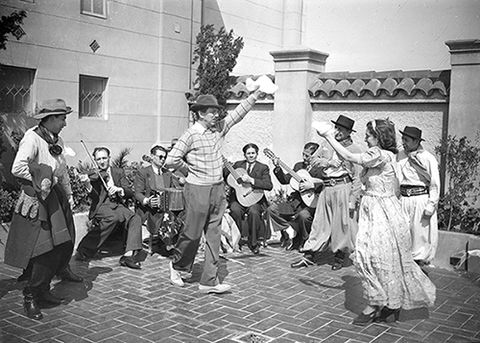
El Grupo’s next destination was Argentina. While in Buenos Aires, a group of local artists visited the Disney party at their base of operations, the Alvear Palace Hotel. Under the direction of Professor Andrés Chazarreta, an authority on music and dances of the Argentine, the troupe performed authentic Argentine folk dances. Walt and El Grupo loved it, noting it combined both instruction and entertainment. One of the dancers, Miguel “Tachuela” Gramajo, performed a solo during a dance called the Malambo. Decades later, Gramajo still remembered that day well, particularly Walt’s demeanor. “Disney got very excited during the Malambo,” he recalled. “He liked it. I was very fond of that guy. This caught my attention, because he could not understand us, and we could not understand him, but I could tell he was very happy.”
After Buenos Aires, El Grupo split up into four smaller groups, each one setting off to explore a new location within South America. In addition to other regions of Argentina, other destinations included Bolivia and Peru. More material was gathered, and by September 29 the majority of El Grupo reunited in Santiago, Chile. On October 4, they boarded the T.E.S. Santa Clara and began the long voyage home.
The trip had been arduous in many ways for Walt. While in Argentina, he received word from his brother Roy that the terms of the animators’ strike had been settled, and not particularly in the Studios’ favor. Roy also had to break the news via telegram that their father, Elias Disney, had passed away. Walt knew he had to fulfill his commitments in South America, so he pressed on. While everyone in the group had to endure the grind of frequent traveling, Walt also was singled out to take part in demonstrated festivities at nearly every turn. Walt met with government officials, dignitaries, presidents, radio personalities, artists, filmmakers, reporters, and more. He was greeted by thousands of children, had countless cameras and microphones pointed at him, and signed hundreds and hundreds of autographs. But he never wavered. Walt’s undeniable charm and childlike demeanor did exactly what the U.S. government had hoped it would. The people loved Walt, and El Grupo’s visit was an undeniable boon for the CIAA’s Good Neighbor Program. The films that resulted from the goodwill tour, Saludos Amigos (1942) and The Three Caballeros (1944) were well-received by critics and audiences alike. Walt and El Grupo had done it. And as for whether or not they ended up needing the government’s money, Walt commented on that in a later interview: “It was one of those things that they thought Disney needed the subsidy,” he recalled, “but you know, fortunately that little thing went out and it did a heck of a business, and the United States government didn’t have to put up one nickel.”
You’ll find more about the adventures of Walt and El Grupo in South of the Border with Disney by J.B. Kaufman (published by the Walt Disney Family Foundation Press and Disney Editions, 2009) and available from our museum store.
Keith Gluck is a contributing writer for The Walt Disney Family Museum and also runs thedisneyproject.com, a Disney fan site.
[MR. DAWES SR.] If you invest your tuppence wisely in the bank Safe and sound Soon that tuppence, safely invested in the bank Will compound
And you’ll achieve that sense of conquest As your affluence expands In the hands of the directors Who invest as propriety demands
[MR. BANKS, spoken] May I, sir?
[MR. DAWES SR., spoken] Carry on, Banks
[MR. BANKS (MR. DAWES SR., spoken)] You see Michael, you’ll be part of… Railways through Africa (Exactly!) Dams across the Nile (The ships! Tell them about the ships!) Fleets of ocean greyhounds (More, tell them more!) Majestic, self-amortizing canals (How it fires the imagination!) Plantations of ripening tea
[BANK DIRECTORS] All from tuppence Prudently, thriftilly, frugally invested in the… To be specific: In the Dawes, Tomes, Mousely, Grubbs Fidelity Fiduciary Bank!
[MR. BANKS (MR. DAWES SR., spoken)] Now, Michael When you deposit tuppence in a bank account Soon you’ll see That it blooms into credit of a generous amount Semiannually
[BANK DIRECTORS] And you’ll achieve that sense of stature As your influence expands To the high financial strata That established credit now commands
You can purchase first and second trust deeds Think of the foreclosures! Bonds! Chattels! Dividends! Shares! Bankruptcies! Debtor sales! Opportunities! All manner of private enterprise! Shipyards! The mercantile! Collieries! Tanneries! Incorporations! Amalgamations! Banks!
[MR. DAWES SR.] While stand the banks of England, England stands… When fall the banks of England, England falls!
[MR. BANKS] You see, Michael, all for the lack of…
[BANK DIRECTORS] Tuppence Patiently, cautiously, trustingly invested in the… To be specific: In the Dawes, Tomes, Mousely, Grubbs Fidelity Fiduciary Bank!
Robert Bernard Sherman was born on December 19, 1925, in New York City to Russian Jewish immigrants Rosa (Dancis) and Al Sherman.[4] Al Sherman, a songwriter, paid for his son’s hospital delivery costs with a royalty check that arrived that day for the song “Save Your Sorrow“. His brother and songwriting partner, Richard, was born in 1928. Sherman’s father was a well-known Tin Pan Alley songwriter.[5]
In his youth, Sherman excelled in violin, piano, painting and poetry. Following seven years of cross-country moves, the Shermans settled down in Beverly Hills, California. Some of the primary schools Sherman attended in Manhattan included PS 241 and the Ethical Culture Fieldston School, and in California, the El Rodeo School.[6] At Beverly Hills High School, Sherman wrote and produced radio and stage programs for which he won much acclaim. At age 16, Sherman wrote Armistice and Dedication Day, a stage play showing how American life was changed following the December 7, 1941 attack on Pearl Harbor. The play yielded thousands of dollars for war bonds and earned a special citation from the War Department.[7][8]
Upon his return to the United States, Sherman attended Bard College in upstate New York where he majored in English literature and painting. Sherman served as editor-in-chief of Bard College‘s campus newspaper, The Bardian. At Bard, Sherman completed his first two novels, The Best Estate and Music, Candy and Painted Eggs. He graduated in 1949.[15]
On May 12, 1990, Sherman received an honorary doctorate from Lincoln College.[16]Archives Hub Menu Search terms: Search Dawes, Tomes & Russell Records Archive Collection For more information, email the repository Advice on accessing these materials Cite this description Bookmark:https://archiveshub.jisc.ac.uk/data/gb386-a/4/1 XML This material is held at Lloyds Banking Group Archives (London) Reference GB 386 a/4/1 Dates of Creation 1826-1827 Name of Creator Dawes, Tomes & Russell Language of Material English Physical Description 1 volume Scope and Content Customer incidental records.
Administrative / Biographical History Foundation
This private bank, also known as the Warwick Old Bank, was established in 1791 on New Street, Warwick.
Takeover
After a change in partnership, the bank became known as Tomes, Russell & Tomes. The new partners were also proprietors of a bank established in 1823 on Bath Street, Leamington, known as Tomes, Russell, Tomes & Russell.
In 1834 the partnership developed into The Warwick & Leamington Banking Company, with an office in each town and one at Stratford-upon-Avon.
Access Information Access is by appointment only, and at the discretion of the Archivist. Please e-mail archives@lloydsbanking.com for further information.
Other Finding Aids Item level catalogue available – please e-mail archives@lloydsbanking.com for further details.
Subjects Banks Finance Financial records Business records Geographical Names Warwick — England Warwickshire — England
Run in the Dawes Tomes Mousley Grubbs Fidelity Fiduciary Bank Run In The Dawes Tomes Mousley Grubbs Fidelity Fiduciary Bank Was a Bank-Run Event Where Thieves Captured Money and Others, Alvin Will Run Off into its Road. The Chipettes and Chipmunks Was Fight off Mr. Dawes Sr. And Destroy The Villains Once and For All. This was A New Legend, and The Heroes Strikes Back Two Events.
Civil libertarian and biographer of my own and other OSS CIA Cold War families tied to the Kennedy assasinatinos and related air disasters (UAL 553, TWA 800)
View more posts