As my exposure of government corruption became more widely known, additional covert agency people continued to contact me with insider information. In mid-1995, a 15-year veteran of deep-cover CIA activities called and started providing me with detailed information on highly secret covert activities, some of which corroborated what other CIA personnel had told me. Stephen Crittenden operated an airline with close CIA ties, Crittenden Air Transport (CAT), based in Bangkok, Thailand. Much of what Crittenden stated to me was corroborated by some of my sources.
Crittenden‘s described how the CIA assisted in starting up his airline, provides funds and operating expertise. He gave me details about the drugs his aircraft flew for the CIA.
CIA operative Gunther Russbacher had earlier mentioned Crittenden Air Transport as a CIA operation, and I listed it as such in the second edition of Defrauding America. But it wasn’t until Crittenden contacted me, and we spent dozens of hours in almost daily deposition-like sessions that I learned more about the secret operation of that airline. Some CIA operatives referred to that airline as the “ghost” airline because it was often seen in covert operations but little was known of it, including where it was based.
Start of a CIA Proprietary
Crittenden, at an early age, was selected by the FAA to be the “owner” of a new CIA proprietary airline. He had much to learn about operating an airline but the CIA provided management personnel and did most of the scheduling from CIA headquarters at McLean, Virginia. He was provided a mentor to organize and operate the airline that was given the name, Crittenden Air Transport (CAT). In January 1976, the airline commenced operation with five C-123s, an office building in Bangkok,[1] and $20 million in start-up operating cash, provided by the CIA. This high-level planning permitted Crittenden to fly many of the flights. This CIA operation continued until December 1988.
It was a businessman’s dream; he had no mortgage payments to make, and engine replacements and aircraft upgrading were provided by the CIA at no charge. Most of his loads consisted of arms and drugs, with payment for full loads, even when flying partial loads or empty.
First Flight to China
In January 1976, Crittenden Air Transport (CAT) made its first flight, which was to Beijing, China, delivering a load of small arms and picking up a load of heroin. CAT received a $100,000 check from the Shamrock Corporation for that flight. Crittenden, a young man given an airline by the CIA, thought he had really hit the big time. Far bigger payments would be made in the future.
The drugs from that flight were unloaded at Bangkok, Thailand, where another CIA proprietary airline, Southern Air Transport, picked it up for delivery at Los Angeles. At that time, Crittenden was flying twin-engine short-range military C-123s, and Southern Air Transport was flying long-range military four-engine C-130s.
Thereafter, CAT aircraft flew to seven different countries flying arms, including Thailand, China, El Salvador, Nigeria, South Africa, Saudi Arabia, and the USSR. The arms were flown from Thailand after Southern Air Transport aircraft unloaded them.
Payments to CAT for the flights were received from the CIA’s Shamrock Corporation through the Bank of Bangkok. Payments were based upon full loads and at five dollars per pound of permissible cargo weight.
Gift of Additional Aircraft
Several years after the formation of Crittenden Air Transport, in 1978, the CIA provided Crittenden Air Transport with seven military C-130s and one Boeing 707, which came from Evergreen International Airline’s operation at Pinal Airport near Marana, Arizona, a small town north of Tucson. Again, no money was paid for the aircraft, and no money was owed on them. Eventually, Crittenden Air Transport had over 15 aircraft.
With these additional and longer-range aircraft, the CIA had Crittenden flying into additional countries, including the United States, Mexico, France, Germany, Great Britain, Egypt, Italy, Colombia, Bolivia, and Panama. Payments for these flights came through the CIA’s Shamrock Corporation, with checks written on various bank accounts, including the Bank of Credit and Commerce International (BCCI), Valley Bank in Phoenix (a reported CIA proprietary), Bank One, and Barclays Bank in Miami. (Barclays is a major British bank, headquartered in London, with offices throughout the world.)
Common destinations in the Pacific were Sydney, Manila, and Singapore. Out of Miami, common destinations included San Salvador in El Salvador; Guatemala City in Guatemala; Managua in Nicaragua; San Jose in Costa Rica; Panama City in Panama.
The C-123s flying from Bangkok to Manila carried approximately 10 to 12,000 pounds of heroin. Because of the large amount of fuel necessary on the long over-water flights from Southeast Asia, the C-130s, normally able to carry about 40,000 pounds, would carry only 10 to 12,000 pounds.
A typical flight from Manila or Bangkok to the United States would make the first stop at Honolulu for fuel, and then go non-stop to either Miami or Mena, Arkansas, often flying over Mexico. Special codes were used in air traffic control procedures that advised customs not to inspect that aircraft.
Crittenden said that the C-123s were used primarily to haul heroin obtained from the powerful Chung family in China. The drugs were sent from China to Bangkok in old DC-3 and other aircraft flown by independent operators, and then loaded onto CAT’s C-123 aircraft. CAT’s ground personnel at Bangkok handled the unloading and loading. The drugs would then be flown to Clark Air Force Base near Manila, where the drugs would be transferred to long-range C-130s operated by Southern Air Transport. SAT then flew to the United States via Honolulu.
Branching Out
After receiving the long-range C-130 aircraft, Crittenden Air Transport then handled much of the Pacific Rim cargo for the CIA that was formerly handled by Southern Air Transport. These drug-related flights often flew direct from Hong Kong to the United States via Honolulu, often over flying Mexico. Southern Air Transport then confined its operations mostly to Central and South America, until it returned to the Pacific Rim in approximately 1987. When Crittenden shut down his Crittenden Air Transport operation in 1988 the CIA used Evergreen International to take its place. For some reason the Chung family was not satisfied using Evergreen, according to Crittenden, and entered negotiations with him to get back into the operation.
Crittenden went into detail describing the type of cargo he carried, the people he dealt with, and many specifics concerning logistics, fueling, billing, payments, and other data that could only be known by someone in a position held by Crittenden. Most of the loads were either arms or drugs, including heroin from Southeast Asia or cocaine and marijuana from Central and South America. Crittenden explained that other covert proprietary airlines, such as Southern Air Transport and Evergreen, also carried similar loads for the Drug Enforcement Administration.
Further Description of Drug Trafficking
Crittenden described numerous CIA flights transporting drugs into the United States. He described his contacts with Fernando Canles, then head of the Bolivian Air Force, who transported cocoa paste in their own aircraft to Medellin, where it was then off-loaded for further processing into cocaine. Crittenden described flying Canles to La Paz in 1984 in a newly overhauled Lodestar 500 (a converted piston-powered Lockheed Lodestar).
Crittenden said that he gave Canles flying lessons in the Lodestar, and that Canles had an expensive condo in Key Colony at Key Biscayne, Florida.
Crittenden had described the many drug loads that he flew for the CIA out of Southeast Asia and Central and South America. He described various contacts that he had with known high-level drug traffickers. He described his Miami meeting with Pablo Escobar in 1990 to arrange payment for a CIA drug flight out of Colombia.
Paymaster For Drug Cartels?
Crittenden described Colombian and Bolivian drug cartel figures landing their Cessna Citations and Lear jets at Marana. Stephen said they did not carry drugs on these flights. They arrived to obtain payment for prior drug shipments. These were usually flights from Cali and Bolivia, which landed at an airport outside of Mexico City, and then on to Marana, 50 miles into the United States from the Mexican border. Stephen said these planes never had to clear customs.
State Police Protecting Drug Loads
Crittenden went into detail about drug loads that he flew into Mena, Arkansas, for the CIA. He described the practice of Arkansas state police guarding the unloading operations, closing off the airport access roads during unloading, which coincided with what pilots had stated to me who had flown drugs in small and corporate-size aircraft for the DEA.
Shamrock Corporation, CIA Paymaster
Other CIA assets, including Gunther Russbacher and Robert Hunt, had described the role played by the Ireland office of the CIA’s Shamrock Corporation[2] in disbursing bribe money to federal judges and other covert agency assets. Crittenden described his relationship with Shamrock that focused on other areas of Shamrock’s activities. He said that the Shamrock Corporation paid his airline for the flights flown, and that totaled approximately $571,350,000 on flights from 1976 to 1988.
Funds in BCCI
Crittenden said that when BCCI closed down, his proprietaries had about $800,000 on deposit, and that he had a claim in for the 20 percent settlement of that amount. During one of many conference calls with another CIA asset, during which I was silently listening, James Pennington discussed this claim, showing that Pennington was familiar with it. Pennington was the CIA’s liaison to Somoza, the head of Nicaragua until the Sandinistas removed Somoza in 1980. Pennington was also the chief CIA adviser to Central America. He arranged for the purchase of arms from England and other European countries for Somoza, most of which were paid for by U.S. aid money intended to help the citizens of that country. Instead, the CIA’s conduct converted that humanitarian money into weapons against the people.
Somoza was the CIA’s choice to head Nicaragua, and his removal through elections was the start of the United States’ war in that country.
Crittenden described flying several flights carrying CIA money to offshore depositories on Grand Cayman Island for deposit into BCCI. In one case, he carried 40 million dollars.[3] Other CIA assets, including Trenton Parker and Gunther Russbacher, had years earlier described doing the same.
Crittenden said that the BCCI bank not only held the account for Shamrock Corporation, one of the money-disbursing proprietaries for the CIA, but handled money involved with the CIA drug and arms trafficking.
There were two BCCI accounts in which Stephen Crittenden had money. One was in the name of Crittenden Air Transport and the other was in the name of Thomas Kary. Stephen thought the account number of one of them was 09090011.
Three Levels of CIA Proprietary Airlines
Crittenden described three levels of CIA operations. As it relates to personnel, level one would be typists and other office personnel; level two personnel would have compartmentalized knowledge, and level three would have a broader knowledge of a particular operation.
As it related to airlines, Crittenden said level one would be airlines that would be suspected by the public to be a CIA proprietary, such as Southern Air Transport. Level two would be an airline that had less of a public exposure, such as Evergreen International Airlines, based in McMinnville, Oregon, with a tightly guarded base at Marana. Level three would be an airline that was virtually unknown, and which he identified as Crittenden Air Transport.
Arms Flights to Moscow During the “Cold War”
Crittenden described several flights that he made into Moscow during the Cold War period, including one flight in the summer of 1976 where a load of M-16 rifles were off-loaded. The load had been brought to Crittenden at Manila by Southern Air Transport. A load of Russian AK 47s were then loaded on the C-130 and flown to San Salvador in El Salvador. A prior load consisted of American M-16s. At San Salvador the unloading of the arms was coordinated by John Forsyth, who worked for James Pennington, the CIA’s liaison to Anastasio Somoza, who headed the Nicaraguan government.
Crittenden said that the U.S. reason for having Russian and U.S. weapons in Nicaragua was to convey the impression to the news people that both American and Russian soldiers were in the country.
Orders From CIA Headquarters
Crittenden described how he received his instructions from the CIA for his various missions. In some cases, he called his handler at the CIA headquarters in McLean, Virginia, named Ross Lipscomb. Crittenden remembered the confidential phone number as 202-357-1100, and when the switchboard operator answered, Crittenden would respond, “Access code 4613,” after which he would be switched to his CIA contact. Stephen said that the “3” in the code signified that he was Level Three.
In some cases his instructions came on computer floppy disks that he would then put into his computer. He described receiving floppy disks on some occasions around 1978 from CIA asset G. Gordon Liddy, who in the mid-1990s was a Washington-area and nationally known talk show host. Crittenden said that the physical handling of the disks from Liddy to Crittenden occurred in the garden area of the DuPont Center in Miami.
Included in the floppy-disk data was information about avoiding radar detection while flying drugs into the United States from Central and South America.
CIA Stolen Aircraft Operation
Crittenden described another facet of how the CIA (and the National Security Council under Oliver North) used stolen aircraft in the Contra arms and drug-smuggling operation. CIA assets Gunther Russbacher and Terry Reed described this practice. Crittenden described how twin-engine Beech D-18s were stolen and then sent to Volpar Aviation at Van Nuys Airport in California for a Volpar conversion to nose-wheel from tail-wheel configuration. Crittenden stated that a Sam Virse from Memphis, Tennessee, took many of these aircraft to Volpar.
Elaborating more on this operation, Crittenden stated that Aviation Materials on Sweeny Road in Memphis, Tennessee, was an aircraft salvage yard containing wrecked Beech 18s, Queenairs, Kingairs, Barons and Cessna 366 and 377s. Reportedly, the owner, Graham Lotts, would give the aircraft manufacturer’s data plates that were riveted onto the fuselages of the wrecked aircraft to Virse, who owned an airport at Bud Island in Memphis.
Virse reportedly had a couple of assistants who would steal identical aircraft. The manufacturer’s identification plates would be removed from the stolen aircraft and replaced with the data plates from the wrecked aircraft. The aircraft would then be flown to Volpar in Van Nuys to be repainted and modified.
Crittenden stated that Volpar knew the CIA was picking up the aircraft after modification, but was probably unaware that the aircraft were stolen. He said that this practice continued from 1976 to 1988, during the time of the CIA, State Department, and National Security Council‘s illicit arms and drug trafficking involving the Contra operation.
Requiring FAA Assistance
Crittenden described how someone within the FAA at its Oklahoma City registration division cooperated in this scheme by furnishing Sam Virse pre-signed aircraft Airworthiness Certificates to be used in the stolen aircraft having the substituted manufacturer’s identification plates.
Companies Cooperating With the CIA
Crittenden described several airlines that are involved with the CIA in a cooperating relationship, including Eastern and Braniff when they were still operating, and Continental. These cooperating airlines received various benefits for their covert role with the CIA, including fuel allotments and fuel discounts, mail contracts, hidden subsidies or payments.
Connections With Evergreen Shipping Lines
The existence of Evergreen Shipping Lines out of Taipei became more prominent in the mid-1990s, causing me to ask Crittenden if that Taipei corporation with a similar name to Evergreen was part of the same operation. He described a prior conversation with Evergreen International Airlines president, Dale Smith, stating that they had acquired a shipping line.
Another Side of CIA-Evergreen Operation
Crittenden described the practice of stealing jet engines and other valuable equipment and avionics from Eastern Airlines aircraft that were stored at Marana after Eastern went into Chapter 7 bankruptcy. He described how low-time jet engines were removed from Eastern Airlines Lockheed 1011s and other aircraft and then replaced with high-time nearly run-out engines, and the records altered to cover up for these activities.
This mindset could be expected to be accompanied by similar conduct in other aircraft maintenance practices, such as placing worn parts on aircraft and counting on averages that they would not be discovered. A former Evergreen mechanic, based in Australia, filed a lawsuit against Evergreen Airlines[4] charging that he was fired for objecting to the standard practice by the airline of installing worn-out parts on Boeing 747s and other aircraft and falsely showing them as meeting replacement specifications.
One of Evergreen’s government contracts involved the “Logair” contract, flying military equipment and supplies from one air force base to another. In my earlier flying days I also flew this contract operation.
A video[5] was produced about Evergreen’s covert activities and CIA connections that were entitled, “Welcome to Evergreen.” The video caused the Air Force Office of Special Investigations (AFOSI) to conduct a secret investigation of Evergreen in 1995.
Former Congressman Denny Smith, who had oversight responsibilities for the CIA, later became a member of Evergreen’s board of directors.
In 1995, Evergreen halted payments on some of its debts, raising the possibility that it could be a typical CIA scam of placing a CIA proprietary into bankruptcy. If that happened, it could have its debts canceled and the assets acquired by another CIA proprietary, thanks to the CIA’s influence of the Justice Department, federal judges, trustees and CIA proprietary or cooperating law firms.
White Slavery of American Women?
Crittenden described on the phone and in writing a flight that he flew from Los Angeles International Airport in one of his Boeing 707s in January 1984. Forty tall, blue-eyed, blonde women boarded the plane at the Flying Tigers hangar, thinking they were going to Singapore to do a movie. Instead, according to Crittenden, while enroute over the Pacific Ocean, he was ordered to divert to Hong Kong. He said the women were “presents” from the CIA to the military leaders of Red China. Crittenden did not know the actual plan for their use, or of their fate, until a later date. Crittenden Air Transport was paid $500,000 for that trip. The women were never heard from again.
My first thought after hearing of this operation was how it could have occurred without media attention. But then I thought of the 30 years of attempts to expose the massive corruption, harm, deaths, that I sought to expose, with every print and broadcast media, and every member of Congress, that I contacted, keeping the lid on the scandals.
A June 17, 1995 article in the San Francisco Examiner described this practice, stating in part:
Smuggling of women from Central and Eastern Europe for prostitution is increasing, the International Organization for Migration said Friday. Many women are tricked by offers of jobs as dancers…the victims passports are taken by smugglers, who threaten them and deprive them of most of their earnings, the report said… cases of smuggled women…had doubled and tripled…in recent years.
Describing His CIA-Related Contacts
Another CIA operator in Houston, Ted Smith,[6] had the job of selling or trading military goods throughout the world. When a deal was made, Crittenden Air Transport would load the military equipment at Fort Hood, Texas, and at that time the list was given to a Major Robert Cooper. Often, the goods were unloaded in San Salvador, El Salvador. The CIA people responsible for subsequent distribution were James Pennington and John Forsyth.
Ports of Call Airline
Among the CIA proprietary airlines that Crittenden had contact with was Ports of Call Airline that had passenger flights for vacationers, and cargo flights for hauling arms and drugs. The airline was based in Denver, a city with heavy CIA involvement. Its fleet consisted of Boeing 707 and Convair 880 and 990 jets. Because of media publicity about the nature of the airline’s flights, the CIA closed down the operation in 1987.
Crittenden said his C-130 aircraft hauled four loads of cocaine during 1983 and 1984 to Guatemala City, where the loads were transferred to Ports of Call Convair 990 jets. Each C-130 carried approximately 20,000 pounds of drugs that were distributed into two Convair 990s. Ports of Call aircraft operated in close liaison with Evergreen International.
He said that Ports of Call aircraft carried passengers in the Boeing 707 aircraft, and carried cargo, such as the food-lift to Ethiopia, often drugs, in the Convair 990s. After Congress conducted closed-door hearings into the Iran-Contra affair, and after Denver papers carried stories of its questionable operation, the CIA shut down the operation.
Contact With CIA’s Evergreen Airline
To those with at least a fair knowledge of CIA activities, Evergreen International Airlines is known to be a CIA proprietary, operated by CIA assets. Crittenden had frequent contacts with top management people at Evergreen’s McMinnville, Oregon headquarters, and Evergreen’s more secretive operation at the Marana Airport. Stephen thought that the McMinnville operation was relatively clean as far as drug trafficking was concerned, and that the drug shipments go through Marana. The parent company for Evergreen International Airlines is The Evergreen Group, a Delaware corporation.
Crittenden described how CIA money is flown from CIA headquarters at McLean, Virginia to Marana, sometimes using a Boeing 707 with NASA markings, flown by CIA pilots, including himself. Part of this money is reportedly used to pay for drug shipments arriving from Central and South America.
Crittenden had dealt personally many times with Evergreen’s president, Dale Smith. Stephen said that Smith was more of a figurehead, and that for many years the main person was Mike Irwin, who provided Stephen with a card authorizing his presence at the heavily guarded Marana operation. Don Doss was head of aircraft scheduling, and was a level-two CIA asset. Doss’s immediate boss was Walt Burnett.
Southwest Airlines, a CIA Proprietary?
In the past, CIA operative Gunther Russbacher had described to me that Southwest Airlines was a CIA proprietary or used by the CIA. Although the details sounded convincing, I felt I needed other data to support that statement. Crittenden said to me that Southwest was indeed a CIA proprietary, describing details to support what he was saying. I feel that more evidence is needed to make this determination, but the statement of these two key CIA operatives is certainly of interest.
Losing CIA Standing
Crittenden explained that he lost CIA backing after he repeatedly criticized George Bush, former CIA director and long-time CIA asset. (Russbacher had stated that Bush was head of a powerful CIA faction, of which there were several, each vying for power.)
Shutting Down Crittenden Air Transport
Crittenden described how the shutdown of the airline resulted in planes being abandoned throughout the world. He said that five C-123s were left parked at the airport in Caracas, Venezuela; seven C-130s at the airport outside Bangkok, Thailand; a Boeing 707 at the airport in Chico, California where Evergreen had a hangar. He said that CIA asset Mike Irwin, who was associated with Evergreen International Airlines at McMinnville, Oregon, took over the Boeing 707.
CIA “Sanctions”
Crittenden described the three levels of sanctions the CIA plans for people who have met their disapproval, with Level-Three sanctions being the physical elimination of the person; death. He stated that the Level Three sanctions are carried out by “outriders,” people who have no family or friends, and have been trained as snipers in the military.
Level Two sanctions usually involve coordination with Justice Department prosecutors, causing charges to be filed against a person and bringing about his or her imprisonment and thereby discrediting the person. I’ve talked to many of these victims, including people already named in these pages, including Gunther Russbacher, Ronald Rewald, Michael Riconosciuto, Basil Abbott, Russell Bowen, and of course, myself.
Using FBI to Silence CIA Assets
Crittenden described how the FBI was used to discredit him to his friends and prospective bride, which followed the scenario the FBI used on CIA agent Gunther Russbacher, and confirmed the CIA requirement that the Agency approve of any marriage. In Russbacher’s case, the CIA had specifically barred him from marrying Rayelan Dyer, because of her Berkeley involvement in the Vietnam protests and because of her collaboration with author Barbara Honegger who was writing a book on the CIA’s October Surprise operation.
Prison for Crittenden
The standard Justice Department tactic for silencing or discrediting people who constitute a threat of exposure is to charge them with a crime and bring about their incarceration, followed by statements that since the person has been convicted of a crime the person isn’t capable of telling the truth. Five years after a mix-up occurring in the CIA’s Valley Bank at Phoenix, the FBI and U.S. Attorney in Phoenix charged Crittenden with wire fraud in a case where no individual lost money and no individual or company filed any complaint.
What had happened, Crittenden‘s mentor at CIA headquarters, Ross Lipscomb, wired $100,000 to Valley Bank, instructing the bank to place the money in escrow, to be released upon the possible purchase of a Boeing 707 aircraft for which Crittenden was acting as an aircraft broker. After Crittenden inspected the Boeing at Evergreen’s Marana Airport facility, he determined that it was an earlier model than was needed. Crittenden and Lipscomb then notified Valley Bank that the deal was off. The bank then returned the $100,000 escrow deposit to Lipscomb.[7]
However, Valley Bank had “accidentally” placed the $100,000 into the account of a Crittenden Air Transport subsidiary, C & C Brokerage, and while in this account, C & C’s financial officer, Rick Challis, wrote checks that used up $87,000 of that $100,000 deposit, including a $50,000 check made out to a friend. Crittenden was unaware of these checks, and was out of the country when they were written. When he learned of this matter, and at the request of the bank, he and Challis signed a note to cover the overdrawn funds. Challis was never charged, even though he was responsible for the overdrawn condition.
In a scenario similar to that which occurred to Russbacher, Crittenden‘s CIA handler, Ross Lipscomb, urged Crittenden to plead nolo contendere, and said he would be shortly released. Crittenden considered such a plea to be a not-guilty plea. However, the legal definition of the term is an implied confession.[8] And that is the way U.S. District Judge Roger G. Strand recognized Crittenden’s position, causing him to be sentenced to five years in prison and five years probation after release. In 1995, Crittenden was still in prison and FBI agent Gil Hirschy stated to a friend of Crittenden that he was going to try and keep Crittenden in prison for as long as possible.
Was Crittenden Set Up to Silence Him?
The combination of events suggests a government frame-up:
· The person writing the checks, a CIA asset, was never charged, even though he was culpable, and Crittenden was only involved in pre-signing checks that required two signatures.
· The person wiring the $100,000 to Valley Bank, Ross Lipscomb, a CIA employee at CIA headquarters, never lost any money.
· Valley Bank was a CIA proprietary. Any loss would have been a result of their negligence. They never made any complaint, and they were covered by a Promissory note signed by Crittenden and Lipscomb.
· Crittenden’s CIA handlers, aware that no crime had been committed, urged Crittenden not to raise a defense (which he complied with), and admitted an offense was committed by pleading nolo contendere. His CIA handlers assured him (as Russbacher was also assured) that he would spend only a short time in prison. Which was not true; he received a five-year prison sentence and five years probation after release.
· The FBI’s and U.S. Attorney’s vigorous prosecution and attempt to again attempt to arrest Crittenden after his release, for either the non-offense, or minor offense at the most, indicates motives outside of the charge itself.
It is possible that Crittenden didn’t realize the legal aspects of the charge, that he actually did not commit an imprisonable offense, and simply followed the directions of his handlers. And for this he was defrauded of years of his life so as to silence or discredit him.
Reluctance to Expose Government Misconduct
I had heard of Crittenden in 1993 and had written him a letter in prison, requesting information about his CIA activities. He did not answer, having been told by his CIA handlers that once he got out of prison they would let him alone. When Justice Department prosecutors continued to seek his incarceration, Crittenden then contacted me, the first contact occurring in early June 1995.
For several hours a day, Crittenden gave me details of his CIA activities, including the unprecedented secret “conference” calls to various high-level CIA proprietaries and CIA personnel. I was, of course, elated over obtaining the wealth of information. I also recognized the immense forces in the print and broadcast media, and in Congress that would keep the lid on these scandals and discredit anyone who came forward.
In a hearing summary report that I obtained from Nancy Graven in the federal public defender’s office at Springfield, Missouri, the evaluation stated:
This examiner is of the opinion there is a possibility that if the bank had not mistakenly credited the $100,000 deposit into the subject’s brokerage account, had instead deposited that amount in the escrow account, that there is a possibility the fraud would not have been committed.
Listening to CIA Conversations
A practice that I had with Gunther Russbacher was repeated several times with Crittenden. While I had them on the phone I would use my telephone conference-call capabilities to call CIA assets and CIA companies who they knew, and I would then secretly listen to the conversations, which provided further proof to me of Crittenden’s CIA relationship and activities. During a June 1995 telephone conversation between Crittenden and Evergreen’s Walt Burnett, the conversation clearly established that they knew each other and had engaged in CIA-related activities. During another call that I placed to Evergreen’s Walt Vernon in June 1995, it was equally obvious that they had both engaged in CIA activities.
The same was done with other CIA proprietaries and assets. Calls were made to Southern Air Transport (SAT) headquarters in Miami, during which he talked CIA business with a key management person who he had known for the past 12 years. It was obvious they knew each other and that they worked and had worked for the CIA. Other secret conference calls were made to other CIA proprietaries and to present and former CIA assets, each of which discussed prior or present CIA activities. Similar calls were made to other CIA assets with whom Crittenden was familiar.
Several calls were made to the Los Angeles representatives of China’s powerful Michael Chung family, with whom Crittenden’s CIA airlines did considerable drug hauling in the past. Crittenden described how the Chung family flew drugs from China to Hong Kong, and then his C-123s would fly the drugs to Clark Air Force Base in Manila, where Southern Air Transport’s long-range C-130s would fly the drugs into the United States, often landing at either Miami or Mena Airport in Arkansas.
Crittenden was dealing with representatives of the Chung family in Los Angeles, who were seeking to have Crittenden obtain for them a fleet of Boeing 727 aircraft to start an airline in China. One of the loads that would be carried by the airline would be drugs. During a series of telephone conversations, Crittenden arranged for a Cesar Resurreccion to inspect 727s in Tucson at Hamilton Aircraft Sales.
Describing a Subsidiary
Crittenden described another subsidiary of Crittenden Air Transport, Saarkes Air Cargo, based in Abai Dabai, whose main cargo was drugs. The CIA furnished the proprietary with three Boeing 707s, which were used to fly drugs to Bangkok, Shanghai, Miami, and Mena Airport in Arkansas. Even though Saarkes was listed as a Crittenden Air Transport subsidiary, Crittenden, who was the titular head of the airline, had no control over it. This reflected how CIA proprietaries that appear to be owned by private interests are actually controlled by the CIA.
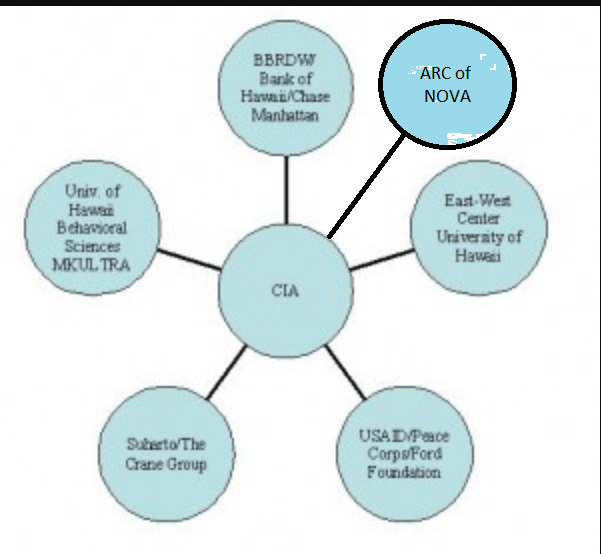
Crittenden Air Transport was of course a classic example of how CIA proprietaries are formed. The people who reportedly owned them were given the planes and start-up capital. This was similar to the CIA proprietary in Hawaii called Bishop, Baldwin, Rewald, Dillingham and Wong (BBRDW).
During various telephone conversations he mentioned names of people with whom he had contact. These included Captain Jack, the alias for the CIA pilot flying for Rowan Drilling out of Houston, and who was reportedly a SR-71 pilot for the CIA. His real name was Sonny Knoles.
Crittenden told me of a 1988 C-130 flight to Ireland carrying CIA arms and a stinger missile for the Irish Republican Army. The flight originated at Fort Hood and then flew to Dublin, where it cleared customs. The C-130 then took off and landed in a field south of Dublin, where the arms were off-loaded.
During one phone call to a secret IRA headquarters, he had a fellow prisoner, Michael Martin, make a call to IRA headquarters, which was in a bar in Ireland. A special security code was used to get the phone operator to connect to IRA headquarters. When the call was over, Crittenden asked me what I thought. I said that I couldn’t understand a single word because of the heavy Irish brogue.
Martin had introduced himself to Crittenden while at the federal prison at Phoenix, asking if he was Stephen Crittenden. Martin had helped in the unloading of the arms in Southern Ireland on the flight flown to Ireland.
He gave me confidential phone numbers that he used to contact CIA headquarters at McLean, Virginia, along with his access code. He said that when he reached the Agency operator, who answered, “Central Intelligence Agency, may I help you,” he replied, “Access Code [number assigned to him, ending in ‘3,’ indicating he held a Level 3 designation].”
He explained that the Evergreen Shipping Lines based in Taiwan was part of the Evergreen Group, which included the CIA’s Evergreen International Airlines. He described people who worked with him, including Robert Newbould, who was chief pilot for Crittenden Air Transport and after its shutdown, flew for Rowan Drilling out of Houston, Texas.
Crittenden described people with whom he worked, and their activities, including, for example, Randy Cotheran, a marijuana distributor in Tennessee; Louis Reyes Heradia, Mafia in East St. Louis; husband of Michelle Stockdale of Springfield, who owns a fleet of trucks that moves marijuana; Mark Goiter of Great Falls, Montana, a mercenary and major drug runner; David Hadley, a cult leader; Robert Brashes of College Park, Georgia, a mercenary and assassin, who worked for the Agency, who he described as level three, a CIA sanction group; Coletta Flying Service, Ypsilanti, Michigan, hauling material for the Cali cartel.
He described his friendship, through the CIA, of various drug cartel people, including Hernando Villarell, Cardehana, Colombia. Crittenden described his Mafia contacts made through the CIA, especially in the St. Louis area. When I asked what the CIA did for the Mafia, he said, “We haul weapons and drugs to them.”
He described being given by the CIA the names of judges and Mafia people, especially in Missouri and Illinois, to contact if he encountered trouble. He gave me the names and phone numbers of many Italian and Mexican Mafia people who worked routinely with the CIA, including assassins that did sanctions (murders) for the Agency.
Crittenden described shipment of weapons to cults that had been stolen from local armories. Crittenden said he delivered weapons to cult leaders in China, one of the many destabilization operations for which the CIA is famous. He described fictitious bank account names, including Thomas Kary, for a bank account with First Bank of Commerce in Grand Cayman.
He described his association with John Emery Wolruffa, a screenwriter in Hollywood, involved in the movie, Wild Geese, with Richard Burton. Crittenden said the movie was about mercenaries that Crittenden flew to South Africa. In the original event, Crittenden took the mercenaries in 1983 to Mozambique in Ethiopia via Kingston, Jamaica. Crittenden’s code name was Iron Man in that operation.
When the aircraft arrived over Mozambique it was depressurized and the ramp at the rear of the aircraft was lowered, permitting the mercenaries to drop out with their parachutes. As planned, Crittenden later landed to pick them up. However, after landing, he received a message canceling the pickup, and the plane immediately took off, abandoning the mercenaries. Most of them were subsequently killed. Political considerations caused them to be sacrificed.
The information given to me by Crittenden was sufficient to bring down high-level people in control of key segments of the U.S. government, including the CIA, DEA, Justice Department, and elsewhere.
CIA Proprietary, Bird Aviation
Using the conference call feature of my phone, Crittenden made several phone calls to William Bird, the head of the CIA-associated Bird Airlines, which had operated in Southeast Asia during the 1960s and 1970s. Bird Air was started by the CIA, making William Bird, a former Air America pilot, its head, and furnishing him with airplanes (including C-46s), operating capital, and contracts. This is the same plan the CIA used to start Crittenden Air Transport.
When the Vietnam War was over, the CIA moved Bird into an aircraft brokerage operation in Fort Lauderdale, Florida. Bird later operated a repossession service with offices in Oakland, California and Phoenix, Arizona. This operation appeared to be tied in with the practice described by CIA operative Gunther Russbacher, in which companies are forced into bankruptcy and their assets looted.
Checking His Credibility
I checked Crittenden’s credibility in several ways. I had already been advised by other deep-cover people and airline pilots of the existence of Crittenden Air Transport. These people included, for instance, CIA operatives Gunther Russbacher, Oswald LeWinter, Russell Bowen, Tosh Plumlee, and others.
Second, as previously stated, I listened to telephone conversations that I placed with known CIA proprietaries or assets, during which Crittenden talked to high management people in these operations.
Third, I quizzed Crittenden repeatedly about minute details of his operations, the aircraft specifications, the type of navigation systems installed on the aircraft, and other specifics that covered intricate areas of CIA activities during the 15 years that Crittenden operated the CIA proprietaries. No one could have been so well informed, and so quick with the answers, if that person hadn’t been directly involved. When Crittenden didn’t know about a particular area that I asked, and which he had no reason to have known, he quickly admitted it, rather than fabricate, which could have easily been done.
Fourth, Crittenden had an address book sent to me that had the names and phone numbers of his many contacts, including drug kingpins with whom he and the CIA did business.
Fifth, I frequently quizzed Crittenden about details that he would not have known unless he was involved with that particular matter. When I asked Crittenden what type of navigational systems were used by CAT’s C-130s, he immediately described the dual Omega navigational systems installed on the aircraft. Also, I frequently repeated questions for which he had given me specific dates, names, or numbers, and these always coincided with what he had stated earlier, something that would be unlikely if he had made them up the first time.
Sixth, my training and experience as a federal investigator, during which I held authority under federal law to determine violations of federal law; my years of private investigator experience; my extensive contacts with other intelligence agency personnel, gave me the expertise for judging the credibility of statements pertaining to areas in which I had extensive knowledge.
Seventh, several of my deep-cover contacts from the Defense Intelligence Agency and the CIA, and others in the airline industry, described their knowledge of Crittenden and his airline. One of these contacts had testified several times to Congress in secret hearings, and was especially reliable. Another of my sources, Russell Bowen, a World War II fighter pilot, who was with the CIA and its predecessor, the OSS, asked Crittenden during a three-way telephone conversation whether he knew Robert Haynes (who Bowen said was an alias used by CIA agent Theodore Shackley). Crittenden described where he had frequently seen him (at a particular hotel in San Salvador), which Bowen acknowledged to be correct. Crittenden provided further corroboration by defining the dates that he saw Shackley, beginning about 1979.
Seeking to Help Crittenden
Because of the valuable information that Crittenden was providing that could expose these criminal activities, I sought to help him get released.
Justice Department prosecutors were seeking to add ten years imprisonment to Crittenden‘s sentence, insuring that his information would never be known to the American people. He had a preliminary date on his parole revocation hearing calendared before U.S. District Judge Roger G. Strand on July 28, 1995. FBI agent Gil Hirschy told Crittenden’s public defender, David Lee Titterington, that he would try to have Crittenden incarcerated for another ten years. Crittenden was obviously seriously concerned.
The first thing that I did was to send a letter to Hirschy, stating that it was my understanding that Crittenden offered to give details on high-level drug trafficking in exchange for halting any further prosecution. Further, that this offer was rejected, which I described as obstruction of justice on his part.
I then sent a four-page letter to Judge Strand, explaining the sham nature of the charges; the evidence of Crittenden‘s CIA relationship, and the nature of the cargo that the CIA ordered Crittenden to carry during his 15 years with the CIA, and included a copy of the second edition of Defrauding America.
Crittenden said after the hearing that the judge had my material in front of him, advised that he had looked over the material at home the night before, and that they would be entered into the court records. Judge Strand then set June 21st for the hearing on Crittenden’s parole-revocation. I also prepared a Title 28 U.S.C. Section 2255 motion seeking to vacate the nolo contendere plea that Crittenden had made in 1991 and to vacate the sentence, allowing Crittenden to be freed.
CIA Warnings to Crittenden
These activities caused considerable concern at the CIA. On July 5, 1995, CIA headquarters left a message for Crittenden to call. During this phone call, the CIA sought to have Crittenden cease talking to me, much the same as the CIA asked, or ordered, Gunther Russbacher to do a couple of years earlier. The CIA tried to win over Crittenden by promising him an aircraft operation based in Beliez. Crittenden responded by hanging up. Crittenden had given me the confidential CIA phone number, and then asked me to destroy it.
Clearing the Court Room
At my suggestion, Crittenden sent me a notarized declaration of his CIA activities, including the years of drug trafficking. I then filed that with the court, along with a friend-of-the-court brief. At the hearing, Judge Strand ordered the courtroom cleared, and then the U.S. Attorney told Crittenden that he could either recant the affidavit that he had signed, or he would ask the court to sentence him for an additional ten years. Crittenden then recanted the affidavit.
Crittenden advised his friend, Chip Stewart, and then me that the affidavit was correct, but he had to recant it, which I agreed he should do. I then asked U.S. Attorney Janet Napolitano for a copy of the transcript of that hearing. She wrote back on October 27, 1995, stating “you can order a copy of the transcript…by contacting Judge Strand‘s court reporter.” In this letter she implied approval to obtain it. But that is not the way it was.
I then contacted the court reporter to obtain a copy of the transcript, and she replied that the hearing was under seal, and that I would have to file a motion with Judge Strand to get the record unsealed. I filed the motion with the court on February 7, 1966, stating:
This is a request to have the court records unsealed, of the hearing in this case occurring on October 2, 1995. The court reporter advised that I had to obtain a judicial unsealing of the record for the reporter to release a copy of the transcript pertaining to the hearing on Stephen Crittenden on that date. Another letter by the U.S. Attorney’s office dated 27, 1995 (copy enclosed) authorized me to obtain a copy by contacting the court reporter.
Since it is the statement of the court and the Justice Department that Crittenden was not associated with any intelligence or other government agency, there surely should not be any objection to releasing the complete, unaltered, transcript.
Judge Strand never responded to the request.
Revelations Were A Public Service
Whatever the reasons may have been for Crittenden‘s revelations to me, the end result is that the United States and the American people were served by those disclosures. The information given to me by Crittenden provided still further evidence of the subversive conduct by high-level people in control of key segments of the U.S. government, including the CIA, the DEA, the Justice Department, and elsewhere.
Crittenden Air Transport C-130 near Bangkok, Thailand
(copy in book)
Air Carrier Operating Certificate for Crittenden Air Transport
(copy in book)
Bill of Sale from Lockheed to Crittenden Air Transport for the sale of a military C-130. The original copy, in author’s possession, is recopied here for easier viewing:
CERTIFICATE OF TRANSFER
(copy in book)(
Lockheed/USAF (“Seller”), Tucson, Arizona, does hereby sell, assign and transfer to Crittenden Air Transport (“Buyer”), of 625-627 Pra Sumain Road, Bangkok, Thailand, 10200, the following property:
PROPERTY: Lockheed C-130 H/J
IDENTIFICATION NUMBER: 4288
The Seller warrants that the property is being transferred to the Buyer is under U.S. Department of Defense restriction and may not be sold and/or transferred outside of the United States without prior approval of the Secretary of Defense.
The above property is sold on an “AS IS” basis. The Seller makes no warranties, express or implied (except as specifically stated above).
This transfer is effective as of August 9, 1980.
The property is now located at Davis-Motham A.F.B., Tucson, Arizona, and all of such property is in the possession of the Seller.
Lockheed/USAF
By: Lockheed/USAF Gen. Wayman Nutt
Crittenden Air Transport:
By: C.E.O. Stephen Crittenden
[1] Crittenden also had offices in Miami and Sydney, Australia.
[2] Crittenden explained that Shamrock was a Delaware corporation.
[3] Crittenden described using a Learjet 23, serial number 20, for these flights.
[4] Andy Anderson was a mechanic for Evergreen in Sidney, Australia, who claimed in the lawsuit, as reported by the Portland Free Press, “that throughout his employment his supervisors regularly and knowingly ordered him to install defective parts on 747 aircraft that were used to transport cargo, rendering these aircraft not airworthy.”
[5] Produced by local cable-access producer Tim Herman, and available at the time of the publication of this book from HHMP News Service in Portland, Oregon, phone (503) 242-2492. The video had news reports from diverse sources, including the Canadian Broadcasting Corporation, KOIN-TV in Portland, and WSAV-TV in Savannah.
[6] Reportedly having an office at one time at 1600 Smith Street, Houston, Texas.
[7] These facts are spelled out in the report of a January 20, 1993, hearing report before a federal parole board that is in my possession.
[8] Nolo contendere. Literally, “I do not wish to contend.” Substantially, though not technically, a plea of guilty; an implied confession; a quasi confession of guilt. 21 Am J2d Crim § 497. It is difficult to define the exact nature of a plea of nolo contendere; regardless of the label attached, the plea for practice purposes is a plea of guilty, or the equivalent thereof. United States v. Safeway Stores, Inc. (DC Tex) 20 FRD 451.R
Civil libertarian and biographer of my own and other OSS CIA Cold War families tied to the Kennedy assasinatinos and related air disasters (UAL 553, TWA 800)
View more posts