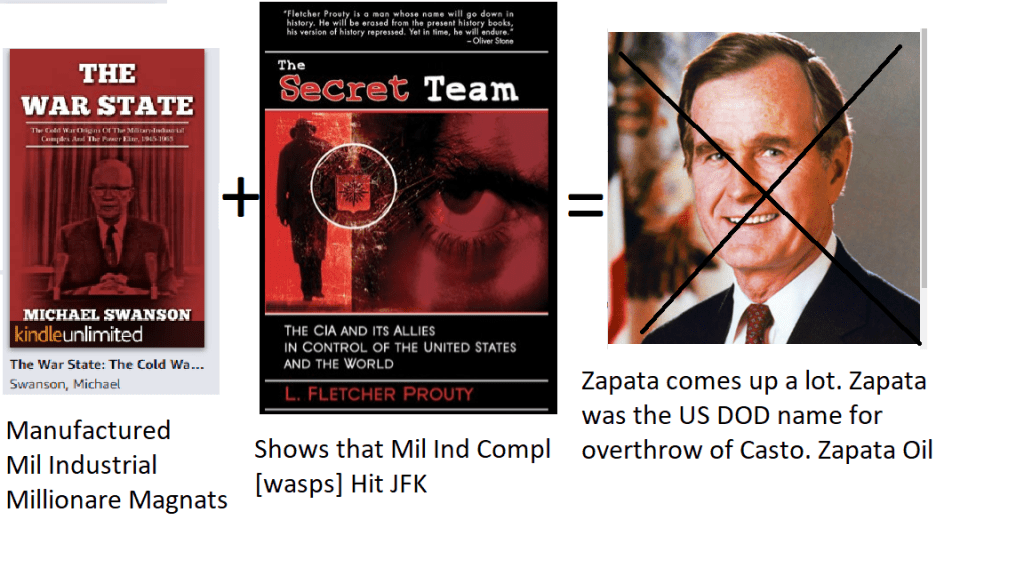
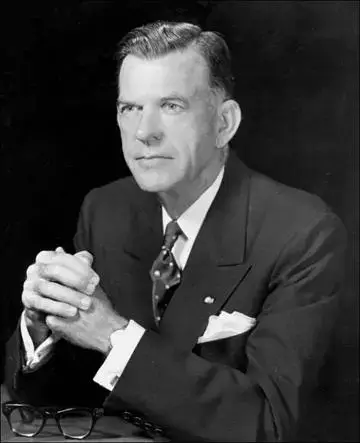
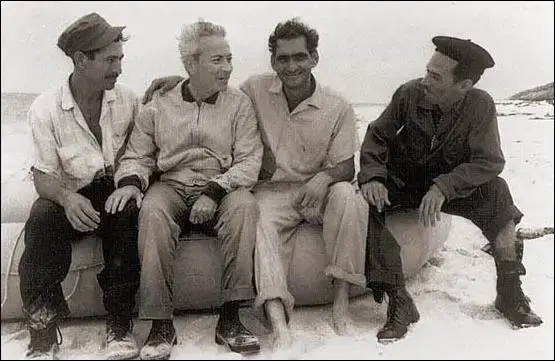
Wild Bill Donovan (OSI, OSS, CIA,) Curtis LeMay, James Jesus Angleton, John Foster Dulles and Alan Dulles ((via Cromwell and Sullivan and Board of Directors of United Fruit Company)) later CIA Director and State Department, Richard Nixon from Edwards Air Force Base distric also other aerospace like Boeing and SSFL Field Labs and Standard Oil) Richard Nixon as VP to Dweight Eisenhower 1952 to 1960 built the ultimate Military Industrial (and media moguls) Cabal of all time.
VP Nixon kept up OSS CIA Subversion as Executive Action (how did the War Powers Resolution later affect this?) and was his Secet Plan To Win The War.
Col Feltcher Prouty and “The Secret” as an overlay to “The War State”
John F. Kennedy and Liberalism (excerpted partially perhaps out of order for brevity and pionts utilized
To understand the situation in 1963 it is necessary to go back to events that took place several years before the assassination. Today we tend to remember John and Robert Kennedy as liberals, but that is not true of their political attitudes in the years following the Second World War. Like their father, they were passionate anti-communists. In 1953 Joe McCarthy appointed Robert Kennedy as one of the 15 assistant counsels to the Senate subcommittee on investigations. JFK also supported McCarthy and when Adlai Stevenson asked him to take part in a political broadcast condemning McCarthyism in 1953, he refused. (15)
One of the leaders of the Democratic Party’s liberal wing, Eleanor Roosevelt, hated JFK for his approach to McCarthyism and called him “a gutless wonder”. Roosevelt wondered, with reason, how the author of Profiles in Courage (1956), “a book extolling political leaders who put principle ahead of expediency, could have avoided taking a stand against McCarthyism, the greatest threat to American democracy of the day.” (16) Roosevelt apparently commented that it was a shame that the glamorous young senator “had a little less profile and a little more courage.” (17)
By the 1960 Presidential Election the main political issue was the government established by Fidel Castro in Cuba. On 9th January, 1960, Vice President Richard Nixon had lunch with William Pawley, who was a close friend and business associate of Fulgencio Batista, the former dictator of Cuba. Nixon regarded Pawley as his main adviser on Latin America. During the lunch they spoke about the situation in Cuba and Nixon suggested that Pawley invited President Dwight Eisenhower for a weekend of hunting at his Virginia farm. (18)
On 14th January, 1960, the National Security Council (NSC) reviewed its policy on Cuba and Livingston T. Merchant of the State Department explained that his agency was “cooperating with CIA in action (redacted) designed to build up an opposition to Castro”. The NSC members discussed different legal bases for intervention. Nixon, who had already been selected as the Republican Party candidate for the 1960 Presidential Election, urged the overthrow of Castro. (19)
Three days later President Eisenhower had meetings to discuss proposals for covert action in Cuba. He told two NSC staffers to meet Pawley. Five days later, Pawley called one of his CIA contacts to report that Matthew Slepin, “chairman of the Dade Country Republican Party, had promised twelve Cuban exiles either $20 million or $200 million on behalf of Vice President Nixon to finance the overthrow of Castro.” (20)
President Eisenhower was not in total agreement with Nixon on the plan against Castro. In a press conference held on 22nd January he claimed that the United States was continuing to prevent aggressive acts against Castro mounted from within U.S. territory, and it recognized Cuba’s right to undertake domestic reforms. He also confirmed that “the policy of non-intervention in the domestic affairs of other countries, including Cuba.” (21)
JMWAVE: CIA Station in Miami
In July 1960, JMWAVE, the CIA station in Miami, Florida, began training a couple of hundred Cubans in counter-intelligence, in order to develop the nucleus of a post-Castro security organization in Havana. The head of the station was Ted Shackley, whose nickname was the “Blond Ghost” (because he hated to be photographed), became involved in CIA’s Black Operations. Shackley was also closely associated with William Pawley and Eddie Bayo, the founder of Alpha 66. (22)
Allen W. Dulles, the director of the Central Intelligence Agency (CIA), put Richard Bissell, Deputy Director for Plans, in charge of this anti-Cuba task force. Later that month Dulles arranged for Kennedy to meet the four leaders of the anti-Castro organization, the Cuban Democratic Revolutionary Front (FRD). “The purpose was to inform Kennedy of the plans that were underway to bring down the Cuban Revolution and to introduce him to the future leaders of the neighboring country.” (23)
As David Corn, the author of Blond Ghost: Ted Shackley and the CIA’s Crusades (1994) has pointed out: “Agency officials… plotted fanciful schemes against Castro. The brainstorming was extreme. One imaginative CIA thinker proposed spraying Castro’s broadcasting studio with a hallucinogenic chemical. The geniuses of the Technical Services Division (TSD) produced a box of cigars treated with a substance that would lead a smoker to become temporarily disoriented… In the summer of 1960, the craftsmen of TSD contaminated a box of Castro’s favorite cigars with a lethal toxin. But the cigars never made it to Castro.” (24)
In September 1960, Bissell and Dulles initiated talks with two leading figures of the Mafia, Johnny Roselli and Sam Giancana. Later, other crime bosses such as Carlos Marcello, Santos Trafficante and Meyer Lansky became involved in this plot against Castro. Robert Maheu, a private investigator and occasional CIA operative, was put in charge of a conspiracy to spike Castro’s food with poison. The plan was abandoned when Castro stopped visiting the Havana restaurant where he was to be poisoned. (25)
According to an investigation carried out by Frank Church and his United States Senate Select Committee to Study Governmental Operations with Respect to Intelligence Activities in 1976, there were during a five year period when there was “concrete evidence of at least eight plots involving the CIA to assassinate Fidel Castro”. (26) After a newspaper report by Drew Pearson that appeared on 3rd March, 1967, about these assassination plots, President Lyndon Johnson, ordered Richard Helms, the Director of the CIA, for a detailed account of the CIA’s plots to assassinate Castro. The completed report was delivered to Johnson on 10th May, 1967. Johnson later commented to a friend: “We were running a damn Murder Incorporated in the Caribbean.” (27)
Richard Nixon was angry with the CIA for briefing John F. Kennedy about how the United States was falling dangerously behind the Soviets in the nuclear arms race during the election campaign. (28) This put Nixon on the defensive, as did Kennedy’s clarion call to support Cuban “freedom fighters” in their crusade to take back the island from Castro. This put Nixon in a very difficult position because he could not tell the public that he had already told the CIA he supported their secret plan to invade Cuba. (29)
JFK brought this issue up during the fourth and final presidential television debate in the campaign. Nixon wrote in his memoirs: “I had no choice but to take a completely opposite stand and attack Kennedy’s advocacy to open intervention in Cuba. I shocked and disappointed many of my own supporters… In the debate, Kennedy conveyed the image – to 60 million people – that he was tougher on Castro and communism than I was.” (30)
Kennedy won a narrow victory in November, 1960. Some of Kennedy’s liberal supporters like John Kenneth Galbraith, the economist, worried about the consequences of promising to help free Cuba. Kennedy had “succeeded in banishing the Democrats’ image of Stevensonian weakness and replacing it with a vigorous new muscularity”. The hawks now expected the new president to deliver. One of Kennedy’s advisors, Harris Wofford, commented: “He had one hand in the cold war and one foot in a new world he saw coming; one hand in the old politics he had begun to master, one in the new politics that his campaign had invoked.” (31)
Dwight D. Eisenhower made his last speech as president on 17th January, 1961. Probably the most controversial speech of his career he gave the American people a serious warning about the situation that faced them: “Until the latest of our world conflicts, the United States had no armaments industry. American makers of plowshares could, with time and as required, make swords as well. But now we can no longer risk emergency improvisation of national defense; we have been compelled to create a permanent armaments industry of vast proportions. Added to this, three and a half million men and women are directly engaged in the defense establishment. We annually spend on military security more than the net income of all United States corporations. This conjunction of an immense military establishment and a large arms industry is new in the American experience. The total influence – economic, political, even spiritual – is felt in every city, every State house, every office of the Federal government. We recognize the imperative need for this development. Yet we must not fail to comprehend its grave implications. Our toil, resources and livelihood are all involved; so is the very structure of our society. In the councils of government, we must guard against the acquisition of unwarranted influence, whether sought or unsought, by the military-industrial complex. The potential for the disastrous rise of misplaced power exists and will persist.” (32)
It has been claimed that Eisenhower’s military-industrial complex speech was a warning to Kennedy about the real sources of power in the United States and the pressure he had been under to order an armed invasion of Cuba. Senior figures in the CIA believed that Kennedy would support their plans for dealing with Castro. The journalist, Joseph Alsop, arranged for Kennedy to meet Richard Bissell, the CIA officer in charge of this anti-Cuba task force. Bissell later wrote: “I found Kennedy to be bright, and he raised a number of topics on which I had something to say… I told him truthfully (although perhaps a little inappropriately since I was part of the current administration) that I agreed with most of his philosophy.” (33) David Atlee Phillips, another senior CIA officer, also supported Kennedy: “I had voted for Kennedy, and all seemed right with the world.” (34)
Bay of Pigs
A few days after Kennedy’s victory, Bissell wrote to his close friend Edmond G. Thomas: “I am glad it came out as it did. I found less to choose between the two candidates than many of my friends, but I think Kennedy is surrounded by a group of men with a much livelier awareness than the Republicans of the extreme crisis that we are living in… What I really mean is that the Democrats will be far less inhibited in trying to do something about it. My guess is that Washington will be more lively and interesting place in which to live and work.” (35)
In December, 1960, Bissell received a disturbing intelligence report, Prospects for the Castro Regime. It claimed that Castro remained “firmly in control” of Cuba and that “internal opposition” was “still generally ineffective”. It also noted that although anti-Castro guerrilla groups were operating in the Escambray Mountains region and in the Oriente province, the “regime has reacted vigorously and has thus been able to contain” them. The report concluded that Castro would continue to consolidate his control over Cuba: “Organized opposition appears to lack the strength and coherence to pose a major threat to the regime, and we foresee no development in the internal political situation which would be likely to bring about a critical shift of popular opinion away from Castro.” (36)
The CIA plan to invade Cuba, code-named JMARC (the Pentagon called it Operation ZAPATA), landed on John Kennedy’s desk before he was sworn in as president. It was based on an earlier plan that had been suggested to President Eisenhower in March 1960. Bissell and the Director of the CIA, Allen W. Dulles briefed the president-elect on the project on 18th November. Bissell was later to recall that he was struck by Kennedy’s impassiveness. “He seemed neither for nor against the operation. He expressed surprise only at the scale of it…. What had begun in the spring of 1960 as a plan to infiltrate a few dozen commandos to slip into the jungle and join the resistance had become by November a full-scale invasion – several hundred men storming a beachhead, backed up by air support.” (37)
Bissell told President Kennedy and Dean Rusk, the Secretary of State, of the operational plan and described how the Cuban exiles (Brigade 2506) would land and secure a beachhead close to a town named Trinidad, on the southern shore of the island some 350 miles from Havana. Rusk objected at once. He said that attempting a landing near a big town like Trinidad would inevitably attract a great deal of publicity. He was not enthusiastic about the operation at all, but if it did not have to take place, he insisted on a more obscure landing place as it would look like a genuine guerilla operation. Bissell was also unable to guarantee that the invasion would definitely result in the overthrow of Castro. Bissell said: “We have reports it will, but how can you possibly tell?” (38)
In the winter of 1961, Richard Bissell told McGeorge Bundy, Kennedy’s National Security Adviser, that he was setting up an “executive action capability” against Fidel Castro. It was pointed out by Ted Shackley that “the CIA had toppled foreign regimes before: in Iran in 1953, in Guatemala in 1954… But with this difference: Whereas in three previous cases our interventions had been motivated by considerations of cold war advantage, the driving force now was personal vendetta. President Kennedy and his brother Robert, smarting from the humiliation of their failure at the Bay of Pigs, wanted to remove Fidel Castro from the picture, no matter whether by palace revolt, military coup, popular uprising, or assassination.” (59)
Of course, it could be argued that the testimony of CIA people such as Shackley should not be trusted. It is definitely true the CIA was very keen to show that it was the Kennedy brothers who were behind the plot to assassinate Castro. However, it is true that after the Bay of Pigs disaster, President John F. Kennedy created a committee, Special Group Augmented (SGA), that was charged with overthrowing Castro’s government. The SGA, chaired by Robert F. Kennedy (Attorney General), included Allen W. Dulles (CIA Director, later replaced by John McCone), Ural Alexis Johnson (State Department), McGeorge Bundy (National Security Adviser), Roswell Gilpatric (Defence Department), General Lyman Lemnitzer (Joint Chiefs of Staff) and General Maxwell Taylor. Although not officially members, Dean Rusk (Secretary of State) and Robert S. McNamara (Secretary of Defence) also attending meetings. (60)
Operation Mongoose was agreed at a meeting of this committee at the White House on 4th November, 1961. It was a covert action program for sabotage and subversion against Cuba. Attorney General Robert F. Kennedy decided that General Edward Lansdale (Staff Member of the President’s Committee on Military Assistance) and a former CIA agent, should be placed in charge of the operation. Lansdale later regretted accepting the job. “I think the thing that hurt me most in the long run was the task that Kennedy gave me on Cuba.” (61)
According to the Alleged Assassination Plots Involving Foreign Leaders An Interim Report of the Select Committee To Study Governmental Operation (1976), in an early meeting of SGA, Robert Kennedy insisted that “a solution to the Cuban problem today carries top priority.” He asserted that no amount of “time, money, effort or manpower” was too great if its expenditure helped achieve Castro’s downfall. (62) “So far as possible, Lansdale wanted SGA to rely on professional anti-castro emigres, labor leaders, youth and church groups, and ‘gangster elements’ to carry out any tasks the group approved… Lansdale tried to introduce a new perspective. The administration should adopt real revolutionary tactics.” (63)
Jake Esterline, the head of the Cuba task force in pre-Bay of Pigs days, also highlighted the role played by the Attorney General in the proposed removal of Castro. In an interview he gave to Don Bohning of the The Miami Herald just before his death, Esterline said that he was in “no doubt that Kennedy knew of the assassination plot” against Fidel Castro. Esterline admitted that Juan Orta, “who functioned as Castro’s private secretary, had been recruited to slip a poisoned pill into a drink. However, a few days before the invasion Orta changed his mind and fled to the Venezuelan Embassy.” (64)
The CIA JM/WAVE station in Miami served as operational headquarters for Operation Mongoose. One of Lansdale’s first decisions was to appoint William King Harvey as head of Task Force W with the brief to bring down Castro’s government. He also ran the CIA-Mafia plots to kill Castro under the CIA’s Executive Action (a plan to remove unfriendly foreign leaders from power), part of which had the code name ZR/RIFLE.
[The Executive Action Committee met as the NSC under VP Richard Nixon, its chair.]
(65) Harvey later told the Senate Committee chaired by Frank Church that Robert Kennedy wanted his agency to overthrow Castro entirely with covert means and without the slightest taint of American involvement. (66)
Some figures close to President John F. Kennedy are adamant that he refused to give permission for agents to assassinate Castro. Tad Szulc, a close friend, had lunch with the Kennedys on 9th November, 1961, when suddenly, the “President leaned forward and asked me, ‘What would you think if I ordered Castro to be assassinated?’ I said this would be terrible idea because (a) it probably wouldn’t do away with regime; on contrary it would strengthen it, and (b) I felt personally US had no business in assassinations. JFK then said he was testing me, that he felt the same way… JFK said he raised question because he was under terrific pressure from advisers (think he said intelligence people, but not positive) to okay a Castro murder. Said he was resisting pressures.” (67)
David Kaiser, the author of The Road to Dallas (2008) suggests that the President did know about the CIA plan to assassinate Castro. “While Kennedy’s participation in planning the Bay of Pigs is clear, his involvement in CIA assassination plots is harder to establish precisely. But at some point he became aware that the idea of eliminating Castro was being pursued by the CIA, and he apparently did not try to stop it… Evidence suggests that President Kennedy himself was informed at least generally about the ongoing assassination plots against Castro (and thus, quite possibly, about the Trujillo plot as well) before the Bay of Pigs invasion.”
Kaiser points out that October 1961 Kennedy requested a secret report on the impact on Cuba of Fidel Castro’s sudden death. The following month, Robert A. Hurwitch of the State Department drafted a long memorandum “to determine the courses of action which the U.S. would follow with reference to Cuba in the event of Fidel Castro’s death in order to insure the replacement of the Castro regime with a friendly government.” Kaiser claims that Kennedy came to the conclusion that “assassinating Castro could be accomplished far more easily than the gigantic task of creating an effective revolutionary movement, and the American military presumably could, it turned loose with a suitable pretext, finish the job of dealing with his decapitated regime.” (68)
On 15th November, 1961, Richard Bissell told William King Harvey, that he was going to be taking over the Castro assassination project from Sheffield Edwards. By April 1962, Johnny Roselli told the CIA that Tony Varona, a Cuban politician who had joined with Manuel Artime to form the anti-Castro organisation, the Movement for the Recovery of the Revolution, was willing to make another assassination attempt in return for some arms and equipment. Harvey met Varona in Miami and gave him poison capsules and supervised the transfer of a truckload of arms provided by Ted Shackley, chief of Miami’s CIA Station JMWAVE. (69)
Richard Helms, Deputy Director of Central Intelligence for Plans, later admitted that John McCone, head of the CIA was not told of this plan to assassinate Castro. As he explained assassination plots are not part of a discussion among “a large group of people sitting around a table in the United States government”. He added: In other words, when you establish a clandestine service as was established in the Central Intelligence Agency, you established something that was totally different from anything else in the United States government. Whether it’s right that you should have it, or wrong that you should have it, it works under different rules than any other part of the government.” (70)
General Fabian Escalante, the head of a counter-intelligence in the Department of State Security (G-2), became aware that Tony Varona had sent a three man team into Cuba. The men were “from the commando unit from Miami with the collaboration of the omnipresent Mafia”. Escalante also described a plot organized by a CIA agent, Norberto Martinez, who had entered Cuba in early 1962. Maria Leopoldina Grau Alsina, the niece of the former President Ramón Grau San Martín, also became involved in the plot. She told Alberto Cruz Caso that “our task consists of finding a person who can give the poison to Fidel without arousing suspicion.” (71)
In a memorandum dated 25th April 1967, Earman notified Richard Helms: “We cannot overemphasize the extent to which responsible Agency officers felt themselves subject to the Kennedy administration’s severe pressures to do something about Castro and his regime. The fruitless and, in retrospect, often unrealistic plotting should be viewed in that light…. After the Cuban missile crisis of October 1962 and the collapse of Project Mongoose, the aggressive scheme that was begun in August 1960 and revived in April 1962 was finally terminated in early 1963. Two other plots were originated in 1963, but both were impracticable and nothing ever came of them.” (72)
The two plots in 1963 were organised by Desmond FitzGerald and Samuel Halpern and involved William Harvey (who denied it) and included a contaminated skin diving suit that was to be given as a present to Castro and an explosives-rigged sea shell. However, there is strong evidence of another, far more serious plot in 1963, that targeted Castro. Why was this not included in Earman’s report? Is it because it was connected to the assassination of John F. Kennedy? The answer to this could be found in the fact that four people interviewed by Earman had their names redacted from the report. Is it really credible that Earman did not interview Ted Shackley, the head of the CIA’s JM/WAVE station in Miami, and the operational headquarters for Operation Mongoose, and the home of the ZR/RIFLE, an operation that is written about in some detail in the report (Phase 2: February-March 1962). (73)
If Shackley is one of the names redacted from the report, who were the other three? I believe other possible names include Carl E. Jenkins, David Sanchez Morales, Henry Hecksher, David Atlee Phillips, and Rafael ‘Chi Chi’ Quintero. Is it possible that these people were involved in the 1963 plot to kill Castro that the CIA wanted to keep secret. Why is it important for the CIA to keep secret a failed attempt to kill Castro? The reason for this could be connected to the assassination of John F. Kennedy and could help to explain Robert Kennedy’s phone call to Enrique (Harry) Ruiz-Williams, and his comment, “One of your guys did it.” (74)
AM/WORLD Project
The plot against Castro in 1963 that the Inspector General of the CIA’s report ignores is the AM/WORLD project. The first AM/WORLD document that has been released was a five-page memo prepared on 28th June, 1963. It was sent by Joseph Caldwell King, Chief of the CIA’s Western Hemisphere Division. “This will serve to alert you to the inception of AM/WORLD, a new CIA program targeted against Cuba. Some manifestations of activity resulting from this program may come to your notice before long… The Kennedy Administration, it should be emphasized, is willing to accept the risks involved in utilizing autonomous Cuban exile groups and individuals who are not necessarily responsive to CIA guidance and to face up to the consequences which are unavoidable in lowering professional standards adhered to by autonomous groups (as compared with fully controlled and disciplined agent assets) is bound to entail.” (75)
The document goes on to point out that the “CIA will confine itself to supporting the efforts” of Manuel Artime and his exile group. “Artime will be in touch with a senior CIA officer, operating under a fully documented alias, who is to serve as his adviser and hopefully as his sole direct link with the Kennedy Administration.” In fact, it was not Artime but Enrique (Harry) Ruiz-Williams who would be in direct contact with Robert Kennedy. Lamar Waldron has pointed out that the CIA was being somewhat disingenuous as Artime had been working with the CIA since 1959, when he attempted his first CIA-backed coup against Castro. “But, what was different about AM/WORLD was that Artime – and the others – were now taking orders not from the CIA, but from Bobby Kennedy”. (76)
The AM/WORLD memo (104-10315-10004) was declassified on 27th January, 1999, and discovered by Stuart Wexler in 2004 and he showed it to the author, Larry Hancock. With the help of researchers such as Malcolm Blunt, Hancock obtained the names of other CIA officers involved in AM/WORLD. Hancock points out that AM/WORLD had its own separate operations staff based in Miami and Mexico City. The head of AM/WORLD and Artime’s case officer was Henry Hecksher. The ranking exile under Artime was Rafael ‘Chi Chi’ Quintero who worked closely with CIA paramilitary officer, Carl E. Jenkins, the was military advisor to the AM/WORLD project. David Atlee Phillips was designated to organize safe houses and related activities for AM/WORLD. Other CIA officers who attended AM/WORLD and AM/TRUCK (an effort to produce an internal revolution against Castro in Cuba) meetings, included Ted Shackley and David Sanchez Morales. (77)
Morales with his key role heading CIA Operations in Miami, had a hand in all the CIA actions against Castro in 1963. Bradley Ayers, a US Army Ranger (Special Forces) Captain who was assigned to the CIA JMWAVE station to train Cuban commandos and who worked for the Special Group Augmented (SGA), later claimed that “Morales held sway with Ted Shackley and dominated the entire operational agenda at the CIA Station…. Morales was often demonstrably irritated with changes to planned covert/paramilitary operations that were handed down by CIA headquarters at Langley or by orders from Bobby Kennedy’s Special Group that seemed to be micro-managing the secret war against Castro.” (78)
When Robert Kennedy telephoned Enrique (Harry) Ruiz-Williams and told him, “One of your guys did it” he was obviously talking about the AM/WORLD project. Why would an operation set up to kill Castro be turned against President Kennedy? As the Ayers statement above shows, some senior figures in the CIA were upset by the attorney general’s involvement in the plot against Castro. This was partly because the CIA believed that the Kennedy administration was not completely committed to removing Castro. In fact, they had evidence that Kennedy was involved in secret negations with Castro. This was revealed when on the 24th November, 2003, the National Security Archives released a collection of documents on these negotiations. (79)
During JFKs end the Vietnam war, End the Cuban Missle Crisis WITHOUT nuclear exchange, program of ending Subversion and Overthrow with Great Brittan MI6, NOT overthrowing Cuba or continuing to plan to overthrow Indonesia as the CIA had just overthrown Hawaii and Guatamala and Japan he was up against the WWII melding of the Supreme Allied Command and melded mission of it, keep winning countries over via OSS CIA PsyOps.
But that meant much to JFK in terms of Republic of Ireland and ending colonialism generally.
The gut change came during the Cuban Missile Crisis as the Hawks left over from WWII were wanting war and half way into Cuba, the Russia nd and Robert F Kennedy were in talks to negotiate globally, Cuban missiles removed and US concessions in Turkey.
Curtis Emerson LeMay was an American Air Force general who implemented a controversial strategic bombing campaign in the Pacific theater of World War II. He later served as Chief of Staff of the U.S. Air Force, from 1961 to 1965. Wikipedia
During WWII Lemay would have been from US Forces standpoint the number 2 man or close to it to Supreme Allied Commander General Dwight D. Eisenhower.
He worked very closely with statistician efficiency expert Robert MacNamara (Hawrvvard Boston) in shutting down the war-time military industrial complex o the Axis war effort, denying oil, transportation, plant and equipment of air and tank manufacture, logistics, communication, etc.,
These figures of WWII and long term military planning were first accepted by JFK but later abandoned.
Eisenhower was born into a large family of mostly Pennsylvania Dutch ancestry in Denison, Texas, and raised in Abilene, Kansas. His family had a strong religious background, and his mother became a Jehovah’s Witness. Eisenhower, however, belonged to no organized church until 1952. He graduated from West Point in 1915 and later married Mamie Doud, with whom he had two sons. During World War I, he was denied a request to serve in Europe and instead commanded a unit that trained tank crews. Following the war, he served under various generals and was promoted to the rank of brigadier general in 1941. After the United States entered World War II, Eisenhower oversaw the invasions of North Africa and Sicily before supervising the invasions of France and Germany. After the war, he served as Army Chief of Staff (1945–1948), as president of Columbia University (1948–1953) and as the first Supreme Commander of NATO (1951–1952).
In 1952, Eisenhower entered the presidential race as a Republican to block the isolationist foreign policies of Senator Robert A. Taft, who opposed NATO and wanted no foreign entanglements. Eisenhower won that election and the 1956 election in landslides, both times defeating Adlai Stevenson II. Eisenhower’s main goals in office were to contain the spread of communism and reduce federal deficits. In 1953, he considered using nuclear weapons to end the Korean War and may have threatened China with nuclear attack if an armistice was not reached quickly. China did agree and an armistice resulted, which remains in effect. His New Look policy of nuclear deterrence prioritized “inexpensive” nuclear weapons while reducing funding for expensive Army divisions. He continued Harry S. Truman‘s policy of recognizing Taiwan as the legitimate government of China, and he won congressional approval of the Formosa Resolution. His administration provided major aid to help the French fight off Vietnamese Communists in the First Indochina War. After the French left, he gave strong financial support to the new state of South Vietnam. He supported regime-changing military coups in Iran and Guatemala orchestrated by his own administration. During the Suez Crisis of 1956, he condemned the Israeli, British, and French invasion of Egypt, and he forced them to withdraw. He also condemned the Soviet invasion during the Hungarian Revolution of 1956 but took no action. He deployed 15,000 soldiers during the 1958 Lebanon crisis. Near the end of his term, he failed to set up a summit meeting with the Soviets when a U.S. spy plane was shot down over the Soviet Union. He approved the Bay of Pigs Invasion, which was left to John F. Kennedy to carry out.
It appears they simply decided to “frag” JFK and later RFK to support International Trade Mart (Clay Shaw) and avenge the dead CIA in Bay of Pigs, and change US post war strategy to allegiance with colonialism
Edwin Anderson Walker (November 10, 1909 – October 31, 1993) was the only U.S. Army general officer to resign his commission amid his tour of duty in the 20th century. After serving in World War II and the Korean War Walker became better known for his white supremacism and extreme political opinions, often made on-duty and in uniform for which he was criticized by President Dwight D. Eisenhower.[citation needed] Walker resigned his commission in 1959, but Eisenhower refused to accept his resignation and gave Walker a new command of the 24th Infantry Division in Augsburg, Germany.
Walker again resigned his commission in 1961 after being publicly and formally admonished by the Joint Chiefs of Staff for allegedly referring to Eleanor Roosevelt and Harry S. Truman as “pink” in print. Walker had also violated the Hatch Act of 1939, they charged, by attempting to influence the votes of his troops. President John F. Kennedy sought to avoid the scandal of the resignation of a US General, so he offered Walker a new command in Hawaii. Walker refused it, and instead chose to move to Dallas, Texas, where anticommunist supporter H.L. Hunt had offered to finance Walker’s campaign to be the Governor of Texas.
In early 1962, Walker campaigned to become governor of Texas and lost the Democratic primary election to the eventual winner, John Connally. In October 1962, Walker was arrested for promoting riots at the University of Mississippi in protest against the admission of black student James Meredith into the all-white university. Attorney General Robert F. Kennedy ordered Walker committed to a mental asylum for a 90-day evaluation, but the ACLU and psychiatrist Thomas Szasz protested along with rightist groups, and Walker was released in five days. Attorney Robert Morris in early 1963 convinced a Mississippi grand jury to acquit Walker.
Walker reported that he was the target of an assassination attempt at his home on April 10, 1963, but escaped serious injury when a bullet fired from outside hit a window frame and fragmented. After its investigation into the assassination of John F. Kennedy, the Warren Commission concluded that Walker’s assailant had been Lee Harvey Oswald.[1]
Civil libertarian and biographer of my own and other OSS CIA Cold War families tied to the Kennedy assasinatinos and related air disasters (UAL 553, TWA 800)
View more posts