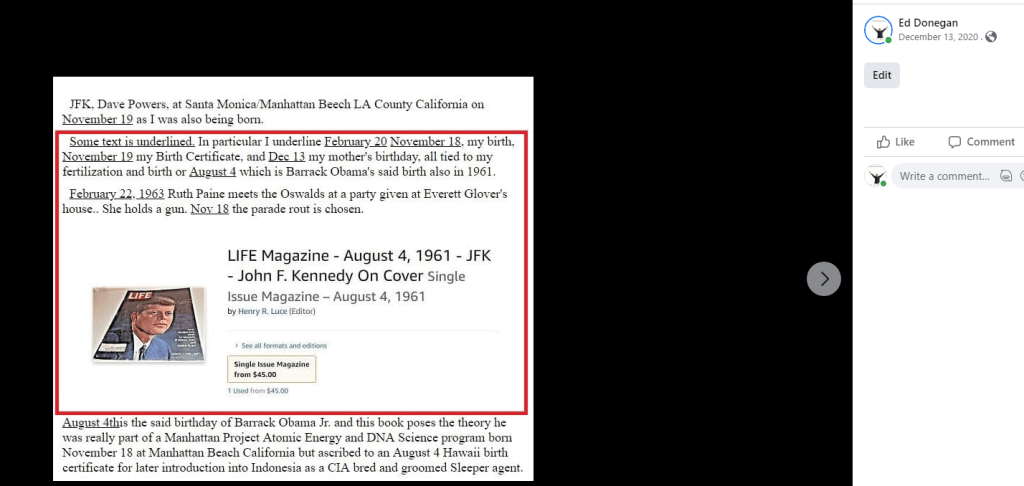
I’ll just say it’s ongoing stay tuned the Zapruder film has had a very interesting journey abraham zapruder shot us on movie on november 22nd it was developed at the Kodak plant in Dallas Texas after it was developed he took it to another lab.
They ran off three copies on a contact printer he took the three copies back to the kodak lab they were also developed at the same kodak lab in Dallas so on the day of the assassination we had four versions of this recruiter film we had the camera original and we had three copies made in a contact printer they were all slit to eight millimeters that day so Zapruder had a
double 8 millimeter film double 8 film has inserted in the camera and as shot in the camera with 16 millimeters wide and consisted of opposing image strips going in opposite directionswe had an A side and a B side after developing the normal procedure at the developing plant was to slit the film or split the film straight down the middle and then splice those two sections together so that instead of having a 16 millimeter film 25 feet long you would have an 8 millimeter film 50 feet long and that’s what was done after the original and the three copies were developed the day of the assassination all of them were split to 8 millimeters Zapruder took his original film home that night showed it to his wife and his daughter he then showed the original film
the next morning to representative from Life magazine mr. Stolley and to the Secret Service in his office at the
Delta X building on Saturday November 23rd Life magazine implemented the first of two sales contracts with mr. Zapruder the first contract on Saturday was for $50,000 and it allowed them to have worldwide print rights now this was printing rights for still images only from his motion picture Life magazine was to be allowed to borrow the original film for one week for the making of these high-quality still images then after one week they
were to give back to mr. Zapruder and he in return was to give them one of the three copies on Saturday afternoon the original film that mr. Zapruder had sold to life was put on an airplane in Dallas and sent toChicago by Life magazinemr. Stolley did not go with it he put the film on an airplane until recently everyone thought
the story went like this that Life magazine had the original film in Chicago all weekend the week in the of
the assassination and that they were busy taking stills from that image for publication in their future magazines we now
believe that’s not the case at all and I’m prepared to talk about that in some detail something happened that
weekend – cause Life magazine – want to repurchase the film in its entirety so and you’ve got to understand this was not to
life’s financial benefit this was to mr. Zapruder z’ benefit Liferay approached mr. Zapruder on Sunday November 24th the day before
President Kennedy’s funeral and they said we’d like to renegotiate our sale contract with you we would like to buy the
original film and all the copies and maintain possession of them and have notonly worldwide print rights but worldwide motion
picture rights we want all the films and we want all the rights to the films including motion picture rights so of course
mr. Zapruder said sure I’ll I’ll do another contract with you so the sale contract was rewritten on Monday November 25th the day of
President Kennedy’s funeral and that contract instead of for $50,000 the new sale price was 150 thousand dollars spaced out over
a period of six yearsmr. Zapruder was to get $25,000 a year and life was to get the original film
and all the copies and the motion picture rights now what’s interesting is is that after spending an extra $100,000
to obtain motion picture rights to the film Life magazine in 12 years never once never once did they exhibit the film as a
motion picture or license it for others to exhibit it as a motion picture so they paid extra money to do this and then never used it as a motion
picturein my opinion the real reason that Life magazine repurchased the Zapruder foam was to suppress that film as a motion picture we all know today
.
that yes the film seems to contain evidence that President Kennedy was shot from the front because his body is propelled rather rapidly to the
left and to the rear I also believe the film was altered the weekend of the assassination in 1963 before the era of digital
technology before computer-generated imagery there were limits to what one
could do to alter a film one could remove let’s say frames of debris
exiting the president’s head in traveling toward the left rear one might be able to remove a car stop but there
were things in 1963 that one could not do with the film you can’t change the motion of someone’s body in the car
there was no CGI in those days so I believe that the film was crudely
altered the weekend of the assassination to black out the location of the true
exit wound to paint false wounds on the president’s head that would appear to be
consistent with a shot from behind and that although these alterations were
done they weren’t done very well I don’t think they would have stood up to the scrutiny of a let’s say television
studio if you licensed as a pruder foam in 1963 to someone who wanted to show it
General Charles Douglas (C. D.) Jackson (March 16, 1902 – September 18, 1964) was a United States government propagandist[1][2] and senior executive of Time Inc. As an expert on psychological warfare he served in the Office of Strategic Services in World War II and later as Special Assistant to the President in the Eisenhower administration.
WWII
Jackson was born in New York City. After graduation from Princeton University in 1924, he entered the private sector. In 1931, Jackson took a position with Time Inc. In 1940, he was President of the Council for Democracy. From 1942 to 1943, he served as special assistant to the Ambassador to Turkey. From 1943 to 1945, he served with the OSS. From 1944 to 1945 he was Deputy Chief at the Psychological Warfare Division, SHAEF.[3]
War State Years Eisenhower Nixon Executive Action Regime Change, Aland Dulles CIA John Foster Dulles State Department 1952 to 1960
After the war, General CD Douglas became Managing Director of Time-Life International from 1945 to 1949. He later became publisher of Fortune Magazine. From 1951 to 1952, he served as president of the anticommunist Free Europe Committee. He was a speech writer for Dwight Eisenhower‘s successful 1952 presidential campaign. He was assigned to be Eisenhower’s liaison between the newly-created CIA and the Pentagon.
From February 1953 to March 1954, Jackson served as adviser to the President on psychological warfare.[4] He worked closely with the Psychological Strategy Board and was a member of the Operations Coordinating Board. He was also a member of the Committee on International Information Activities, which was known, after its chairman, William Harding Jackson, as the Jackson Committee.[5]
During 1953 and 1954, Jackson was key in establishing the Bilderberg Group and ensuring American participation. He attended meetings of the group in 1954, 1957, 1958, 1960, 1961, 1962, 1963, and 1964.[6]
Jackson was a defender of Radio Free Europe, stating, “Over the years, Radio Free Europe has never, in a single broadcast or leaflet, deviated from its essential policy, and did not broadcast a single program during the recent Polish and Hungarian developments which could be described as an ‘incitement’ program.”[7][8]
He later served in a position at the United Nations. From 1958 to 1960, he served as a speechwriter and White House manager after the departure of Sherman Adams and the death of John Foster Dulles.
In 1960, he was publisher of Life magazine.
Jackson became acquainted with Whittaker Chambers at Time Inc. He developed a harsh opinion of Chambers as a psychopath.[citation needed] During the first two years of the Eisenhower administration, Jackson urged strong action by the President in dealing with personalities like Senator Joseph McCarthy[9] and Chambers.[citation needed] In Jackson’s opinion, they were damaging the anticommunist cause with self-serving and unstable behavior. Sherman Adams, Chief of Staff urged a more moderate, political approach, which the President followed.
After Abraham Zapruder took the famous film in Dallas on November 22, 1963, Jackson purchased it on behalf of Time/Life to “protect the integrity of the film.” Upon viewing it on Sunday morning, he ordered it locked in a vault at the Time/Life building in Manhattan.[citation needed]
Stolley was born in Pekin, Illinois, on October 3, 1928. His father worked as a factory manager; his mother was employed as an English teacher.[2] During high school, Stolley served as the editor of his school paper,[3] as well as sports editor for his hometown newspaper, The Pekin Daily Times. He subsequently joined the United States Navy before studying at Northwestern University. He graduated with a bachelor’s degree in 1952, before obtaining a master’s degree in journalism the following year.[2]
Career[edit]
Stolley first worked for Life magazine, which he joined the same year after graduating. He soon gained recognition as “one of the magazine’s best young editorial managers”.[2] He was an editor at Life and reported on the civil rights movement and the Space Race throughout the 1960s. He was serving as its Los Angeles bureau chief when John F. Kennedy was assassinated. He promptly flew to Dallas and was the first reporter to get in touch with Abraham Zapruder, who captured the shooting in Dealey Plaza on his film. Eager to obtain the footage, Stolley initially wanted to go to Zapruder’s house on the night after the assassination to see the film. However, he acquiesced to Zapruder’s request to meet at his office the next morning, with the latter citing exhaustion from the events he had witnessed earlier that day. Stolley said this was the “smartest decision I ever made”,[2] and “quite possibly the most important of my career”.[3]
Stolley arrived an hour ahead of the agreed-upon meeting time to pre-empt other reporters. He offered $50,000 for print publication rights and raised the amount to $150,000 for all rights one week later. Other journalists offered to pay Zapruder more money for the film, but he ultimately gave it to Stolley because he acted like “a gentleman”.[2][3] This reassured Zapruder that his film would never be manipulated by the magazine with a person like Stolley at the helm.[3] Zapruder told Stolley how, on the night of the assassination, he dreamed of a huckster in Times Square peddling his film, indicating that he wanted it to be “handled with care”.[4] Stolley later recounted that the Zapruder film was the “single most dramatic moment” in his career as a journalist.[2]
Life halted its weekly run in 1972, which Stolley called a “devastating blow”.[2] Two years later, he became the inaugural editor of People magazine when it was first issued in March 1974.[3] During his eight-year tenure, it became the most profitable magazine in the US, with a readership of 2.35 million. He stated that the “biggest mistake” of his career came in 1977, when he spurned the opportunity to put Elvis Presley on the front cover after his death.[2] He went back to Life in 1982, serving first as its managing editor before becoming editorial director of Time Inc.,[2] the second-highest editorial management position there.[1] He held the post until his retirement in 1993,[5] but continued to serve as a company adviser.[2]
Stolley replaced David Nuell as executive producer of Extra from 1995 to 1996.[1][6] He was inducted into the American Society of Magazine Editors Hall of Fame in April 1996.[1][3] One year later, he was part of the inaugural class of the Medill Hall of Achievement.[1] In 2000, Stolley edited Life: Century of Change: America in Pictures.[7] He retired from journalism altogether in 2014.[2]
Personal life[edit]
Stolley’s first marriage was to Anne Shawber, a newspaper reporter.[8] She had been “pinned” to him while she was a guest editor at Mademoiselle.[9] Together, they had four children: Hope, Martha, Lisa, and Melinda.[2] They divorced due to Stolley’s infidelity.[10] His subsequent marriage to Lise Hilboldt also ended in divorce.[2]
Stolley died on June 16, 2021, at a hospital in Evanston, Illinois. He was 92, and suffered from a heart ailment prior to his death
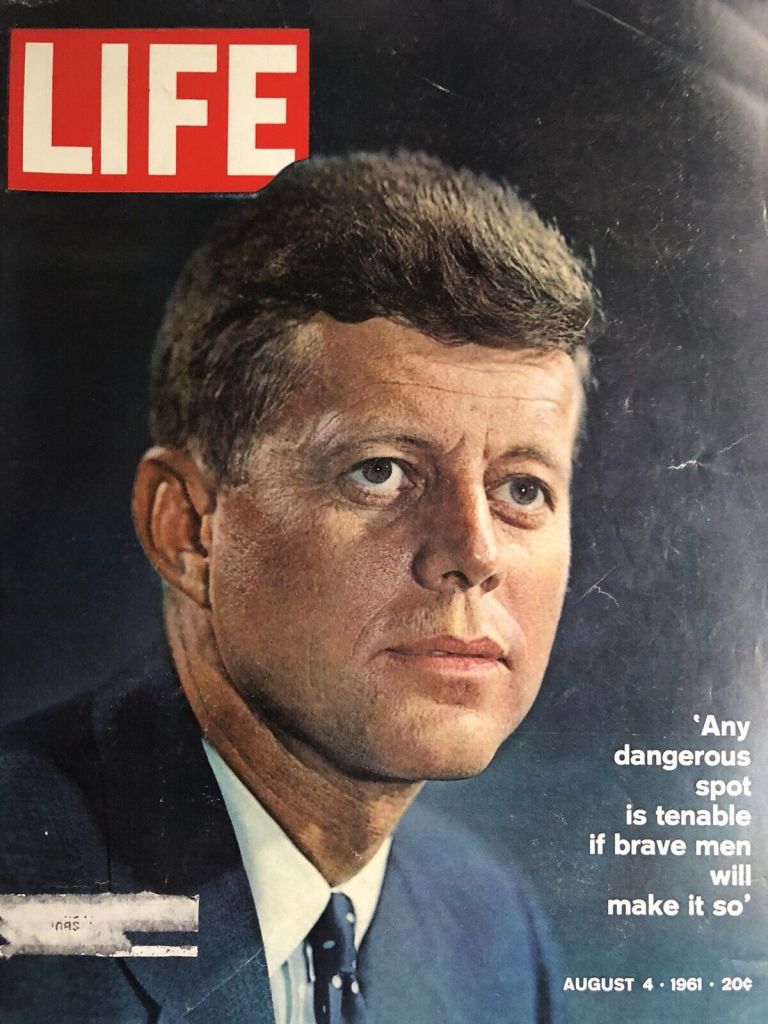
Many ambigouse November 12-19 or August 4 pictures were carried by Time Life I think hinting at the story of the CIA manafacture of Obama Jr planned under Eisenhower.
Hearst Communications, Inc., often referred to simply as Hearst, is an American multinational mass media and business information conglomerate based in Hearst Tower in Midtown Manhattan, New York City.[3]
Hearst owns newspapers, magazines, television channels, and television stations, including the San Francisco Chronicle, the Houston Chronicle, Cosmopolitan and Esquire. It owns 50% of the A&E Networks cable network group and 20% of the sports cable network group ESPN, both in partnership with The Walt Disney Company.[4]
The conglomerate also owns several business-information companies, including Fitch Ratings and First Databank.[5]
The company was founded by William Randolph Hearst as an owner of newspapers, and the Hearst family remains involved in its ownership and management.[6]
Hearst Newspaper group along with Life were part of propoganda the CIA wanted and had controld of as was Desilu, RKO, Ian Flemming works, and other mainstream media like Fox News.